The deck opens with a title slide and a Bill Gates quote placing ChatGPT alongside the GUI as a revolutionary technology. It then shows the hype around AI through Hacker News trends, Y Combinator startup fields, venture investment, and a wave of new models from OpenAI, Google, Meta and open source projects. Next it turns to compute demand, with Nvidia revenue and hyperscaler capex charts, and to corporate adoption. The middle sections argue that generative AI is a platform shift, using S-curves and past platforms, then question whether it is a database, a reasoning engine or something else, and examine how value is bundled and unbundled. Later sections cover the path toward AGI and the uncertainty about what it means. The closing sections place AI within wider trends such as regulation, e-commerce, online dating and fast fashion, and end with a short About slide and a thank-you page.
Slides worth studying
Questions about this deck
How many slides does the Benedict Evans AI, and everything else deck have?
The deck has 87 slides. Slide 1 is the title slide, which reads "AI, and everything else" by Benedict Evans, December 2023.
What does the Benedict Evans AI deck say about Nvidia revenue?
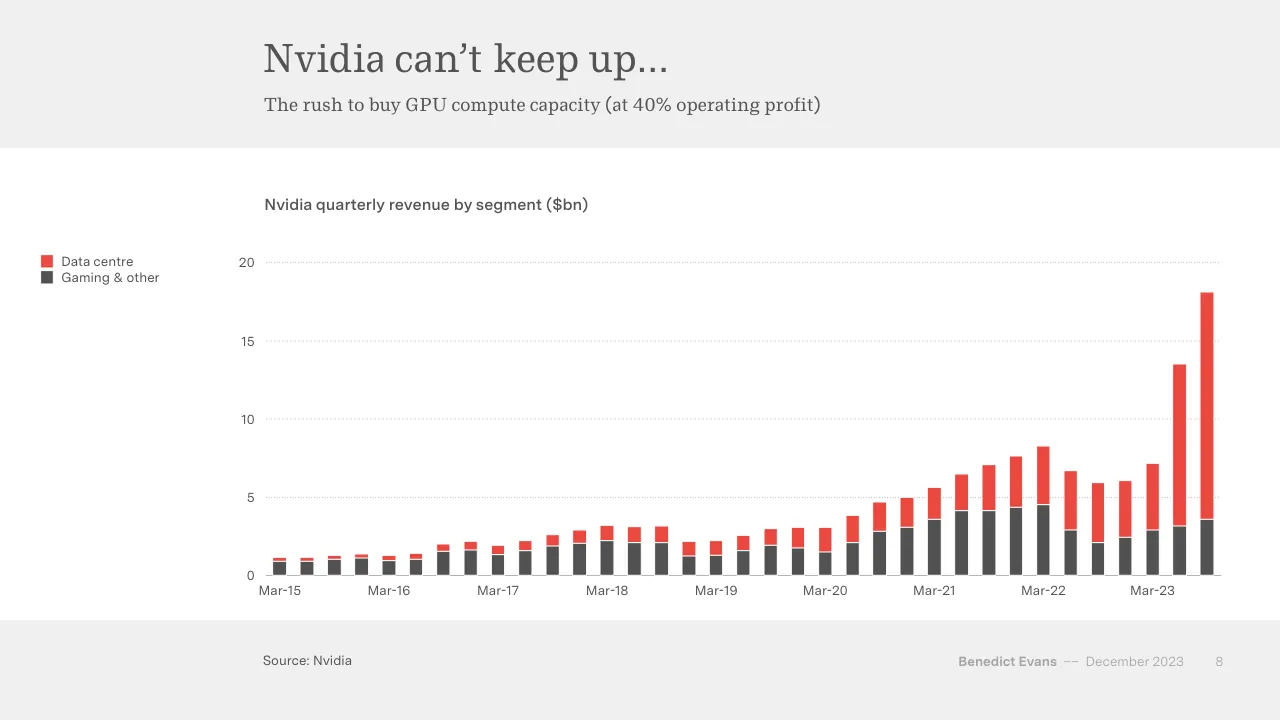
Slide 8, titled "Nvidia can't keep up", says there is a rush to buy GPU compute capacity at 40% operating profit. It charts Nvidia quarterly revenue by segment in $bn, with the data centre and gaming and other segments, sourced from Nvidia.
What does the Benedict Evans AI deck say about hyperscaler spending on AI infrastructure?
Slide 9 says the "big three" cloud platforms may spend $100bn on infrastructure this year. The chart shows platform capex in $bn for Meta, Alphabet, AWS and Microsoft from 2015 to 2023e.
What does the Benedict Evans AI deck say about ChatGPT users and OpenAI revenue?
Slide 11 states "100m ChatGPT weekly active users!" and "OpenAI has $1.3bn revenue!!". The slide carries no further detail on these figures.
Details
- Company: Benedict Evans
- Year: 2023
- Type: Conference talk
- Industry: Technology
- Pages: 87
More from Benedict Evans
- Benedict Evans conference talk, 2026
- Benedict Evans conference talk, Autumn 2025
- Benedict Evans conference talk, Spring 2025
- Benedict Evans conference talk, 2023
- Benedict Evans strategy presentation, 2022
- Benedict Evans conference talk, 2021
All Benedict Evans decks in the library
Review score: 8 out of 10, Strong
Presentation quality, judged with the SlideDeck Co review heuristic. Ask, evidence and idea merit are not rated here.
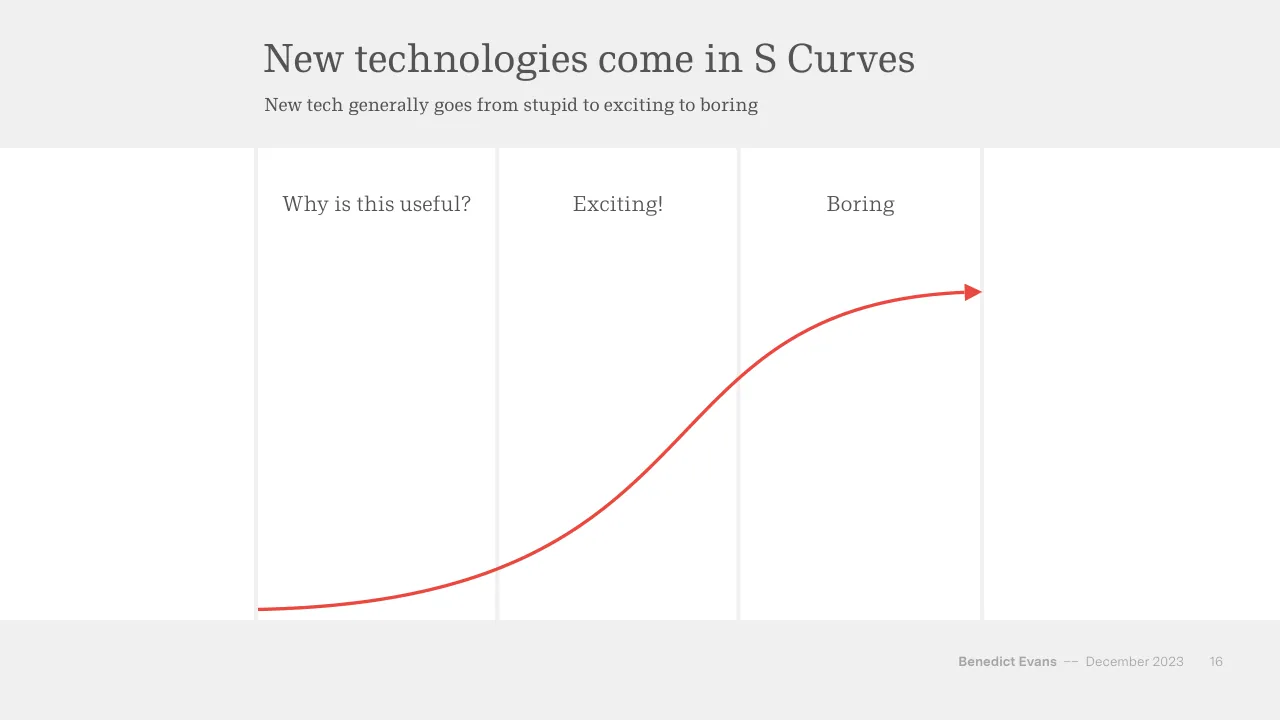
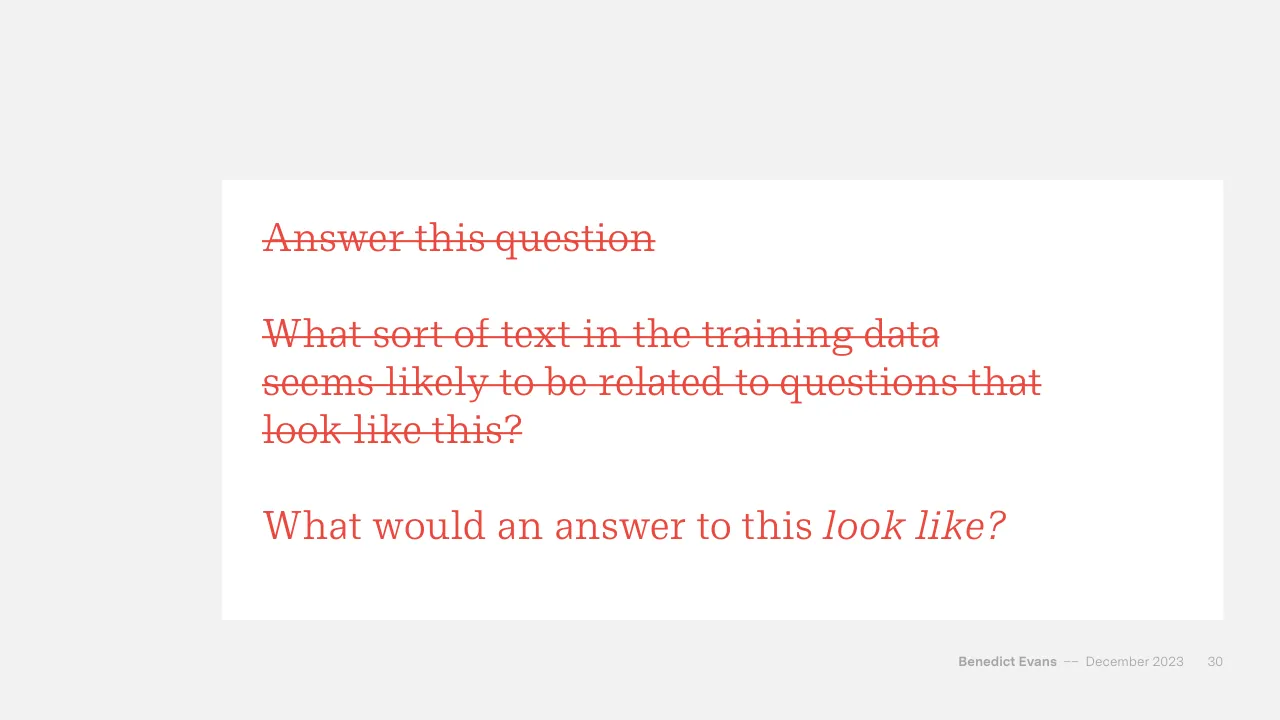
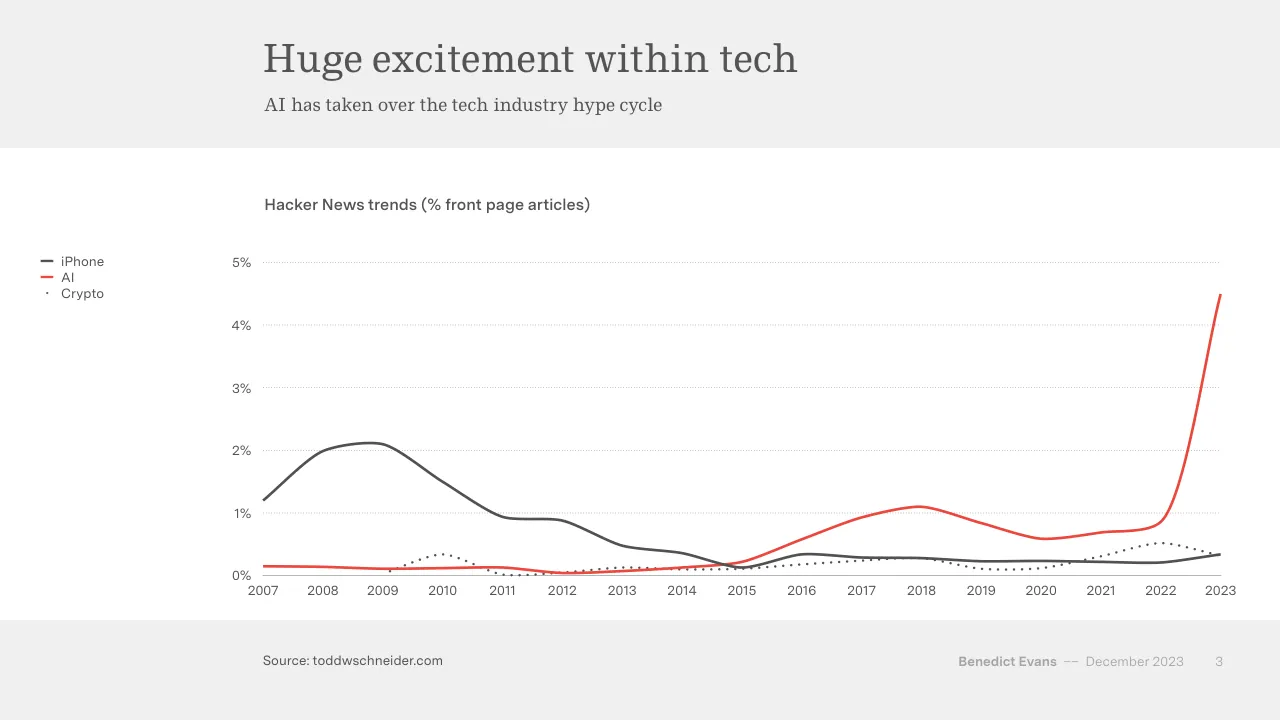
The deck makes one argument in a clear order: hype and money (3-10), then 'what is this?' (13-36), then value capture and platform shifts (37-47), then AGI and uncertainty (61-72). Each slide carries one idea in a consistent system of a serif title, a one-line subtitle, a red accent for the point of interest and grey for context. Charts such as slide 3 are clean and legible, and the S-curve built across slides 16-19 and the strikethrough on slide 30 show the thinking well. The weaknesses are tiny legend and axis text on the chart slides (4, 5, 8-10), thin pages with big empty areas (2, 11, 28, 35), and a template that gets repetitive, with the circle-and-arrow diagrams recurring (13, 21, 34, 39, 47, 60, 64). Several pages also depend on the speaker to carry the meaning.
Worth keeping: Keep the single-idea slides, the red-versus-grey emphasis, the S-curve build on slides 16-19, and the strikethrough reveal on slide 30.
Most useful repair: Enlarge legends and axis labels on the chart slides (4, 5, 8, 9, 10) and give the circle diagrams more varied or more informative forms.
What would change the score: Shrink the empty white boxes on the quote slides (2, 11, 35, 58) and the section dividers (14, 48, 62), and put the Barksdale quote on slide 40 only once, not again on slide 53.
Confidence medium. 72 of 87 pages inspected on contact sheets, 4 at readable size. Reviewed 2026-11-08. Model-assisted review (claude-sonnet-5-5).
Full text of the slides (87 slides)
Every slide's words and a description of its charts and images, so the deck can be searched and rebuilt. Also available as Markdown.
Slide 1
AI, and everything else / Benedict Evans / December 2023 / www.ben-evans.com
Slide 2
“In my lifetime, I’ve seen two / demonstrations of technology that struck / me as revolutionary… the GUI and / ChatGPT” / Bill Gates, March 2023 / Benedict Evans / –– December 2023 / 2
Slide 3
Huge excitement within tech
AI has taken over the tech industry hype cycle
Hacker News trends (% front page articles)
iPhone
AI
Crypto
5%
4%
3%
2%
1%
0%
2007
2008
2009
2010
2011
2012
2013
2014
2015
2016
2017
2018
2019
2020
2021
2022
2023
Source: toddwschneider.com
Benedict Evans
–– December 2023
3
Visuals: Chart: line chart, titled 'Hacker News trends (% front page articles)'. Y-axis: percentage of front page articles, labelled 0% to 5% in 1% steps (range 0% to 5%, gridlines dotted grey at each 1%). X-axis: years 2007 to 2023, one label per year, with a solid thin grey baseline at 0%. Three series drawn as smoothed lines: iPhone is a solid dark grey (#545454) line; AI is a solid red (#E8473B) line; Crypto is a dotted dark grey (#545454) line. Values are not printed on the slide; estimates: iPhone about 1.2% (2007), 2.0% (2008), 2.1% (2009), 1.5% (2010), 0.9% (2011), 0.9% (2012), 0.5% (2013), 0.4% (2014), about 0.1% (2015), 0.35% (2016), 0.3% (2017), 0.3% (2018), 0.25% (2019), 0.25% (2020), 0.2% (2021), 0.2% (2022), 0.35% (2023). AI: about 0.15% (2007), 0.15% (2008), 0.12% (2009), 0.12% (2010), 0.13% (2011), 0.05% (2012), 0.08% (2013), 0.12% (2014), 0.2% (2015), 0.6% (2016), 0.95% (2017), 1.1% (2018), 0.85% (2019), 0.6% (2020), 0.7% (2021), 0.8% (2022), about 4.5% (2023, the highest point on the chart, at the top right). Crypto: about 0.08% (2009), 0.35% (2010), 0.02% (2011), 0.05% (2012), 0.12% (2013), 0.12% (2014), 0.12% (2015), 0.2% (2016), 0.25% (2017), 0.28% (2018), 0.12% (2019), 0.12% (2020), 0.3% (2021), 0.5% (2022), 0.35% (2023). Legend: top-left of the plot, stacked vertically, each entry a short line swatch followed by its label: iPhone (dark grey solid line), AI (red solid line), Crypto (small dark grey dot). No highlighted points.
Slide 4
The startup surge
If your startup isn’t working on generative AI… what’s wrong with you?
Y Combinator startups by field
Other
500
AI
400
300
200
100
0
W 2015
W 2016
W 2017
W 2018
W 2019
W 2020
W 2021
W 2022
W 2023
Source: Y Combinator
Benedict Evans
–– December 2023
4
Visuals: Chart: stacked vertical bar chart titled 'Y Combinator startups by field'. Y axis runs 0 to 500 with labelled ticks at 0, 100, 200, 300, 400 and 500, no unit label. Dotted light-grey horizontal gridlines at each tick. X axis has 18 thin bars, one per half-period, with labels W 2015, W 2016, W 2017, W 2018, W 2019, W 2020, W 2021, W 2022 and W 2023 placed under alternate bars. Two stacked series: bottom series 'AI' in red, top series 'Other' in dark grey. Each bar has a thin white separator between the segments. Values are not printed; estimates from bar heights (about): bar 1 total about 110, AI about 15; bar 2 total about 105, AI about 5; bar 3 total about 122, AI about 15; bar 4 total about 101, AI about 23; bar 5 total about 116, AI about 20; bar 6 total about 126, AI about 23; bar 7 total about 148, AI about 24; bar 8 total about 131, AI about 19; bar 9 total about 196, AI about 24; bar 10 total about 173, AI about 24; bar 11 total about 227, AI about 34; bar 12 total about 208, AI about 24; bar 13 total about 336, AI about 49; bar 14 total about 393, AI about 69; bar 15 total about 401, AI about 66; bar 16 total about 234, AI about 52; bar 17 total about 270, AI about 84; bar 18 total about 217, AI about 138. Legend at left, outside the plot: dark grey square 'Other' above red square 'AI'. No highlighted points. No photographs, logos or icons.
Slide 5
Even as the broader industry slows down / As the ‘Covid Rotation’ rotates, tech venture slows down - except in AI / US venture investments in software ($bn) / 50 / 40 / 30 / 20 / 10 / 0 / Mar-15 / Mar-16 / Mar-17 / Mar-18 / Mar-19 / Mar-20 / Mar-21 / Mar-22 / Mar-23 / Source: NVCA / Benedict Evans –– December 2023 5
Visuals: One line chart. Chart title: 'US venture investments in software ($bn)'. Y-axis: US$bn, linear, range 0 to 50, gridlines and labels at 0, 10, 20, 30, 40, 50 (light grey dotted horizontal gridlines at 10, 20, 30, 40, 50; solid thin grey baseline at 0). X-axis: dates labelled Mar-15, Mar-16, Mar-17, Mar-18, Mar-19, Mar-20, Mar-21, Mar-22, Mar-23, one label per year, spanning roughly Mar-15 to late 2023. Single series, red (#E8443A) smoothed line about 3 px wide, no markers, no legend, no data labels. Values are not printed; estimated values: Mar-15 about 7; Mar-16 about 8; Mar-17 about 5; Mar-18 about 11; Mar-19 about 11; Mar-20 about 11; mid-2020 about 14; Mar-21 about 27; late 2021 peak about 41; Mar-22 about 31; late 2022 trough about 13; Mar-23 peak about 27; end of series about 9. No highlighted points.
Slide 6
The great model boom of 2023
OpenAI showed the way, but there are dozens of projects scrambling to catch up, of all shapes and sizes
OpenAI!
(& Microsoft)
Google & Meta
rush to ship
their own
New
entrants &
open source
boom
Lots of
models
Lots of
questions
Benedict Evans
–– December 2023
6
Visuals: A process diagram with four circles in a row and connectors. Circle 1 is dark grey #535353 with the text 'OpenAI! / (& Microsoft)'. Between circle 1 and circle 2 is a colour emoji of a face with exploding head (🤯, a head bursting into a mushroom-cloud shape with orange-yellow debris, face shown with an open-mouthed worried expression), about 3.5% wide by 6.2% high, placed on the background with no box. Circle 2 is dark grey #535353 with the text 'Google & Meta / rush to ship / their own'. Between circle 2 and circle 3 is a solid right-pointing block arrow in light grey #A6A6A6, about 4.0% wide by 7.0% high, vertically centred on the circles. Circle 3 is dark grey #535353 with the text 'New / entrants & / open source / boom'. Between circle 3 and circle 4 is a second identical grey block arrow. Circle 4 is red #EB483F, the only accent-coloured shape, with the text 'Lots of / models / Lots of / questions'. No chart, table or photograph. Nothing is cropped, shadowed or gradient-filled; all shapes are flat.
Slide 7
Lots of science questions…
OpenAI broke through by making a giant model, so now, do models get still-bigger, or smaller?
Few models?
A few huge, powerful, / capital-intensive / models relied on for / everything else
How many / models, how / big, how / powerful, how / expensive?
Many models?
Many models of / different sizes, / costs & capabilities
(c.f. databases)
Benedict Evans –– December 2023 7
Visuals: Three circles and two block arrows, all vector shapes, no photographs, charts, logos or icons. Left circle: white fill, solid dark grey outline (#545454, about 2 px at slide scale), containing a bold heading 'Few models?' and body text. Centre circle: no visible fill (background shows through), dotted dark grey outline (#545454, about 2 px dots), containing bold text 'How many models, how big, how powerful, how expensive?'. Right circle: white fill, solid red outline (about #E74C3C, about 2 px), containing bold heading 'Many models?' and body text. Two block arrows in mid grey #A7A7A7 with flat fill and no outline: the left one (x about 41.6%, w 5.2%, h 9.3%) is a left-pointing block arrow with a shaft and head; the right one (x about 69.0%) is a right-pointing block arrow of the same size. Arrows point away from the centre circle, toward the left and right circles. No shadows or gradients.
Slide 8
Nvidia can’t keep up…
The rush to buy GPU compute capacity (at 40% operating profit)
Nvidia quarterly revenue by segment ($bn)
Data centre
20
Gaming & other
15
10
5
0
Mar-15
Mar-16
Mar-17
Mar-18
Mar-19
Mar-20
Mar-21
Mar-22
Mar-23
Source: Nvidia
Benedict Evans
–– December 2023
8
Visuals: Chart: stacked column chart titled 'Nvidia quarterly revenue by segment ($bn)'. Vertical axis labelled in $bn with tick labels 0, 5, 10, 15, 20 and a range of 0 to 20; horizontal dotted gridlines at each tick in light grey. Horizontal axis shows quarterly periods labelled Mar-15, Mar-16, Mar-17, Mar-18, Mar-19, Mar-20, Mar-21, Mar-22 and Mar-23 at every fourth bar, with about 35 quarterly columns in total. Two series stacked per column: bottom series 'Gaming & other' in dark grey, top series 'Data centre' in red. Values are not printed; estimates: first column about 1.2 total (about 0.9 gaming, 0.3 data centre); Mar-20 column about 3.1 total; Mar-22 peak column about 8.2 total (about 4.5 gaming, 3.7 data centre); the penultimate tall column about 13.5 total (about 3.2 gaming, 10.3 data centre); the final column is the tallest at about 18.1 total (about 3.6 gaming, 14.5 data centre). Legend at left: red square labelled 'Data centre' above dark grey square labelled 'Gaming & other'. No highlighted points beyond the tallest final column.
Slide 9
And the hyperscalers… scale / The ‘big three’ cloud platforms may spend $100bn on infrastructure this year / Platform capex* ($bn) / Meta / Alphabet / AWS / Microsoft / 150 / 125 / 100 / 75 / 50 / 25 / 0 / 2015 / 2016 / 2017 / 2018 / 2019 / 2020 / 2021 / 2022 / 2023e / Source: Companies, Goldman Sachs / *Including capital leases / Benedict Evans / –– December 2023 / 9
Visuals: Stacked column chart, titled 'Platform capex* ($bn)'. Vertical axis: 'Platform capex* ($bn)' from 0 to 150 in steps of 25, with light dotted horizontal gridlines at 25, 50, 75, 100, 125 and 150; no axis title beyond the chart title. Horizontal axis: categories 2015, 2016, 2017, 2018, 2019, 2020, 2021, 2022, 2023e (the last marked as an estimate). Four stacked series, bottom to top: Microsoft (red #EE4B3F), AWS (salmon #F4A09B), Alphabet (pale pink #F9DAD7), Meta (dark grey #505050); each segment is separated by a thin white line. No data labels are printed, so all values are estimates: 2015 about Microsoft 7, AWS 3, Alphabet 10, Meta 2 (total about 22); 2016 about Microsoft 10, AWS 5, Alphabet 10, Meta 4 (total about 29); 2017 about Microsoft 11, AWS 7, Alphabet 13, Meta 7 (total about 38); 2018 about Microsoft 16, AWS 9, Alphabet 26, Meta 13 (total about 64); 2019 about Microsoft 18, AWS 13, Alphabet 24, Meta 15 (total about 69); 2020 about Microsoft 21, AWS 17, Alphabet 22, Meta 15 (total about 75); 2021 about Microsoft 27, AWS 23, Alphabet 25, Meta 19 (total about 94); 2022 about Microsoft 28, AWS 30, Alphabet 32, Meta 31 (total about 121); 2023e about Microsoft 40, AWS 32, Alphabet 32, Meta 29 (total about 133). Legend at the left of the chart, listed top to bottom: Meta (dark grey square), Alphabet (pale pink square), AWS (salmon square), Microsoft (red square). No highlighted points. Bars are of equal width, about 6% of the plot width each, with the plot baseline a thin grey line at 0.
Slide 10
“What’s our AI strategy?” / Huge interest in old economy companies after just a few months / Corporate management exposure to generative AI, April 2023 / Have not tried / 100% / Have tried / Use for personal / Use for work & personal / Use for work / 75% / 50% / 25% / 0% / TMT / Finance / High-tech / Healthcare & pharma Energy & materials / Professional / Consumer / services / Source: McKinsey / Benedict Evans –– December 2023 10
Visuals: Chart: 100% stacked column chart, vertical bars. Title: Corporate management exposure to generative AI, April 2023. Y axis: percentage of respondents, 0% to 100%, labelled at 0%, 25%, 50%, 75%, 100%, with light dotted horizontal gridlines at each label. X axis: seven categories, labelled TMT, Finance, High-tech, Healthcare & pharma, Energy & materials, Professional services, Consumer. Series, bottom to top: Use for work (black #000000), Use for work & personal (dark grey #545454), Use for personal (mid grey #808080), Have tried (light grey #A6A6A6), Have not tried (red #EA4A41). No values are printed on the bars; the following are estimates marked about. TMT: Use for work about 15%, work and personal about 20%, personal about 17%, have tried about 39%, have not tried about 9.5%. Finance: work about 8.5%, work and personal about 17%, personal about 18%, have tried about 42%, have not tried about 14%. High-tech: work about 5.5%, work and personal about 12%, personal about 17%, have tried about 50%, have not tried about 16%. Healthcare and pharma: work about 6.5%, work and personal about 11%, personal about 18%, have tried about 47%, have not tried about 16%. Energy and materials: work about 6%, work and personal about 9%, personal about 15%, have tried about 51%, have not tried about 19%. Professional services: work about 7.5%, work and personal about 16%, personal about 13%, have tried about 42%, have not tried about 21%. Consumer: work about 7.5%, work and personal about 12%, personal about 12%, have tried about 42%, have not tried about 27%. Segments are separated by thin white hairlines. Bars are about 4.3% of slide width wide with equal spacing of about 10.7%. Legend: five square swatches, about 1.5% of slide width each, stacked vertically at left, top to bottom: Have not tried (red), Have tried (light grey), Use for personal (mid grey), Use for work & personal (dark grey), Use for work (black). The horizontal baseline at 0% is a thin dark grey line. No photographs, logos or icons.
Slide 11
100m ChatGPT weekly active users!
OpenAI has $1.3bn revenue!!
Benedict Evans –– December 2023 11
Slide 12
And a rush to regulate? / The New York Times / The A.I. Race > / How It Began / Key Figures in the Field / One Year of ChatGPT / Regulating / Global Leaders Warn A.I. Could Cause ‘Catastrophic’ Harm / At a U.K. summit, 28 governments, including China and the U.S., signed a declaration agreeing to cooperate on evaluating the risks of artificial intelligence. / Share full article / 178 / nytimes.com / Benedict Evans / –– December 2023 / 12
Visuals: One photograph-like screenshot of a web browser window showing a New York Times article, placed as a single rounded rectangle with a soft grey drop shadow. Browser chrome: three small traffic-light dots at top left (red, yellow, green), a rounded address bar with a document icon, a padlock and the text nytimes.com, and a reload icon. Below that, the NYT masthead wordmark with a hamburger menu icon at left and a user/account icon at right, then a section navigation row. Article block: a bold italic serif headline, a serif deck of three lines, a row of pill-shaped buttons (Share full article with a gift icon, a share arrow icon, a bookmark icon, and a comment bubble icon with the count 178). The lower part of the window is a full-width photograph, cropped to a wide band, of a large Victorian-style brick mansion with ornate gables, tall chimneys, bay windows, a green copper-roofed turret at left, and a low arcaded porch at right, under an overcast grey sky. Lighting is flat, diffuse daylight. Dominant colours: grey sky, red-brown brick, green turret, cream stone trim.
Slide 13
Yes, but what is this?
Almost everyone in tech agrees this is The Thing, but it’s much less clear what that means
The next platform shift?
This changes the nature of software?
This takes us to AGI?
Benedict Evans
–– December 2023
13
Visuals: Three filled red circles, each about 22.1% of slide width and 39.3% of slide height, with white text centred inside. Between circle 1 and circle 2, and between circle 2 and circle 3, sits a solid grey right-pointing block arrow (shaft plus triangular head) about 5.2% wide and 9.3% tall, vertically centred on the circles' midline. The arrows point left to right, showing the sequence circle 1 to circle 2 to circle 3. No photographs, charts, logos or icons.
Slide 14
A platform shift?
Benedict Evans
–– December 2023
14
Slide 15
The tech industry moves in platform shifts
Every 10-15 years, a new platform resets the tech industry
Mainframes
PCs
Web
Open Source
Smartphones
Cloud
Generative AI
Benedict Evans –– December 2023
15
Visuals: Five grey curved arrows and one red dashed curved arrow, each rising from left to right as a smooth S-shaped line with a filled triangular arrowhead. Each arrow runs across one column boundary: the first grey arrow runs from the Mainframes column into the PCs column, the second from PCs into Web/Open Source, the third from Web/Open Source into Smartphones/Cloud, the fourth from Smartphones/Cloud into the Generative AI column, and the red dashed arrow rises within the Generative AI column. Grey arrows are solid stroke in mid grey #808080 about 0.4% of slide height thick, with grey arrowheads of about 2.5% slide width. The red arrow is a dotted stroke in #EB483F with a red arrowhead at its upper right end. Each arrow sits above its column label, with the steps rising from lower left to upper right. No photographs, logos or icons. Labels are in text elements listed below, not part of the arrows.
Slide 16
New technologies come in S Curves
New tech generally goes from stupid to exciting to boring
Why is this useful?
Exciting!
Boring
Benedict Evans
–– December 2023
16
Visuals: One diagram: a single red S-curve (logistic growth curve) with an arrowhead, drawn as a line with no axes, no numbers and no data labels. The curve starts at the lower left of the white panel near the bottom edge, rises gently through the first column, climbs steeply across the boundary between columns two and three, and flattens to horizontal as it reaches an arrowhead pointing right at the right end of column three. Stroke is about 0.4% of slide height, colour red #E8453C, round joins, no shadow. The arrowhead is a solid red filled triangle pointing right. Column labels 'Why is this useful?', 'Exciting!' and 'Boring' sit above the curve, marking the three stages of the S-curve from left to right.
Slide 17
New technologies come in S Curves
Smartphones are mature, which means they’re amazing and boring
Why is this useful?
Exciting!
Boring
Smart
phones
Benedict Evans
–– December 2023
17
Visuals: A single S-curve line chart drawn as a thick red (#EB483F) stroke, starting bottom-left at the lower edge of the second column region, rising steeply through the middle of the 'Exciting!' column and flattening into the 'Boring' column, ending in a red arrowhead pointing right just past the gutter at the right of the Boring column. A solid red circle (#EB483F) sits on the curve in the Boring column, labelled 'Smart phones' in white sans-serif text on two lines, with the curve entering its lower-left edge and an arrow leaving its right edge. No axes, legend, or numeric values are shown.
Slide 18
New technologies come in S Curves
And after ten years, machine learning is well on the way to ‘boring’
Why is this useful?
Exciting!
Boring
Smart
phones
Machine
Learning
Benedict Evans
–– December 2023
18
Visuals: One diagram: an S-curve line drawn in red starting at the bottom-left of the first column (about x 20%, y 94.5%), rising gently through the first column, steepening through the second column and ending in an arrowhead at about x 76.5%, y 40.5% in the third column. Two circular nodes sit on the curve. A red circle (#EB483F) labelled 'Machine Learning' sits at the boundary of columns two and three, centred about x 55.8%, y 54.5%. A dark grey circle (#535353) labelled 'Smart phones' sits in column three, centred about x 67.3%, y 43.2%, with the curve passing behind its lower-left and emerging from its right side into the arrow. Each column has a text heading above the curve; the columns contain no other graphics. The curve is a smooth red stroke of about 0.3% of slide width, with a solid red triangular arrowhead about 1.4% wide. No photographs, logos or icons.
Slide 19
New technologies come in S Curves
And now we have a new cycle?
Why is this useful?
Exciting!
Boring
Smart
phones
Machine
Learning
Generative
ML
Benedict Evans –– December 2023 19
Visuals: One diagram: an S-curve drawn as a red line rising from the bottom left to the upper right, ending in an arrowhead pointing right. Three dark grey circles and one red circle sit on the curve as labelled nodes, in order from left to right: red circle 'Generative ML' (lowest, on the curve at the boundary of columns one and two), dark grey circle 'Machine Learning' (middle, straddling columns two and three), and dark grey circle 'Smart phones' (highest, in column three). The curve passes behind and through each circle, and the arrowhead ends just short of the right column divider. No axes, legend or values.
Slide 20
2013: why is Machine
Learning useful?
“That’s clever, but so what?”
Source: Imagenet
Benedict Evans –– December 2023 20
Visuals: One photograph with bounding boxes overlaid (object-detection example). Subject: an indoor scene of a wooden-plank floor with a sleeping tan/brown dog lying on its side at lower left, a small child in an orange top sitting at centre, a dark office chair at upper right, and a dark chair leg at upper left, seen through a window with white light at the top. Composition: wide landscape frame, full scene visible, with a black vertical strip on the right side (about 18% of the image width) containing the labels. Lighting: even daylight from the window, warm brown floor tones. Dominant colours: brown wood, orange, white window, black strip. The image is boxed (not full-bleed) with a soft grey drop shadow beneath and around it. Overlays: four coloured rectangles with no fill, stroke about 0.4% of slide height: green box around the upper-left chair leg (about x 4.6 to 11.3, y 26 to 44); green box around the upper-right chair (about x 56.3 to 75.3, y 26 to 50); yellow box around the child (about x 43.5 to 61.8, y 37 to 59); red box around the dog (about x 56.7 to 73.0, y 50 to 74). Labels in the black strip next to the image: 'person' in yellow at the top, 'dog' in red in the middle, 'chair' in green at the bottom, each in a sans-serif face. The boxes overlap the image content and each other (the yellow box overlaps the green chair box and the red dog box touches the yellow box edge).
Slide 21
2013: why is Machine Learning useful? / What’s the right level of abstraction to understand this? / Image / recognition / works now! / And so do / lots of other / unsolved / problems / This is / pattern / recognition / What can we / turn into / pattern / recognition? / Benedict Evans –– December 2023 / 21
Visuals: Diagram: a left-to-right process of four circles connected by three grey block arrows. Circle 1 (dark grey #535353) reads 'Image recognition works now!'. Circle 2 (dark grey #535353) reads 'And so do lots of other unsolved problems'. Circle 3 (dark grey #535353) reads 'This is pattern recognition'. Circle 4 (red #EB483F) reads 'What can we turn into pattern recognition?'. Each arrow is a solid right-pointing block arrow in light grey #A6A6A6, sitting in the gap between adjacent circles, with its point aimed at the next circle. No photographs, logos or charts.
Slide 22
“Artificial intelligence is whatever hasn’t
been done yet”
Larry Tesler, early 1970s
Benedict Evans
–– December 2023
22
Slide 23
2023: why is Generative / Machine Learning useful? / “That’s clever, but so what?” / Source: Benedict Evans / Midjourney / Benedict Evans / –– December 2023 / 23
Visuals: One photograph, no chart, table, logo or icon. Subject: two young tabby kittens with grey and brown striped fur, sitting close together with their front paws on the edge of a silver laptop keyboard. The left kitten is slightly behind and turned to the left; the right kitten is in sharper focus, facing the viewer with its head slightly tilted. Composition: square frame, subject in the right two-thirds, dark out-of-focus laptop lid running diagonally down the left side, and the laptop keyboard and base cut across the lower third. Lighting: soft, low-key, warm ambient light with a shallow depth of field so the background is blurred. Dominant colours: taupe and grey-brown fur, warm dark brown and near-black shadows, muted silver on the laptop. The photo is not cropped, is boxed (not full-bleed), and has no overlay or tint. A second placed image of 882 by 882 pixels sits behind it at x 52.0, y 6.6, w 45.9, h 81.7, acting as a soft grey drop shadow beneath and around the photo.
Slide 24
The cool demo
“write a song about Tesla and spacex”
Cool, but why is this useful?
Source: Benedict Evans / OpenAI
Benedict Evans
–– December 2023
24
You
write a song about Tesla and spacex
ChatGPT
Sure, I can help you with that! Here's a song that celebrates the innovative spirit of Tesla and SpaceX:
Title: Stars and Roads Unveiled
(Verse 1)
In the heart of Silicon dreams, where ideas soar,
Stands a vision bold, with electric roar.
Tesla's wheels glide, in a whispering dance,
Crafting a future where we all advance.
(Chorus)
Oh, Tesla, in your light we ride,
SpaceX, where dreams and stars collide.
Message ChatGPT...
ChatGPT can make mistakes. Consider checking important information.
chat.openai.com
ChatGPT 4
Visuals: One photograph-like screenshot of a web browser window showing the ChatGPT interface, placed at x 51.6%, y 4.5%, w 46.9%, h 91.0% of the slide (source image 900 by 983 pixels). It is boxed rather than cropped or full-bleed: a rounded-corner browser window with a soft drop shadow beneath it on the white panel. Window chrome at top: three small traffic-light dots, red (left), yellow (middle), green (right); a rounded address bar in the centre showing a page icon, a padlock and 'chat.openai.com' with a reload icon. Below the chrome is a header bar with a hamburger icon at left, the title 'ChatGPT 4' with a down chevron in the centre, and a compose/edit icon at right. The conversation area shows a user row with a green circular avatar reading 'BE' and the message 'write a song about Tesla and spacex' with a small pencil edit icon beneath; then a ChatGPT row with a purple circular OpenAI-style logo avatar, the reply text, a thin horizontal divider line, and a bold title followed by four-line verse and two-line chorus in italic section labels. A round white down-arrow scroll button overlaps the chorus area at right. At the bottom is a rounded input field with a paperclip icon at left, placeholder 'Message ChatGPT...' with a text cursor, and a grey up-arrow send button at right; below it is a small grey disclaimer line. Colours are predominantly white and light grey with black and dark grey text, a green avatar, a purple logo avatar, and red, yellow and green window dots. Lighting is flat and even, as in a clean screen capture.
Slide 25
Generative search? / What does this do to search? / The web? / Everything else? / Source: Benedict Evans / OpenAI / Benedict Evans / –– December 2023 / 25 / chat.openai.com / ChatGPT 4 / You / Write a brief itinerary for a long weekend in Barcelona. Suggest a boutique hotel, restaurants and some architecture / ChatGPT / A long weekend in Barcelona promises a delightful blend of culture, cuisine, and architecture. Here's a suggested itinerary: / Day 1: Arrival and Exploring the Gothic Quarter / Morning: Arrive in Barcelona and check into a boutique hotel. A great choice would be the "Casa Bonay," known for its unique blend of historic charm and modern design. / Afternoon: Explore the Gothic Quarter. Wander through its narrow medieval streets, visit the Barcelona Cathedral, and enjoy the vibrant atmosphere. / Evening: Dine at "Bodega Biarritz," a popular spot for tapas, offering a cozy atmosphere and a selection of local wines. / Day 2: Gaudí and Gràcia / Morning: Visit the iconic Sagrada Familia, Antoni Gaudí's unfinished masterpiece. Book tickets in advance to avoid lon es. / Afternoon: Head to Park Güell, another of Gaudi's creations, and enjoy panoramic / Message ChatGPT... / ChatGPT can make mistakes. Consider checking important information.
Visuals: One photograph-style screenshot of a web browser window showing the ChatGPT 4 interface at chat.openai.com. Subject: a chat conversation in which the user asks for a long-weekend itinerary for Barcelona and ChatGPT replies with Day 1 and Day 2 plans as bold headings with bulleted Morning, Afternoon and Evening items. Composition: the window is framed straight-on, fully visible, with a soft drop shadow beneath and around it, boxed rather than full-bleed. Lighting: flat, even, neutral. Dominant colours: white and light grey interface, black text, a teal avatar circle for 'You' and a green-and-white ChatGPT logo avatar. Browser chrome has red, yellow and green traffic-light dots at top left, a rounded address bar with a lock icon reading chat.openai.com and a reload icon, and a hamburger icon at left and compose icon at right of the header bar. A grey message input box with a paperclip icon at the bottom left and a send arrow at the bottom right, and a circular down-arrow scroll button overlapping the text near the 'lon es' word in the Day 2 Morning bullet. No charts, tables or logos besides the small icons described.
Slide 26
However…
A.I. and Chatbots
How the A.I. Race Began
One Year of ChatGPT
Key Figures in A.I.
How A.I.
The ChatGPT Lawyer Explains Himself
In a cringe-inducing court hearing, a lawyer who relied on A.I. to craft a motion full of made-up case law said he “did not comprehend” that the chat bot could lead him astray.
Share full article
267
Benedict Evans
–– December 2023
26
Visuals: One screenshot of a Safari-style browser window showing the New York Times website, with a photograph inside it. Browser chrome: rounded-corner window with a light grey title bar, red, yellow and green traffic-light dots at top left, a rounded address bar showing a reader icon, a padlock and 'nytimes.com' with a reload icon, all in grey on #F0F0F0. Below is the white NYT masthead with a hamburger menu icon at left, 'The New York Times' wordmark in black blackletter-style serif centred, and a user/account silhouette icon at right. Beneath is a section navigation bar with 'A.I. and Chatbots ›' in bold at left, a thin vertical divider, then links 'How the A.I. Race Began', 'One Year of ChatGPT', 'Key Figures in A.I.' and 'How A.I.' (cut off at the edge). Article area: headline 'The ChatGPT Lawyer Explains Himself' in large bold italic serif, black; deck in regular serif, three lines. Action row: a pill button with a gift icon and 'Share full article', a circular share arrow icon, a circular bookmark icon, and a pill with a speech-bubble icon and the number 267. Photograph at the bottom of the window, full width of the window and cropped at the window's bottom edge: a bald-to-grey-haired middle-aged man in profile facing left, looking down with a stern expression, wearing a dark navy suit jacket, white collared shirt and a light blue striped tie; background is dense green tree foliage in daylight, with sunlit greens; the figure is framed right of centre with his head in the upper right of the photo. Lighting is natural daylight, soft and even. Dominant colours: green foliage, navy, white and pale blue. The photo is boxed inside the window, not full-bleed, with no overlay or tint. The window has a soft grey drop shadow around it on the white panel.
Slide 27
This paper does not exist / What is an answer likely to look like? Well… / Economics history papers have the most citations / Douglass North is one of the most highly cited authors / Douglass North’s most-cited co-authored paper was published in The Journal of Economic History / Economics papers most commonly have two co-authors… / So what’s the pattern? / Source: David Smerdon / Benedict Evans –– December 2023 / 27 / SM / What is the most cited economics paper of all time / The most cited economics paper of all time is "A Theory of Economic History" by Douglass North and Robert Thomas, which was published in The Journal of Economic History in 1969. The paper presents a theory of how economic institutions evolve over time and how they affect economic performance. It has been cited over 30,000 times according to Google Scholar, making it the most highly cited economics paper of all time. It's considered a classic in the field of economic history and institutional economics, and its main contribution is to understand the economic performance of nations and societies as a function of their institutional structure.
Visuals: One photograph-style illustration: a macOS-style chat window mockup, placed as a boxed element with rounded corners and a soft drop shadow, spanning about x 51.6 to 98.5 and y 4.5 to 95.5 (placed image 900 by 983 pixels). Its title bar has three traffic-light dots at top left: red #FF5F57, amber #FEBC2E and green #28C840, left to right. Inside the window is a chat transcript (placed image 745 by 459 pixels, at about x 55.6, y 18.2, w 38.8, h 42.4): a user row with a grey square avatar reading SM (#8C8C8C) and the question 'What is the most cited economics paper of all time' in dark grey text on white; a light grey #F5F5F5 response band below with a teal-green #10A37F square icon bearing a white interlocking swirl mark, followed by the answer text in dark grey #333333 sans-serif. The window's lower half is empty white. No photographs of people; no charts or tables.
Slide 28
Answer this question / Benedict Evans –– December 2023 28
Slide 29
Answer this question / What sort of text in the training data / seems likely to be related to questions that / look like this? / Benedict Evans / –– December 2023 / 29
Visuals: none; the only graphic mark is a red horizontal strikethrough line running through the title text 'Answer this question' at about mid x-height.
Slide 30
Answer this question / What sort of text in the training data / seems likely to be related to questions that / look like this? / What would an answer to this look like? / Benedict Evans / –– December 2023 / 30
Visuals: none. The only graphic marks are the strikethrough rules drawn through the first three text blocks ("Answer this question" and the three-line question), which are part of the text formatting.
Slide 31
A little exposure can be misleading
Generative ML results are very likely to look correct, and that can be persuasive if you’re not careful
“Generative AI always produces factually accurate answers” (UK, June 2023)
Aware of
Have used
50%
40%
30%
20%
10%
0%
Agree
Neither or don't know
Disagree
Source: Deloitte
Benedict Evans
–– December 2023
31
Visuals: Clustered vertical bar chart. Title: “Generative AI always produces factually accurate answers” (UK, June 2023). Y axis: percentage of respondents, 0% to 50%, gridlines every 10% (dotted light grey lines). X axis: three categories, Agree, Neither or don't know, Disagree; no axis unit label printed. Series 1 'Aware of' (dark grey #535353): Agree about 28%, Neither or don't know about 35%, Disagree about 37%. Series 2 'Have used' (red #EB483F): Agree about 43%, Neither or don't know about 25%, Disagree about 32%. No data values are printed on the bars; these are estimates read from bar heights against the gridlines. Legend at upper left of chart: dark grey square labelled Aware of, red square labelled Have used, stacked vertically. No highlighted points. Bars are flat with no outline, with a thin white gap between paired bars. The horizontal 0% baseline is a thin grey line.
Slide 32
What is this? We’re still working it out
How do we understand what these systems are doing?
Not a database!
Not Napster
Not predictable
Does not ‘understand’
Bad at things computers
are good at
Probabilistic
Trained on everything (but
half-remembers it)
Looks like it ‘understands’
Good at things computers
are bad at
Benedict Evans
–– December 2023
32
Visuals: none (apart from a decorative dashed outline chevron: red dashed boundary on the left and top/bottom, grey dashed boundary on the right, meeting at a point at about x 52%, y 59.5%). No photographs, charts, icons or logos.
Slide 33
Machine learning, automated learning / Instead of telling a computer how to think, give it the data and get it to work it out for itself / 2013: ML 1.0 / How do we tell a computer how to recognise a cat? / Give the computer a million pictures of cats / 2023: ML 2.0 / How do we tell a computer how to reason and understand? / Give the computer the entire written output of all human intelligence (!) / Benedict Evans / –– December 2023 / 33
Visuals: Two identical diagram rows, each a left-to-right flow: a question in serif text, then a red dotted arrow, then an answer in serif text. Arrow 1 (row 2013): dotted line in red #E8453C, about 0.5% of slide height thick, from x 49.4% to 65.0% at y about 36.1%, ending in a small solid filled red triangular arrowhead pointing right. Arrow 2 (row 2023): same dotted red line and arrowhead from x 49.4% to 65.0% at y about 70.2%. No photographs, charts, icons or logos.
Slide 34
2023: how should we understand generative ML?
What’s the right level of abstraction to understand this?
Pattern creation?
Synthesis &
summary?
Reasoning?
Something else?
What can we do
with this?
Benedict Evans
–– December 2023
34
Visuals: Three filled circles connected left to right by two grey block arrows. Circle 1 (dark grey #535353) reads 'Pattern creation?'. Circle 2 (dark grey #535353) reads 'Synthesis & summary?' / 'Reasoning?' / 'Something else?' stacked. Circle 3 (red #EB483F) reads 'What can we do with this?' The two arrows are right-pointing block arrows in light grey #A7A7A7, each with a rectangular shaft and triangular head, positioned in the gaps between circles. No photographs, charts or logos.
Slide 35
“AI gives you infinite interns”
Benedict Evans –– December 2023 35
Slide 36
2023 use cases
Step one: duct-tape the new tool to the problems you already understand. Step two:…
Early wins
Code assistants
Brainstorming
Autosuggest
‘Thin wrappers’
Add some UI and
data linkage to
OpenAI APIs
Synthesis
Point an LLM at
your corpus and
get answers
2024?
What new
problems can we
discover?
Benedict Evans
–– December 2023
36
Visuals: Four white circles in a horizontal row, each with a thin dark grey outline (about 2 px, #545454). The first, second and third circles have dark grey outlines; the fourth has a red outline (#E74C3C) of the same weight. Each circle holds a bold heading and one to three lines of centred text. The circles are not photographs, charts or icons; they are plain geometric shapes with no fill gradient, shadow or overlay. Circle 1 (Early wins) and circle 3 (Synthesis) and circle 4 (2024?) sit at the same vertical level; circle 2 sits slightly higher. No logos, icons or images appear.
Slide 37
“Every text box on the internet will get an LLM”
Solving LinkedIn’s shortage of generic self-promotion
Benedict Evans
Post to Anyone
Start typing or draft with AI
Let AI help you with a first draft
Give us detailed information on what you want to write about, including key points and examples, and we’ll help you get started with an AI-powered first draft.
Post
Source: LinkedIn
Benedict Evans
–– December 2023
37
Visuals: One photograph-style UI screenshot of a LinkedIn 'Post' composer dialog, boxed (not full-bleed) with a soft grey drop shadow, centred at about x 18.7 to 69.2 percent and y 18.3 to 89 percent. Content: a white modal card with a circular headshot of Benedict Evans (a man with glasses and short grey hair, cropped to a circle, about 3.5% of slide width) beside the name 'Benedict Evans' with a dropdown triangle and the line 'Post to Anyone'; a close X at top right; the prompt 'Start typing or draft with AI' with a magic-wand sparkle icon, 'draft with AI' underlined; a pale blue rounded callout reading 'Let AI help you with a first draft' with a small X and two lines of body text; an empty writing area; a smiley emoji icon at lower left; a row of four pale beige circular buttons holding an image icon, a video camera icon, a calendar icon and an ellipsis; a divider line; a clock icon and a greyed 'Post' pill button at lower right. Lighting is flat with no visible light source; dominant colours are white, near-black text, grey icons and a pale blue callout. The screenshot is not cropped. The measurements file lists two placed copies of the image (970 by 762 px and 964 by 765 px) at almost the same position; the second is slightly offset, which suggests a duplicate shadow layer.
Slide 38
Infinite interns (to make your product shots)
“Every single team at Amazon is exploring generative AI” - Amazon CEO
Source: Amazon
Benedict Evans
–– December 2023
38
Visuals: One photograph, a split-image composite in a wide landscape box with a soft drop shadow. The left portion shows a stainless-steel four-slot toaster with the brand GRUX in embossed lettering, shot as a cut-out product photo on a white-to-light-grey gradient, with black feet and dark side knobs, two toast-level dials and a small label panel. A thick diagonal yellow stripe, running from the top edge near x 61% down to the bottom edge near x 40% of the photo, divides the image. The right portion shows the same toaster on a dark wooden table in an autumn setting: a grey linen napkin, toast topped with cream cheese and orange slices of pumpkin or squash, a grey metal spoon, a fork at lower right, a dried orange-brown leaf at upper left, a large orange pumpkin cropped at the right edge, and a weathered wooden tray on a grey wall at upper right. Lighting is soft and warm in the lifestyle half and even and bright in the cut-out half. Dominant colours are silver, grey, warm brown, orange and bright yellow. The photo is boxed, not full-bleed, and is cropped at the edges of its rectangle.
Slide 39
How is value captured in a platform shift?
If generative AI is the new platform - this is the pattern for how new platforms work
Incumbents make it a feature
Startups use it to unbundle
Sometimes, you change the nature of the market
Benedict Evans –– December 2023 39
Visuals: Three filled circles, no photographs or charts. Left circle: dark grey #535353, diameter about 22.1% of slide width, containing white serif text 'Incumbents make it a feature'. Middle circle: dark grey #535353, same size, containing white serif text 'Startups use it to unbundle'. Right circle: red-coral #EB483F, same size, containing white serif text 'Sometimes, you change the nature of the market'. All circles are flat fills with no outline, no shadow and no gradient, vertically centred on the same horizontal line around 53% of slide height. No arrows, lines or logos.
Slide 40
“There are two ways to make money. / You can bundle, or you can unbundle”
Jim Barksdale
Benedict Evans
–– December 2023
40
Slide 41
And Adobe is trying to do both / Adding Generative AI features to Photoshop while launching Firefly (and buying Figma) / Make it a feature / Generative Fill etc / in Photoshop / Unbundle / New dedicated app / in ‘Firefly’ / Benedict Evans –– December 2023 41 / Jaguar drinking from pond / Generate
Visuals: Three shape groups and one photograph. (1) Left circle: an outlined circle, white fill, dark grey stroke about 3 px, containing the text Make it a feature and Generative Fill etc in Photoshop. (2) Left block arrow: solid grey #A7A7A7 left-pointing block arrow, about 5.2 percent wide by 9.3 percent high, flat shaft and triangular head. (3) Centre photograph: a 600 by 452 pixel rendered image, unboxed with square corners and no border, of a spotted jaguar standing and drinking from a dark green pond in a jungle setting with tall wooden bookshelves full of books on the left and right, green leaves and a small butterfly at the right edge; a white dotted ellipse (selection marquee) is drawn around the jaguar and pond; the image is lit evenly with a soft green-gold tone and dominant colours dark green, brown and gold. The image is not cropped. Overlaid across its lower part is a dark grey (#3A3A3A approx) rounded-corner generative panel with a dark prompt field reading Jaguar drinking from pond, a grey Generate button with a star-sparkle icon and the word Generate in white, and a row of three thumbnail images of the jaguar; the middle thumbnail has a blue (#1E88E5 approx) selection border. The panel has a soft drop shadow. (4) Right block arrow: solid grey #A7A7A7 right-pointing block arrow, same size as left arrow. (5) Right circle: outlined circle, white fill, red (#E84C3D approx) stroke about 3 px, containing Unbundle and New dedicated app in ‘Firefly’.
Slide 42
But then, new tools change the nature of the work / First we make the new tool fit the work - then we change the work to fit the tool / Source: The Apartment, 1960 / Benedict Evans –– December 2023 / 42
Visuals: One black-and-white photograph, full width (0 to 100% of slide width), from y 17.0% to y 93.1%, unboxed and uncropped at the left and right edges. It shows a large open-plan office from The Apartment (1960): rows of desks with typewriters and telephones receding toward a vanishing point, many clerks in dark suits and dresses working at them, and a grid of fluorescent ceiling light panels supported by square columns. Composition is a one-point perspective centred on the middle of the frame, with the foreground desks at the bottom. Lighting is flat, even fluorescent light, rendered in greyscale with mid to high contrast. Dominant colours are grey, black and white. No overlay or tint. No logos or icons.
Slide 43
Platform shifts tend to change everything else
New kinds of building blocks can go a lot further than people expect
“SQL makes arbitrary data queries easier”
Just-in-time supply chains…
“We put multitouch and macOS on a phone”
Uber, Instagram, Tiktok… and 5bn people online
“We made a thing that can predict your next word”
???
Benedict Evans –– December 2023 43
Visuals: Three identical horizontal dotted arrows, one per row, in red #EB483F. Each is a dotted line about 15.6% of slide width running from x 49.4% to x 65.0%, ending in a small solid right-pointing triangular arrowhead. Arrow 1 is at y about 30.2%, arrow 2 at y about 53.1%, arrow 3 at y about 75.8%. They point from the left quote to the right result in each row. No photographs, charts, logos or icons.
Slide 44
And create new gatekeepers
New channels and new platforms mean new points of
control and leverage
Source: Apple
Benedict Evans –– December 2023 44
Visuals: One photograph of an Apple iPhone (first-generation, black bezel, silver edge) shown upright, front-on, centred in the right half, with its home button visible at bottom. The screen shows the App Store 'Featured' view at 9:42 AM with AT&T 3G status bar, a blue navigation bar with a 'New' / 'What's Hot' segmented control, two game banners (SEGA Super Monkey Ball green banner, Cro-Mag Rally grey banner), and a list of apps: Vivendi Games Mobile, Crash Bandicoot..., $9.99, 812 reviews; Pangea Software, Inc., Enigmo, $1.99, 1476 reviews; Apple Inc., Texas Hold'Em, $4.99, 800 reviews; Namco Networks America Inc., PAC-MAN, $9.99 (partly cut off). A bottom tab bar shows Featured, Categories, Top 25, Search, Updates. The phone is lit evenly, with dark black body and silver chrome edge, against white; the image is not cropped, full phone shown, boxed only by its own edges with no overlay or tint.
Slide 45
The end of links?
From discovery to aggregation to synthesis - what’s the SEO for ChatGPT?
Web
Google &
YouTube /
Instagram /
TikTok
LLMs
Benedict Evans
–– December 2023
45
Visuals: Four solid circles connected left to right by three grey right-pointing block arrows (a flat rectangular shaft with a triangular head). Circle 1 is dark grey #535353 and labelled Web. Circle 2 is dark grey #535353 and labelled Google & / Facebook. Circle 3 is dark grey #535353 and labelled YouTube / Instagram / TikTok. Circle 4 is red #EB483F, the only coloured element, and labelled LLMs. Each circle is about 324 px in diameter on a 2000 by 1125 px slide, and all four share the same vertical centre near y 53%. The three arrows are light grey #A6A6A6, each about 4% of slide width by 7% of slide height, centred vertically on the circles, located between circles 1 and 2, 2 and 3, and 3 and 4. The flow is a left-to-right diagram: Web to Google & Facebook to YouTube / Instagram / TikTok to LLMs.
Slide 46
But beware of extrapolating / Generative AI comes to us first as chat bots, but don’t / presume that’s the right or only model / Source: RIM / BlackBerry / 1XEV / 12:21 PM FRI MAY 25 / Messages (3) / verizon / Benedict Evans / –– December 2023 / 46
Visuals: One photograph of a silver and black BlackBerry Curve smartphone with a Verizon badge, shown front-on and fully upright, centred in the right half. The screen shows a status bar with signal bars and 1XEV at top left and a battery icon at top right, a light panel reading 12:21 PM FRI MAY 25 with a '3' envelope-style notification icon and a Bluetooth symbol, a faint red Verizon check-mark watermark, the words Messages (3) in bold, and a row of five app icons (phone, envelope with red bow, phone with arrows, red telephone, calendar showing 25). The keyboard is a full QWERTY layout with dark grey keys, letters and symbols on each key, a SPACE bar, SYM and ALT keys, a central navigation trackball and red and green call keys above. The 'verizon' wordmark in red and black appears on the chin below the keyboard. Lighting is flat and even studio lighting with soft shadows, the phone is dominated by silver metallic greys and black, on a plain white background. The photo is a full, uncropped cut-out with no overlay or tint, placed directly on the white panel.
Slide 47
Posit: all AI questions have one of two answers / Most AI questions match to a pattern - unless you want to know if the pattern will be broken / Answer: / “It will work / like every other / platform shift” / Insert your / question here… / Answer: / “No-one / knows” / Benedict Evans –– December 2023 47
Visuals: Diagram: three filled circles in a row, left to right, with two block arrows between them. Left circle is dark grey #535353 and holds the text 'Answer: / “It will work like every other platform shift”'. Centre circle is red #EB483F and holds 'Insert your question here…'. Right circle is dark grey #535353 and holds 'Answer: / “No-one knows”'. Between the left circle and the centre circle is a left-pointing block arrow in #A7A7A7 whose head points at the left circle. Between the centre circle and the right circle is a right-pointing block arrow in #A7A7A7 whose head points at the right circle. The arrows point outward from the centre, so the centre circle is the question and each side is one of its two answers. No photographs, charts or logos.
Slide 48
More than a platform shift?
Benedict Evans –– December 2023 48
Slide 49
“In my lifetime, I’ve seen two / demonstrations of technology that struck / me as revolutionary… the GUI and / ChatGPT” / / Bill Gates, March 2023 / / Benedict Evans –– December 2023 / 49
Slide 50
A step change in generalisation?
Is generative AI a change in how broad software can be?
Command line
Learn the
commands and
type them
GUI
See the options
and choose
them
Generative AI
Tell the
computer what
you want?
Benedict Evans –– December 2023 50
Visuals: Process diagram with three white circles (ellipses of equal size) with dark grey 2px outlines, the first two outlined #545454 and the third outlined red #E84C3D. Each circle contains a bold heading and a regular two- or three-line body label, centred. Two solid grey block arrows (right-pointing, #A7A7A7, stubby shaft with triangular head) sit between circle 1 and circle 2 and between circle 2 and circle 3, connecting left to right in sequence. No photographs, charts or icons.
Slide 51
Return of the ‘agent’ (or the / mainframe)?
The 30-year dream of the general purpose ‘AI Agent’ / that can do anything for you
Benedict Evans –– December 2023 51
Visuals: One illustration: a cartoon paperclip character with googly eyes and raised eyebrows, standing on a sheet of yellow-green lined notepaper that curves upward to the right, casting a soft grey shadow to the lower right. Beside its head is a pale yellow speech bubble with a dark thin outline and rounded corners reading 'Would you like me to manage your kid's high school application?' with two boxed buttons, 'Yes' on the left and 'No' on the right, with a pointer from the bubble to the paperclip's eye. The paperclip is lavender-grey with dark outline; the paper is pale yellow-green with thin olive lines and a faint red margin line. Lighting is flat and even, composition is a boxed image on white with no cropping, no overlay, not full-bleed. Dominant colours: lavender grey, pale yellow, olive green, white.
Slide 52
Return of the ‘agent’ (or the / mainframe)? / The 30-year dream of the general purpose ‘AI Agent’ / that can do anything for you / Benedict Evans –– December 2023 / 52
Visuals: One illustration: a cartoon of the Microsoft Office-style paperclip assistant character, purple-grey with large cartoon eyes and raised eyebrows, standing on a yellow-lined legal pad that curves up toward the right edge. It has a cream speech bubble with black rounded border reading 'Would you like / me to optimise / your checkout flow?' with two buttons below, labelled 'Yes' and 'No', drawn as small grey-outlined rectangles. The pad has pale yellow-green fill with thin darker olive ruling lines and a faint red margin line; the paperclip casts a soft grey shadow to its right. Composition is a full image with the whole illustration visible, not cropped, on a white background, placed in the right half with roughly 27% to 77% of slide height. Lighting is flat and even with a slight drop shadow. Dominant colours: cream #FFFFCC bubble, pale yellow-green #E6E68A pad, lavender-grey #8A8AB0 paperclip, black text.
Slide 53
“There are two ways to make money. / You can bundle, or you can unbundle” / Jim Barksdale / Benedict Evans / –– December 2023 / 53
Slides 54 to 87 continue in the full text file.
Download this deck
The hosted PDF of every library deck is free for readers of the SlideDeck Co newsletter. Join with your email and the viewer and download appear here.
Building a deck of your own? The SlideDeck Co Standard Deck is a slide library for business presentations: reviews, updates and plans.