
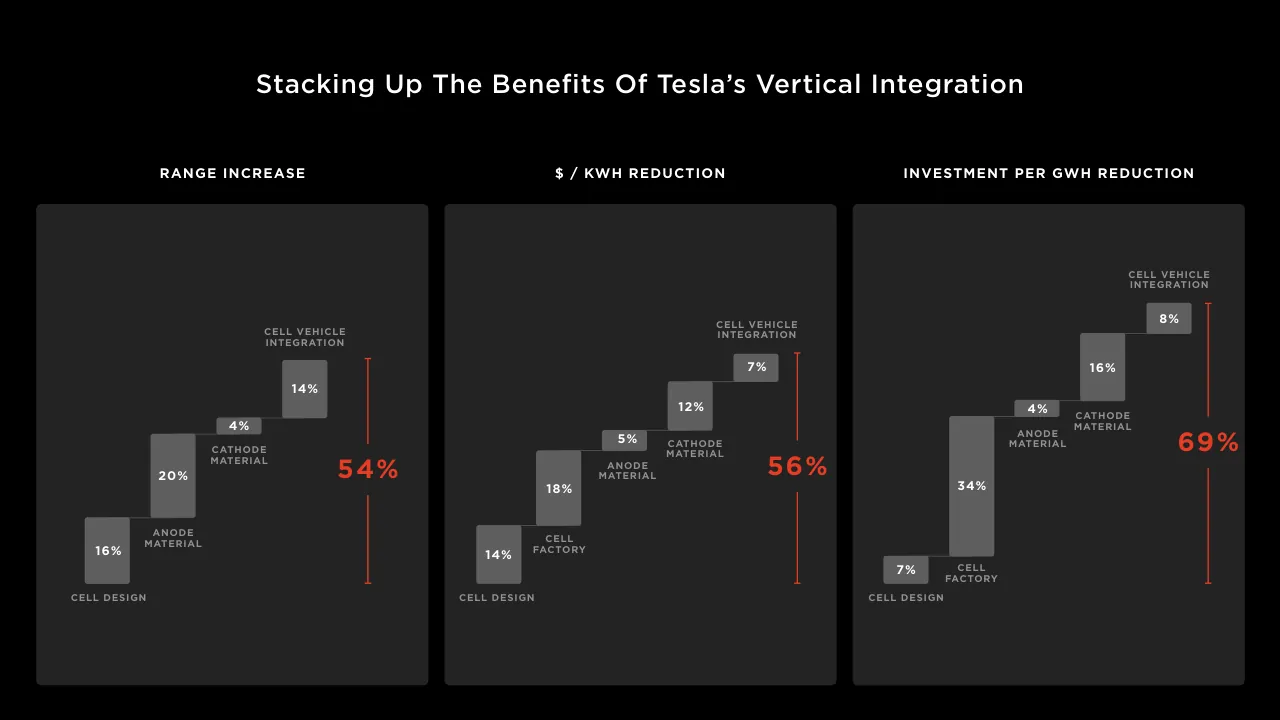
The deck opens with a September 22, 2020 title slide and a climate framing. A CO2 concentration chart leads to a note that the shift to sustainable energy needs more affordable EVs and energy storage, built faster and with less investment. It then sets goals: terawatt-hour scale battery production and more affordable cells. Bar charts of gigawatt-hour demand by vehicle segment and by heating and electricity category show the scale of growth required. The middle sections cover cell design, the cell factory, anode materials, cathode materials, and cell-vehicle integration, each with a cost-per-kWh reduction figure. Topics include larger cylindrical cells, a dry electrode process, silicon anodes, a diversified cathode approach, North American cathode and lithium supply, recycling, giga casting, and structural batteries. The deck closes with a 2030 target of 3 TWh, a stacked chart of cost benefits from vertical integration, an industry cost trend compared with Tesla's forecast, a call for suppliers to help, and a closing look at lower-cost vehicles and a high-performance model.
Slides worth studying
Questions about this deck
How many slides does the Tesla battery day presentation deck have?
The deck has 74 slides. Slide 1 is the title slide dated September 22, 2020.
What battery production targets does the Tesla deck set out?
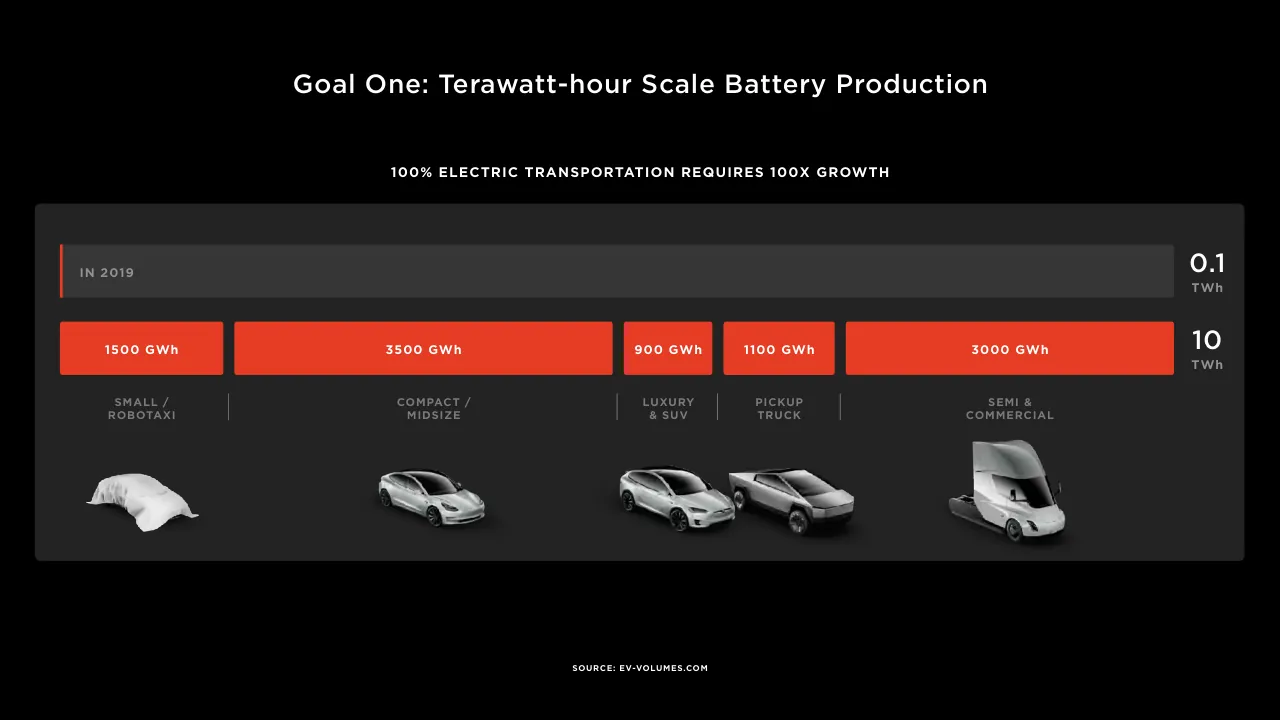
Slide 39 gives the plan as 100 GWh in 2022 and 3 TWh by 2030. Slide 6 is titled Goal One: Terawatt-hour Scale Battery Production.
What does the Tesla deck say about silicon anodes and their cost?
Slide 41 says silicon is the most abundant element in Earth's crust after oxygen. Slide 43 lists Tesla Silicon at 1.2 $/KWh, compared with 10.2 $/KWh for silicon structured in graphite.
What cost reduction goal does the Tesla deck state for battery cells?
Slide 15 is titled We Have A Plan To Halve The Cost Per KWh. It introduces the topics of cell design, cell factory, anode materials, cathode materials and cell vehicle integration.
Details
- Company: Tesla
- Year: 2020
- Type: Keynote
- Industry: Automotive
- Pages: 74
More from Tesla
- Tesla investor presentation, 2026
- Tesla investor presentation, 2025
- Tesla investor presentation, Q4 2023 update
- Tesla investor presentation, Q4 2024 update
- Tesla investor presentation, 2024 annual shareholder meeting
- Tesla investor presentation, Q4 2022 update
All Tesla decks in the library
Review score: 9 out of 10, Excellent
Presentation quality, judged with the SlideDeck Co review heuristic. Ask, evidence and idea merit are not rated here.
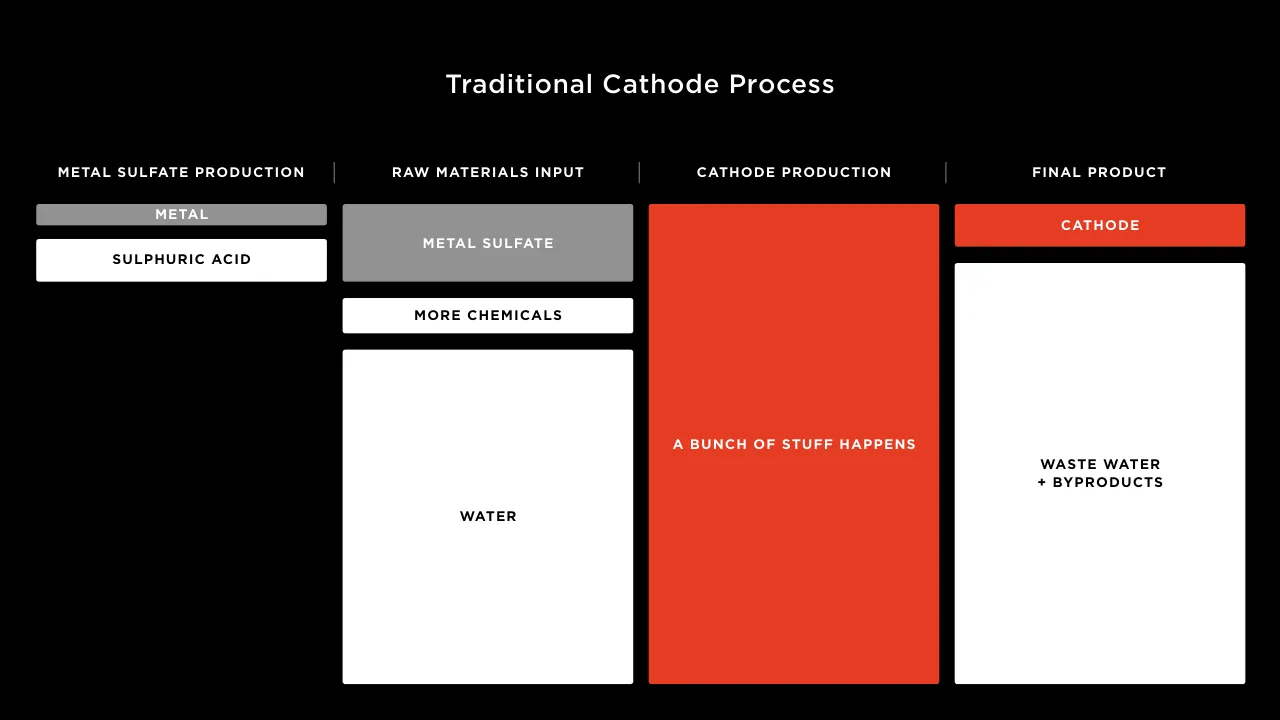
The deck makes a long technical argument easy to follow: climate framing in slides 2 to 5, two goals on slides 6 to 11, a five-part plan on slide 15, and then a repeating progress ring (slides 16, 29, 40, 45, 59, 66) that shows the running cost-per-kWh reduction and pays off in the stacked benefits on slide 67. Each page carries one idea, with one accent color, one typeface and consistent titles, and the visuals do the explaining: the cell animation on slides 17 to 22, the wet versus dry electrode comparison on slides 32 and 34, and the blocks on slides 50 and 51, where the empty space in the dry-process column makes the point. Contrast is strong on black, and the readable slides show good hierarchy and alignment. Small caption text on some diagrams (slides 6, 67) is only fit for a large screen, and a few pages carry little content beyond a photo and a stat, but this suits a live keynote with narration.
Worth keeping: Keep the progress ring and tile tracker, the single red accent against black, the animated cell build on slides 17 to 22, and the sparse before and after process diagrams on slides 50 and 51.
Most useful repair: Enlarge the tiny labels, axis text and source lines on chart and diagram slides such as 6, 10, 24 and 67, and fix the chart on slide 10, which has no value labels.
What would change the score: I would label the key values on the line charts (slides 10, 11, 68) and make the slide 67 waterfall bars carry more of the color emphasis so the totals read faster.
Confidence medium. 72 of 74 pages inspected on contact sheets, 4 at readable size. Reviewed 2026-11-08. Model-assisted review (claude-sonnet-5-5).
Full text of the slides (74 slides)
Every slide's words and a description of its charts and images, so the deck can be searched and rebuilt. Also available as Markdown.
Slide 1
TESLA / SEPTEMBER 22, 2020
Visuals: Full-bleed background illustration: a dense stipple of white and light-grey dots forming near-vertical, slightly diagonal streaks that lean right at the top and curve through the slide, like flowing particles or fibres. The streaks are brightest in the centre-left and fade into black at the edges. No overlay or tint. Centred white Tesla wordmark, the letters T, E, S, L, A in a squared geometric sans with flat horizontal cuts, spaced widely apart, spanning about x 34 to 66 percent and y 47 to 53 percent.
Slide 2
The Past 5 Years Were The 5 Hottest On Record / CO₂ CONCENTRATION (PPM) / 425 / 400 / 375 / 350 / 325 / 300 / 275 / 250 / 225 / 200 / 175 / 150 / 800 / 700 / 600 / 500 / 400 / 300 / 200 / 100 / TODAY / THOUSANDS OF YEARS AGO
Visuals: One line chart, a white time series drawn over a semi-transparent white gradient area fill, sitting on the photograph. Chart type: line/area chart. Title: none inside the chart; the slide title above serves as its headline. Y axis: CO₂ concentration (PPM), linear, range 150 to 425, gridlines and labels at 150, 175, 200, 225, 250, 275, 300, 325, 350, 375, 400, 425. X axis: thousands of years ago, reversed scale from 800 on the left to TODAY on the right, labelled 800, 700, 600, 500, 400, 300, 200, 100, TODAY. Series: one white line, values only approximate since no values are printed; about 180 to 190 ppm near 800 thousand years ago, about 250 ppm peak near 780 thousand years ago, about 170 ppm trough near 670 thousand years ago, about 280 ppm peaks near 410 thousand years ago and near 340 thousand years ago, about 280 ppm peak near 135 years ago, and a final vertical spike to about 420 ppm at TODAY that reaches the 425 gridline area. Legend: none. Highlighted points: the TODAY spike is the only highlighted point, drawn as a tall vertical line to the top of the chart. Photograph behind chart: the San Francisco–Oakland Bay Bridge tower and cables in silhouette at dusk, seen across calm water, with shoreline at right; the bridge tower sits behind the 400 tick region and the cables fan leftwards; the scene is tinted orange and dark red with a warm sky at top fading to deep maroon at bottom; lighting is backlit dusk with a sun-glow haze; framing is a wide landscape shot filling the full slide, not cropped visibly; the photo has a warm orange-to-maroon colour overlay.
Slide 3
The Trend Is Reversing But We Need To Accelerate
Wind and solar comprise 76% / of new electricity capacity in the / U.S. this year: 32 GW.
In 2010 46% of electricity in / the U.S. was generated with coal. / Today, that number is half.
SOURCE: EIA.GOV
Visuals: One photograph, an aerial drone view of a tropical coastline and a solar farm, placed as a wide boxed image with small rounded corners. Subject: on the left, dark blue ocean with white surf breaking along a rocky shoreline; the centre and left-centre are dense dark green tropical forest with palm trees; on the right a cleared brown earth site holds about 15 rows of dark blue-grey solar panels running vertically, with a light grey access road curving down the right side; at top right are more rows of panels and a small cluster of white buildings; a white outlined octagonal feature sits at the far right edge. Composition: top-down, wide crop, the panel rows lead the eye from left to right. Lighting: flat overhead daylight, dimmed by a dark overlay so the image reads at low brightness. Dominant colours: deep navy #0B2A3F for the sea, dark forest green #1F3A22, brown #4A3A2C for the earth, slate blue-grey #3E4A57 for the panels. Overlay: a black tint of roughly 40% opacity over the entire photo. The image is not cropped into a shape and is not full-bleed.
Slide 4
Tesla’s Contribution 1+ MILLION ELECTRIC / VEHICLES DELIVERED 26 BILLION ELECTRIC / MILES DRIVEN 5 GWh OF / STATIONARY BATTERIES 17 TWh OF / SOLAR GENERATED
Visuals: Four photographs in a 2x2 grid, each a rectangle with small rounded corners and full-bleed inside its frame. Top-left: a white Tesla Semi truck with grey trailer and a red Model 3, a white Model S and a dark grey Model X parked in a row on grey asphalt in front of a port with gantry cranes and containers, warm low sun and orange-tinged sky at the horizon, cropped at the top and sides, with a dark gradient darkening the left edge. Top-right: a red Model 3 in right-facing profile at speed on a road with horizontal motion blur in the background, grey-brown dusky sky, dark vignette on the left, lit from the right by warm low light. Bottom-left: a long row of white Tesla stationary battery cabinets on reddish-brown dirt with black pads, with green farmland, forested hills and a heavy grey cloud sky behind, diffuse overcast light, a Tesla wordmark visible on one cabinet, dark gradient on the left and bottom. Bottom-right: a two-storey suburban house with grey pitched roof and solar roof tiles, white garage door, warm lit windows, a grey Tesla Model S parked in the driveway with a charger on the wall beside the garage, green lawn and stepping stones, dusk light, dark gradient on the left and a subtle darkening at the bottom.
Slide 5
To achieve the transition to sustainable energy,
we must produce more affordable EVs and
Energy Storage, while building factories faster
and with far less investment
Visuals: One full-bleed monochrome texture behind the text: a dense field of fine white speckled, dithered vertical streaks that lean slightly diagonally, scattered across a black ground. The streaks are brightest and sharpest in thin lines and fade into grain toward the edges. There is no recognisable subject, no people, no logos, no charts and no overlay other than the black base.
Slide 6
Goal One: Terawatt-hour Scale Battery Production
100% ELECTRIC TRANSPORTATION REQUIRES 100X GROWTH
IN 2019
0.1
TWh
1500 GWh
3500 GWh
900 GWh
1100 GWh
3000 GWh
10
TWh
SMALL /
ROBOTAXI
COMPACT /
MIDSIZE
LUXURY
& SUV
PICKUP
TRUCK
SEMI &
COMMERCIAL
SOURCE: EV-VOLUMES.COM
Visuals: Bar chart drawn as two horizontal rows inside a dark grey panel. Row 1 is a single long grey bar labelled IN 2019 with the value 0.1 TWh at its right end. Row 2 is a segmented row of five red bars whose lengths are proportional to their GWh values: 1500 GWh (small/robotaxi), 3500 GWh (compact/midsize), 900 GWh (luxury and SUV), 1100 GWh (pickup truck), 3000 GWh (semi and commercial); the total is shown at the right as 10 TWh. Values are printed inside each red bar; no axes, scale ticks or legend are printed. Below the second row, five category labels are separated by thin vertical grey divider lines. Beneath the labels are five greyscale rendered vehicle images: a white covered shape (robotaxi, cropped by its box, soft shadow), a silver compact sedan (Model 3 style, three-quarter view facing right, soft shadow beneath), a silver crossover SUV (Model X style, side three-quarter view facing right) overlapping a grey angular pickup truck (cybertruck style, facing right, dark shadow), and a silver tractor-trailer cab (semi style, three-quarter view facing right, dark shadow). All images are cut out on the dark panel with no boxes or borders; lighting is a soft studio highlight; dominant colours are white, silver and black.
Slide 7
Goal One: Terawatt-hour Scale Battery Production
100% RENEWABLE ENERGY REQUIRES 1600X GROWTH
IN 2019
0.006
TWh
2300 GWh
1400 GWh
2100 GWh
800 GWh
1500 GWh
1900 GWh
10
TWh
NON RENEWABLE
ELECTRICITY
COAL
HEATING
GAS
HEATING
OIL
HEATING
FUTURE
EV
FUTURE
GROWTH
SOURCE: IHS
Visuals: Bar chart drawn as two rows of rectangles, with no axis or gridlines. Row 1 (top): one long grey bar titled 'IN 2019' with a thin red left edge, labelled at the right end as 0.006 TWh. Row 2: six red bars of unequal width, each with a value label inside: 2300 GWh (non renewable electricity), 1400 GWh (coal heating), 2100 GWh (gas heating), 800 GWh (oil heating), 1500 GWh (future EV), 1900 GWh (future growth). The bars are not drawn to a common scale; their widths do not follow the values. Row 2 total is labelled at the right as 10 TWh. Below the bars, six category labels sit in uppercase grey-white text, separated by five thin vertical grey divider lines. Under each label is a monochrome grey pictogram: an electricity utility pole with transformer (non renewable electricity); a shovel with a pile of coal lumps (coal heating); a pipe fitting with three flanged joints (gas heating); a steel oil drum (oil heating); a silver electric sedan in three-quarter view with a soft shadow (future EV); a white hard hat (future growth). All pictograms are greyscale photographic renders on the dark panel, with no framing or boxing. No legend and no highlighted points beyond the red bars.
Slide 8
Goal One Problem: Today’s Battery Factories Cannot Scale Fast Enough / 0.15 = / 1 / GIGAFACTORY / TWh / $2T / INVESTMENT IN MATERIALS, CELL, / AND BATTERY MANUFACTURING / 2.8M / TOTAL PEOPLE ESTIMATED
Visuals: One photograph-style illustration of a solar cell in the left panel: a rectangular monocrystalline cell with chamfered (cut) top-left, top-right, bottom-left and bottom-right corners, shown head-on, centred in the panel and not cropped. Its surface is dark navy blue (about #2A2F45 to #1E2336) with a fine grid of silver-grey busbar and finger lines and four vertical thicker dividing lines. The image is slightly soft and blurred, has an even flat front light with no visible shadows, and its edge is a light grey (about #6E6E6E) bevel. It is boxed by the cell outline, with no overlay or tint. Right panel: one thin horizontal divider line, colour about #333333, about 0.2% of slide height thick, spanning x 52.5 to 95.4% at y about 62%. No other graphics, logos or icons.
Slide 9
Goal One Problem: Today’s Battery Factories Cannot Scale Fast Enough / 20 / = / 135 / TWh / GIGAFACTORIES / $2T / INVESTMENT IN MATERIALS, CELL, / AND BATTERY MANUFACTURING / 2.8M / TOTAL PEOPLE / ESTIMATED
Visuals: Illustration: a grid of 135 identical solar-cell-style rectangles arranged in 9 columns and 15 rows inside the left panel, spanning about x 5.3% to 46.7% and y 32.9% to 90.3% of the slide. Each cell is a rounded rectangle about 3.9% wide by 2.7% high with a dark navy-grey fill (about #2A3142) showing a fine light grid of busbars, and a thin light-grey outline (about #8A8A8A, about 1 px). Cells are evenly spaced with horizontal gaps of about 0.9% and vertical gaps of about 1%, and no cell is cropped. The cell grid is flat, with no shadow, and the overlaid white numerals sit on top of cells in the middle rows. No charts, photographs or logos are present.
Slide 10
Goal Two: More Affordable Cells / $/kWh / INDUSTRY TREND / FORECAST / 0 / 2012 / 2013 / 2014 / 2015 / 2016 / 2017 / 2018 / 2019 / 2020 / 2021 / 2022 / 2023 / 2024 / 2025
Visuals: Line chart. Title: none separate from the slide title. Y-axis: $/kWh, labelled at top-left, with only the baseline value 0 printed; gridlines at equal intervals (about 11 gridlines above the baseline), no other values printed, so values are estimated: about 1.0 at 2013 peak descending. X-axis: years 2012 to 2025 printed at each tick, no unit. Series 1, INDUSTRY TREND (solid grey line, about #6B6B73, roughly 0.4% of slide height thick): starts at 2013 at a high value (about 9.5 $/kWh on the scale, the top of the curve near y 30%), falls steeply to about 2014 then flattens, passing about 2016 near the middle, reaching about 2020 at a low point and ending at 2021 (about 2.9 relative to the 0 baseline). Series 2, FORECAST (dashed white line, about #E0E0E0, dash length about 1.5% of width): continues from 2021 at the end of the solid line, declining gently to 2025 at about 2.6 on the same scale. No data labels, no highlighted points. Legend: two rounded pills, INDUSTRY TREND (grey pill) and FORECAST (light grey pill).
Slide 11
Goal Two Problem: EV Market Share Is Growing / But EVs Still Aren’t Accessible To All / EV MARKET SHARE / 2.0% / 1.8% / 1.6% / 1.4% / 1.2% / 1.0% / 0.8% / 0.6% / 0.4% / 0.2% / 0.0% / 2009 / 2010 / 2011 / 2012 / 2013 / 2014 / 2015 / 2016 / 2017 / 2018 / 2019 / SOURCE: EV-VOLUMES.COM / OICA
Visuals: Chart: filled line chart with an area fill, titled by the red pill label 'EV MARKET SHARE'. Y axis is percent of market share, labelled 0.0% to 2.0% in 0.2 steps, with horizontal gridlines at each step. X axis is years, labelled 2009 to 2019 at one-year intervals. Series 'EV market share' is a single red line (about #E8392A, roughly 0.6 of the slide's line weight in the image) with a gradient area fill beneath it, from about #521410 near the line to black at the baseline. Printed values: none; the values below are estimates. About 0.02% in 2009, about 0.03% in 2010, about 0.06% in 2011, about 0.07% in 2012, about 0.11% in 2013, about 0.22% in 2014, about 0.27% in 2015, about 0.49% in 2016, about 0.90% in 2017, about 1.48% in 2018, about 1.85% in 2019. Legend: none; the red pill labelled 'EV MARKET SHARE' serves as the series label. Highlighted points: none; the line ends at the 2019 point, which is the last value and is not marked. The gridlines are thin grey (about #2A2A2A), and the area fill stops at the 2019 vertical.
Slide 12
To Make The Best Cars In The World,
We Design Vehicles And Factories From The Ground Up
Visuals: One photograph, a wide landscape band of an automotive body-welding cell. Subject: several orange KUKA industrial robot arms with grey and silver welding and clamping tooling, blue and green cable harnesses, and a partly assembled silver car body frame in the centre. Action: the robots are working on the body, with a shower of bright white weld sparks rising in the upper centre and right. Composition: a horizontal band, shown as a wide crop, with robots framing the left and right edges and the body in the middle. Lighting: bright, even factory light with cool highlights on the metal. Dominant colours: orange #E8561F, silver-grey #B8BCC2, black #101010, blue #1F4FA3. The photo is boxed, not full-bleed, with small rounded corners and no overlay or tint. A KUKA logo is visible on several robot arms, and a grey KUKA controller box is at lower left.
Slide 13
And Now We Do This For Batteries As Well
Slide 14
BATTERY DAY
Visuals: Full-bleed monochrome photograph-like texture of diagonal streaks: many fine, grainy white and light-grey particle streaks running from lower left to upper right at a steep angle, fading into black, resembling a dithered or stippled flow field. Streaks are densest in the middle and lower half and sparse at the top edge. Composition is full-bleed with no border, no crop of the lockup, and no overlay other than the image itself. Lighting is uniform, no shading. Dominant colours are black #000000 with white #FFFFFF and light grey streaks. One logo: the Tesla T mark (white, about 4.5% of slide width, sitting at left of the lockup, roughly x 32.5 to 35.8, y 26.5 to 29.5) followed by the wordmark BATTERY DAY.
Slide 15
We Have A Plan To Halve The Cost Per KWh / CELL DESIGN / CELL FACTORY / ANODE MATERIALS / CATHODE / MATERIALS / CELL VEHICLE / INTEGRATION
Visuals: Five greyscale product-style images, one inside each card, all centred horizontally in their cards and placed above the card label. Top row, left to right: a single upright silver cylindrical battery cell; a rectangular silver-grey cell factory unit holding two tiers of cylindrical cells on a grey base plate; a dark silver lumpy anode material chunk. Bottom row, left to right: a grey granular spherical cathode material ball with a rough, textured surface; a silver-grey vehicle body frame with a battery tray and grid structure beneath it, shown at an angle. Each image is a transparent cut-out on the grey card with no border or shadow. Lighting is soft studio lighting from above, and the palette is silver, grey and black.
Slide 16
CELL DESIGN
CELL FACTORY
ANODE MATERIALS
CATHODE MATERIALS
CELL VEHICLE INTEGRATION
Visuals: Five small photographic images, one per tile, each on a dark background: (1) a silver metallic cylindrical battery cell, standing upright, photographed in front view with soft studio lighting and a bright highlight on its shiny body, shown in greyscale; (2) a cell-factory assembly machine, a grey, boxy multi-part industrial unit with cylindrical stacks and connectors on top, in greyscale and dimly lit; (3) an irregular, crumpled dark-grey anode-material lump, greyscale, dim lighting; (4) a dark-grey, matte, granular sphere representing cathode material, greyscale, dim lighting; (5) a grey wireframe-like car body frame, a vehicle chassis and roll-cage structure with a floor-pan element, greyscale, dim lighting. All photographs are cut out with no visible boxes and sit within their tiles. A decorative open ring made of about eight separate dark-grey rounded arc segments with gaps forms a circle on the left, with no text or fill inside it.
Slide 17
CAP
CAN
Visuals: Photograph of a single upright cylindrical lithium-ion style battery cell (18650 format) standing on a dark textured surface, viewed straight on at eye level, slightly above the base. The cell is a dark grey metal can with a rolled, ringed top cap, a small raised central vent/terminal visible on top, and a soft shadow falling to the right of its base. Lighting is soft and low-key from the front-left, producing gentle highlights on the cap rim and a subtle sheen on the can. Dominant colours are near-black background and charcoal grey metal. The image is full-bleed, not cropped, with no overlay or tint. Two callouts: a white thin line (about 0.2% of slide height) runs horizontally from the top rim of the cap at about x 55%, y 24% to a label 'CAP' at about x 71%, y 25%; a second white thin line runs horizontally from the left edge of the can at about x 50%, y 46% leftward to a label 'CAN' at about x 26%, y 46%. Both labels are white uppercase geometric sans-serif (Futura/Century Gothic-like), medium weight, letter-spaced slightly.
Slide 18
TAB
JELLYROLL
Visuals: Photograph of a cylindrical lithium-ion battery cell standing upright, shown in close-up against a black background. The upper part is a light blue cylindrical wrapper (the jellyroll section) with a white-grey crimped rim at the top; a thin silver-and-gold foil tab protrudes upward from the top centre. The lower part is a brushed silver metal can extending down to the bottom edge of the frame. Lighting is soft and directional from the front, producing highlights on the metal can and the blue wrapper. Composition is centred, with the cell cropped at the bottom edge of the frame; the photograph is full-bleed. No overlay or tint other than the black background. Two white callout leader lines: one horizontal line from about x 56% to x 66.5% at y 21.5% pointing from the TAB label to the tab, and one horizontal line from about x 32.5% to x 43.2% at y 38.3% pointing from the JELLYROLL label to the blue wrapper.
Slide 19
Visuals: One photograph, full-bleed, uncropped at the edges. Subject: a white cylindrical battery cell lying horizontally, with a bent gold-yellow insulating tab and a bent silver metal tab protruding from its left end. Below the cell, a flat grey electrode or separator foil unrolls from beneath it and curves down toward the bottom edge of the frame. Composition: a close, low, side-on view with the cell in the upper-middle band and the foil filling the lower half. Lighting: soft studio light from the front and above, with a soft highlight along the cell's top and a gentle gradient shadow beneath it. Dominant colours: black background, light grey cell about #C9CED3, mid grey foil about #6E747A, gold tab about #D6A23A. Not boxed, not tinted, no overlay.
Slide 20
+ / − / CATHODE / SEPARATOR / ANODE
Visuals: Full-bleed photograph of a cylindrical battery cell cut away to show its layers, lying on dark charcoal fabric. The cell is seen from the side at eye level, slightly low, centred horizontally, filling about 38% of the slide width. The cylinder's outer casing is pale silver-grey with a white highlight along the top. A cutaway band shows the layers: a mid-grey cathode band, a white rolled separator strip beneath it, and a tan-gold anode sheet at the bottom. A flat silver tab with a gold tip extends left from the cell (positive end, marked +), and a flat silver tab extends right (negative end, marked −). Lighting is soft studio light from above and front, leaving the background in deep shadow. Dominant colours: black, charcoal, silver-grey, gold. The image is not cropped and has no overlay or tint other than the drawn gold icon and labels. A flat gold battery-level icon of eight stacked cells, with a white terminal cap on top and white cell dividers, sits to the left of the cell at about 12% x and 46% y. Gold plus and minus symbols mark the two terminals. Three white thin leader lines run from the labels to the layers: CATHODE line to the cathode band, SEPARATOR line to the separator strip, ANODE line to the anode sheet.
Slide 21
DISCHARGE
+
Li+ (about 28 labels)
CATHODE
SEPARATOR
ANODE
−
Visuals: Photograph-style 3D render of a cylindrical lithium battery cell in cutaway, lying horizontally on a dark charcoal fabric surface, full-bleed. The cell has a light grey metal can at the top, a grey cathode band across the middle filled with about 28 yellow 'Li+' ion discs, a pale grey separator sheet below it, and a tan/gold anode strip along the base. A silver positive tab with a gold section projects from the left end, marked '+' in gold; a silver negative tab projects from the right end, marked '−' in gold. A thin white circuit line runs from the positive tab up, across the top and down to the negative tab, with a row of about seven small glowing yellow dots along the top segment and about four along the right descending segment, indicating electron flow. Left of the cell is a vertical battery-level icon labelled DISCHARGE: a white outlined rectangle with a small cap on top, divided into seven segments, the bottom five segments filled yellow and the top two black. Lighting is a soft spotlight from above and front, with dark vignetting; dominant colours are black, charcoal grey, silver, gold and yellow. The image is full-bleed, not cropped or boxed, with no tint overlay beyond the darkening of the background.
Slide 22
CHARGING / ANODE / CATHODE / SEPARATOR / Li+ (repeated about 31 times as ion markers on the anode and separator)
Visuals: Illustration of a cutaway cylindrical lithium-ion cell lying on its side on a dark textured surface. The cell body is a silver-grey cylinder with a lighter grey cathode band and a pale grey separator sheet at the lower edge. At the bottom, a bronze-gold anode sheet is covered with about 31 yellow glowing circular Li+ ion markers, each with the text Li+ inside. A thin white outline wire loops from the positive tab on the left (a silver tab with a gold end, marked by a gold plus sign) up to the top, across to the right and down to the negative silver tab on the right (marked by a gold minus sign). About 20 small glowing yellow dots run along this wire to show electron flow, and the dots are denser at the bends. On the left, a battery icon with a white outline has a small white terminal cap on top and six horizontal cells: the top three are black and the bottom five are filled gold. Three thin white leader lines point to CATHODE (to the grey band), SEPARATOR (to the pale sheet) and ANODE (to the bronze sheet). Composition is a horizontal eye-level shot, centred, with the cell occupying about the middle third of the frame. Lighting is soft and studio-like from above, with the black fabric background falling into deep shadow. Dominant colours are black, charcoal grey, silver, gold and bronze. The photograph is full-bleed with no crop, border or frame, and no tint overlay other than the darkening vignette.
Slide 23
1865
+50%
ENERGY
EVOLUTION
2008
2170
2017
Visuals: Two photographic renderings of cylindrical metal battery cells, standing upright, same scale, placed side by side. Left cell: labelled 1865 above and 2008 below, a silver-grey metallic cylinder with a flat domed top cap, slightly shorter than the right cell, lit from the left with a bright specular highlight on the cap. Right cell: labelled 2170 above and 2017 below, a larger silver-grey cylinder with a rounded top cap, lit from the upper left with soft gradient shading to dark grey on the right edge. Between them a thin light-grey (#929292) horizontal line with an open arrowhead pointing right, running from just right of the left cell to just left of the right cell at about mid-height of the cells. Above the arrow, centred: '+50%' with 'ENERGY' beneath it. Below the arrow, centred: 'EVOLUTION'. No chart, table or logo.
Slide 24
Bigger Cylindrical Cells Cost Less
IMPROVEMENT
NEW CELL
VEHICLE RANGE
COST REDUCTION
20%
15%
10%
5%
0%
21
26
31
36
41
46
51
56
61
CELL OUTER DIAMETER
MM
Visuals: Line chart with two series on a black background. Title: none inside the chart; the slide title Bigger Cylindrical Cells Cost Less serves as the heading. Y axis: IMPROVEMENT, 0% to 20%, gridlines and labels at 0%, 5%, 10%, 15% and 20%. X axis: CELL OUTER DIAMETER (MM), 21 to 61 mm, labelled every 5 mm (21, 26, 31, 36, 41, 46, 51, 56, 61). Series 1, COST REDUCTION, red line: about 0% at 21 mm, about 5.5% at 24 mm, about 9% at 27 mm, about 11.7% at 30 mm, about 13.6% at 33 mm, about 15.2% at 36 mm, about 16.5% at 39 mm, about 18.1% at 46 mm, about 19.0% at 51 mm, about 19.5% at 56 mm, about 19.4% at 61 mm; values are estimates because no values are printed. Series 2, VEHICLE RANGE, orange line: about 0% at 21 mm, about 1.4% at 24 mm, about 2.6% at 27 mm, about 3.7% at 30 mm, about 4.7% at 33 mm, about 5.5% at 36 mm, about 6.0% at 39 mm, about 6.7% at 46 mm, about 6.8% at 49 mm, about 6.7% at 51 mm, about 6.0% at 56 mm, about 5.7% at 61 mm; values are estimates. Both lines are smooth-ish polylines of about 4 px stroke width, the red line in #E63B24 and the orange line in #E8A04C. Legend: three pill-shaped labels, NEW CELL in grey, VEHICLE RANGE in orange, COST REDUCTION in red, each with white letter-spaced caps text. Highlighted point: a vertical grey reference line at 46 mm, the NEW CELL marker, running from the pill down to the 0% baseline, with the red and orange lines crossing it at about 18% and about 6.7%. Gridlines: thin dark grey horizontal lines at each 5% step.
Slide 25
SUPERCHARGE TIME INCREASE
The Challenge With Big Cells Is Supercharging
NEW CELL
CHARGE TIME (1 TAB)
0
21
26
31
36
41
46
51
56
61
CELL OUTER DIAMETER MM
Visuals: Line chart with a single curved series and no legend. Title: The Challenge With Big Cells Is Supercharging. Y-axis: titled SUPERCHARGE TIME INCREASE, no units and no numeric tick labels; only a zero label is printed at the baseline; five horizontal gridlines are evenly spaced above the baseline with no values printed (values about 0, 20, 40, 60, 80, 100 of the unlabelled scale are not printed, so none are stated). X-axis: CELL OUTER DIAMETER in MM, labelled ticks 21, 26, 31, 36, 41, 46, 51, 56, 61, with the axis running from about 21 to about 61. Series CHARGE TIME (1 TAB): a red curve starting at about x=21 at the baseline (about 0), rising slowly to about 26 then increasingly steeply; about 0.46 of the gridline span at x=46 (estimated, no value printed); ending at about x=57.5 at about 0.92 of the top gridline span (estimated, no value printed). The curve is a smooth convex (accelerating) line about 4 px thick. Highlighted point: a vertical grey reference line at x=46 marked by a grey pill label NEW CELL at the top, crossing the curve at about 0.46 of the span. The curve end is labelled CHARGE TIME (1 TAB) in red text to its right.
Slide 26
The Challenge With Big Cells Is Supercharging
NEW CELL
SUPERCHARGE TIME INCREASE
0
21 / 26 / 31 / 36 / 41 / 46 / 51 / 56 / 61
CHARGE TIME (1 TAB)
CHARGE TIME (TABLESS)
CELL OUTER DIAMETER MM
Visuals: Line chart. Title: none separate beyond the slide headline. X-axis: CELL OUTER DIAMETER (MM), ticks labelled 21, 26, 31, 36, 41, 46, 51, 56, 61 mm, plotted from about 21 to about 59 mm. Y-axis: SUPERCHARGE TIME INCREASE, unitless, labelled only with 0 at the baseline; no other values printed; gridlines at five evenly spaced heights above baseline. Series 1: CHARGE TIME (1 TAB), dotted dark-red line rising from near zero at about 22 mm, curving upward steeply to about 80 percent of the top gridline height at about 58 mm; value at 46 mm about 35 percent of the top gridline height (estimate, no value printed). Series 2: CHARGE TIME (TABLESS), solid bright red line, thick, nearly flat at the baseline from 21 to about 40 mm, rising gently to about 4 percent of plot height at about 58 mm (estimate, no value printed). Legend: none as a box; series identified by red end labels at the line ends. Highlighted point: vertical grey line at 46 mm from baseline to the NEW CELL pill, which overlaps the red tabless line at its crossing.
Slide 27
SIMPLER MANUFACTURING
FEWER PARTS
5X REDUCTION IN ELECTRICAL PATH
Visuals: One photograph: a copper coil or winding viewed straight on from one end, forming a circle. Its outer ring is a band of wide, curved copper segments separated by thin dark red-brown gaps, and the band tapers inward. Inside it, many thousands of thin copper bars lie in concentric rings that spiral toward a small central bore. The bore is a dark round opening with a black interior and a thin silver-grey rim with a faint highlight on its lower-left edge. The subject is centred with a small margin on all sides, shown full frame and not cropped, with no overlay or tint. Lighting is a warm front light with specular highlights on the copper, and the dominant colours are copper about #B87355, dark copper about #5A3428 and black #000000. The photograph is unboxed and sits directly on the black background.
Slide 28
5X / ENERGY / +16% / RANGE / 6X / POWER / 80 MM / 46 MM
Visuals: Photograph of a single cylindrical lithium-ion battery cell, standing upright and viewed slightly from above, with a crimped silver lid and a small raised vent at the top. The cell is brushed stainless or aluminium silver with vertical specular highlights, lit from the upper left, and it fades to black at the base. Its black surround blends into the slide background, so the photo reads as unboxed. Dimension annotations are thin grey (#929292) lines: a vertical line at about x 35.6% from y 11.4% to 79.7% with short end ticks, labelled '80 MM' rotated 90 degrees to read bottom-to-top; and a horizontal bracket at about y 88.8% from x 40.8% to 59.2% with upward end ticks, labelled '46 MM' beneath. Statistics are typeset numerals with no chart, icon, or logo.
Slide 29
14%
$/KWH REDUCTION
14%
CELL FACTORY
ANODE MATERIALS
CATHODE
MATERIALS
CELL VEHICLE
INTEGRATION
Visuals: Chart: a circular progress ring (gauge). Type: donut/arc gauge. Title: none printed. Value: 14% printed in the centre, with the unit label '$/KWH REDUCTION' below it. The ring is a full circle drawn as a dark grey track (about #333333, roughly 1.3% of slide width stroke, round caps) with a white arc (#FFFFFF, same stroke width, round caps) overlaying the top segment from about 10 o'clock to about 2 o'clock. The track has a gap at the bottom between about 5 and 6 o'clock. No axes, legend or scale values are shown. Visual group: five cards, each a rounded rectangle with a small photograph and a label. Card 1 (dark #242424): a photographed cylindrical battery cell, dark grey metal, upright, centred, with the label '14%' in white bold below. Card 2 (light grey #D5D5D5, the only highlighted card): a photograph of a cell factory, a grey-silver stack of cylindrical cells with metal terminals on a square base, shown in full colour-neutral greyscale, with label 'CELL FACTORY' in black bold below. Card 3 (dark #242424): a greyscale photograph of an irregular dark grey anode material lump, label 'ANODE MATERIALS' below. Card 4 (dark #242424): a greyscale sphere with a grainy textured surface, label 'CATHODE / MATERIALS' below. Card 5 (dark #242424): a greyscale line drawing style photograph of a vehicle body frame cell-integration structure, label 'CELL VEHICLE / INTEGRATION' below. All photographs are isolated on their cards with no crop, lit from above with soft even lighting, neutral grey tones, no overlay. The inactive cards' images and labels appear dimmed.
Slide 30
Inspiration / PRINTING / BOTTLING
Visuals: Two photographs side by side, both boxed with small rounded corners. Left photograph: PRINTING. Subject: a curved, looping overhead conveyor or track inside a warehouse-like industrial hall, carrying a long chain of white-and-grey paper or print-sheet products draped over a series of parallel steel rods that arc around a bend. Behind it is a corrugated metal roof with exposed white steel beams and diagonal bracing, with daylight visible at the lower left. Composition: wide landscape frame, camera looking up at the structure from below, the loop running diagonally from upper centre to lower left. Lighting: natural daylight from openings in the roof, with low-contrast grey shadows. Dominant colours: grey, off-white, rust brown, steel grey. Not cropped. Right photograph: BOTTLING. Subject: a close, side-on view of a bottling line machine with a row of dark glass bottles standing in a line on a rotating star-wheel, a green guide rail curving beneath them, and stainless-steel filling and capping heads above. Composition: landscape frame, horizontal bands of machinery, bottles in the mid-lower third, machinery filling the top. Lighting: even indoor light with soft highlights on the steel. Dominant colours: charcoal and black, steel grey, bottle-green rails. Not cropped apart from the frame edges.
Slide 31
ELECTRODE
WINDING
ASSEMBLY
FORMATION
Visuals: Four photographs in a horizontal row, each boxed with small rounded corners and identical size (about 22.8% by 32.3% of the slide). 1) ELECTRODE: close-up of a dark metallic triangular-profile electrode coating roller or foil on a bar, with a bright specular highlight across its centre, lit from above, dark grey and mauve-brown tones, tight framing, cropped at edges. 2) WINDING: close-up of a white cylindrical wound electrode roll on a winding spindle held by metal clamps and a white curved tube, black background, cool silver and white highlights, shallow depth of field, cropped. 3) ASSEMBLY: close-up of a silver metal cylindrical cell held under a press head in a machine, blurred background of steel columns, muted grey-green and brown tones, soft lighting, cropped. 4) FORMATION: close-up of a row of cylindrical cells in a grey plastic tray under a white bar with green indicator lights and a red machine part at top right, neutral grey and white with small green highlights, cropped. Below each photo a thin light-grey (#A0A0A0) horizontal line with an open arrowhead pointing right, spanning the photo width, stroke about 1 px.
Slide 32
Electrode – Wet Process / 1 / MIX / 2 & 3 / COAT & DRY / SOLVENT RECOVERY / 4 / COMPRESS
Visuals: Grey-white 3D rendered industrial equipment drawings on black, shown in elevation with no shading gradient. Top row: five identical mixer units with vertical agitator shafts and tanks, each with a small human figure for scale at the left. Middle: a long coating and drying line with a tall enclosed housing, a walkway and a stepped end section, with a small human figure for scale at the left. Upper right: a solvent recovery plant with four large cylindrical storage tanks, a tall lattice tower with a rounded top, and a rectangular base on a light grey ground plane. Right middle: two smaller horizontal exhaust or dryer units stacked. Lower middle: a second long coating and drying line identical in form to the middle one, with a human figure for scale. Bottom left: six compressor units in two rows of three, each a motor-and-pump package on a skid. No chart, table, or labelled values are shown.
Slide 33
Powder Into Film / LAB SCALE POWDER INTO FILM
Visuals: One photograph, a wide landscape frame (about 1279 by 378 pixels, roughly 3.4:1). Subject: a dark, rough, granular mound-like surface of clumped powder or agglomerate filling the lower third, with a heavy field of falling vertical streaks of particles or rain-like lines across the upper two-thirds, and a small dark droplet-like form hanging in the middle right. Lighting: diffuse bright haze with soft white light patches on the left and centre-right, against a dark background at the far right. Dominant colours: near-black, charcoal grey, muted olive-grey and pale grey-white highlights. The photo is full-width inside its box, not cropped to a circle, with rounded corners of about 0.5% of slide width and a faint dark vignette at the edges. A small white caption 'LAB SCALE POWDER INTO FILM' is overlaid near the bottom centre of the image.
Slide 34
Dry Electrode
1
MIX
FOOTPRINT REDUCTION
10x
ENERGY REDUCTION
10x
2
DRY COAT
Visuals: Two small grey-scale images of mixing machines (industrial batch mixers with motors on top, the pair side by side) next to a tiny standing human silhouette for scale at the MIX step, at about x 14 to 24%, y 21 to 27%. At the DRY COAT step a long grey-scale industrial coating line (a horizontal machine train with a drive housing, rollers and a boxed cabinet at the right end) sits on a flat base, at about x 17 to 32%, y 83 to 88%, with a tiny human silhouette for scale at about x 16%. A thin grey vertical line with a downward arrowhead runs from about x 3.5%, y 19.5% to y 77.5%, connecting the two steps. Right panel is a rounded dark grey box holding two large white numerals '10x' each with a grey caption beneath; no charts. Images are unboxed, set on black, monochrome white-grey renderings with no tint.
Slide 35
Simple is Hard / BENCH / LAB / PILOT
Visuals: Three photographs of industrial roll-to-roll equipment, each boxed with slightly rounded corners and no overlay. Left photo (BENCH): a close view of a polished steel roller in the foreground with a dark spoon-like tool dipping into a dark viscous material on the roller surface; behind it a person in a red top and blue nitrile gloves, with a blue and white safety sign at the left edge. Middle photo (LAB): a grey-silver machine frame with a black carriage and small wheeled mechanism bridging a steel roller; a dark grey sheet or film is fed diagonally across the roller toward the lower left; dark background. Right photo (PILOT): a long receding row of large polished silver rollers in a multi-stand production line, with white and grey machine housings and bolted end plates on each side, bright white room behind; the foreground roller shows a thin band of coloured wires or strips. Lighting is soft and even in the pilot shot, warm highlights on the steel in the bench shot, and dim mixed light in the lab shot. Dominant colours: silver, grey, black, with red in the bench photo and white in the pilot photo. None of the photographs is cropped beyond rectangular framing.
Slide 36
High-Speed Continuous Motion Assembly
1
ASSEMBLY LINE
20
GWh
7x
LINE OUTPUT
Visuals: A wide photograph of an automated high-speed continuous motion assembly machine: a rotating circular indexing table carrying cylindrical metal cans or cells in pockets, a white mounting plate with three rows of small round holes at upper left, a vertical white support column and tool heads with green and grey hoses at upper right, and a dark machined base in the foreground. Composition is a landscape crop with the machine running across the full width and the camera at a low three-quarter angle. Lighting is flat, neutral and cool, with dark grey and black shadows. Dominant colours are greyscale: charcoal #2A2A2A, mid grey #6B6B6B, light grey #B8B8B8 and white highlights. The photo is boxed with slightly rounded corners and is darkened by a black overlay at 50% opacity, which reduces its brightness so the white numerals read clearly.
Slide 37
Tesla Power Electronics / -86% / FORMATION INVESTMENT / -75% / FORMATION FOOTPRINT / TESLA POWER ELECTRONICS
Visuals: One photograph of an industrial battery/power-electronics production line, shown as a wide rectangular band (x 2.7%, y 28.2%, w 94.6%, h 49.7%, 1814 by 536 px) with slightly rounded corners. Subject: orange-red safety railings and platforms on lifts or work cages in front of white-grey racked cabinets and shelving with many small modular units; cables, pipes and white electrical enclosures are visible at lower left. Composition is a wide, slightly elevated view with the platforms in the centre. Lighting is flat, even industrial light. Dominant colours are orange-red, white and grey. The photo is boxed, not full-bleed, and carries a black overlay at 50% opacity that darkens it. No chart, logo or icon.
Slide 38
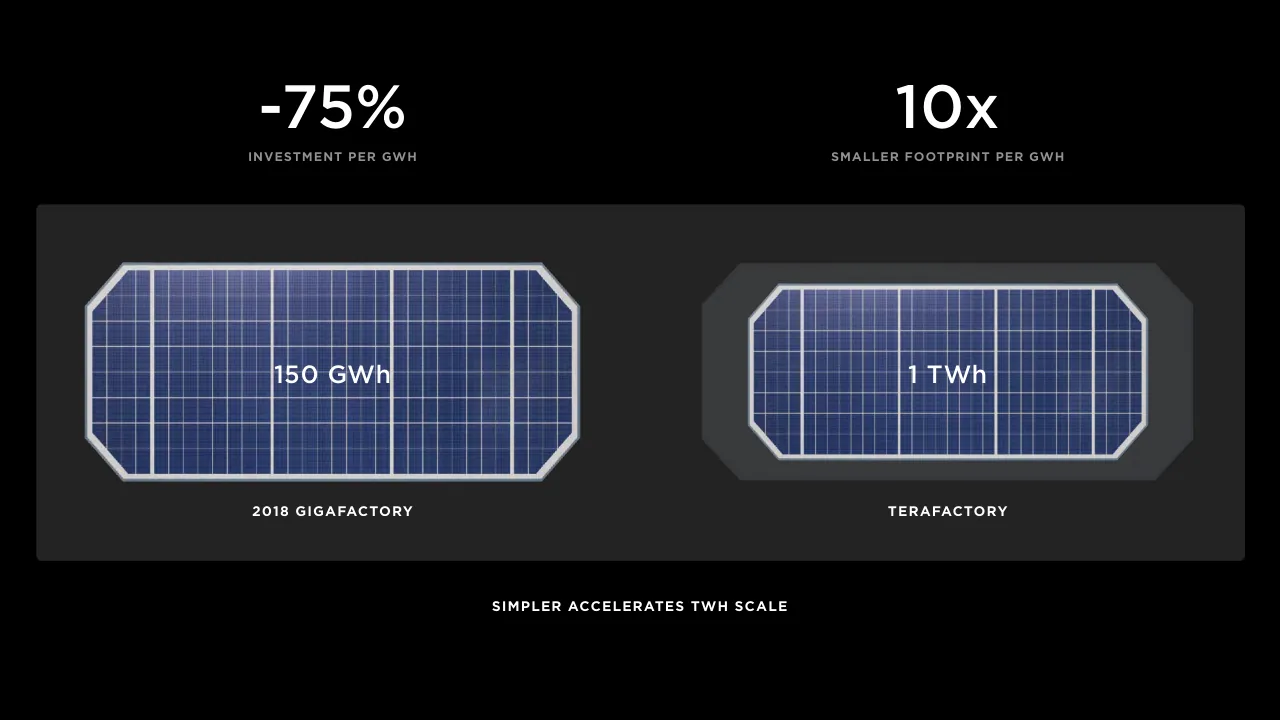
-75% / INVESTMENT PER GWH / 10x / SMALLER FOOTPRINT PER GWH / 150 GWh / 1 TWh / 2018 GIGAFACTORY / TERAFACTORY / SIMPLER ACCELERATES TWH SCALE
Visuals: Two chamfered-rectangle images, each a photograph-style illustration of a solar cell or module. Left: the 2018 Gigafactory cell, a full wide octagon-cornered panel of dark-blue polycrystalline cells (about #2A3F7A) with fine light-grey grid lines and thicker silver-grey (#D0D0D0) busbars forming four vertical divisions, lit evenly from the front, shown whole and not cropped, with the label '150 GWh' printed over its centre in white. Right: the Terafactory cell, the same octagon-cornered form drawn smaller, sitting on a lighter dark-grey (#3A3A3A) chamfered halo that is wider than the cell itself, with the same dark-blue cells and silver busbars divided into four sections, and the label '1 TWh' printed over its centre in white. The two statistics above are typographic only, with no chart, icon or logo.
Slide 39
The Plan / 100 GWh / IN 2022 / 3 TWh / BY 2030
Slide 40
32%
$/KWH REDUCTION
14%
18%
ANODE MATERIALS
CATHODE
MATERIALS
CELL VEHICLE
INTEGRATION
Visuals: Donut-style progress ring, about 32.7% of slide width and 58% of slide height, centred at roughly x 24%, y 50%. The ring is drawn as a thick round-capped arc (stroke about 1.2% of slide height) in two parts: a white arc (#FFFFFF) covering roughly the top and right side, from about 10 o'clock to about 4 o'clock, and a dark grey track (#333333) covering the remaining left and bottom portion, with a gap at the bottom centre. The white arc marks 32% of the ring. Centre of ring: the large figure '32%' and the caption '$/KWH REDUCTION'. Five tiles, each a rounded-corner rectangle with a photograph and a label: (1) battery cell, a grey cylindrical lithium-ion cell in a vertical orientation, dark grey to black metallic shading, label '14%'; (2) battery module, a dark grey mechanical assembly with cell-holder frame and terminals, label '18%'; (3) anode materials, a lumpy, shiny black-and-silver graphite-like rock fragment with light highlights, label 'ANODE MATERIALS'; (4) cathode materials, a dark grey granular spherical powder ball with a textured surface, label 'CATHODE MATERIALS'; (5) cell vehicle integration, a grey wireframe-like vehicle body structure with a floor pack, label 'CELL VEHICLE INTEGRATION'. Photographs are monochrome, lit from above with soft highlights, on flat backgrounds, not cropped, not full-bleed; each sits inside its tile. Tile 3 is the only highlighted tile.
Slide 41
Silicon Is Awesome And Inexpensive
MOST ABUNDANT ELEMENT IN EARTH’S CRUST AFTER OXYGEN
STORES 9X MORE LITHIUM THAN GRAPHITE
Visuals: One photograph, full colour not present; it is a greyscale close-up of a heap of metallic silicon lumps filling a rectangular box spanning x 2.8% to 97.2% and y 28.3% to 77.9% of the slide, pixel size 1813 by 536. Subject: angular, rough-surfaced silver-grey lumps of silicon piled loosely and seen from above and slightly in front, with bright specular highlights on their upper faces and dark shadowed gaps between them. Composition: edge-to-edge tiling filling the box, cropped by the box edges on all sides, no focal point, no people or text. Lighting: even, diffuse studio light with bright highlights and deep crevice shadows. Dominant colours: silver-grey #8C9096 with highlights near #D8DCE0 and shadows near #1E2024. The box has slightly rounded corners of about 0.3% of slide width and no border or shadow. No overlay or tint.
Slide 42
Challenge: Volume Expansion / 4X VOLUME EXPANSION / MANY CYCLES / MANY CYCLES / ELECTRICAL / ISOLATION / SEI LAYER / -Li+ / BROKEN / SEI LAYER / MANY CYCLES / THICK / SEI LAYER
Visuals: Three three-step particle diagrams, one per panel, drawn in soft grey-blue 3D render style. Left panel: a smooth sphere at the top, a downward arrow labelled 4X VOLUME EXPANSION to its right, then a downward arrow labelled MANY CYCLES on the left, leading to a sphere whose shell is cracked into shards at the middle, then a downward arrow leading to a fragmented, shard-covered sphere at the bottom. Middle panel: a flat grey-blue plate densely covered in small spheres at the top, a downward arrow labelled MANY CYCLES, then a plate where many spheres have scattered and separated into loose clusters at the bottom, with a thin-outlined circle around a few isolated spheres and a leader line from the circle down-right to the label ELECTRICAL ISOLATION. Right panel: a cluster of five to six spheres each with a thin grey shell at the top, a downward arrow labelled -Li+, a cluster of spheres with dashed, broken outer shells in the middle, a downward arrow labelled MANY CYCLES, and a cluster of spheres sitting inside a thick smooth dark-grey blob at the bottom, labelled THICK SEI LAYER. Illustrations are full-colour renders with soft studio lighting from upper left, shown unboxed against the panel fill, with no cropping. Dominant colours are light blue-grey #C5CAD6 for the spheres and mid grey #6B6B6B for the shells and plate.
Slide 43
Current Approaches To Silicon Are Highly
Engineered Expensive Materials
SILICON STRUCTURED
IN SIO GLASS
6.6 $/KWh
SILICON STRUCTURED
IN GRAPHITE
10.2 $/KWh
SILICON
NANOWIRES
>100 $/KWh
TESLA
SILICON
1.2 $/KWh
Visuals: Four square grayscale microscopy and electron-microscope images, each boxed with small rounded corners and no overlay, arranged left to right in the panels. (1) Silicon structured in SiO glass: a transmission electron micrograph with a dark curved carbon shell running from top-left down to bottom-right, a dotted white line tracing the shell edge, grey granular matrix, a label 'SiOx matrix' at top centre, dashed white ellipses around crystalline lattice patches, white arrows pointing to a label 'Si', and a label 'Carbon shell' with an arrow pointing to the shell edge at lower left. (2) Silicon structured in graphite: a dark porous network of particles on a light grey ground, with a lighter inset rectangle in the upper right showing a grey particle, and a small red dashed circle near the bottom edge around one particle. (3) Silicon nanowires: a scanning electron micrograph of dense upright grey wire-like columns seen from the side, filling the square with light and shadow variation. (4) Tesla silicon: a grey electron micrograph of an irregular fragment with a dark rim along its edge, a smooth mid-grey interior and a few light streaks, against a light grey background at the top left. No charts, tables, logos or icons.
Slide 44
Instead, We Design For Expansion And Use / Raw Silicon To Increase Range 20% / RAW METALLURGICAL SILICON / STABILIZE SURFACE / THROUGH ELASTIC, / ION-CONDUCTING POLYMER COATING / ROBUST NETWORK / HIGHLY ELASTIC BINDER / + ELECTRODE DESIGN
Visuals: Three-part left-to-right process diagram. (1) Photograph of a raw metallurgical silicon lump: a chunky, irregular, glossy silver-grey fragment with sharp facets and specular highlights, shown in black-and-white, full-colour-free, placed on the dark panel with no crop or overlay. (2) Vertical stack of three stages connected by thin light-grey downward arrows: top row shows three teardrop-shaped dark translucent droplets each containing four small pale blue-grey angular silicon particles, plus one more droplet below in the centre; middle row shows about nine smaller droplets arranged in two staggered rows (four on top, five below) each containing a pale blue-grey particle; bottom row shows about seven dark grey circular coated particles with pale blue-grey cores, arranged in a row of four above a row of three. (3) Illustration of a robust network: grey rounded blobby particles of varying size scattered in a horizontal band, linked by thin dark blue curved lines acting as binder strands, with a few small grey specks. Light grey (#9A9A9A approx.) horizontal arrows with open arrowheads sit between the first and second columns and between the second and third columns, pointing right.
Slide 45
37% / $/KWH REDUCTION / 14% / 18% / 5% / CATHODE / MATERIALS / CELL VEHICLE / INTEGRATION
Visuals: Circular progress ring (shape): a thick, round-capped arc stroke forming a broken circle, about 1.3 percent of slide width in stroke width. Three bright white arc segments run clockwise from the upper-left gap across the top, down the right side and into the lower-right; two dark grey (#333333) track segments fill the left side and the lower-left, leaving gaps at the upper-left, lower-right and bottom. The ring encloses the figure 37% and its caption. Five cards: (1) top-left card, dark grey #242424, with a greyscale battery cell cylinder above the figure 14%; (2) top-middle card, #242424, with a greyscale battery module assembly with four protruding terminals above 18%; (3) top-right card, #242424, with a dark crumpled, foil-like lump above 5%; (4) bottom-left card, light grey #D5D5D5, with a mottled grey granular sphere above the label CATHODE MATERIALS in black; (5) bottom-right card, #242424, with a dimmed greyscale wireframe of a vehicle body frame above the dimmed label CELL VEHICLE INTEGRATION. Images are dark, low-contrast renders on the cards with no visible lighting direction, not cropped, and not overlaid.
Slide 46
What Is A Battery Cathode? | CATHODES ARE LIKE BOOKSHELVES | METAL COST MATTERS | NICKEL / COBALT MANGANESE / ALUMINUM | LITHIUM | $/kWh METALS | 35 | 30 | 25 | 20 | 15 | 10 | 5 | 0 | COBALT | NICKEL | IRON | Wh/kg | 200 | 400 | 600 | 800 | 1000 | 1200 | 1400
Visuals: Left: an illustration (not a photograph) of a battery cathode crystal structure. Four layers of translucent grey-white octahedra, each drawn as a flat slab with small white-grey spheres at its corners, stacked from top to bottom, with three intervening rows of lavender-grey spheres representing lithium between them. Each octahedral slab is slightly tilted. The illustration is set on the dark panel with no boxing and no overlay, and is not cropped. Two thin white leader arrows with open arrowheads: one from the label NICKEL / COBALT MANGANESE / ALUMINUM points right to the middle octahedral slab; one from the label LITHIUM points left to the lithium row beside it. Right: a scatter-style dot chart with no legend. Title printed as the panel's label: $/kWh METALS (vertical axis). Vertical axis: $/kWh, range 0 to 35, gridlines and labels at 0, 5, 10, 15, 20, 25, 30 and 35. Horizontal axis: Wh/kg, range about 200 to 1400, labels at 200, 400, 600, 800, 1000, 1200 and 1400. Three highlighted red points, each with a bold white label: COBALT at about 1080 Wh/kg and about 27.5 $/kWh; NICKEL at about 1150 Wh/kg and about 15 $/kWh; IRON at about 610 Wh/kg and about 4.5 $/kWh. Values are estimates marked 'about' because the slide prints no numeric values for the points.
Slide 47
High Nickel Cathode Development
MAXIMIZE NICKEL, REMOVE COBALT
NOVEL COATINGS & DOPANTS
15% REDUCTION IN CATHODE $/KWh
Visuals: One greyscale scanning electron micrograph of high-nickel cathode particles, boxed within a rectangle at x 1.8%, y 28.3%, w 94.4%, h 49.6% (1813 by 536 px) with slightly rounded corners. Upper left: a cluster of small rounded granules filling a rounded, partly cut-off particle. Lower left: a grainy, dark particle partly cropped by the left edge. Centre: a large curved spherical particle whose edge is outlined by a bright white rim running diagonally from top centre down to the bottom centre-left, with dark shadow to its left. Right half: densely packed faceted, blocky crystalline grains with flat faces and small bright specks at grain boundaries. Lighting is directional from the upper left, producing bright edge highlights and soft grey shading. Dominant colours are mid to light greys with black shadows. The image is cropped at the top, bottom and left edges of the box and is boxed rather than full-bleed. No overlay or tint. Two thin vertical grey divider rules sit between the labels, at about x 34.0% and x 66.0%, spanning y 22.5% to 25.4%.
Slide 48
Diversified Cathode Approach
IRON BASED
LONG CYCLE LIFE
NICKEL + MANGANESE
LONG RANGE
HIGH NICKEL
MASS SENSITIVE
Visuals: Nine photographic product renders on dark grey tiles, all in white/silver with soft grey shadows on black. Left group: a small tile with a white cloth-covered car silhouette (covered vehicle, top left); a small tile with a silver Model 3 sedan in three-quarter view facing right and slightly down; a wide tile at the bottom with a white Megapack battery cabinet in three-quarter view, horizontal. Middle group: a tall-format tile with a white Tesla Powerwall wall battery, upright, with a TESLA wordmark in small grey letters near the top; a tile with a silver Model Y in three-quarter view facing right; a tile with a silver Model S sedan in three-quarter view facing right; a tile with a silver Model X in three-quarter view facing right. Right group: one large tile with a silver Cybertruck pickup in front and a silver Tesla Semi truck behind it, both in three-quarter view facing right, with soft grey shadow beneath. Lighting is soft studio light, neutral white and grey tones, no colour cast. The renders are full tiles, not cropped, with the product centred in each tile. Two thin vertical grey divider lines, about 0.2% wide and about 7% tall, separate the caption groups.
Slide 49
The Cathode Manufacturing Processing Is A Big Target
CATHODE COST BREAKDOWN
35%
25%
5%
35%
NICKEL
LITHIUM
COBALT
PROCESSING
Visuals: A single 100% stacked horizontal bar chart with no axes, gridlines or legend, built as four rectangles of equal height (about 28.3% to 77.9% of slide height) with small rounded corners. Segments from left to right: Nickel 35% (grey #5E5E5E), Lithium 25% (dark grey, file measurement #5E5E5E, visually about #353535), Cobalt 5% (very dark grey, file measurement #5E5E5E, visually about #2A2A2A, the narrowest segment), and Processing 35% (red-orange #E53C24, highlighted). The Processing segment is the only highlighted point. Each segment carries its percentage label centred in white, and each has its category name centred in white uppercase below the bar. Segment widths are proportional to 35, 25, 5 and 35 percent of the bar.
Slides 50 to 74 continue in the full text file.
Download this deck
The hosted PDF of every library deck is free for readers of the SlideDeck Co newsletter. Join with your email and the viewer and download appear here.
Building a deck of your own? The SlideDeck Co Standard Deck is a slide library for business presentations: reviews, updates and plans.