The deck opens with a rhetorical question about European enterprise customers and a headline figure on ecosystem investment, then frames AI as a new industrial revolution. It moves through a layered view of Europe's AI economy, from energy and compute to models and applications, and then presents the Vera Rubin platform as a full-stack AI factory with reference architectures for modular data centres. A middle section covers agents, arguing that AI factories produce intelligence and agents put it to work, followed by open model contributions, customisation benchmarks for Nemotron models, the agent knowledge foundation, and CUDA-X tools. Later slides show industry examples across biology, manufacturing, design software, telecom, healthcare, robotaxis and robotics, and the deck closes with a consumer PC announcement supported by press quotes. Many slides are built as large single headlines over architecture diagrams, and benchmark slides use bar comparisons with a highlighted gain. The deck is dense with product names and logos, so it works best as a reference for how a keynote stacks platform, partners and proof points.
Slides worth studying
Questions about this deck
How many slides does the NVIDIA presentation deck have?
The NVIDIA deck has 55 pages in total. Its structure runs from an opening on Europe's AI economy through the Vera Rubin platform and agents to industry examples and benchmark slides.
What does the NVIDIA deck say about its ecosystem investment?
Slide 5 shows $10B over the last year, 14 new investments, and 12K+ companies in the NVIDIA ecosystem. The slide also includes a wall of partner logos grouped under the headings TECHNOLOGY and other categories.
What does the NVIDIA deck say about the Vera Rubin DSX POD?
Slide 13 announces the NVIDIA Vera Rubin DSX POD as a full-stack modular AI factory reference architecture. It states that delivery-to-deployment is cut from months to days and lists factory-built, integrated, pre-tested clusters.
What does the NVIDIA deck say about agent token usage?
Slide 16 is headed Useful AI Creates Demand for More Intelligence and states that agents used 34× more tokens today than at the start of Feb. Its chart shows weekly tokens used by agents across OpenRouter from Sep 2, 2025 to Oct 5, 2026.
Details
- Company: NVIDIA
- Year: 2026
- Type: Keynote
- Industry: Semiconductors and AI infrastructure
- Pages: 55
More from NVIDIA
- NVIDIA investor presentation, September 2026 NDR
- NVIDIA investor presentation, Annual Stockholder Meeting June 2026
- NVIDIA investor presentation, Q2 FY27 quarterly presentation
- NVIDIA presentation, 2026
- NVIDIA keynote, GTC 2026 Keynote
- NVIDIA investor presentation, October 2025 NDR presentation
All NVIDIA decks in the library
Review score: 6 out of 10, Needs substantial work
Presentation quality, judged with the SlideDeck Co review heuristic. Ask, evidence and idea merit are not rated here.
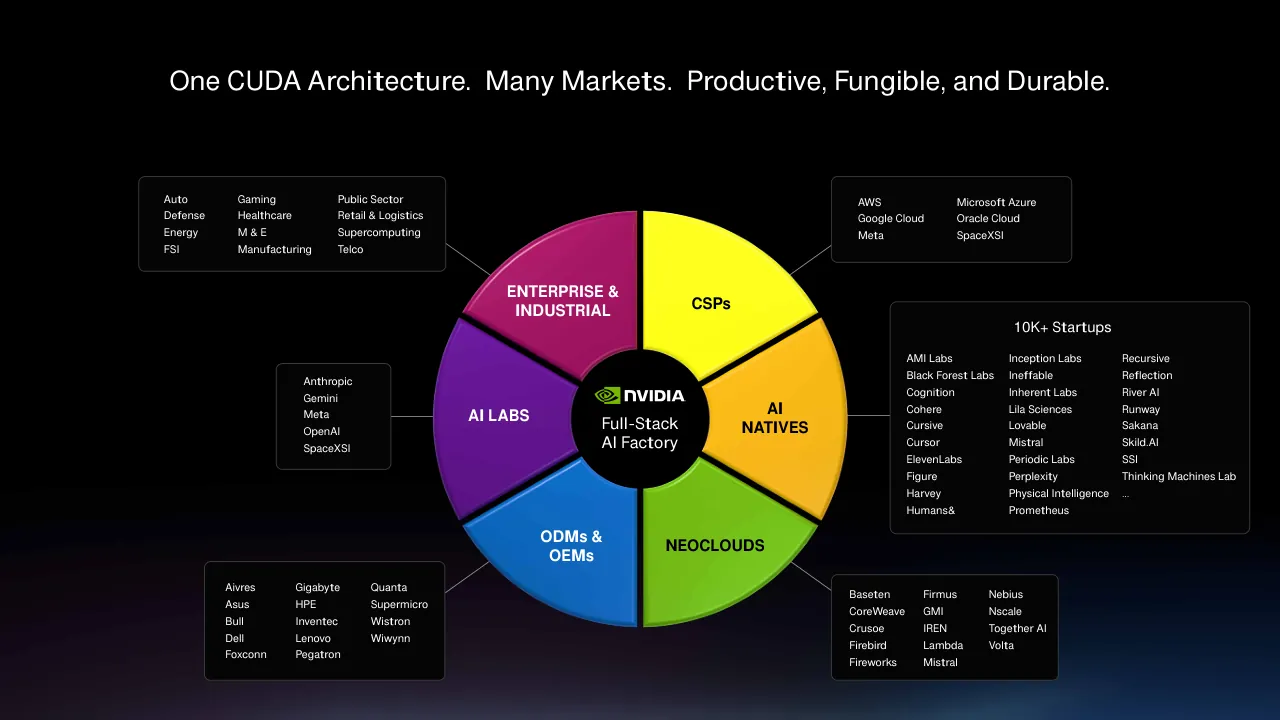
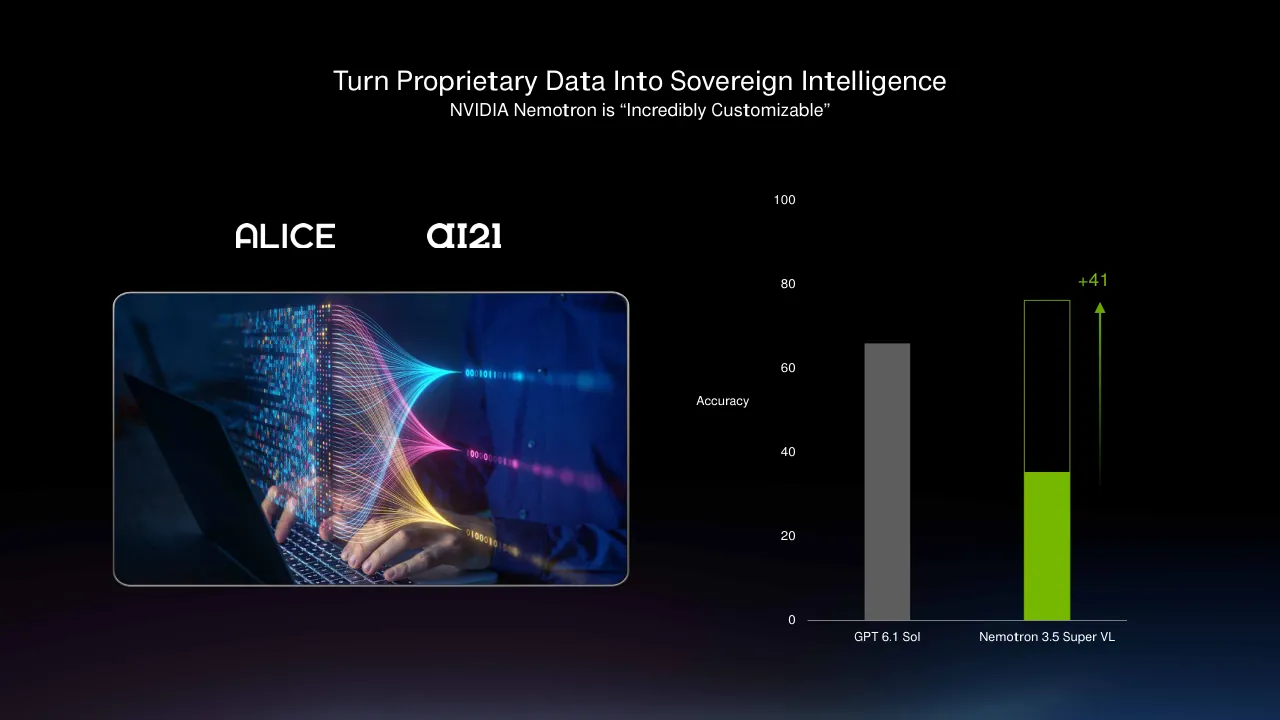
The deck has a strong, consistent visual identity (black ground, green accent, large images, repeated agent diagrams on slides 17 to 19 and 37 to 39) and a clear main sequence from platform to agents to industries. But several slides cannot be understood from the page alone. Slide 23 shows a bar chart where the NVIDIA bar is a green fill to about 35 inside an outline to about 76, with '+41' above it, and the grey bar sits near 66, so the gain reads ambiguously. Slides 23 to 27 repeat the same layout with tiny labels, and the logo walls on slides 5, 8, 41 and 54 and the pie lists on slide 14 are too small to read in a room.
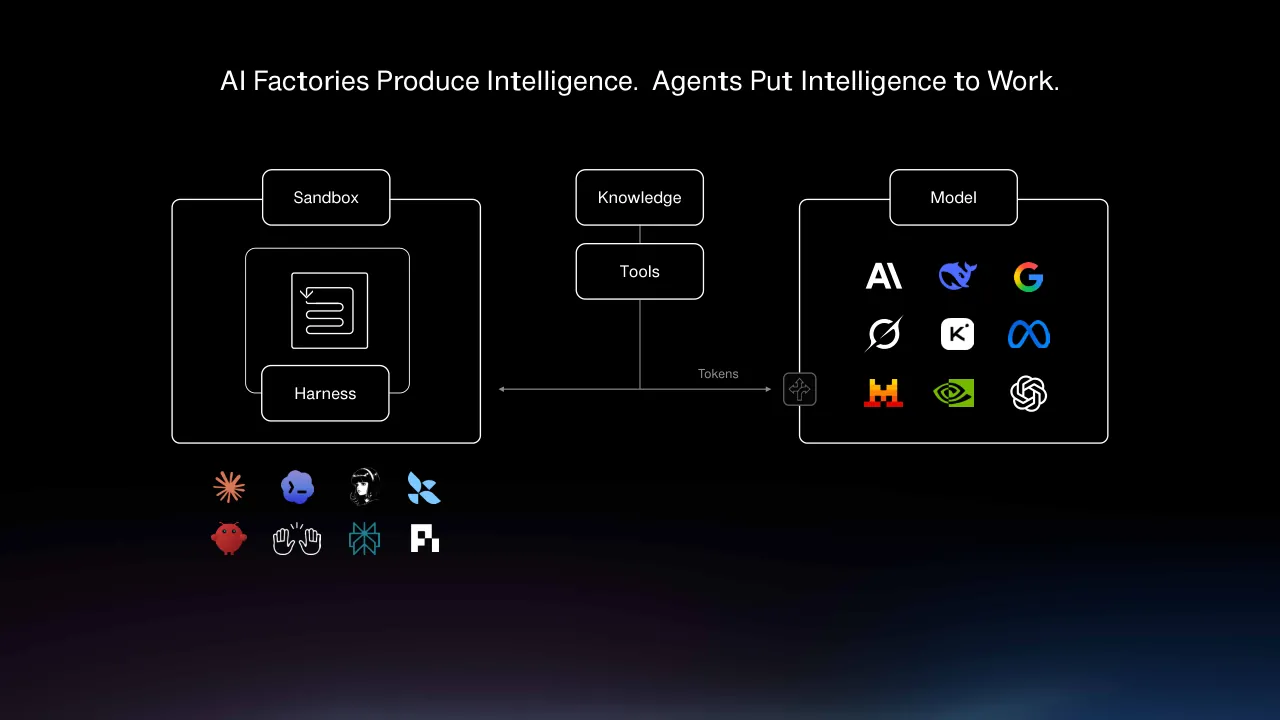
Worth keeping: Keep the dark, consistent look, the single-claim headlines such as slide 17's 'AI Factories Produce Intelligence. Agents Put Intelligence to Work', and the progressive-highlight build on slides 30 to 33, which walks the audience through the pipeline one stage at a time.
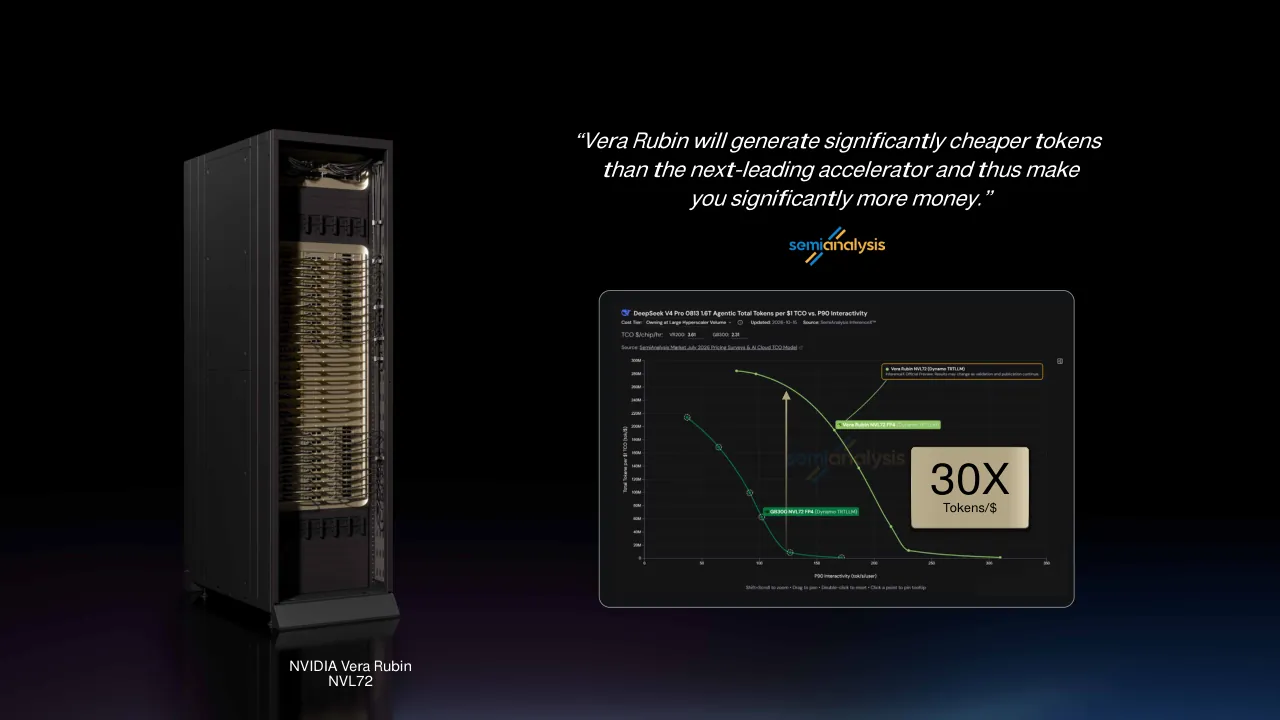
Most useful repair: Redraw the benchmark slides 23 to 27 so the comparison is unambiguous, with a clear baseline, values labelled on the bars and larger axis and model labels, and enlarge the 30X chart on slide 11 so its axes can be read.
What would change the score: I would cut or merge the repeated near-identical benchmark slides and the logo-wall slides, and add a short title or caption to the full-bleed image slides (12, 34, 40, 50, 51, 53) so that each page states its point.
Confidence medium. 55 of 55 pages inspected on contact sheets, 4 at readable size. Reviewed 2026-11-08. Model-assisted review (claude-sonnet-5-5).
Full text of the slides (55 slides)
Every slide's words and a description of its charts and images, so the deck can be searched and rebuilt. Also available as Markdown.
Slide 1
NVIDIA
Visuals: One logo lockup: the NVIDIA eye-and-square mark in bright green, followed by the white NVIDIA wordmark in bold, wide sans-serif capitals. The mark is a green square with a stylised eye cut from it in black, split down the vertical centre. Composition is centred and unboxed, with no cropping. Below the logo, a soft diffuse gradient fills roughly the bottom third of the slide, shading from near-black to dark purple-maroon on the left (about #1A0B17 to #2A1530) and to dark navy blue on the right (about #061A33 to #0B2A4F), with a faint blue highlight in the bottom-right corner. No photograph, chart or table.
Slide 2
Visuals: One photograph, a night view of a long, low glass-walled office building under a faceted, folded roof. The sky above is deep navy with scattered stars. The roof is dark blue-grey with rows of small triangular warm-white skylights or lights set into its facets. The lower band is a full-height glass curtain wall through which lit office interiors, desks, a mezzanine with railings and a central wide staircase in warm wood are visible. The lower edge shows dark shrubbery and a paved strip. Composition is a straight-on, eye-level, symmetrical horizontal view with the building spanning the full width of the frame and the roof line near the middle height. Lighting is artificial: warm amber interior light and white skylight glints against a cool night sky. Dominant colours are navy #1B2A44, slate blue-grey #3A4A5E, warm amber #F2C48D and near-black #0A0C10. The photo is not cropped at the top or bottom; the roof edges run slightly past the left and right sides of the frame. It is boxed, not full-bleed, with rounded corners and a thin pale edge stroke, and has no overlay or tint. Two tiny light marks sit on the bottom edge near x 34% and x 66%.
Slide 3
George Kurtz / Arthur Kaindl / Frédéric Godemel / Arkady Volozh / Pascal Daloz / Deirdre Bosa / David Silver / Jensen Huang / Robin Rombach / Gavin Baker / Artem Sokolov / Ola Källenius / Jeannette zu Fürstenberg / Zhaopeng Chen / AI Generated
Visuals: A 3D-rendered cartoon illustration of fourteen stylised figures, each with a glossy plastic-like finish, in front of a Berlin-style skyline. From left: George Kurtz in a blue checked blazer holding a white helmet; Arthur Kaindl in a navy suit with white shirt; Frédéric Godemel in a dark grey blazer over a light blue shirt; Arkady Volozh in a maroon shirt and navy trousers; Pascal Daloz in a grey suit with lilac shirt; Deirdre Bosa in a dark green suit holding a green GTC microphone; David Silver in an olive henley and beige trousers; Jensen Huang in a black leather jacket making a heart gesture with his hands; Robin Rombach in a black t-shirt with a small white bird on his shoulder; Gavin Baker in a grey knit sweater and navy trousers holding a black GTC microphone; Artem Sokolov in a dark knit sweater and olive trousers; Ola Källenius in a brown three-piece suit; Jeannette zu Fürstenberg in a white dress with pearl necklace and black belt, waving; Zhaopeng Chen in a tan jacket over a white t-shirt and khaki trousers. Behind them, from left: the Reichstag dome with German and EU flags, a white sail-like curved pavilion, the Brandenburg Gate with its quadriga, the Siegessäule column topped by a golden figure, and a yellow-roofed concert hall; green trees line the riverside and a blue water channel runs behind the figures. Lighting is soft and even, daylight. Dominant colours: sky blue, white, cream stone, green foliage, blue water, yellow. Full-bleed scene, uncropped except the outer figures at the edges. Clouds float in the sky.
Slide 4
What Do L’Oréal, Revolut, Spotify, Merck, Vodafone, Zara,
Porsche, Nestlé, and HSBC Have in Common?
Visuals: A full-bleed abstract dark gradient image (3840 by 2160 px) covering the whole slide. It shows no recognisable subject: a black upper area fading into a soft glow along the bottom edge, with a plum/magenta haze at the lower left, a deep navy-blue haze at the lower right, and a faint bright blue-white highlight at the bottom right corner. No overlay beyond the image itself; no photograph, logo or icon.
Slide 5
NVIDIA / ♥ / $10B / Over the Last Year / 14 New Investments / In Start-Ups This Week / 12K+ / Companies in Our Ecosystem / Logo wall, top band: TECHNOLOGY / ABB Robotics / adidas / AgileRL / AGILE ROBOTS / aiMotive / Aive / Akila / aleria / ALEPH ALPHA / ALICE & BOB / AllSides / AMBER / antmicro / AWbotics / apian / Audi / AUTOTRAINS / AUTOMATA / AVELIOS / AVEVA / AVL / AX / Barcelona Supercomputing Center / Base44 / Biolevate / Black Forest Labs / Bolt / Boltz / BT / Bull / bunq / celiabs / Canonical / CATCHES / CHECK POINT / CINECA / CLAR AI / ClearML / CIVO / CMR Surgical / cohere / COGNITE / COMSOL / Mind / cusp.ai / Dassault Systèmes / decart / deepset / T / DEXORY / distil labs / DOCAPOSTE / Domyn / doubleAI / DREAM / dSPACE / DuckDB / e.on / einride / ElevenLabs / Left block: elisa / embed / Enchanted Tools / ENCORD / CAIGMA / EPOCHAL / foretellix / Fraunhofer IAIS / RESEARCH / alene.AI / Genedata / HEXAGON Robotics / HITACHI / HLRIS / HOLOGEN / HORSE / HSBC / IONOS CLOUD / IQM / ISAR / IVEX / JETBRAINS / IR / LEGORA / LEONARDO.AI / LINAGORA / LLOYDS BANKING GROUP / L'ORÉAL / microagi / milestone / mimic / mira / MIRAKL / n8n / NatWest / NEBIUS / NEURA / NEURAL CONCEPT / NSCALE / Oak Lab / OLIGO / omi / ONETERA / otto group / OXA / Pangaea / Parloa / phagos / Photoroom / Right block: ETHRC / fermionic / Flexion / Falkor / fogsphere / GIDEON / Gradium / H / Heidi / Henkel / HUMANOID / idealworks / impossible / Infineon / inherent / intella / 70 Zülich / ICON / Kaiko / KIEFER / KION / KUKA / Locai Labs / LSEG / Lovable / ltx / Mercedes-Benz / MERCK / Mirelo / Mistra / Modulr / MOBIA / MULTIVERSE / Muybridge / NOKIA / nomagic / norrsken / quake ai / NOVIAN / Open Nebula / Opteran / orange / Orbital Industries / ORCA COMPUTING / PHYSICS X / Polarise. / Polars / PolyAI / polynome / Bottom band: poolside / PORSCHE / PRIMA MENTE / prosus / QCentroid / QMatter / QRT / QUANDELA / RADIANT / RavenPack / REASONABLE / Revolut / Reynolds & Moore / RobCo / Roche / RUNWARE / SAAB / SAP / Santander / Scaleway / SCHAEFFLER / Schneider Electric / schwarz digits / secunet cloud / seqera labs / sereact / shopify / SICK / SIE / SIEMENS / Siemens Energy / Siemens Healthineers / sky / SPREAD / STARLING / SUSE / synthesia / TECAN / TERADYNE ROBOTICS / therna / ThinkDeep / TIM / TNG / Toyota Material Handling / TOYOTA / nationalgrid / UNIVERSAL ROBOTS / VAISALA / Valeo / verda / Vestiaire Collective / VitVio / Volkswagen Group / VOLTA / VOLVO / Wandelbots / wayve / XOLTAR / YOUNITE / zalando / zeroport / zooplus
Visuals: Logo wall of roughly 200 company wordmarks, all in white or light grey on dark, in rows as listed in text. Top band: 4 rows of about 20 logos each. Left column: 6 rows of about 5 logos each (elisa, embed, Enchanted Tools, ENCORD, CAIGMA, EPOCHAL; foretellix, Fraunhofer IAIS, RESEARCH, alene.AI, Genedata; HEXAGON Robotics, HITACHI, HLRIS, HOLOGEN, HORSE, HSBC; IONOS CLOUD, IQM, ISAR, IVEX, JETBRAINS, IR; LEGORA, LEONARDO.AI, LINAGORA, LLOYDS BANKING GROUP, L'ORÉAL; microagi, milestone, mimic, mira, MIRAKL; n8n, NatWest, NEBIUS, NEURA, NEURAL CONCEPT; NSCALE, Oak Lab, OLIGO, omi, ONETERA; otto group, OXA, Pangaea, Parloa, phagos, Photoroom). Right column: ETHRC, fermionic, Flexion, Falkor, fogsphere; GIDEON, Gradium, H, Heidi, Henkel; HUMANOID, idealworks, impossible, Infineon, inherent, intella; 70 Zülich, ICON, Kaiko, KIEFER, KION, KUKA; Locai Labs, LSEG, Lovable, ltx, Mercedes-Benz, MERCK; Mirelo, Mistra, Modulr, MOBIA, MULTIVERSE, Muybridge; NOKIA, nomagic, norrsken, quake ai, NOVIAN; Open Nebula, Opteran, orange, Orbital Industries, ORCA COMPUTING; PHYSICS X, Polarise., Polars, PolyAI, polynome. Bottom band: 4 rows of about 20 logos (poolside, PORSCHE, PRIMA MENTE, prosus, QCentroid, QMatter, QRT, QUANDELA, RADIANT, RavenPack, REASONABLE, Revolut, Reynolds & Moore, RobCo, Roche, RUNWARE, SAAB, SAP, Santander, Scaleway, SCHAEFFLER; Schneider Electric, schwarz digits, secunet cloud, seqera labs, sereact, shopify, SICK, SIE, SIEMENS, Siemens Energy, Siemens Healthineers, sky, SPREAD, STARLING, SUSE, synthesia, TECAN, TERADYNE ROBOTICS, therna, ThinkDeep, TIM, TNG; Toyota Material Handling, TOYOTA, nationalgrid, UNIVERSAL ROBOTS, VAISALA, Valeo, verda, Vestiaire Collective, VitVio, Volkswagen Group, VOLTA, VOLVO, Wandelbots, wayve, XOLTAR, YOUNITE, zalando, zeroport, zooplus). Centre panel: the NVIDIA logo (green eye mark in #76B900 with white NVIDIA wordmark) at left-centre; a red 3D heart emoji-style icon at right of it; and a 3D grey-black globe with Europe and North Africa in tan/beige land on dark grey ocean, lit from upper left, partly fading into the panel's dark background at its lower edge, shown as a circle roughly 20.7 by 35 percent of the slide. The globe is full-sphere, not cropped, and has no overlay. The panel background image is a near-black textured field.
Slide 6
Roche / SIEMENS / Mercedes-Benz
Visuals: Photographic-style rendered illustration of a futuristic urban campus at sunset in Berlin. Subject: a single-storey data-centre hall with a large magenta T-Mobile logo panel above the entrance; six rows of black server racks with green-lit vents stand in the hall; a grey-white shipping-style container with a small white logo on a green band sits in a bay door at right of the hall; a white-and-grey hospital or research building with a green cross sign is at upper left; a Roche laboratory with a scientist in a white coat at a bench is at lower left; a Siemens showroom with glass walls contains a blue 1950s Mercedes-Benz 300 SL gullwing coupe on a turntable platform, two white industrial robot arms, a humanoid robot and a man in a dark jacket standing at a counter; an orange and white Volkswagen ID. Buzz-style van drives on the road at lower centre; a small grey-green autonomous cargo cart sits at lower left; a quadruped robot dog walks on a path at centre; a white BMW i8-style car drives on the road at right; a yellow and red Berlin S-Bahn train runs on the rail line at upper right; a sheltered test hall with a glowing fusion-style device sits at upper right; the Berlin TV tower and Berlin Cathedral dome are visible on the skyline. Green glowing light trails and data streams curve across the scene from the left and link the buildings. Composition: wide-angle elevated three-quarter view, full frame, not cropped, not boxed, no overlay other than the green light trails and a warm sunset glow. Lighting: low golden sunset light from the right, warm highlights, lit windows and street lamps. Dominant colours: warm gold #E8A35C, dusk blue-grey #4A5566, dark charcoal #2B2F36, glowing green #7CFF5B, magenta #C8197A for the T-Mobile panel, and deep burgundy #6B1F3A for shrubs.
Slide 7
AI Powers a New Industrial Revolution
APPLICATIONS
MODELS
AI FACTORIES
COMPUTE
ENERGY
Visuals: Five hand-drawn, sketchy rounded-rectangle outlines stacked vertically, drawn in white strokes of about 2 px at slide scale, with no fill, so the dark background shows through. From top to bottom: APPLICATIONS (large box, about 39.4% wide by 24% tall, label centred in its middle), MODELS (about 39.4% wide by 10.6% tall), AI FACTORIES (about 39.4% wide by 10.6% tall), COMPUTE (about 39.4% wide by 10.5% tall), ENERGY (about 39.4% wide by 10.5% tall). Each label is set in white capitals in a hand-drawn, slightly uneven display face, centred in its box. There are no charts, photographs, logos or icons; the only other visual is the dark gradient glow in the lower part of the slide.
Slide 8
Building Europe’s AI Economy
Applications
AgileRL / AGILE ROBOTS / MWbotics / AVELIOS / BASECAMP RESEARCH / Black Forest Labs / Cursive / DeepL / distil labs / IIElevenLabs
Gradium / Helsing II / H / HUMANOID / inherent / Langdock / Latent Labs / LEGORA / Lovable / microagi
MULTIVERSE COMPUTING / n8n / NEURA ROBOTICS / OXA / PHYSICS X / PRIMA MENTE / recursive / synthesia / wayve
Models
ALEPH ALPHA / Advanced Machine Intelligence / Black Forest Labs / ineffable / Mistral AI
AI Factories
Bull / T / firebird / Mistral AI / NEBIUS / NSCALE / NOKIA / RADIANT / VOLTA
Compute
NVIDIA
Energy
Rolls-Royce SMR / Schneider Electric / SIEMENS / SIEMENS Energy
Visuals: Grid of about 50 logo tiles, each a rounded-corner dark rectangle with a thin grey outline, containing the company wordmark or logo in white or light grey. Applications: row 1 has AgileRL (outlined grey), Agile Robots, MWbotics, AVELIOS, BASECAMP RESEARCH, Black Forest Labs, Cursive, DeepL, distil labs, IIElevenLabs; row 2 has Gradium, Helsing with two bars, a white circle with H, HUMANOID, inherent with a circular emblem, Langdock, Latent Labs, LEGORA, Lovable, microagi; row 3 has Multiverse Computing, n8n, NEURA Robotics, OXA, PHYSICS X, PRIMA MENTE, recursive, synthesia, wayve. Models: ALEPH ALPHA, Advanced Machine Intelligence, Black Forest Labs, ineffable, Mistral AI with a logo mark. AI Factories: Bull, a T mark, firebird, Mistral AI, NEBIUS in an outlined box, NSCALE, NOKIA, RADIANT, VOLTA with a chevron. Compute: a single NVIDIA logo on a beige-gold rounded tile with a slight bevel. Energy: Rolls-Royce SMR with its emblem, Schneider Electric, SIEMENS, SIEMENS Energy. No photographs or charts.
Slide 9
The NVIDIA DSX Full-Stack AI Factory Platform / CUDA-X Libraries / Platform Libraries / Open Models / CCCL / CUDA Python / cuTILE Python / CUTLASS / NIXL / cuDNN / NVSHMEM / NCCL / TensorRT-LLM / Megatron / Core / Transformer / Engine / Dynamo / cuSPARSE / cuBLAS / CuTe DSL / NVTX / NVRTC / DOCA / Vera Rubin / NVL72 / NVLink 6 / Switch / Vera BlueField-4 / Compute / Spectrum-6 / Switch / Groq 3 / LPX / Vera BlueField-4 / Storage / Vera RTX / Compute / Rubin / Vera / BlueField-4 / ConnectX-9 / NVLink 6 / Switch / Groq 3 / Spectrum-6 / Switch / BlueField-4 / Vera BlueField-4 / STX / Vera / NVIDIA DSX
Visuals: Three card-fan graphics and seven rack illustrations plus one large building rendering. (1) CUDA-X Libraries: a fan of five to six rounded-corner cards, with the centre card (about 6.8 to 28.5% of width at 21.1 to 36.9% of height) showing an isometric data-centre scene with small blue figures and green-lit server racks; the other cards show a green checkerboard pattern, a dark isometric chip layout, a teal chip, a dark starfield-like texture, and a blurred red-grey abstract shape at the right edge. (2) Platform Libraries: a stack of dark grey rounded tiles (about 40.9 to 59% of width, 21.5 to 37% of height) with beige rounded rectangle labels; the centre column is a larger dark tile holding CCCL, CUDA Python, cuTILE Python and CUTLASS in beige boxes, flanked by columns with NIXL, NVSHMEM, TensorRT-LLM, Transformer Engine on the left and cuDNN, NCCL, Megatron Core, Dynamo on the right, with further edge tiles reading cuSPARSE, cuBLAS, CuTe DSL on the left and NVTX, NVRTC, DOCA on the right. (3) Open Models: a fan of cards (about 71 to 92.7% of width, 21.1 to 36.9% of height) showing a dark green-blue ring-and-globe motif, a globe, a teal molecular structure, a cartoon robot-like figure in the centre card, a purple spiral, a humanoid figure in grey, and a car-like light trail at the right edge. Cards overlap, with the centre card the largest and in front. (4) Seven rack illustrations, each a tall dark chassis with white-outline and gold-lit components, rendered as line-art style renderings on black: Vera Rubin NVL72 (about 8.5 to 15% of width, 49.8 to 70.7% of height) with gold-outlined chips labelled Rubin (top rows), Vera (middle row), BlueField-4 (lower centre) and ConnectX-9 (bottom left); NVLink 6 Switch (about 21 to 27.8%) with three gold-lit switch chips in a triangle at the top labelled NVLink 6 Switch; Vera BlueField-4 Compute (about 34 to 40.5%) with four pairs of gold chips per level and BlueField-4 pointing to a lower-left pair; Spectrum-6 Switch (about 46.8 to 53.3%) with a single square gold chip in the centre labelled Spectrum-6 Switch; Groq 3 LPX (about 59.5 to 66%) with two rows of four gold chips labelled Groq 3; Vera BlueField-4 Storage (about 72 to 78.8%) with two gold chips in the middle and a row of small indicators, labelled Vera BlueField-4 STX; Vera RTX Compute (about 84.8 to 91.8%) with a dense board showing a gold chip pair in the lower right labelled Vera. (5) NVIDIA DSX: a wide flat data-centre building rendering in dark grey steel with a raised central block, many horizontal rows of warm white light strips along the roof level and a small green NVIDIA logo on the central front panel, lit from within, with faint blue reflection on a black floor; it spans the bottom from about 7.4 to 92.6% of width and 75 to 92% of height. The image is not cropped.
Slide 10
NVIDIA Vera Rubin Powers the Whole Agent
Vera Rubin NVL72
Compute Node
Model Processing
Vera MGX
Compute Node
Secure Agent Processing
Vera CMX
Storage Node
Knowledge Serving
Vera RTX
Compute Node
CUDA-X Tools Processing
Visuals: Four photographs of NVIDIA server compute and storage nodes, shown at a slight three-quarter top-down angle, each standing on a dark reflective surface with a faint mirrored reflection below. From left to right: (1) Vera Rubin NVL72 Compute Node: a long flat tray with a dark purple-grey chassis, four gold-tinted GPU packages in the upper row and a central pink-and-blue processor module, gold connectors at the ends. (2) Vera MGX Compute Node: a taller tray with a dark chassis, eight blue-green chip packages in two rows, four small pink-and-gold modules along the front edge, and a silver front panel. (3) Vera CMX Storage Node: an open-top chassis with a dark interior, a central circuit board carrying four large chip packages and several smaller modules, and a silver front panel with gold-trimmed handles. (4) Vera RTX Compute Node: a boxy rack-mount unit with a dark perforated side, gold heat-sink fins at the top, a central board with multiple chips, and a dark perforated front grille with gold trim. Lighting is a soft spotlight from above, the background is near-black fading to deep navy blue at the bottom right, and the photos are not cropped, boxed or tinted.
Slide 11
“Vera Rubin will generate significantly cheaper tokens / than the next-leading accelerator and thus make / you significantly more money.” / semianalysis / DeepSeek V4 Pro 0813 1.6T Agentic Total Tokens per $1 TCO vs. P90 Interactivity / Cost Tier: Owning at Large Hyperscaler Volume / Updated: 2026-10-15 / Source: SemiAnalysis InferenceX™ / TCO $/chip/hr: VR200: 3.61 GB300: 2.31 / Source: SemiAnalysis Market July 2026 Pricing Surveys & AI Cloud TCO Model / Vera Rubin NVL72 (Dynamo TRTLLM) / InferenceX Official Preview: Results may change as validation and publication continue. / Vera Rubin NVL72 FP4 (Dynamo TRTLLM) / GB300 NVL72 FP4 (Dynamo TRTLLM) / Total Tokens per $1 TCO (tok/$) / P90 Interactivity (tok/s/user) / Shift+Scroll to zoom • Drag to pan • Double-click to reset • Click a point to pin tooltip / 30X / Tokens/$ / NVIDIA Vera Rubin / NVL72
Visuals: Photograph of an NVIDIA Vera Rubin NVL72 rack, a tall black cabinet viewed from the front three-quarter angle, lit from the front so the gold-lit cable trays and panels stand out, reflecting faintly on a dark floor; it is full-height, not cropped, and boxed by the black background. Below the quote is the semianalysis logo: a blue (#2F8BE6) 'semi' followed by an amber-orange (#F5A623) 'analysis' with blue and amber diagonal slashes. The chart panel is a screenshot of a SemiAnalysis line chart, titled 'DeepSeek V4 Pro 0813 1.6T Agentic Total Tokens per $1 TCO vs. P90 Interactivity', with a dark background (#121416 to #141618). Y axis: 'Total Tokens per $1 TCO (tok/$)' from 0 to 300M, ticks every 20M. X axis: 'P90 Interactivity (tok/s/user)' from 0 to 350, ticks every 50. Series 1, dark green line with markers, labelled 'GB300 NVL72 FP4 (Dynamo TRTLLM)', runs from about 40 tok/s at about 220M down to about 0 by about 150 tok/s with markers at roughly 40, 75, 95, 100 and 125 tok/s. Series 2, light green line with markers labelled 'Vera Rubin NVL72 FP4 (Dynamo TRTLLM)', starts at about 80 tok/s near 290M, falls through about 185 tok/s near 175M, about 230 tok/s near 40M and ends near 310 tok/s near 0; its values are estimates as the slide prints none. A tan vertical arrow at about 125 tok/s points up from the axis to about 250M, marking the gap between the two curves. An orange-outlined callout box near the top right reads 'Vera Rubin NVL72 (Dynamo TRTLLM)' with a subline, connected by a thin line to the light green curve. A faint semianalysis watermark sits in the centre of the plot. A gold card overlays the lower right of the plot reading '30X' over 'Tokens/$'. Tiny caption under the plot: the navigation hint line. No legend box other than the labels.
Slide 12
Visuals: One photograph, an elevated three-quarter aerial view of a utility-scale battery energy storage site in a desert. Subject: about 200 rectangular grey-beige cabinet containers with green plinths, arranged in staggered rows and blocks across a flat concrete pad. Behind them, a fenced dark-asphalt maintenance access road runs across the foreground, with a chain-link fence along its far edge. Beyond the pad is a large dark solar panel array on racks, mounted on a raised bank at the top right. Further back are sparse scrub vegetation and a range of tan and rust-coloured mountains along the top left and top centre under a hazy sky. Composition: landscape, wide framing, camera looking down at about 25 degrees from the front-left, subject occupying the centre band of the frame, cropped at the left and right edges. Lighting: low warm late-afternoon sun from the left, long soft shadows, golden highlights on the containers and ground. Dominant colours: warm tan and ochre desert, light beige #D9CDB8 containers, bright green #7DC242 plinths, dark asphalt #2B2B2B, pale concrete #B9B3A6, and muted olive scrub. The photograph is boxed as a rounded rectangle with a thin light edge, not full-bleed, and has no overlay or tint.
Slide 13
Announcing NVIDIA Vera Rubin DSX POD
Full-Stack Modular AI Factory Reference Architecture
Factory-Built, Integrated, Pre-Tested Clusters
Delivery-to-Deployment Cut From Months to Days
The Container is the AI Factory
ANDURIL ARMADA Bull Crusoe DAYONE DELL Technologies DELTA EATON GIGABYTE
HPE Ingrasys Lenovo PEGATRON QCT Schneider Electric VERTIV Wistron
Visuals: Full-width photorealistic 3D rendering of an open-sided modular AI data centre container, shown as a side cutaway in straight-on elevation. The container has a light grey (#B8B8B8) top and end frame with a row of small corner lugs along the roof, green (#76B900) vertical panels on both ends at the lower corners, and a dark interior. Left of centre is a grey electrical switchgear cabinet with a control panel of small dials and indicator lights, next to a red fire-suppression cylinder on a black frame. A red overhead sprinkler pipe runs the full interior length. Six groups of black server racks (near-black #111111) with yellow (#E8C000) fibre cable loops hang on the racks, with cooling fan units between groups; the rightmost three racks are fully cabled with yellow loops. Lighting is even, studio-style, with soft grey highlights on the interior walls. The image is full-bleed across the bottom edge, cropped at the slide edge, with no overlay. Above it, sixteen-plus partner logos are set in white on black: ANDURIL, ARMADA, Bull, Crusoe, DAYONE, DELL Technologies, DELTA, EATON, GIGABYTE, HPE, Ingrasys, Lenovo (white rectangle with black wordmark), PEGATRON, QCT, Schneider Electric, VERTIV and Wistron.
Slide 14
One CUDA Architecture. Many Markets. Productive, Fungible, and Durable.
ENTERPRISE & INDUSTRIAL
CSPs
AI NATIVES
NEOCLOUDS
ODMs & OEMs
AI LABS
NVIDIA
Full-Stack AI Factory
Auto
Gaming
Public Sector
Defense
Healthcare
Retail & Logistics
Energy
M & E
Supercomputing
FSI
Manufacturing
Telco
AWS
Microsoft Azure
Google Cloud
Oracle Cloud
Meta
SpaceXSI
10K+ Startups
AMI Labs
Inception Labs
Recursive
Black Forest Labs
Ineffable
Reflection
Cognition
Inherent Labs
River AI
Cursive
Lovable
Sakana
Cursor
Mistral
Skild.AI
ElevenLabs
Periodic Labs
SSI
Figure
Perplexity
Thinking Machines Lab
Harvey
Physical Intelligence …
Humans&
Prometheus
Anthropic
Gemini
Meta
OpenAI
SpaceXSI
Aivres
Gigabyte
Quanta
Asus
HPE
Supermicro
Bull
Inventec
Wistron
Dell
Lenovo
Wiwynn
Foxconn
Pegatron
Baseten
Firmus
Nebius
CoreWeave
GMI
Nscale
Crusoe
IREN
Together AI
Firebird
Lambda
Volta
Fireworks
Mistral
Visuals: One diagram: a ring (donut) chart of six equal 60-degree wedges, drawn with a black gap between wedges, centred at about x 50%, y 58% of the slide, roughly 33% of slide width. Wedges clockwise from top-left: ENTERPRISE & INDUSTRIAL (magenta), CSPs (yellow, top-right), AI NATIVES (amber, right), NEOCLOUDS (green, bottom-right), ODMs & OEMs (blue, bottom-left), AI LABS (purple, left). Each wedge has a bold label in its middle. The hub at the centre is a black circle containing the NVIDIA logo and the text Full-Stack AI Factory. Each wedge has a soft bevelled edge highlight. Six thin grey (#555555, 0.5 pt) leader lines connect wedges to callout boxes. Logo: the NVIDIA eye mark in green #76B900 followed by the white NVIDIA wordmark. Lighting is flat and dark, with a faint blue and purple glow along the bottom edge of the background.
Slide 15
Inference Inflection Arrives
Star History
openclaw/openclaw
facebook/react
torvalds/linux
200K
150K
100K
50K
GitHub Stars
2012 / 2014 / 2016 / 2018 / 2020 / 2022 / 2024 / 2026
Date
star-history.com
Visuals: Photograph, full-bleed, of a dark arena stage during a presentation. A projection screen centre-frame shows a line chart titled 'Star History'. Y-axis 'GitHub Stars' ranges 0 to about 200K with labelled ticks at 50K, 100K, 150K and 200K. X-axis 'Date' runs 2012 to 2026 with labelled ticks at every two years. Series: openclaw/openclaw (red, legend marker red square and circle) rises almost vertically at the far right edge to about 200K+ at 2026; facebook/react (yellow) rises slowly from near 0 in 2012 to about 170K at 2026 (about, no value printed); torvalds/linux (blue) rises from near 0 in 2012 to about 200K at 2026 (about, no value printed). Legend box sits in the upper-left of the plot area with a thin dark grey border. No highlighted points. Watermark 'star-history.com' with a small green star icon at bottom-right of the chart. A red-orange cartoon lobster mascot stands at the left of the screen, overlapping its lower-left corner, lit from the front. The presenter in a dark jacket and trousers is a small figure at centre. Lighting is dark with spotlights on the stage and the screen glowing white. Dominant colours are near-black, deep navy blue audience light, white screen and red-orange lobster. The photo is not cropped and not boxed.
Slide 16
Useful AI Creates Demand for More Intelligence / Agents used 34× more tokens / today than at the start of Feb / Weekly tokens used by agents across OpenRouter | Sep 2, 2025 - Oct 5, 2026 / 132.6T / 3.9T / 130T / 120T / 110T / 100T / 90T / 80T / 70T / 60T / 50T / 40T / 30T / 20T / 10T / 0T / Sep 08 / Sep 22 / Oct 06 / Oct 20 / Nov 03 / Nov 17 / Dec 01 / Dec 15 / Dec 29 / Jan 12 / Jan 26 / Feb 09 / Feb 23 / Mar 09 / Mar 23 / Apr 06 / Apr 20 / May 04 / May 18 / Jun 01 / Jun 15 / Jun 29 / Jul 13 / Jul 27 / Aug 10 / Aug 24 / Sep 07 / Sep 21 / Oct 05 / openrouter / Subscribe for more token insights: openrouter.ai/data
Visuals: One area chart rendered inside the card image. Type: filled area line chart with a single series. Title: headline 'Agents used 34× more tokens today than at the start of Feb' and subtitle 'Weekly tokens used by agents across OpenRouter | Sep 2, 2025 - Oct 5, 2026'. Y-axis: unit tokens in trillions (T), range 0T to 130T with labelled gridlines every 10T (0T, 10T, 20T, 30T, 40T, 50T, 60T, 70T, 80T, 90T, 100T, 110T, 120T, 130T); the top label 132.6T marks the last point above the 130T gridline. X-axis: weekly dates, labelled every second week from Sep 08 to Oct 05 (29 labels, rotated about 90 degrees, reading bottom to top): Sep 08, Sep 22, Oct 06, Oct 20, Nov 03, Nov 17, Dec 01, Dec 15, Dec 29, Jan 12, Jan 26, Feb 09, Feb 23, Mar 09, Mar 23, Apr 06, Apr 20, May 04, May 18, Jun 01, Jun 15, Jun 29, Jul 13, Jul 27, Aug 10, Aug 24, Sep 07, Sep 21, Oct 05. Series values: labelled points are 3.9T near Jan 26 to Feb 09 and 132.6T at Oct 05. Unlabelled values are estimates: about 0T from Sep 08 to Dec 01, about 1T at Dec 15 and Dec 29, about 3T at Jan 12, about 6T at Feb 09, about 5T at Feb 23, about 8T at Mar 09, about 13T at Mar 23, about 17T at Apr 06, about 10T at Apr 20, about 14T at May 04, about 17T at May 18, about 22T at Jun 01, about 27T at Jun 15, about 29T at Jun 29, about 35T at Jul 13, about 44T at Jul 13 peak, about 38T at Jul 27, about 49T at Aug 10, about 88T at Aug 24, about 102T at Sep 07, about 104T at Sep 21, about 132.6T at Oct 05. Legend: none. Highlighted points: the 3.9T label and the 132.6T label in lime, and the headline number 34× in lime. Line is lime green with a dark olive gradient fill beneath it fading to the baseline; no markers.
Slide 17
AI Factories Produce Intelligence. Agents Put Intelligence to Work. / Sandbox / Knowledge / Model / Tools / Harness / Tokens
Visuals: Diagram. Left: a rounded-corner outlined panel labelled Sandbox (title tab on its top edge) containing an inner rounded panel with a Harness box at its bottom edge; inside the Harness panel is an icon of a rectangle with a return-arrow glyph and rounded inner bars, resembling a document or flow symbol. Centre: a box labelled Knowledge with a short vertical line down to a box labelled Tools, and a vertical line from Tools down to a horizontal double-headed arrow that points left to the Sandbox panel and right to a small square icon at the Model panel's left edge; the arrow is labelled Tokens in grey above its right half. Right: a rounded-corner outlined panel labelled Model holding nine logos in three rows of three: row 1 Anthropic-style 'A' wordmark in white, DeepSeek whale in blue, Google 'G' in multicolour; row 2 a white ring-slash mark, a white 'K' in a rounded white square, Meta infinity mark in blue; row 3 Mistral-style orange and red pixel 'M', NVIDIA logo in green, OpenAI knot mark in white. Small square icon at the Model panel's left edge: a rounded dark-grey square with thin grey outline holding a white bidirectional arrow glyph. Below the Sandbox panel, eight logos in two rows of four: row 1 an orange starburst, a blue cloud-terminal icon, a black-and-white anime-style face, a light-blue bow-tie-like mark; row 2 a red round creature, a pair of white outlined hands, a teal spiked emblem, a white square-F mark. All graphics are flat, no photographs. Lighting is none; no crop; the whole slide is a flat composition.
Slide 18
Announcing NVIDIA OpenShell Reference Architecture for Safe AI Agents
NVIDIA OpenShell
Gateway
Supervisor
Policy Prover
Harness
Knowledge
Tools
Tokens
Model
BlueField-4 DPU
NVIDIA
Sentry
Visuals: Diagram with rounded rectangles and connecting lines. Left: a large green-outlined container labelled NVIDIA OpenShell (label tab on its top edge) holding an inner green-outlined rounded panel with a padlock icon at its top-left, a white-outlined square icon depicting a looping path or document with a return arrow, a white-outlined box labelled Harness, and three green-outlined boxes stacked at right labelled Gateway, Supervisor and Policy Prover. Centre: white-outlined boxes Knowledge (top), Tools (below it, joined by a short vertical line), then a vertical line from Tools down to a photograph of the BlueField-4 DPU chip, captioned BlueField-4 DPU beneath it, and a green-outlined box NVIDIA Sentry at the bottom. A horizontal double-direction line runs left from the DPU to the OpenShell container with an arrowhead at the left end; a second line runs right from the DPU to a small grey-outlined rounded square icon with an up-and-across arrow symbol, with an arrowhead pointing right, labelled Tokens in grey. Right: a large white-outlined container labelled Model (label tab on its top edge) holding a 3-by-3 grid of white model-provider logos on black, row 1: an 'A' with a slash-like wordmark, a whale silhouette, a stylised 'G'; row 2: a circle with a diagonal slash, a square with a 'K' and a dot, an infinity-like loop; row 3: a pixel-style 'M' block mark, an eye-like NVIDIA mark, an interlocking knot (OpenAI-style). The DPU photograph is a dark gold-toned processor card with a grid-like die and a smaller square die, shown full-colour, unboxed, centred on the vertical line, with a slight gold tint. Lighting is even and frontal; framing is tight, vertical, no crop.
Slide 19
NVIDIA OpenShell
Harness
Gateway
Supervisor
Policy Prover
Permissions Ceiling
Within the Ceiling
Visuals: Two line-art diagrams, no photographs and no chart. Left diagram, titled NVIDIA OpenShell, drawn in green outline: a large rounded rectangle containing a green padlock icon at its top-left, an inner rounded rectangle holding a white outline document icon (a square with a looping arrow and three horizontal scroll lines) above a white-outlined black box labelled Harness. A thin green line runs from the padlock down the left side of the inner rectangle and joins the Harness box, and another short green line links the inner rectangle's lower-right corner to the Harness box's right side. To the right, three stacked green-outlined rounded boxes labelled Gateway, Supervisor and Policy Prover are aligned in one column. Right diagram, titled Permissions Ceiling, drawn in grey outline. A horizontal red line (about 2 pt) spans the panel near its upper third. Above the line sit two solid red squares with a red cross mark above the right-hand square. Below the line is a diagonal staircase of green squares rising from lower left to upper right: 3 squares in the bottom row, 2 in the next row, 2 in the row after, 1, 2, then 1 at the top, all about 1.8% of slide width. Beneath the staircase, a green check mark precedes the label Within the Ceiling. No arrows connect the two diagrams.
Slide 20
Over 100 Partners Advance Agent Safety with NVIDIA OpenShell
ANTHROP\C
aws
Canonical
CISCO
CROWDSTRIKE
DASSAULT SYSTEMES
Fireworks
FORTINET
Google Cloud
IBM
JPMorganChase
Meta
Microsoft
Mistral
okta
OpenAI
ORACLE CLOUD Infrastructure
Palantir
paloalto NETWORKS
perplexity
Red Hat
SAP
servicenow
SIEMENS
SPACEX
Visuals: Twenty-five partner logos, each white on a dark rounded tile, in a 5 by 5 grid, read left to right and top to bottom. Row 1: Anthropic wordmark (ANTHROP\C), aws smile logo, Canonical logo (square emblem with 'Canonical' wordmark), Cisco logo (bars mark above CISCO wordmark), CrowdStrike wordmark with swoosh. Row 2: Dassault Systemes logo (3DS mark with DASSAULT SYSTEMES), Fireworks logo (flame mark with Fireworks wordmark), FORTINET wordmark, Google Cloud wordmark, IBM wordmark. Row 3: JPMorganChase wordmark, Meta logo (infinity mark with Meta wordmark), Microsoft logo (four-square mark with Microsoft wordmark), Mistral logo (pixel mark with Mistral wordmark), okta logo (sunburst mark with okta wordmark). Row 4: OpenAI wordmark, Oracle Cloud Infrastructure logo (ORACLE CLOUD over Infrastructure), Palantir logo (mark with Palantir wordmark), Palo Alto Networks logo (chevron mark with paloalto NETWORKS wordmark), Perplexity logo (star mark with perplexity wordmark). Row 5: Red Hat logo (fedora mark with Red Hat wordmark), SAP logo (SAP in white block), servicenow wordmark, SIEMENS wordmark, SpaceX wordmark. All logos are flat white, no imagery or photographs. Nothing is cropped.
Slide 21
A new approach to agent security with
Claude Managed Agents and NVIDIA
On September 28, NVIDIA announced the Open Agent Safety Platform,
an open software platform and reference system design for
strengthening AI security. Anthropic and NVIDIA collaborated to bring
additional layers of security and control to the agent stack.
Public financial datasets
Claude Orchestrator
Frontier model
Investment briefs
1 tasks
4 redacted summaries only
Your network
NVIDIA OpenShell
CMA worker
Agent sandbox
2
Gateway
Supervisor
Policy Prover
LLM
3
Private data
Proprietary financial repositories
Visuals: Full-slide photograph-free diagram rendered inside the card. Shapes: (1) light peach rounded rectangle, border orange #D97757, labelled Claude Orchestrator with the Anthropic logo above it and 'Frontier model' below; (2) small outline document icon above the orchestrator with a downward arrow into it, and an orange document icon below with a downward arrow from it, labelled Investment briefs; (3) a double-headed black arrow at the orchestrator's mid-height, marked with orange circle badge 1 'tasks' above and orange badge 4 'redacted summaries only' below; (4) dashed grey rounded rectangle labelled Your network; (5) white rounded rectangle labelled NVIDIA OpenShell containing a dashed-outline box with a lock icon and an orange asterisk icon labelled CMA worker / Agent sandbox, plus three stacked grey-outlined buttons labelled Gateway, Supervisor, Policy Prover, with orange badge 2 between CMA worker and Supervisor; (6) double-headed black arrow from the OpenShell box to the LLM box; (7) white rounded rectangle labelled LLM containing the black NVIDIA eye logo; (8) orange badge 3 on a vertical black arrow pointing down from the arrow line to (9) white rounded rectangle labelled Private data containing three small black database cylinder icons each with a small orange lock, captioned Proprietary financial repositories. Lines are thin black strokes about 1.5 px at slide scale; no shadows.
Slide 22
Open Models Turn Expertise Into Advantage / NVIDIA Leads Open Model Contribution / NVIDIA / Alibaba / Cloud / Hugging / Face / Meta / Microsoft / IBM / Google / Baidu / AMD / ByteDance / Z.ai / Jan Feb Mar Apr May Jun Jul Aug Sep Oct Nov Dec Jan Feb Mar Apr May Jun Jul Aug Sep / 2025-2026 / Source: Hugging Face / Ising / Quantum / Computing / Earth-2 / AI Physics / BioNeMo / Biology AI / Nemotron / Agentic AI / Cosmos / Physical AI / GR00T / Robotics / Alpamayo / Autonomous / Vehicles
Visuals: One line chart inside the central card: title 'NVIDIA Leads Open Model Contribution'; x-axis months Jan to Sep across 2025-2026 with the label '2025-2026' centred below the axis; no y-axis labels, units or range printed; no axis unit given. Series (end-of-line labels with circular logo markers, top to bottom): NVIDIA (bright green #76B900 line, highest, rising steeply from about the origin to the top right, with the NVIDIA logo in a green-outlined circle and the bold word NVIDIA beside it); Alibaba Cloud (orange line, second highest, marker orange circle); Hugging Face (yellow line, third, marker yellow circle with the Hugging Face emoji); Meta (blue line, marker blue circle with Meta infinity symbol); Microsoft (red-orange line, marker with four-square Microsoft logo); IBM (dark blue line, marker with IBM logo); Google (grey-blue line, marker with Google G logo); Baidu (purple line, marker with Baidu paw logo); AMD (red line, marker with AMD logo); ByteDance (cyan line, flat near the top of the cluster, marker with bar-chart logo); Z.ai (light blue line, lowest, marker with Z.ai logo). Values are not printed; the NVIDIA line ends at about the top of the plot and the others cluster in the lower half, all rising from the same origin at the left of the axis. Source line reads 'Source: Hugging Face' with Hugging Face in green underlined link text. Other visuals: five sleeve-like illustrated cards with stylised artwork: Ising (gold wireframe atomic knot on dark purple-blue glow), Earth-2 (blue-green globe with gold rim), BioNeMo (molecular chemical structure in gold and teal brush stroke, labelled H3C, O, CH3, NH2, N), Nemotron (line-drawn cartoon robot with glasses and waving hand, cream outlines), Cosmos (purple and gold spiral galaxy-like swirl), GR00T (armoured humanoid robot in red and gold), Alpamayo (gold and blue-tinted autonomous car on dark card). AI World logo: blue stylised sun-like icon with the words AI WORLD in blue, bottom right of the chart card.
Slide 23
Turn Proprietary Data Into Sovereign Intelligence
NVIDIA Nemotron is “Incredibly Customizable”
ALICE
AI21
+41
100
80
60
Accuracy
40
20
0
GPT 6.1 Sol
Nemotron 3.5 Super VL
Visuals: Bar chart with no chart title. Y-axis labelled 'Accuracy' (no unit printed), scale 0 to 100 with labels at 0, 20, 40, 60, 80, 100; gridlines absent; thin light-grey horizontal baseline at 0. X-axis categories: 'GPT 6.1 Sol' (left) and 'Nemotron 3.5 Super VL' (right). Series 1, GPT 6.1 Sol: solid grey bar, no printed value, about 66 on the axis. Series 2, Nemotron 3.5 Super VL: a green-outlined empty upper section topped at about 76 with a solid green lower section to about 35 (no printed values); the difference is labelled '+41' in green above the bar, with a vertical green arrow pointing up beside it, running from about 42% to 68% of slide height and fading towards its base. No legend. No highlighted points beyond the green bar and +41 annotation. Photograph: a laptop in use, shown in a rounded rectangle with a thin light-grey border; a person in a dark blue shirt types on a keyboard in the lower-left and centre; from the screen, a vertical stack of blue binary-code and data columns on the left feeds into a fan of glowing thin curved lines in cyan, magenta and yellow that converge into three streams of binary digits ('0010101', '10000', '01000') on the right. Lighting is dark and low-key with the glowing lines as the main light source; dominant colours are deep navy blue, black, cyan, magenta and yellow. Framing is a mid-shot, not cropped at the subject, boxed (not full-bleed). Two wordmarks in white: ALICE (left, sans-serif geometric bold capitals) and AI21 (right, bold geometric numerals and letters).
Slide 24
Turn Proprietary Data Into Sovereign Intelligence / NVIDIA Nemotron is “Incredibly Customizable” / CodeRabbit / baseten / +40 / 100 / 80 / 60 / Accuracy / 40 / 20 / 0 / GPT 5.4 Nano / Nemotron 3.5 Lightning / Enterprise / Triage / Change Stack / Security / Customers / Pricing / Blog / Resources / 01 Review / 02 Prioritize across all PRs / 03 / Now / Within each person's daily capacity / 14 / Next / All remaining reviews / 66 / P0 / Skip bot-authored comment review tasks / Review this early because it can resolve assumptions that may affect nearby PRs and reduce rework. / Low security risk / Maintenance / Deep review / P1 / fix(dashboard): scope PR details authors by org / Keep this visible for async review because it is useful work without an immediate interruption signal. / Low security risk / Bug fix / Standard review / P1 / feat(agents): extend per-run prompt_cache_key to cbe/c... / Review this early because it can resolve assumptions that may affect nearby PRs and reduce rework. / Low security risk / Feature / Deep review / P2 / [codex] Lean path instruction metrics insert / Hold this behind refresh work because draft, conflict, or drift signals would make reviewer attention premature. / Needs author action / Low security risk / Draft
Visuals: Bar chart with no printed title, two bars on a 0 to 100 accuracy axis with tick labels 0, 20, 40, 60, 80 and 100 and the axis label Accuracy at left (no units printed). Series 1: GPT 5.4 Nano, solid grey bar #5E5E5E, height about 76 (no value printed). Series 2: Nemotron 3.5 Lightning, green bar #76B900 filled to about 42, with a thin green outlined box rising to about 81 above it; the gap between the two green tops is annotated +40 in green with a vertical green arrow pointing up from the filled top to the outline top, the arrow fading to transparent at its lower end. No legend, no gridlines, no highlighted points beyond the green bar. Logos: CodeRabbit (white rabbit icon with bold white wordmark) and baseten (white square-stepped mark with white lowercase wordmark). Product screenshot: dark-mode web application UI in a rounded grey-outlined device frame, showing a top navigation bar, a three-step tab strip and two kanban-style columns of prioritised pull-request cards. No photograph of people; no icons beyond the small orange rabbit avatar in the UI.
Slide 25
Turn Proprietary Data Into Sovereign Intelligence / NVIDIA Nemotron is “Incredibly Customizable” / Harvey / Trajectory / Harvey / New Thread / Agents / Vaults / Command Center / More / Apps / Contract Intelligence / Recents / Overview of Transaction / Key Issues in Transaction / Essential Points in / View History / Spaces / Acme Acquisition / Project Compass / Delphi Litigation / View Spaces / Maya Sterling / Whitford Lane's Command Center / Peers / View all analysis / Ask Harvey / There are 15 recommended actions to increase your Harvey usage / 49.5% / DAU/MAU / 305 / Active users / Product usage / Based on percentage of users using each product / Top power users / Based on number of active days / 100 / 80 / 60 / Accuracy / 40 / 20 / 0 / GPT 5.5 / Nemotron 3 Ultra / +30
Visuals: Bar chart with the y-axis labelled Accuracy running 0 to 100 in steps of 20 (0, 20, 40, 60, 80, 100), and two categories on the x-axis: GPT 5.5 and Nemotron 3 Ultra. GPT 5.5 is a solid grey bar (#5E5E5E) reaching about 78 with no printed value. Nemotron 3 Ultra is a green bar (#76B900) filled to about 52 with a thin green outlined empty section above it up to about 81, with no printed values. A green upward arrow (#76B900, tapering line with a triangular head) sits to the right of the Nemotron bar and is labelled +30 in green text above it. No legend and no gridlines; the baseline is a thin grey line. The left half holds a tablet-style device in a dark grey textured frame (speckled charcoal and light grey stone-like texture, slightly rounded corners, about 1 percent corner radius, with a thin light grey edge) showing a Harvey dashboard screenshot: dark left sidebar with menu items, and a light grey main panel with cards for 49.5% DAU/MAU line-and-area chart, a Product usage grouped bar chart with dark and light grey bars across Accenture, Morrison Foerster, Pinpoint, Wilson, Shearman Sterling, Ropes & Gray and Duane Morris, and a 305 Active users area chart and a Top power users horizontal bar list. Two wordmarks are shown in white: Harvey in a high-contrast serif and Trajectory with a stylised geometric open-diamond icon followed by a sans-serif wordmark.
Slide 26
Turn Proprietary Data Into Sovereign Intelligence
NVIDIA Nemotron is “Incredibly Customizable”
SKYDANCE
SCALE
+15
100
80
60
Accuracy
40
20
0
Claude Opus 5
Nemotron 3.5 Super VL
Visuals: Left: two white logos in a row. The first is the SKYDANCE wordmark in white high-contrast serif capitals with a thin curved swoosh under the letters. The second is the SCALE logo: a white angular mark (a square with a diagonal notch cut from its lower left) followed by the lowercase-style wordmark SCALE in white geometric sans. Below them is a photograph in a rounded-corner box showing a behind-the-scenes film or video production set: a large rectangular softbox light panel hangs from the top of the frame, emitting bright white light; black drapes and flags fill the upper background; a row of crew members and a camera on a crane or dolly stand in the middle distance, with a few silhouetted figures in the foreground and wooden crates and chairs on the floor. The photo is warm and high-contrast, lit mainly by the bright overhead panel and a bright backlit area on the left, with dominant colours of black, warm amber and cream. It is boxed, not full-bleed, with a thin light-grey rounded outline and no visible overlay. Right: a vertical bar chart titled by its y-axis label 'Accuracy' with no printed chart title. The y-axis runs 0 to 100 in steps of 20 (0, 20, 40, 60, 80, 100) with no gridlines. Two bars: Claude Opus 5 is a solid grey bar, about 81 (no value printed). Nemotron 3.5 Super VL is a solid NVIDIA-green bar, about 71 (no value printed), topped by a hollow outlined box in green of the same width rising to about 86 (the box is black-filled with a thin green outline), and a green up-arrow beside it labelled +15 that marks the gap from about 71 to about 86. No legend. Highlighted points: the green Nemotron bar and its +15 gain are the only highlighted items.
Slide 27
Turn Proprietary Data Into Sovereign Intelligence
NVIDIA Nemotron is “Incredibly Customizable”
Tampa General Hospital (TGH logo)
Palantir (logo)
+20
100
80
60
Accuracy
40
20
0
Claude Opus 5.5
Nemotron 3.5 Lightning
Visuals: Bar chart. Title: none printed. Y-axis labelled 'Accuracy' (no unit), range 0 to 100 with tick labels 0, 20, 40, 60, 80, 100, no gridlines. X-axis categories: 'Claude Opus 5.5' and 'Nemotron 3.5 Lightning'. Series 1, Claude Opus 5.5: solid grey bar #5E5E5E, value about 88 (no printed value). Series 2, Nemotron 3.5 Lightning: solid green bar #76B900 to about 76 (no printed value), with a thin green outlined empty box #76B900 on top of it reaching about 96 (black interior). The outlined portion is labelled '+20' in green #76B900 above the bar, with a green up-arrow beside it (thin vertical line with arrowhead at top, fading to transparent at the bottom, at x about 85.5%, y 30 to 42%). No legend. No highlighted points beyond the green bar and '+20' annotation. Baseline: thin grey horizontal axis line at 0 from about x 63% to 88%. Photograph: a control room with a wide video wall of monitors displaying dashboards, bar charts and line graphs across the top, and rows of desks with monitors, phones and dark office chairs; two people are seen from behind at the front (one on the left in a dark jacket, one in a headset in the centre), and a third person is at the far right; a face is visible on one screen. Lighting is cool overhead fluorescent light strips at the top right; dominant colours are dark navy and black screens, grey walls, and light grey desks. Composition is landscape, cropped to a rounded rectangle, boxed with a thin light grey border (about #8A8A8A, about 0.3% of slide width) and a corner radius of about 2% of slide width; not full-bleed and no overlay or tint. Logos: 'TGH Tampa General Hospital' logo in white (circular TGH monogram with 'Tampa General Hospital' in bold stacked type) at top left of the photo, and 'Palantir' logo in white (circular mark with a stylised P-like pin and bold wordmark) to its right.
Slide 28
An Ecosystem to Help Build Your Super Agents
adaption
AfterQuery
AI21
Applied Compute
baseten
cohere
Deep Cogito
distil labs
Fireworks
Handshake
inferact
LangChain
Letta
MERCOR
Mistral
MULTIVERSE
Palantir
PRIME Intellect
RadixArk
Reflection
river
SCALE
THINKING MACHINES
Trajectory
Vercel
Visuals: Twenty-five logo tiles, arranged in five rows of five, each a dark rounded rectangle containing one white logotype centred in it. Row 1: adaption, AfterQuery, AI21, Applied Compute, baseten. Row 2: cohere, Deep Cogito, distil labs, Fireworks, Handshake. Row 3: inferact, LangChain, Letta, MERCOR, Mistral. Row 4: MULTIVERSE (with a stacked circle emblem above it), Palantir, PRIME Intellect, RadixArk, Reflection. Row 5: river, SCALE, THINKING MACHINES (two-line stacked wordmark), Trajectory, Vercel. All logos are white or near-white on black. Behind the grid, along the bottom edge, a soft dark glow fades from deep purple-black at the lower left to deep navy blue at the lower right.
Slide 29
NVIDIA Agent Knowledge Foundation. Turn Company Data Into Company Knowledge. / Unstructured / Data / Nemotron / Nemotron / cuVS / Nemotron / Parse / Embed / Rerank / Structured / Data / cuDF / Auto-Ontology / Kumo / Analytical / Predictive
Visuals: Diagram with no chart axes or legend. Row 1 (Unstructured Data): a text label 'Unstructured Data' then a chain of four green hexagonal NVIDIA-style icons, Nemotron Parse, Nemotron Embed, cuVS (orange, not green) and Nemotron Rerank, joined by thin light-grey double-headed arrows (about 0.15% stroke, grey #A0A0A0, arrowheads at both ends). Each arrow runs from one icon to the next, and the first arrow starts at the label and the last arrow ends after Nemotron Rerank with an open end. The green icons are glossy lime-green (#76B900) hexagonal prisms with a dark network-node glyph in the centre. The cuVS icon is a square outlined in orange-red (#E8562A) with a small orange scatter-plot glyph and a green base bar. Row 2 (Structured Data): a text label 'Structured Data' with a double-headed arrow to an Auto-Ontology green hexagon icon showing a dark tools glyph (crossed hammer and wrench). From the Auto-Ontology icon, a single grey line with a rounded bracket splits into two branches. The upper branch runs horizontally through the label 'Analytical' to a green cuDF icon (tools glyph) with a double-headed arrow to its right. The lower branch runs through the label 'Predictive' to a green Kumo icon (network glyph) with a double-headed arrow to its right. Raster image layers sit behind the diagram at the label and arrow positions, with no visible content beyond the labels and arrows.
Slide 30
NVIDIA Agent Knowledge Foundation
Unstructured
Data
Nemotron
Parse
Nemotron
Embed
cuVS
Nemotron
Rerank
Analytical
cuDF
Structured
Data
Auto-Ontology
Predictive
Kumo
ParseBench
nvidia/Nemotron-3.5-Parse
lightonai/LightOnOCR-3-0.8B
PaddlePaddle/PaddleOCR-VL-1.6
4
PaddlePaddle/PaddleOCR-VL-1.5
5
Datalab-to/surya-ocr-2
Visuals: Diagram on the left, dim: a row of hexagonal 3D tiles at y about 35 to 42 for Nemotron Parse (bright #76B900 lime-green, highlighted, the only fully lit tile), Nemotron Embed (dark olive green #2E4A0E), cuVS (near-black tile with thin red-brown #5A1E14 wireframe and a green base bar) and Nemotron Rerank (dark olive green #2E4A0E), each joined to the next by thin grey (#5A5A5A) double-headed arrows. A second row at y about 51 to 63 has a cuDF tile (dark olive hexagon with crossed-tools icon) and a Kumo tile (dark olive hexagon with network icon) at the right, and an Auto-Ontology tile (dark olive hexagon with crossed-tools icon) at left; a thin grey elbow line runs from Auto-Ontology to a vertical bracket at x about 27 that branches horizontally to Analytical (upper, to cuDF) and Predictive (lower, to Kumo), each with a double-headed arrow to the tile. Small dim image fragments sit behind the Unstructured Data and Structured Data labels and near the cuVS tile base. Ranking panel: three medal icons at x about 62 (first orange-gold medal on blue-grey ribbon, second silver-grey medal, third bronze medal on blue-grey ribbon), rows 4 and 5 show plain grey numerals (#8D8D8D). Logos at x about 64.5 to 66.5: NVIDIA logo (white square with black NVIDIA wordmark, row 1), a white filled circle (row 2), a small black PaddlePaddle paddle-figure mark (rows 3 and 4), and a white square with a black stylised figure (row 5, Datalab). The background image is a dark photographic gradient: black with a dim maroon glow along the bottom-left and a dim blue glow along the bottom-right, unlit and unboxed, full-bleed with a faint tint over the lower third.
Slides 31 to 55 continue in the full text file.
Download this deck
The hosted PDF of every library deck is free for readers of the SlideDeck Co newsletter. Join with your email and the viewer and download appear here.
Building a deck of your own? The SlideDeck Co Standard Deck is a slide library for business presentations: reviews, updates and plans.