The deck opens with a title slide for the June 24, 2026 Annual Stockholder Meeting, followed by a long cautionary statement on forward-looking statements and product availability. It then sets out the agenda: procedural items, proposals and voting, a business update from founder and CEO Jensen Huang, preliminary voting results and a question-and-answer session. The proposals section runs across several slides, listing three management proposals (director elections, executive compensation and auditor ratification) and four stockholder proposals with their lead proponents. The business update summarises fiscal 2026 results in a compact table of revenue, gross margin, operating income and diluted EPS, each set against the prior year. A chart slide compares inference performance and token cost across GPU systems, using a dual-axis plot that makes a cost argument visually. A short section introduces the Vera Rubin platform and early adopters, and the deck closes with the voting result and Q and A. Slides 15 and 16 carry no extracted text, so they are likely image-led.
Full text of the slides (19 slides)
Every slide's words and a description of its charts and images, so the deck can be searched and rebuilt. Also available as Markdown.
Slide 1
NVIDIA
Annual Stockholder
Meeting
June 24, 2026
Visuals: Full-bleed photograph/render of a dark, faceted, triangular-tiled surface with glossy black and blue-grey planes, lit from upper right. In the right half, a large glossy 3D NVIDIA eye emblem in bright green, shown at an angle with its beveled edges catching light; it is cropped by the right edge of the slide. Composition is wide, with the emblem as the focal point on the right and dark texture on the left. The NVIDIA logo (green eye emblem followed by white NVIDIA wordmark) sits top-left, boxed by nothing.
Slide 2
Certain matters in this presentation including, but not limited to, statements as to: expectations with respect to growth, demand, performance, benefits and / availability of NVIDIA’s products, services, and technologies, and related trends and drivers; NVIDIA’s financial position and financial and business outlook; / expectations with respect to NVIDIA’s third party arrangements, including with its collaborators and partners; expectations with respect to technology / developments, and related trends and drivers; projected market growth and trends; expectations with respect to AI and related industries; and other statements / that are not historical facts are forward-looking statements within the meaning of Section 27A of the Securities Act of 1933, as amended, and Section 21E of / the Securities Exchange Act of 1934, as amended, which are subject to the “safe harbor” created by those sections based on management’s beliefs and / assumptions and on information currently available to management and are subject to risks and uncertainties that could cause results to be materially different / than expectations.
Important factors that could cause actual results to differ materially include: global economic and political conditions; NVIDIA’s reliance on third parties to / manufacture, assemble, package and test NVIDIA’s products; the impact of technological development and competition; development of new products and / technologies or enhancements to NVIDIA’s existing products and technologies; market acceptance of NVIDIA’s products or NVIDIA’s partners’ products; design, / manufacturing or software defects; changes in consumer preferences or demands; changes in industry standards and interfaces; unexpected loss of / performance of NVIDIA’s products or technologies when integrated into systems; NVIDIA’s ability to realize the potential benefits of business investments or / acquisitions; and changes in applicable laws and regulations, as well as other factors detailed from time to time in the most recent reports NVIDIA files with the / Securities and Exchange Commission, or SEC, including, but not limited to, its Annual Report on Form 10-K and Quarterly Reports on Form 10-Q. Copies of / reports filed with the SEC are posted on the company’s website and are available from NVIDIA without charge. These forward-looking statements are not / guarantees of future performance and speak only as of the date hereof, and, except as required by law, NVIDIA disclaims any obligation to update these forward- / looking statements to reflect future events or circumstances.
Many of the products and features described herein remain in various stages and will be offered on a when-and-if-available basis. The statements within are not / intended to be, and should not be interpreted as a commitment, promise, or legal obligation, and the development, release, and timing of any features or / functionalities described for our products is subject to change and remains at the sole discretion of NVIDIA. NVIDIA will have no liability for failure to deliver or / delay in the delivery of any of the products, features or functions set forth herein.
Slide 3
Welcome
Visuals: Full-bleed photograph (rendered 3D scene): a wall of dark, faceted black tiles in rows of triangular and angled panels, with a large glossy green three-dimensional NVIDIA-style eye logo entering from the lower-left and bottom edges. The logo is cropped by the left and bottom edges of the slide and its upper edge runs diagonally from about x 12%, y 68% up to x 49%, y 34% and then down toward the lower right. Composition is close and low-angle, with the logo filling the lower-left third. Lighting is directional from the upper left, producing specular highlights on the green surfaces and deep shadows in the recesses. Dominant colours are near-black charcoal and bright lime green. No overlay or tint is applied; the image is not boxed.
Slide 4
Agenda
1. Call to Order and Procedural Items
2. Proposals and Voting
3. Jensen Huang, Founder and CEO, Business Update
4. Preliminary Results of Voting and Adjournment
5. Q & A
Visuals: Full-bleed photograph of a dark, faceted three-dimensional surface made of many small angular triangular and pyramidal tiles in charcoal and graphite tones, with light catching the edges of the facets, particularly in the upper right. In the lower right a large glossy bright green three-dimensional emblem (the NVIDIA-style eye-shaped logo mark) is partially cropped by the right and bottom edges of the slide, rendered with specular highlights and dark green recesses. The photograph is not boxed and has no tint overlay beyond the natural darkening of the scene. Dominant colours: near-black #0B0D10, charcoal #2A2E33, graphite #4A4F55, and bright green #76B900 on the emblem with darker green shadows around #3A5C00. Lighting is directional from the upper right, producing edge highlights on the tiles. Framing is a wide landscape crop with the emblem entering from the right edge.
Slide 5
Management Proposals
Proposal 1
The election of 10 individuals to serve as directors until our 2027 Annual Meeting
Proposal 2
The approval of the compensation of our named executive officers for fiscal 2026
as disclosed in our proxy statement
Proposal 3
The ratification of PwC as our independent registered public accounting firm
for fiscal 2027
Visuals: One non-text element: a full-bleed, abstract dark background photograph or light-glow image covering the whole slide, with no recognisable subject. Soft glows sit along the bottom edge: a dim magenta-purple haze at lower left, a dark navy-blue zone at lower right, and a small teal-blue highlight near the bottom right at about 80% across. The top two-thirds are almost pure black. It is not cropped, boxed or tinted by any overlay.
Slide 6
Stockholder Proposals / Proposal 4 / The approval of a stockholder proposal to eliminate all supermajority voting provisions / Lead Proponent / John Chevedden
Visuals: None. The only non-text content is a soft blurred light glow in the bottom edge of the background (dark purple at lower left, dark blue and teal at lower right, fading upward into black); it is a background treatment, not a discrete illustration.
Slide 7
Stockholder Proposals / Proposal 5 / The approval of a stockholder proposal requesting an evaluation and report on faith-based / community resource groups / Lead Proponent / William Cunningham
Slide 8
Stockholder Proposals
Proposal 6
The approval of a stockholder proposal requesting an evaluation and report on civil rights
and non-discrimination related to DEI
Lead Proponent
American Conservative Values ETF
Visuals: None apart from the full-bleed background photograph described under background. It is a dark abstract light image with no recognisable subject: soft purplish-red glow at the bottom left, dark blue glow at the bottom right, and a faint bright band along the bottom edge near the centre-right. It is full-bleed, uncropped, with no overlay or tint beyond its own darkness.
Slide 9
Stockholder Proposals / Proposal 7 / The approval of a stockholder proposal requesting a report disclosing greenhouse gas / emissions from the use of the Company’s sold products / Lead Proponent / Green Century Capital Management, Inc. and Mercy Investment Services, Inc.
Slide 10
Business Update
Visuals: One photograph, full-bleed and uncropped by any frame: a close-up, low-angle view of a three-dimensional green emblem in the lower left, its curved arcs and angular top plate running off the bottom and left edges of the slide, set against a dark wall of repeating faceted, pyramid-like black tiles that recede diagonally from upper left to lower right. The emblem is lit from above and left, with bright specular highlights on its top faces and deep shadows in its inner recesses. Dominant colours are near-black #111417 for the tiles and vivid green #76B900 for the emblem. No overlay or tint is visible.
Slide 11
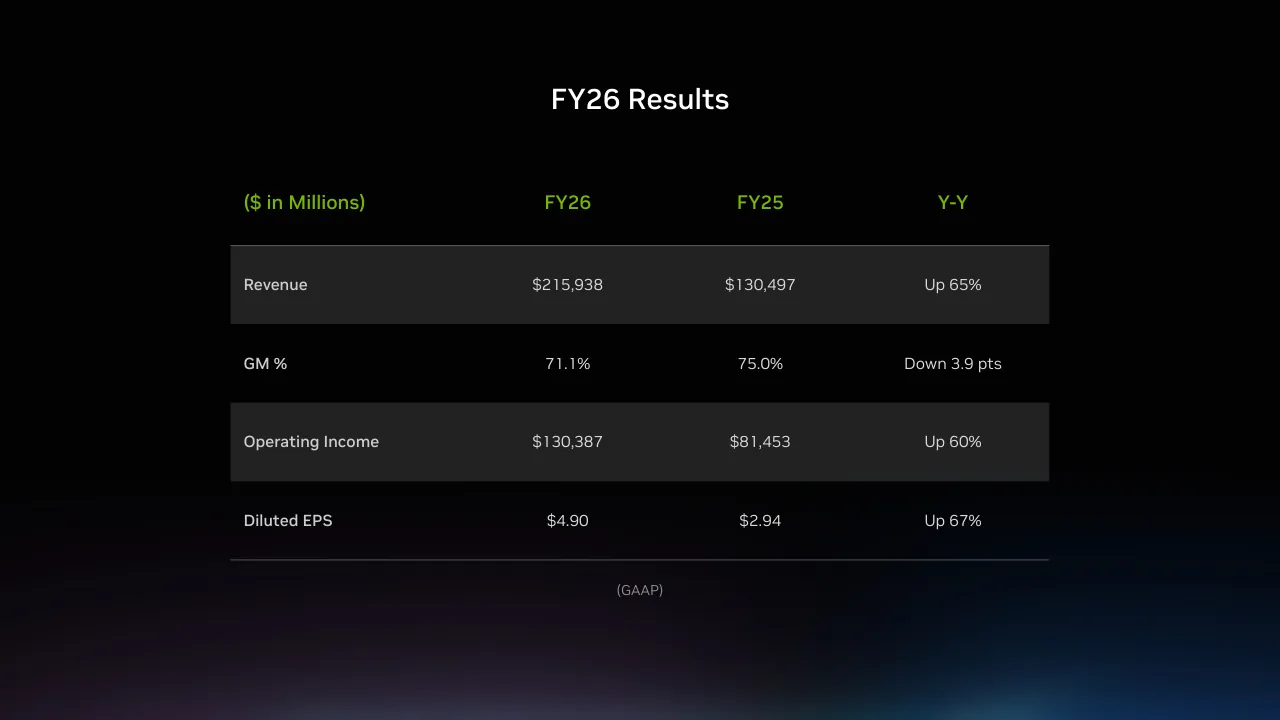
FY26 Results
($ in Millions) / FY26 / FY25 / Y-Y
Revenue / $215,938 / $130,497 / Up 65%
GM % / 71.1% / 75.0% / Down 3.9 pts
Operating Income / $130,387 / $81,453 / Up 60%
Diluted EPS / $4.90 / $2.94 / Up 67%
(GAAP)
Visuals: A table with four columns and five rows, no chart. Columns: ($ in Millions) row labels; FY26; FY25; Y-Y. Rows: Revenue ($215,938; $130,497; Up 65%); GM % (71.1%; 75.0%; Down 3.9 pts); Operating Income ($130,387; $81,453; Up 60%); Diluted EPS ($4.90; $2.94; Up 67%). Revenue and Operating Income rows have a translucent grey band (#A7A7A7 at 20% opacity, reading as about #222222 on black); GM % and Diluted EPS rows are unshaded. Thin light-grey horizontal rules (about #A7A7A7, roughly 1px) sit above the first row and below the last row. Faint vertical column separation is visible only through the shaded cell bands. No photographs or icons are visible apart from the dark glow background.
Slide 12
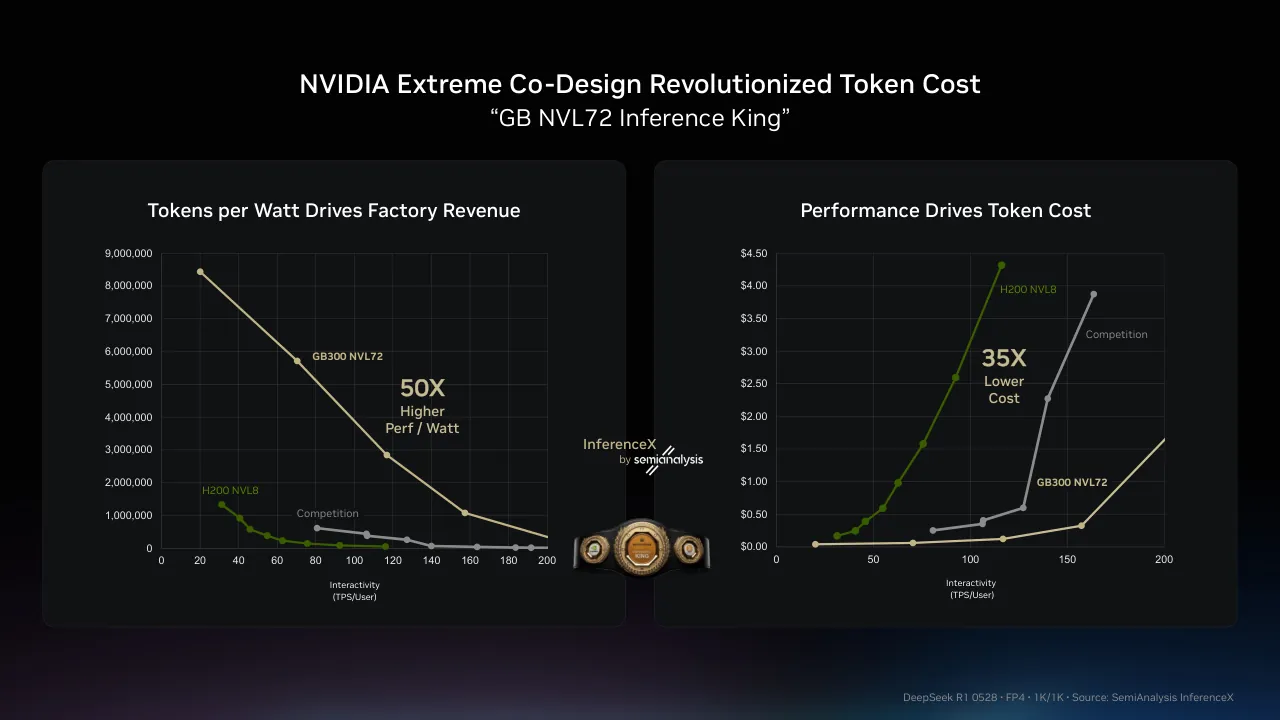
NVIDIA Extreme Co-Design Revolutionized Token Cost
“GB NVL72 Inference King”
Tokens per Watt Drives Factory Revenue
9,000,000
8,000,000
7,000,000
6,000,000
5,000,000
4,000,000
3,000,000
2,000,000
1,000,000
0
GB300 NVL72
H200 NVL8
Competition
50X
Higher
Perf / Watt
Interactivity
(TPS/User)
0
20
40
60
80
100
120
140
160
180
200
Performance Drives Token Cost
$4.50
$4.00
$3.50
$3.00
$2.50
$2.00
$1.50
$1.00
$0.50
$0.00
H200 NVL8
35X
Lower
Cost
Competition
GB300 NVL72
0
50
100
150
200
Interactivity
(TPS/User)
InferenceX
by
semianalysis
DeepSeek R1 0528 · FP4 · 1K/1K · Source: SemiAnalysis InferenceX
Visuals: Two line charts plus two logos. Left chart: title 'Tokens per Watt Drives Factory Revenue'; y-axis 'Tokens per Watt' is not labelled, tick labels run from 0 to 9,000,000 in steps of 1,000,000 with thousands separators; x-axis 'Interactivity (TPS/User)' runs 0 to 200 in steps of 20. Series, values about: GB300 NVL72 (gold line, markers) at about (20, 8.4M), (70, 5.7M), (117, 2.8M), (157, 1.1M), then continues to about (200, 0.3M); labelled 'GB300 NVL72' next to the curve. H200 NVL8 (green line, markers) at about (31, 1.3M), (40, 0.9M), (46, 0.6M), (55, 0.4M), (63, 0.2M), (75, 0.15M), (92, 0.06M), (116, 0.02M); labelled 'H200 NVL8'. Competition (grey line, markers) at about (80, 0.6M), (106, 0.4M), (127, 0.2M), (140, 0.06M), (163, 0.02M), (184, 0M), (191, 0M); labelled 'Competition'. Annotation '50X Higher Perf / Watt' in gold. Right chart: title 'Performance Drives Token Cost'; y-axis tick labels $0.00 to $4.50 in steps of $0.50 (no axis title); x-axis 'Interactivity (TPS/User)' 0 to 200 in steps of 50. Series, values about: H200 NVL8 (green) at about (31, $0.18), (41, $0.25), (46, $0.40), (55, $0.60), (63, $0.99), (75, $1.58), (92, $2.59), (116, $4.31); labelled 'H200 NVL8'. Competition (grey) at about (80, $0.26), (107, $0.41), (127, $0.61), (140, $2.28), (164, $3.87); labelled 'Competition'. GB300 NVL72 (gold) at about (20, $0.05), (70, $0.07), (117, $0.13), (157, $0.33), (200, $1.65); labelled 'GB300 NVL72'. Annotation '35X Lower Cost' in gold. No legend; no highlighted points beyond annotations. Logo 1: an InferenceX championship belt, a black leather strap with a large gold central medallion inscribed 'INFERENCEX KING' and two smaller gold side medallions. Logo 2: the semianalysis wordmark in white with three diagonal slash marks, preceded by 'by' and the gold text 'InferenceX'.
Slide 13
Vera Rubin in Full Production
Vera Rubin NVL72
Compute Tray
Vera
Grace BlueField
ConnectX-9
Vera Rubin NVL72
NVLink Switch Tray
NVLink 6
Switch
Vera CPU Tray
Vera
Spectrum-6 SPX
Switch Tray
Spectrum-6
Switch
Groq 3 LPX Tray
Groq 3
Vera BlueField-4
STX Storage Tray
Vera BlueField
Visuals: Six black-and-white line-art cutaway renderings of server trays with gold-lit chips, set in a row: (1) Vera Rubin NVL72 Compute Tray, with four gold-rimmed chips across the top row, two chips labelled Vera below them, a small chip labelled Grace BlueField lower down and two small connectors labelled ConnectX-9 at the bottom; (2) Vera Rubin NVL72 NVLink Switch Tray, with four small chips rotated at about 45 degrees in a triangular cluster labelled NVLink 6 Switch, with cable runs and a dense lower bay; (3) Vera CPU Tray, with two columns of paired gold-rimmed chips, four chips in the upper area and four in the lower area, labelled Vera; (4) Spectrum-6 SPX Switch Tray, with one large multicoloured chip in the centre labelled Spectrum-6 Switch; (5) Groq 3 LPX Tray, with a 2 by 4 grid of eight gold-rimmed chips labelled Groq 3; (6) Vera BlueField-4 STX Storage Tray, with two chips and a row of four small connectors labelled Vera BlueField. Below the trays, a full-width row of about 40 vertical drawer modules side by side in a rack, mostly dark charcoal faces with tan-gold lit front panels in varying brightness, some modules blank and dark, lit from above, cropped at the bottom edge of the slide; the strip has a faint blue glow at the bottom-right corner. Trays are shown with white-grey outlines on black, with no tints or overlays.
Slide 14
NVIDIA Vera Opens Large Market / CPU for Agents / Early Adopters / Cloud / Ecosystem Partners
Visuals: Photograph 1 (full-bleed background): a near-black studio backdrop with a faint dark-blue and purple glow in the lower-right corner and a soft grey floor reflection under the hardware. Photograph 2 (boxed to the left half, not cropped): a black NVIDIA Vera server rack shown in three-quarter view, front panel open, with rows of pale gold/beige compute trays and horizontal bars lit from within, and a light-grey top panel; its base sits on a dark plinth. Photograph 3 (overlapping the base of the rack, not cropped): a single compute tray pulled out of the rack toward the viewer, black chassis with gold-lit edges, a row of small green-lit chip modules, and a silver front handle. Lighting is a single warm key light on the hardware with dim cool ambient light; dominant colours are black, gold #C1B485 and grey. Logos: 29 partner wordmarks in white on the dark panels, listed in the elements below; none are boxed, each sits on a semi-transparent panel. No charts, tables or diagrams.
Slide 15
BREAKTHROUGHS / ECOSYSTEMS / 20 YEARS / CUDA / FLYWHEEL / DEVELOPERS / INSTALLED / BASE
Visuals: Circular cycle diagram with four hand-sketched white curved arrows, each with a filled white triangular arrowhead. Arrow 1 runs from BREAKTHROUGHS down-left to ECOSYSTEMS, with its head at the ECOSYSTEMS end. Arrow 2 runs from DEVELOPERS up to BREAKTHROUGHS, with its head at the BREAKTHROUGHS end. Arrow 3 runs from ECOSYSTEMS down-right to INSTALLED BASE, with its head at the INSTALLED BASE end. Arrow 4 runs from INSTALLED BASE up-right to DEVELOPERS, with its head at the DEVELOPERS end. The sequence reads BREAKTHROUGHS to ECOSYSTEMS to INSTALLED BASE to DEVELOPERS back to BREAKTHROUGHS. No values, axes or legend. No photograph, logo or icon; the background is a soft glow treatment only.
Slide 16
ISAAC GROOT / SPACE-1 / HYPERION / DGX STATION / FOR WINDOWS / RTX / SPARK / DGX / SPARK / GEFORCE RTX / VERA RUBIN / THOR / VERA / AGENT / AERIAL ARC / HOLOSCAN
Visuals: Hub-and-spoke diagram on a black background. Centre node: a stacked illustration of Vera Rubin server racks, drawn in a sketch style, with black chassis and gold/brass-coloured modules, labelled VERA RUBIN. Eight spokes, each a thin white double-headed arrow with small arrowheads at both ends, connecting the centre to: (1) top-left, HYPERION, a sketched black car with cyan/blue circuit-line highlights; (2) top-centre, ISAAC GROOT, a gold humanoid robot standing next to a small white wheeled robot; (3) top-right, SPACE-1, a grey and silver satellite with dark blue solar panels; (4) left, a cluster of three products: DGX STATION FOR WINDOWS, a black tower workstation with a visible chassis and two small GPU modules, RTX SPARK, an open black laptop with a glowing chip on its screen, and DGX SPARK, a small beige desktop box; (5) right, GEFORCE RTX, a black graphics card with gold trim and an X-shaped cutout; (6) lower-right, HOLOSCAN, a white and grey medical scanner with a green accent band and patient table; (7) lower-left, THOR, a yellow excavator; (8) bottom-centre, VERA, a small square green-grey processor chip next to AGENT, a cartoon avatar of a smiling man with grey hair, glasses and a dark jacket; (9) bottom-centre-right, AERIAL ARC, a grey drone-like antenna or aerial frame with multiple arms. All illustrations are hand-drawn with white or light outlines and soft shading. Lighting is a flat dark studio look with the objects lit from the top.
Slide 17
Preliminary Results of
Voting and Adjournment
Visuals: Photograph, full-bleed, uncropped at the slide edges. Subject: a large three-dimensional glossy lime-green NVIDIA-style eye/shield emblem, shown partly, at the lower-left, with its upper-right edge and a wedge-shaped top face rising diagonally from about x 14%, y 47% to a peak at about x 49%, y 34%, then falling to about x 78%, y 100% at the bottom edge. The emblem's concentric arcs and inner cutouts are visible at the bottom-left, with the lower-left arc running off the left and bottom edges. Behind it is a dark charcoal-black wall of small faceted, pyramid-like tiles arranged in rows, catching faint highlights, with a diagonal band of brighter facets crossing the upper-left. Lighting: a soft directional light from the upper left produces specular sheen and fine speckle highlights on the green surfaces and rim light on the tile edges. Dominant colours: lime green about #76B900 on the emblem with darker green shadows about #1F4D00, and near-black about #111316 for the tiled background. No overlay or tint; the photograph is shown at full colour.
Slide 18
Q & A Session
Visuals: One photograph, full-bleed and uncropped at the slide edges. It shows a close-up of a black wall covered in dense, raised, faceted triangular tiles, angled diagonally from upper-left to lower-right, with a glossy bright green 3D emblem in the lower-left corner. The green emblem is an NVIDIA-style eye-and-shield logo, shown as a large relief shape seen from above and cropped by the bottom and left edges. Its top edge forms a large flat green block running diagonally up to the right, and its inner curved bands show darker green shadowed recesses. Lighting is directional from above, with specular highlights on the green surfaces and soft shadows in the tile grooves. Dominant colours are near-black charcoal (about #1A1D21) and vivid lime green (about #76B900). No overlay or tint is applied. The dark upper-right area leaves clear space for the title.
Slide 19
NVIDIA
Visuals: A photograph-style 3D render of a field of dark glossy faceted triangular tiles (pyramid-like bumps) covering the whole slide, with light reflections on the upper-right tiles. In the right portion, a large three-dimensional bright green NVIDIA eye emblem (a stylised eye/shield shape with concentric inset rings) is extruded and tilted toward the viewer, cropped by the right edge of the slide. In the lower-left, a small horizontal logo lockup: the green eye icon in a rectangle followed by the white uppercase wordmark 'NVIDIA' in a bold geometric sans. Lighting is directional from the upper right, producing specular highlights on the green surfaces and tile edges. Dominant colours: near-black #0A0C0A and charcoal #2A2E2A for the tiles, NVIDIA green #76B900 for the emblem and icon, white #FFFFFF for the wordmark. The background image is full-bleed with no border or tint.