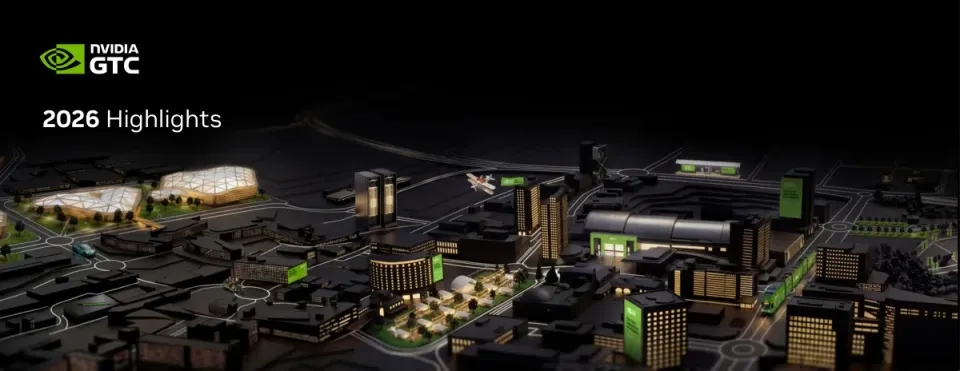
This recap of NVIDIA's GTC 2026 event in San Jose opens with a title slide and a series of press and analyst quotes framing the event as a major moment for AI. The body then moves through the company's argument in order: AI as a five-layer system from energy to applications, the shift from training to inference, the economics of cost per token and tokens per watt, the Vera Rubin platform and Vera CPU, Dynamo and Groq for inference orchestration, agentic AI with OpenClaw and NemoClaw, open models and sovereign AI, the DSX framework for AI factories, and physical AI in robotics and autonomous driving. Several slides use large quoted headlines and short paragraphs to tie each section to a single idea. Event statistics such as keynote views and attendance appear mid-deck, and analyst and press reactions fill the later slides. The deck closes with a summary slide that restates the platform and the claim that agentic and physical AI are just beginning. Slides 7, 10, 12 and 13 are good examples of headline-driven structure with figures carrying the argument.
Slides worth studying
Questions about this deck
How many slides does the NVIDIA GTC 2026 Highlights deck have?
The NVIDIA GTC 2026 Highlights deck has 76 slides. It opens with a title slide and press and analyst quotes, then moves through the company's argument in order, ending with a summary slide on the platform.
What does the NVIDIA GTC 2026 deck say about the five layers of AI?
Slide 8 says AI depends on five layers: energy, chips, infrastructure, models, and applications, and that all five need to scale together. It adds that if one layer stalls, the system stalls.
What does the NVIDIA GTC 2026 deck say about demand visibility for Blackwell and Rubin?
Slide 10 states that one year ago NVIDIA saw roughly $500 billion of demand, and that today visibility is at least $1 trillion through 2027. It says this reflects Blackwell and Rubin only.
What performance gains does the NVIDIA GTC 2026 deck attribute to Dynamo?
Slide 14 says Dynamo boosts inference performance by up to 7x, lowering token cost and increasing revenue. The same slide says that with Blackwell and GB300 NVL72, it drives up to 50x performance gains.
Details
- Company: NVIDIA
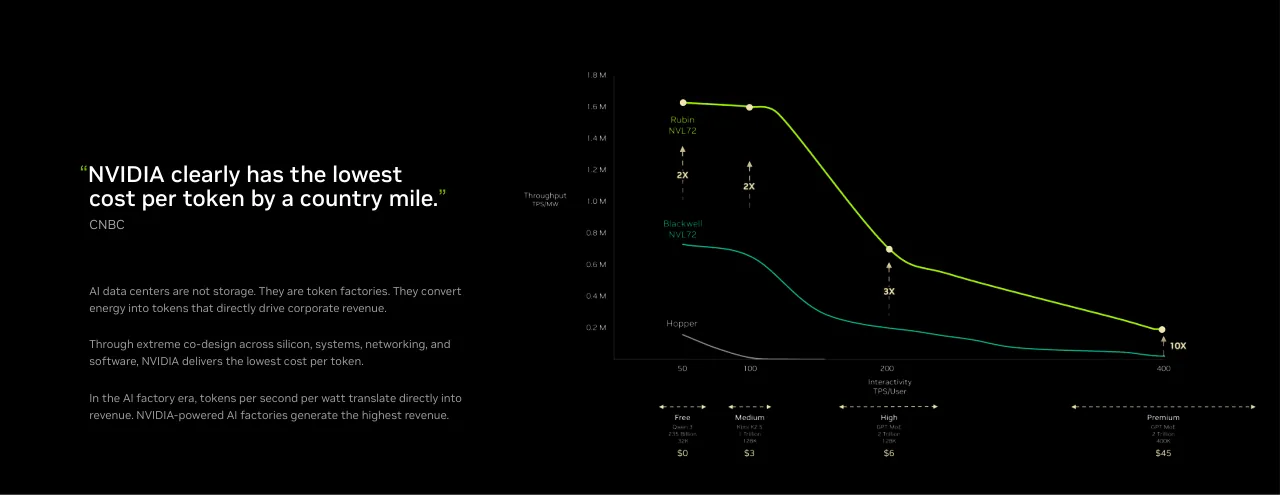
- Year: 2026
- Type: Presentation
- Industry: Semiconductors
- Pages: 76
More from NVIDIA
- NVIDIA investor presentation, September 2026 NDR
- NVIDIA investor presentation, Annual Stockholder Meeting June 2026
- NVIDIA investor presentation, Q2 FY27 quarterly presentation
- NVIDIA keynote, GTC Europe 2026
- NVIDIA keynote, GTC 2026 Keynote
- NVIDIA investor presentation, October 2025 NDR presentation
All NVIDIA decks in the library
Review score: 6 out of 10, Needs substantial work
Presentation quality, judged with the SlideDeck Co review heuristic. Ask, evidence and idea merit are not rated here.
The deck has a strong, consistent identity: black ground, green accent, large quoted headlines, and polished photography and renders (slides 1, 13, 31). But the body paragraphs on slides 7 to 28 are tiny and low contrast, so the supporting explanation is unreadable at any normal viewing size. The 76-page route is also weak. Slides 32 to 43 are photo grids with no message, and slides 45 to 72 repeat earlier content as two-up thumbnails with text too small to read, some with near-empty chart frames (slide 57). The core message can be recovered from the headline quotes, but the deck needs real editing.
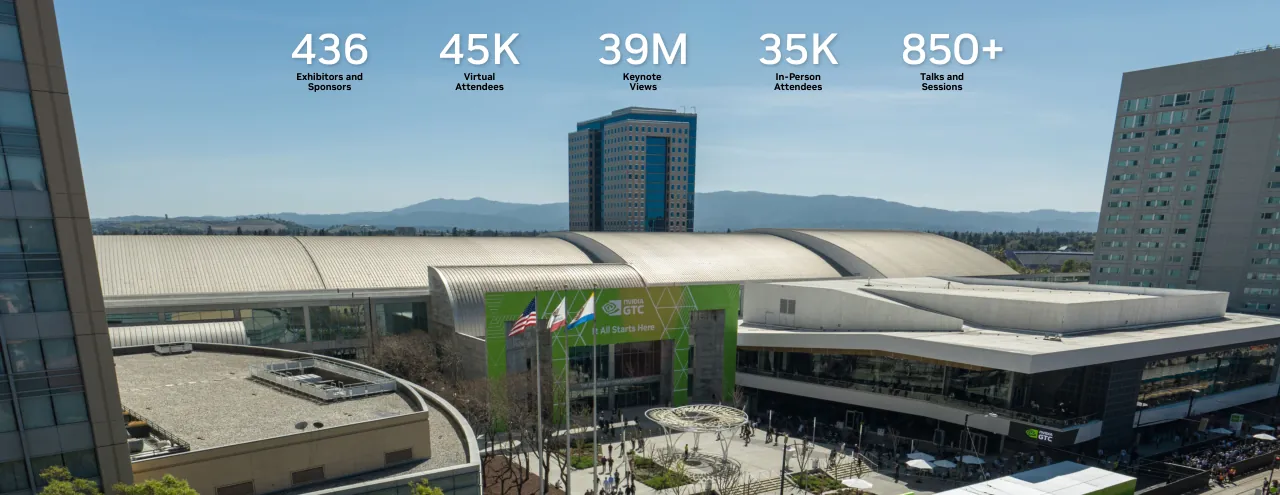
Worth keeping: Keep the dark, green-accent system, the large quote headlines with attribution, the clean cost-per-token chart on slide 13 with its labeled 2X, 3X and 10X callouts, and the stat strip on slide 31.
Most useful repair: Raise body text to a readable size and contrast, cut the repeated two-up slides 45 to 72 or rebuild them as single full-size slides, and fix the empty chart frames on slide 57.
What would change the score: Condense the photo montages and the quote walls (slides 29 and 30) into a few purposeful pages so the argument from slides 7 to 28 reaches the close without interruption.
Confidence medium. 72 of 76 pages inspected on contact sheets, 4 at readable size. Reviewed 2026-11-08. Model-assisted review (claude-sonnet-5-5).
Full text of the slides (76 slides)
Every slide's words and a description of its charts and images, so the deck can be searched and rebuilt. Also available as Markdown.
Slide 1
NVIDIA
GTC
2026 Highlights
Visuals: One full-bleed 3D rendered illustration of a miniature night-time city model, shown from a high oblique angle with the scene receding from lower-left to upper-right. Left: a pair of large faceted glowing white-gold buildings on a green lawn. Centre: a dark rounded tower with warm lit windows, a cylindrical glass-roofed hall, and a small green-and-white NVIDIA GTC kiosk. Upper centre: a small red-and-yellow biplane in flight. Several green NVIDIA GTC billboards stand on the buildings, too small to read. Right: a green-and-black articulated tram, a street of lit office blocks, and a green-lit tree-lined park. Roads are dark with thin white and grey lane lines and roundabouts. Lighting is dark ambient with warm yellow window light and green accent glow. Dominant colours are black, charcoal, warm gold and NVIDIA green #76B900. The image is not cropped, is full-bleed, and has a dark gradient fading to black across the upper area behind the title.
Slide 2
SAP center / NVIDIA GTC / It All Starts Here / Proud Sponsor / ORACLE / NVIDIA / Serve Robotics / nvidia.com/gtc / NVIDIA GTC / Brilliant Minds, / Breakthrough / Discoveries / San Jose Convention Center / March 16-19, 2026 / GTC26 / Santa Clara St / South Registration / and Badge Pick-up / South Registration and Badge Pick-up
Visuals: Eight photographs in a 4 by 2 grid. Top row, left to right: (1) aerial-angle wide view of the SAP Center arena, a glass-and-steel pitched-roof entrance with a large SAP center sign, green NVIDIA GTC banners on the facade and crowds along the street below, bright daylight, blue sky; (2) pedestrians in motion walking past a large lime-green NVIDIA GTC wall with the white NVIDIA GTC logo, trees behind, shallow-focus blur on the walkers; (3) three large lime-green 3D letters reading GTC26 standing on a grey plinth on a lawn, trees behind, warm sunlight; (4) a man in a plaid shirt riding a white cargo tricycle with a green NVIDIA GTC panel reading It All Starts Here and the word ORACLE in red, a second rider behind, a white colonial-style building behind. Bottom row, left to right: (5) close view of a green and white NVIDIA-branded Serve Robotics delivery robot with six-wheel base on grass, green foliage behind; (6) a tall billboard reading nvidia.com/gtc, Brilliant Minds, Breakthrough Discoveries, San Jose Convention Center March 16-19, 2026 with a green NVIDIA logo cube, above a crowd walking on a city street with palm trees and office towers; (7) a low-angle view of two tall double-sided pylon signs, the front one with the NVIDIA GTC logo on green and text South Registration and Badge Pick-up, a jet airliner flying past above palm trees; (8) a green NVIDIA GTC sign on a white lattice frame with a blurred man in a dark jacket in the foreground, a white parasol above, and a red traffic light and Santa Clara St street sign behind. Lighting is natural daylight throughout. Dominant colours are lime green #76B900, white, and black. All photographs are full-rectangle, unboxed and uncropped to their cells, with no overlays or tints.
Slide 3
cover every single layer of the five layer cake of artificial intelligence
from land power and shell the infrastructure.
Keynote Entrance
NVIDIA GTC
It All
Starts Here
nvidia.com/gtc
SAP
Visuals: Six photographs of an NVIDIA GTC conference. Top-left: an outdoor stage in a park at dusk-like daylight, with a large LED screen showing a speaker on stage and caption text, rows of seated attendees with wooden chairs in the foreground, and tall trees behind. Top-middle: a close-up selfie-style shot of two smiling attendees in black NVIDIA GTC t-shirts with green lanyards, in front of a large green backdrop with a white NVIDIA GTC logo. Top-right: a wide view of a dense crowd of several hundred attendees seated and standing on a plaza, facing a large screen labelled Keynote Entrance, with palm-lined trees and a green banner. Bottom-left: a tall green vertical banner reading NVIDIA GTC, It All Starts Here, and nvidia.com/gtc, beside a glass and steel building with an SAP sign, above an aerial view of a crowd walking along a palm-lined street past a green-roofed booth. Bottom-middle: two men relaxing on wooden lounge chairs on grass, one with glasses and a grey t-shirt, one in a navy shirt holding a phone. Bottom-right: attendees in dark jackets and lanyards holding up phones to photograph in a sunlit park beside a tall stone column. All photos are full-colour, natural daylight, with green as the dominant accent colour and the crowd scenes showing mixed dark clothing. None is cropped beyond rectangular frames, none has an overlay or tint apart from the printed text and logos.
Slide 4
NVIDIA GTC / LIVE (logo on the desk panel in the left photo) / NVIDIA GTC (green banner in the top-middle photo) / SOUTH TICKET OF / Blo ergy (partly cut-off sign in the top-right photo; the rest is hidden) / NVIDIA GTC LIVE (logo on the microphone flag in the bottom-middle photo)
Visuals: Five photographs, all unframed, uncropped to a rectangle, and with square corners. (1) Left, 2077 by 1620 px, full height: a wide outdoor street scene at a GTC LIVE broadcast set. A man in a black leather jacket stands at the left, a woman in a lilac jacket with a headset sits at the far-left edge, and four men in headsets sit behind a black desk with green-lit panels. Palm trees, a white steel truss and a sunlit street with a blue sky appear behind them, and the tones are blue sky, green and black. (2) Top-middle, 803 by 624 px: a woman in a pale blue blazer holds a microphone up to a smiling older man in a denim jacket and dark jeans, beside a green NVIDIA GTC banner and a white lattice frame, on grass under trees. Bright daylight, dominant colours green, pale blue and denim blue. (3) Top-right, 1178 by 917 px: three people seated at a black broadcast desk with a green edge light, a woman in a black sweater and sunglasses on the left, a man in a light blue shirt and headset in the centre, and a man in a black jacket on the right; a white sign reads SOUTH TICKET OF and Blo ergy, and a green NVIDIA panel stands behind. Warm natural light, dominant colours black, light blue and green. (4) Bottom-middle, 1116 by 858 px: a close-up of a smiling man with curly dark hair in a navy polo holding a microphone whose flag reads NVIDIA GTC LIVE; a white lattice frame and blurred people stand behind him. Shallow depth of field, dominant colours navy, white and grey. (5) Bottom-right, 804 by 625 px: a woman with blonde hair in a lilac blazer and headset gestures with open hands while a bearded man in a navy jacket and grey hoodie wears a headset, seated at a black desk with a green edge light; blurred green and blue background. Soft daylight, dominant colours lilac, navy and green.
Slide 5
KO / K5 Invited Guests / Reserved / Guests
Visuals: Four photographs of audiences and event guests at an NVIDIA GTC event. Top-left: a dim blue-violet auditorium with rows of seated attendees; a silver-haired woman with glasses in a dark jacket is centred, with a man in a dark blazer beside her and an attendee holding a phone at left. Top-right: a backstage or wings scene under dark rigging; a man in a dark suit embraces a man in a black leather jacket with silver hair, with other people blurred in the background. Bottom-left: three men in suits seated in green-and-black theatre seats, one gesturing with a raised hand, with green lanyards; a green seat placard reads 'KO / K5 Invited Guests' and 'Reserved'. Bottom-right: a row of seated men in dark blazers and a light checked shirt, several clapping, one holding a phone aloft, lit in purple-blue light with green lanyards visible. Each photo is a rectangle, not cropped to a shape, with no overlay or tint beyond the existing stage lighting.
Slide 6
“This is GTC, the AI festival of everything that drives the tech world.” / Jim Cramer, CNBC
Visuals: One full-bleed photograph of a large arena stage during a keynote. A presenter in a dark jacket stands small on a dark multi-level stage at centre-right, facing a huge illuminated LED screen behind him. The screen shows a daytime render of a modern campus of glass-walled buildings with curved white roofs, a road, lawns, trees and hedges, under a pale blue sky with white clouds. The foreground is a dense audience seen from above and to the left, lit in cool blue and white, with a few raised phones visible. Rows of white stage lights hang along the top edge. Lighting: bright screen and spotlights against a dark room. Dominant colours: black, deep blue, sky blue and white. The photo is uncropped apart from full bleed, with a dark gradient overlay over the lower half that darkens the audience behind the quote. The quote sits on a dark translucent band.
Slide 7
BREAKTHROUGHS
ECOSYSTEMS
DEVELOPERS
20 YEARS
CUDA
FLYWHEEL
INSTALLED
BASE
“CUDA has over 4 million developers,
3,000+ optimized applications, and deep
integration into every major AI framework.”
Forbes
For 20 years, CUDA has built the developer flywheel powering accelerated computing.
CUDA-X turns algorithms into infrastructure across AI, data, and science, compounding
performance at scale.
As compute grows, software drives efficiency—defining throughput, cost per token,
and how much intelligence the world can produce.
Visuals: One hand-drawn cycle diagram in white chalk-style strokes with four node labels (BREAKTHROUGHS top, DEVELOPERS right, INSTALLED BASE bottom, ECOSYSTEMS left) and a green hand-lettered centre label reading 20 YEARS / CUDA / FLYWHEEL. Four curved white sketched arrows connect the nodes clockwise: BREAKTHROUGHS to ECOSYSTEMS (arrowhead at ECOSYSTEMS), ECOSYSTEMS to INSTALLED BASE (arrowhead at INSTALLED BASE), INSTALLED BASE to DEVELOPERS (arrowhead at DEVELOPERS), DEVELOPERS to BREAKTHROUGHS (arrowhead at BREAKTHROUGHS). No chart axes, legend or highlighted points; no photographs or logos.
Slide 8
“AI depends on five layers—energy, / chips, infrastructure, models, and / applications—and that all five need / to scale together.” / Fortune / AI does not scale in isolation. It scales as a system. Energy powers chips, / chips power infrastructure, infrastructure runs models, and models / enable applications. Each layer compounds the next. If one stalls, the / system stalls. AI factories demand all five layers advance together. / APPLICATIONS / MODELS / INFRASTRUCTURE / CHIPS / ENERGY / CHATBOTS / DIGITAL BIOLOGY / ROBOTAXI / ENTERPRISE / AI AGENTS / SCIENCE / ROBOTICS / MANUFACTURING / AI CODER / LLM / VLM / VLA / MMLLM / GPT / DM / GNN / MOE / SSM / LBM / AI FACTORIES
Visuals: Hand-drawn chalk-style sketch illustration in white and gold. Five stacked rounded rectangles with white hand-drawn outlines and no fill, labelled from top to bottom APPLICATIONS, MODELS, INFRASTRUCTURE, CHIPS and ENERGY. Each has a right-side curly brace; the top brace spans APPLICATIONS, the middle brace spans MODELS, the lower brace spans INFRASTRUCTURE, CHIPS and ENERGY. Application icons in a 4 by 2 grid: row 1 CHATBOTS (a speech bubble with a gold arrow), DIGITAL BIOLOGY (a gold molecular strand), ROBOTAXI (a white car with gold accents), ENTERPRISE AI AGENTS (a robot with stacked gold cubes); row 2 SCIENCE (a gold atom), ROBOTICS (a humanoid robot with raised arm), MANUFACTURING (a robotic arm), AI CODER (a laptop window showing a code symbol with a gold chip). Model tags are small rounded rectangles with thin white outlines and white capitals: row 1 LLM, VLM, VLA, MMLLM, GPT; row 2 DM, GNN, MOE, SSM, LBM. Below them, the label AI FACTORIES above a sketched illustration of three stacked tiers of server racks in a pyramid, drawn in white outline with gold-lit rack units, widest at the bottom. No photographs; no cropping; no overlays.
Slide 9
NVIDIA
AI Natives
AI for Auto
Aurora / momento / nuro / pony.ai / waabi / Wayve
AI for Customer Support
Decagon / ElevenLabs / Fin / kore.ai / Sierra / synthesia
AI for Engineering
BeyondMath / Emmi AI / Physicsx / luminary / Rapstar / Hyperbolic
AI for Healthcare
Arc Institute / bioHub / Boltz / Chai Discovery / Edison / Isomorphic Labs / LILA / Prism Design
AI for Robotics
Agibot / Agile Robots / FieldAI / Figure / Generalist / Physical Intelligence / Shild AI
AI for Search
brave / glean / perplexity / you.com
AI for Software Development
CodeRabbit / Cognition / CURSOR / FACTORY / graphite / Lovable / opencode / OpenHands / qodo / tabnine
DL Frameworks
PyTorch / JAX
Inference Frameworks
SGL / vLLM
Agent Frameworks/Protocols
A2A / AutoGen / crewAI / LangChain / Model Context Protocol / OpenClaw
Frontier Model Builders
AI2 / Black Forest Labs / ANTHROPIC / Black Forest Labs / cohere / Decart / deepseek / Gemma / humans& / Inception / Inflection / KIMI / Magic / Thinking Machines / Mistral AI / OpenAI / poolside / Qwen / Reflection / runway / Thinking Machines / xAI
Model to Production
Anyscale / baseten / BigPanda / Braintrust / DataRobot / Distyl / Fireworks AI / H2O.ai / LogicMonitor / Modal / Nutanix / OpenRouter / Red Hat / replicate / scale / Snowflake / together.ai
NVIDIA AI Platform
cuDNN / Magnum IO / cuOpt / cuVS / cuDF / Omniverse / TRT-LLM / Dynamo / NeMo / PhysicsNeMo / Cosmos / Nemotron
NVIDIA Hopper / NVIDIA RTX PRO Blackwell Server Edition / NVIDIA Blackwell / Confidential Computing / NVIDIA Rubin / NVIDIA ConnectX and BlueField Networking / NVIDIA Quantum IB, Spectrum-X Networking
“Every company in the world / today needs to have an agentic / system strategy.”
Business Insider
AI has expanded beyond research into every sector—AI natives, / enterprises, industrial systems, and sovereign infrastructure. Startups / and incumbents are building on accelerated computing, and every / industry now depends on inference at scale. This is no longer adoption. / It is the emergence of a universal computing platform.
Visuals: A dense logo map (single raster image, about 1500 by 826 px) on black. Top: the green NVIDIA eye logo with the wordmark NVIDIA in white, a red heart emoji, and the words AI Natives in white sans-serif. Below, a row of six grey-outlined rounded panels containing small white logo wordmarks grouped by label: AI for Auto (4 rows of logos), AI for Customer Support, AI for Engineering, AI for Healthcare, AI for Robotics, AI for Search (4 logos), AI for Software Development. Second band of three panels on the left (DL Frameworks, Inference Frameworks) and four panels (Agent Frameworks/Protocols, Frontier Model Builders, Model to Production) as listed in text. Lower: a gold-outlined dark rounded box titled NVIDIA AI Platform with a gold pill label at its top; inside, a row of 12 gold-outlined rounded tiles (cuDNN, Magnum IO, cuOpt, cuVS, cuDF, Omniverse, TRT-LLM, Dynamo, NeMo, PhysicsNeMo, Cosmos, Nemotron) above a row of seven gold line-drawn hardware icons with labels: server-chassis outline (NVIDIA Hopper), long flat card with dot pattern (NVIDIA RTX PRO Blackwell Server Edition), tall rack server (NVIDIA Blackwell), hexagonal shield-chip icon (Confidential Computing), tall rack server (NVIDIA Rubin), network card (NVIDIA ConnectX and BlueField Networking), flat switch module (NVIDIA Quantum IB, Spectrum-X Networking). Below the gold box, a faded, blurred duplicate strip of the same labels, mostly unreadable, cut off at the bottom edge. Right of the map is a narrow vertical strip (about 2.4 percent wide) that shades from black to dark blue glow at its lower part. The quote marks are green. Lighting is flat, no photograph.
Slide 10
BLACKWELL + RUBIN
$1T+
STILL GROWING
$0.5T
ANTHROPIC
METASL
MULTIPLE OSS
XAI
GEMINI
OPENAI
NEW SINCE
GTC DC 2025
GTC DC 2025
2025-2026
GTC SJ 2026
2025-2027
CUDA IN CLOUD
AI NATIVES
NCP
SCC
SOVEREIGN AI
INDUSTRIAL
ENTERPRISE
60%
40%
HYPERSCALERS
“$1 trillion in sales as new computing era begins.”
The Wall Street Journal
One year ago, we saw roughly $500 billion of demand. Today, that visibility is at least $1 trillion through 2027.
This is not speculative. It is infrastructure being built—across hyperscalers, model builders, sovereign clouds, and enterprises. And this only reflects Blackwell and Rubin. The AI factory buildout is just beginning.
2027 is a step-function in AI factory scale.
Visuals: One sketch-style illustration spanning x 3.1 to 59.1 percent and y 16.3 to 81.0 percent, containing two hand-drawn charts. Chart 1 is a vertical bar chart titled BLACKWELL + RUBIN with two bars in bright green #76B900 with darker green shading and a rough charcoal-grey outline. Bar 1 labelled $0.5T sits over the bar, with category labels GTC DC 2025 and 2025-2026 beneath it; bar 2 is tall and labelled $1T+ above and STILL GROWING beneath that label, with category labels GTC SJ 2026 and 2025-2027 beneath it. The bars sit on a thin white horizontal baseline with small tick marks; no numeric axes or ranges are printed. A white curly brace points from the upper bar region to a list in green and white: ANTHROPIC, METASL, MULTIPLE OSS (green, labelled NEW SINCE GTC DC 2025 in dimmer green beside it), then XAI, GEMINI, OPENAI in white. Chart 2 is a hand-drawn pie chart of two green wedges, with the larger left wedge labelled 60% and the right wedge labelled 40% in black bold type; the wedges are separated by a dark gap, outlined in white, with jagged green edges. Leader lines connect CUDA IN CLOUD AI NATIVES (top), NCP SCC SOVEREIGN AI INDUSTRIAL ENTERPRISE (right) and HYPERSCALERS (bottom) to their wedges. The illustration is unboxed on the black background, with no photographic content.
Slide 11
“GTC 2026 revealed a major shift in how AI is built and deployed.” / TechRepublic
Visuals: Photograph of a speaker on a dark stage in front of a large projected image of Earth. Subject: a presenter in a dark jacket and dark trousers standing on a dark stage floor near bottom centre, one arm extended toward the globe. Earth is shown as a large sphere centred horizontally, occupying roughly the middle and lower-middle of the slide, with North America visible, snow-white northern regions, brown and tan continental land, deep blue oceans, and a bright blue atmospheric rim on the right edge. Background is black with scattered small white star points. Lighting: dramatic stage lighting on the presenter, the globe self-lit. Composition: wide shot, full-bleed, not cropped at the edges, no box or frame, no overlay tint beyond the black background. Dominant colours: black, deep blue, tan/brown, white.
Slide 12
Inference Inflection Arrives / 10,000X ChatGPT Compute / MODELS & CONTEXT 10X / TOKENS 10X / MODELS & CONTEXT 100X / TOKENS 100X / 2023 / 2024 / 2025 / “NVIDIA made it clear at GTC / that it is the provider of entire / AI computing systems powering / the new ‘inference’ phase of AI.” / Fortune / AI was defined by training. Now it is defined by inference. / Models reason, agents use tools, and every interaction / generates tokens continuously at scale. Inference is no longer / episodic—it is persistent, compounding, and driving exponential / compute demand. This is the inflection point.
Visuals: One illustration (timeline graphic, 1900 by 613 px, placed at x 2.2%, y 24.6%, w 57.6%, h 48.0%, not cropped, not boxed, sits on the black background with no tint). It shows a horizontal thin hand-drawn green (#76B900) line running from the left edge of the graphic to about x 58%, with three hand-sketched white circular outlines placed on it at roughly x 11-19%, 27-35% and 44-51% of the slide width, each about 19% of the slide wide. Inside the first circle is the OpenAI logo (interlocking knot mark) in teal-green (about #10A37F) with a rough hand-drawn outline; beneath it the year 2023. Inside the second circle is the o1 logo in pale yellow-gold and white, with the year 2024 beneath it and above it the thin white uppercase label MODELS & CONTEXT 10X / TOKENS 10X. Inside the third circle is the text CLAUDE CODE in a blocky pixel-style font in orange-red (about #D97757), with the year 2025 beneath it and above it the label MODELS & CONTEXT 100X / TOKENS 100X. Above the timeline, centred, the white sans-serif title Inference Inflection Arrives / 10,000X ChatGPT Compute. Lighting is flat, with no shadows or gradients; the dominant colours are black, white, green and the logo colours. Logos: OpenAI, o1, Claude Code.
Slide 13
“NVIDIA clearly has the lowest
cost per token by a country mile.”
CNBC
AI data centers are not storage. They are token factories. They convert
energy into tokens that directly drive corporate revenue.
Through extreme co-design across silicon, systems, networking, and
software, NVIDIA delivers the lowest cost per token.
In the AI factory era, tokens per second per watt translate directly into
revenue. NVIDIA-powered AI factories generate the highest revenue.
Throughput
TPS/MW
1.8 M
1.6 M
1.4 M
1.2 M
1.0 M
0.8 M
0.6 M
0.4 M
0.2 M
Rubin
NVL72
2X
2X
Blackwell
NVL72
Hopper
3X
50
100
200
400
Interactivity
TPS/User
10X
Free
Qwen 3
235 Billion
32K
$0
Medium
Kimi K2.5
1 Trillion
128K
$3
High
GPT MoE
2 Trillion
128K
$6
Premium
GPT MoE
2 Trillion
400K
$45
Visuals: One line chart image, 2003 by 1160 pixels, placed at x 39.3%, y 4.5%, w 60.7%, h 90.9%, unboxed on the black background with no border, shadow or overlay. Chart type: line chart with no chart title. Y-axis: titled Throughput with unit TPS/MW (subtitle line), tick labels 0.2 M, 0.4 M, 0.6 M, 0.8 M, 1.0 M, 1.2 M, 1.4 M, 1.6 M, 1.8 M, linear scale about 0 to 1.8 M, grey axis line. X-axis: titled Interactivity with unit TPS/User, tick labels 50, 100, 200, 400, grey baseline. Series 1, Rubin NVL72, lime green line: about 1.62 M at 50, about 1.6 M at 100, about 0.7 M at 200, about 0.19 M at 400; curve drops steeply between 100 and 200. Series 2, Blackwell NVL72, teal green line: about 0.68 M at 50, about 0.6 M near 100, about 0.3 M near 150, about 0.2 M at 200 and about 0.02 M at 400. Series 3, Hopper, grey line: starts about 0.25 M at 50 and falls to about 0 by about 120. Highlighted points: pale yellow-white filled dots on Rubin at 50, 100, 200 and 400. Dashed grey arrows with labels: 2X above Rubin and 2X above the 100 point, 3X at 200 between Rubin and Blackwell, 10X at 400 between Rubin and Blackwell. Below the axis, dashed double-headed arrow bands with labels: Free (Qwen 3, 235 Billion, 32K, $0) spanning 50; Medium (Kimi K2.5, 1 Trillion, 128K, $3) at 100; High (GPT MoE, 2 Trillion, 128K, $6) spanning about 150 to 250; Premium (GPT MoE, 2 Trillion, 400K, $45) spanning about 300 to 480. No legend; series are identified by direct labels in their colours.
Slide 14
NVIDIA Dynamo / Prefill / Input / KV Cache / 1st Token / Remaining Tokens / Decode / Vera Rubin NVL72 / Groq 3 LPX / KV CACHE / PREFILL / DECODE ATTN / ACTIVATIONS / DECODE FFN / TOKENS / “Dynamo boosts inference / performance by up to 7x, lowering / token cost and increasing revenue.” / Stock Titan / NVIDIA Dynamo is the operating system of the AI factory. It / orchestrates GPUs and memory across rack-scale systems to / run generative and agentic inference at scale. With Blackwell / and GB300 NVL72, it drives up to 50x performance gains. / Integrated into an open ecosystem, it ensures maximum / throughput and efficiency.
Visuals: Left: a black-line schematic titled 'NVIDIA Dynamo' in light beige-grey text. An arrow labelled 'Input' points right into a square chip icon labelled 'Prefill' (a gold-framed square with a grid of small dark squares). From the Prefill chip, a line labelled 'KV Cache' runs straight down, with an arrow into a second identical chip labelled 'Decode' below. From Prefill, a curved elbow arrow runs right to a row of five small squares: the first is solid white and labelled '1st Token' beneath, the other four are dark grey (#5F5F5F) and labelled 'Remaining Tokens' above a brace; a line from the Decode chip runs right and up with an arrow into the brace. Centre: two tall black server racks in outline with dark grey frames. Left rack labelled 'Vera Rubin NVL72' with the blocks stacked vertically: a top grey-gold vent unit, a green (#76B900) block labelled 'PREFILL', a grey middle section, a green block labelled 'DECODE ATTN' at the bottom. A curved white arrow on the left side labelled 'KV CACHE' points down into the rack. Between racks, two horizontal arrows: upper arrow pointing right labelled 'ACTIVATIONS', lower arrow pointing left. Right rack labelled 'Groq 3 LPX' with a top vent unit and one tall green (#76B900) block labelled 'DECODE FFN'. A right-pointing arrow labelled 'TOKENS' leaves the right rack. Racks have grey plinths at the bottom. Lighting: dark, studio-style, metallic highlights on the rack tops.
Slide 15
“The Inference King has been crowned.”
SemiAnalysis
GB300 NVL72 redefines the economics of inference. SemiAnalysis’
InferenceX testing shows performance per watt improving by nearly
50x in real-world workloads. At gigawatt scale, that is decisive.
Higher throughput within a fixed power envelope lowers cost per
token and expands revenue.
Cost per token defines leadership.
Visuals: One photograph and one narrow companion image. The main photograph (about 58% width, full height, x 42%) shows a man with silver hair and rimless glasses, wearing a black leather zip jacket over a black high-neck top and black trousers, standing on a dark stage with both arms raised. In his raised hands he holds a black championship belt with gold medallions. The centre medallion is orange and gold with a crown above the text 'semianalysis InferenceMAX KING'. The left medallion is gold with a green-and-white NVIDIA logo. The right medallion is gold with a small white emblem. Behind him is a dark chart backdrop with a thin gold line descending from left, grey axis lines, and printed labels '$0.50', '$0.00', '200' and '0'. Lighting is a soft spotlight from above and a purple-blue wash on the stage floor at the lower part of the frame. Dominant colours are black, gold #C9A227 and purple-grey #3B3650. The photo is unboxed and full-bleed on the right side. A second image (about 14% width, x 39.8%, full height) is a narrow vertical crop of the same stage backdrop and darkens into the black background at its left edge, so the two images overlap and merge.
Slide 16
“Vera Rubin is 10x more efficient than its predecessor.”
CNBC
Vera Rubin is not just an NVL72 rack. It is a full AI factory pod. Blackwell systems scaled at the rack level. Rubin scales at the pod level—integrating compute, memory,
networking, and software into a single production unit. This shift increases throughput, reduces cost per token, and redefines how AI factories are built.
Visuals: One photograph spanning the full slide width in the lower part of the slide. Subject: a long row of about 45 dark server racks (rack-scale AI systems) arranged side by side across a dark stage, most lit from inside with warm amber and white light through their front panels; a few racks at the centre-right are brighter white. A single dark silhouette of a person walks near the left-hand racks. Below the racks is a dark stage floor with thin bright white light strips along the front edge of the rack base, and a faint dark audience with scattered small points of light at the bottom edge. Composition: wide horizontal panoramic framing, racks running edge to edge, eye-level view slightly from the front, the bottom of the photo cropped by the slide edge. Lighting: low-key, mostly black surroundings with warm incandescent glow from the racks. Dominant colours: black #000000, warm amber #C8A070, pale cream #F0E0C8, white highlights. Full-bleed, unboxed, no overlay or tint.
Slide 17
NVIDIA Vera Rubin / 40,000,000X -10 years
“Vera Rubin will deliver 10x higher / inference throughput per watt and / roughly one-tenth the cost per token.” / Melius
Vera Rubin is a fully integrated AI computing system. Hardware and / software are co-designed end to end, operating as one architecture for / reasoning and agentic AI at scale.
Seven chips work together as one system: CPU, GPU, LPU, NVLink, / SuperNIC, DPU, and Spectrum-X. This level of integration defines / performance, efficiency, and AI factory economics. NVIDIA’s platform / spans CUDA-X, DSX infrastructure, and Vera Rubin systems.
Visuals: One photograph and a second, narrower photograph. Photo 1 (left, full height, 0 to 58.4% wide): a man with swept grey hair and dark-framed glasses, wearing a black leather jacket over a black shirt, speaks while standing behind a dark stage counter. On the counter lie server trays tilted at an angle, showing exposed circuit boards, heatsinks and connectors in dark grey and black metal with some copper and orange-brown accents. Above and behind him a projection screen shows white sans-serif text in a perspective skew: 'NVIDIA Vera Rubin' on the upper line, larger, and '40,000,000X -10 years' below it, smaller. The composition is low-angle with the subject in the left third. The lighting is dark stage lighting with spot highlights on the hardware and the speaker. The dominant colours are black, charcoal grey and warm copper. The photo is full-bleed to the top and bottom edges and is not boxed. Photo 2 (overlapping the first, 43.3 to 64% wide, nearly full height): a portrait-format close-up of a second server tray lying at a slant on the stage, with dark grey chassis, exposed boards and a tall copper-coloured cable at its lower left. It is cropped at the bottom edge of the slide and blends into the black background. No charts, tables, diagrams or logos.
Slide 18
“NVIDIA reinvents the CPU / for the age of agentic AI.” / SiliconANGLE / Vera is our first fully custom data center CPU. It is built for / the AI factory. / Agentic systems need a control plane—workflow orchestration, / memory management, CPU-native execution alongside / accelerated compute. Vera integrates tightly with Rubin / systems to deliver predictable latency and coherence at scale. / This completes the architecture. / Announcing NVIDIA Vera CPU / Launch Partners / Cloud / Meta / ORACLE CLOUD Infrastructure / CoreWeave / Crusoe / Lambda / NEBIUS / NSCALE / together.ai / OEMs and ODMs / CISCO / DELL Technologies / HPE / Lenovo / Supermicro / AIVRES / ASRock Rack / ASUS / COMPAL / Foxconn / GIGABYTE / hyve solutions / Inventec / MITAC Computing / msi / PEGATRON / QCT / wistron / wiwynn / 256 Vera CPUs | 300 TB/s LPDDR5X | ETL Spine | 6.5X Throughput
Visuals: Photograph-style render of a tall black server rack (Vera CPU rack) centred slightly left of middle, front three-quarter view with its door open, showing a lit beige-gold grille of stacked compute trays and a second black rack with horizontal slatted vents behind it on the right. The rack stands on a dark reflective floor with a faint reflection below it. Lighting is a soft spotlight on the front rack, with warm gold highlights on the trays and dark surroundings. Dominant colours are black, charcoal #1E1E1E and warm beige #C8BFA0. The image is full-height and not boxed, blending into the black background, with a faint blue glow at the bottom right corner. A narrow vertical image strip sits at the left edge of the image area as a dark fade. Right panel: two rounded-corner outlined boxes (about 1 px stroke, grey #3A3A3A) containing logos. Cloud box with the label Cloud in olive-gold #A8A07A on a line break: Meta, ORACLE CLOUD Infrastructure, CoreWeave, Crusoe, Lambda, NEBIUS, NSCALE, together.ai, all rendered as white monochrome wordmarks. OEMs and ODMs box with label in the same colour: row 1 CISCO, DELL Technologies, HPE, Lenovo, Supermicro (in an oval); row 2 AIVRES, ASRock Rack, ASUS, COMPAL, Foxconn; row 3 GIGABYTE, hyve solutions, Inventec, MITAC Computing, msi; row 4 PEGATRON, QCT, wistron, wiwynn. All logos are white on black. The spec line is white-grey text, small, separated by vertical bars.
Slide 19
Rubin GPU
288 GB HBM4
22 TB/s
50 PFLOPs (NVFP4)
336B Transistors
+ 2.5T (HBM4)
Groq 3 LPU
4 GB SRAM
1,200 TB/s SRAM Bandwidth
55X
9.6 PFLOPs (FP8)
784B Transistors
“Groq will play a role similar to Mellanox, extending the architecture as an ‘accelerator’ for low-latency decode.”
Wccftech
Inference is no longer monolithic. Reasoning and token
generation run on different architectures, each optimized for its
task. Dynamo orchestrates these systems, coordinating
compute, memory, and networking for maximum throughput.
Groq extends NVIDIA’s infrastructure stack, much like Mellanox
did for networking, adding a new pillar for low-latency decode.
Together, output rises and cost per token falls within the same
power envelope.
Visuals: One boxed photograph (not full-bleed, not cropped) at x 3.6 y 14.4 w 57.6 h 75.5 showing two chips on black. Left: a large square Rubin GPU package with a gold/bronze metal lid and frame, a black substrate and multiple gold silicon dies, with the central compute tiles in teal, purple and pink. Right: a smaller Groq 3 LPU package in the same gold frame, with a pink, orange and teal grid-patterned die, followed by seven progressively darker bronze cards trailing to the right, receding into the black. Lighting is soft and even from the front; the dominant colours are black, gold/bronze and the teal, pink and purple of the die. Also a green badge reading 55X (fill #76B900, black bold text) placed beside the 1,200 TB/s SRAM Bandwidth label, and two text labels for the chips. Specification figures are printed as text in two columns beneath the chips.
Slide 20
Inference Inflection Arrives / Star History / GitHub Stars / 200K / 150K / 100K / 50K / 2012 / 2014 / 2016 / 2018 / 2020 / 2022 / 2024 / 2026 / Date / star-history.com / openclaw/openclaw / facebook/react / torvalds/linux / “NVIDIA goes all-in on agents at GTC / with toolkits, OpenClaw and models.” / SDxCentral / AI is moving beyond chatbots. It now reasons, uses tools, and executes multi-step / tasks. It doesn’t just respond—it works continuously. This is the inflection point / for agentic AI. / OpenClaw is the operating system for this new class of systems. It standardizes / how agents are built, orchestrated, and deployed at scale—marking the shift from / prompt-driven AI to autonomous software.
Visuals: Chart: white rounded-rectangle card containing a line chart titled 'Star History' (hand-drawn style monospace title). Y-axis labelled 'GitHub Stars' with tick labels 50K, 100K, 150K, 200K (no units beyond K; range about 0 to 250K). X-axis labelled 'Date' with ticks 2012, 2014, 2016, 2018, 2020, 2022, 2024, 2026 (range 2012 to 2026). Three series: red line openclaw/openclaw, yellow line facebook/react, blue line torvalds/linux. No values are printed; about 2012 all lines near 0; blue about 5K at 2014 and about 200K near 2026; yellow about 170K at 2026; red near 0 until 2025 then rising almost vertically to about 240K at 2026. Blue and yellow are near-linear to convex, blue highest from about 2015 onward. Legend box top-left of plot area with black border, red square and red octopus-like icon for openclaw/openclaw, yellow square and blue infinity-like icon for facebook/react, blue square and Linux penguin-like icon for torvalds/linux. Highlighted point: none. Watermark: green star-like logo with 'star-history.com' bottom-right of card. Mascot: a glossy 3D-rendered red-orange lobster with big cartoon eyes and raised antennae, standing bottom-left, overlapping the lower-left corner of the chart card and casting a dark reflection below. The chart card has a faint mirrored reflection beneath it on the black floor. Lighting is soft studio light on the lobster; the image is full-bleed black at the left with a faint blue glow at the bottom right of the panel.
Slide 21
“NemoClaw brings security, scale to / the agent platform taking over AI.” / VentureBeat / OpenClaw makes agentic systems possible. NemoClaw makes / them deployable. / Agents can access sensitive data, execute code, and communicate / externally. That requires enterprise-grade guardrails. / NemoClaw integrates policy enforcement, privacy controls, and / network protections directly into the runtime—enabling safe, / scalable adoption across cloud and on-prem environments. / Announcing NVIDIA NemoClaw Reference OpenClaw / NVIDIA Agent Toolkit for Building Specialized Agents / MULTI-MODAL PROMPT / FILES / STRUCTURED, UNSTRUCTURED / MEMORY / NEMOCLAW / COMPUTER USE / LLM / NEMOTRON / NEMO / DYNAMO / NIM / CUDF, CUVS / VGPU / AI-Q / cuOPT / SUB-AGENTS / TOOLS / CLI, MCP / OPENSHELL / SKILLS
Visuals: One illustration: a white-line hand-drawn infographic on black titled Announcing NVIDIA NemoClaw Reference OpenClaw with subtitle NVIDIA Agent Toolkit for Building Specialized Agents. Centre: a dashed circle with a caricature of a grey-haired man in a black jacket holding a red lobster in each hand, labelled NEMOCLAW. Around the circle are small white line-drawn icons with labels: MULTI-MODAL PROMPT (speech bubble with a prompt chevron, top, arrow down into the circle), FILES STRUCTURED, UNSTRUCTURED (stacked database cylinder with document, arrow to circle), MEMORY (brain, arrow to circle), LLM (text label, double-headed arrow to circle, arrow out to the right box), COMPUTER USE (monitor with charts, double-headed arrow to circle), TOOLS CLI, MCP (hammer and wrench, arrow up to circle), SUB-AGENTS (cluster of small robot figures, double-headed arrows to circle and to right box), SKILLS (document icon, double-headed arrow to the cuOPT area). Central lower box OPENSHELL: a sandbox with a cone, sphere and red shape, outlined with a green glow and a white stroke, linked by dashed lines to the circle. Left green-glowing rounded box (about x 21 to 26 percent of slide width, y 33 to 56 percent) with white outline containing cuDF, cuVS (purple 3D cube-grid illustration) and vGPU (monitor with charts and keyboard illustration), joined by curved white arrows to FILES and COMPUTER USE. Right green-glowing rounded box (about x 88 to 98 percent, y 41 to 81 percent) with white outline containing a green hexagonal NVIDIA-style node icon labelled NEMOTRON NEMO DYNAMO NIM in green, a blue-and-grey stacked AI-Q block illustration labelled AI-Q in green, and a tan wireframe terrain surface labelled cuOPT in green. Lines are thin white with small arrowheads on a black background. Image is unboxed, not cropped, full-height of its area with the black field showing around it; no photograph, no overlay or tint. Dominant colours: black, white line art, bright green #76B900 glow and labels, purple, blue and tan illustration accents.
Slide 22
NVIDIA Leaderboard Topping Open Models / NVIDIA is World's Largest Contributor to Open-Source AI / 400 / 300 / Repos 200 / 100 / NVIDIA / Alibaba Cloud / Hugging Face / AI2 / Meta / Google / IBM / ByteDance / Baidu / Tencent / Microsoft / Zai / Jan 2025 / Feb 2026 / Source: Hugging Face / BioNeMo / Biology AI / Earth-2 / AI Physics / Nemotron / Agentic AI / Cosmos / Physical AI / GR00T / Robotics / Alpamayo / Autonomous Vehicles / “ / Open ecosystems drive hardware / adoption. What's new is they now / extend beyond compute into models, / agents, and orchestration. / ” / Bain & Company / Open frontier models and OpenClaw have moved AI from generation into / execution. Models reason, agents take action, and connect to tools, / memory, and workflows at scale. NVIDIA's open model ecosystem / enables developers and enterprises to build and deploy agentic systems / across industries.
Visuals: Illustration/diagram of eight cards arranged in a shallow arc with the centre one enlarged. Left to right: BioNeMo (Biology AI) showing a green-teal molecular chain on a dark card; Earth-2 (AI Physics) showing a gold-outlined globe with green land and blue ocean; Nemotron (Agentic AI) showing a gold line-drawn cartoon character waving; central chart card; Cosmos (Physical AI) showing a purple spiral galaxy with gold rim; GR00T (Robotics) showing a gold-outlined red humanoid robot waving; Alpamayo (Autonomous Vehicles) showing a gold-outlined yellow car. Each card is a dark charcoal rounded rectangle with a thin gold line-art style illustration and a white label beneath. The chart card is a near-black rounded panel with a thin grey border, no shadow visible, containing a line chart titled NVIDIA is World's Largest Contributor to Open-Source AI. Y-axis labelled Repos, ticks 100, 200, 300, 400, no unit beyond repos count, range 0 to about 420. X-axis from Jan 2025 to Feb 2026, unlabelled ticks. Series, each a cumulative line rising from near 0 at Jan 2025: NVIDIA in lime green #76B900 rising steepest to about 400 at Feb 2026 and labelled by a green NVIDIA logo badge at the top right of the line; Alibaba Cloud in orange-red line ending about 350 at Feb 2026, labelled with orange logo badge; Hugging Face and AI2 in yellow line stepping to about 230 at Feb 2026; Meta (blue), Google (green), IBM, ByteDance, Baidu, Tencent, Microsoft, Zai (grey) lines ending between about 60 and 150 at Feb 2026, each with a small coloured logo badge in a legend at the right. Source line Source: Hugging Face at bottom left in small grey text with the words Hugging Face underlined in blue; AI World logo badge (blue square with white mark and small AI WORLD text) at bottom right. Reflections of the cards and glowing blue and orange light spills appear on the black floor below the cards. A narrow vertical strip image at the right edge of the cards shows dim blue and orange glow.
Slide 23
The World Building Regional AI With NVIDIA Nemotron
United States
WideLabs
Linagora
Bielik.ai
SOOFI
EuroLLM
Dicta
HUMAN
TII
BharatGen
Gnani.ai
Sarvam AI
NAVER
Trillion Labs
Viettel
Institute of Science
Tokyo Stockmark
AI Singapore
Indosat
“The imperative is clear: sovereign
AI is essential for economic growth.”
Civo
AI is expanding beyond centralized labs and proprietary platforms. AI
natives, enterprises, industrial systems, sovereign initiatives, and regional
cloud providers are building infrastructure tailored to their industries and
data. Open frontier models enable this shift, allowing AI to be built and
deployed across languages, domains, and regulatory environments.
Through the Nemotron Coalition, NVIDIA is helping developers and
enterprises build, customize, and scale AI across regions and industries.
Visuals: One 3D-rendered world map (about 2939 by 1324 px source) seen in a slight perspective tilt, with extruded landmass edges. City lights glow warm gold-amber (about #F2C27A) on dark brown-black (about #2A2118) land, with the dimmest regions near black; the map is lit only by its own city lights against a pure black background, and it is not cropped, boxed or tinted. Overlaid on it are about 17 map pins, each a round white-rimmed flag marker (USA, Spain, Germany, Poland, France, Israel, Saudi Arabia, UAE, India, South Korea, Japan, Vietnam, Singapore, Indonesia, Brazil and others) on a short stem pointing to the location, each paired with a black rounded label tag with white sans-serif text. Small gold coin-stack database icons sit beside the labels for Linagora, United States, Institute of Science Tokyo Stockmark, Gnani.ai, AI Singapore and WideLabs. The map is not a chart: no axes, legend or data series.
Slide 24
“A turnkey solution to help plan, / build and maintain AI factories.” / Forbes / DSX defines how AI factories are built as a system. It integrates / compute, networking, storage, power, and cooling into a single / architecture—from rack to pod to gigawatt scale. With simulation / and co-design, factories are optimized before deployment, / maximizing tokens per watt and ensuring the highest throughput / and lowest cost per token. / NVIDIA DSX AI Factory Platform / Extreme Co-Design at Infrastructure Scale / Rubin DSX / Reference Designs / DSX / Ecosystem / Omniverse / DSX Blueprint / Reference Designs, / Best Practices, / Methodologies / DSX Max-Q / DSX Flex / DSX Exchange / DSX Sim / DSX Libraries, / APIs, Software / Power / Liquid Cooling / Chips, Systems, / Facilities
Visuals: One diagram, a dark rendered illustration titled NVIDIA DSX AI Factory Platform with subtitle Extreme Co-Design at Infrastructure Scale. Top row, a horizontal line connecting three square tiles labelled Rubin DSX Reference Designs (grey server racks photo), DSX Ecosystem (dark tile with small coloured logo grid), and Omniverse DSX Blueprint (render of a building interior); the row is labelled at left as Reference Designs, Best Practices, Methodologies. Middle row, a horizontal line connecting four tiles labelled DSX Max-Q (dark tile with rows of coloured cylinders, red, orange and yellow), DSX Flex (grey server rack photo), DSX Exchange (dark tilted cabinets photo), and DSX Sim (white-grey data hall photo); the row is labelled at left as DSX Libraries, APIs, Software. Bottom row, labelled at left as Chips, Systems, Facilities, a line runs to a small tile labelled Power (gold cylindrical components on black) and then to a long horizontal strip of many gold-and-black server racks, which connects to a small tile labelled Liquid Cooling (dark tile with pipes). Two thin diagonal leader lines run from the Power tile and the Liquid Cooling tile down to a large isometric illustration at the bottom: a grey-black multi-level data centre building with a raised central block, rows of glowing warm-white light strips along the roofs, and a dark blue-grey glow at the lower right. The building sits on a black ground and is cropped at the bottom edge of the slide. Lighting is dark with warm white highlights; dominant colours are black, charcoal grey, gold and warm white with a faint blue glow at lower right. Composition is centred on the diagram with the building as the base; the image is full-height within the right half, not boxed.
Slide 25
“NVIDIA expands robotics ecosystem at GTC as physical AI moves toward large-scale deployment.”
TrendForce
Physical AI is the next wave of AI. It is moving from simulation into the real world. Robotics, industrial automation, and autonomous systems are scaling across
manufacturing, logistics, and mobility. NVIDIA works with virtually every major robotics developer. Its full-stack platform spans training, simulation, and
deployment, enabling a global ecosystem where robots become a new class of workforce.
Visuals: One photographic render, full-bleed across the whole width and bottom-aligned, covering roughly the lower 73 percent of the slide. It shows an indoor exhibition hall with a black angular truss ceiling forming a large triangle, a dark grey back wall carrying the NVIDIA logo, and a tiered stage holding rows of humanoid robots. A yellow Caterpillar excavator stands at left with a CAT logo on its cab, and yellow and orange industrial robot arms stand at right. Two white-and-grey robot arms and several small wheeled robots sit in the foreground, and three cars (a silver sedan at about centre right, a grey-green coupe, and a blue sports car) are parked at the lower right edge. Some humanoid robots stand on balconies at upper left and upper right. The composition is wide and centred on the stage. Lighting is soft, low-key overhead light with a dim, moody look. Dominant colours are black, charcoal grey, with yellow, silver and blue accents. The top of the render fades into black through a dark gradient strip, so the image has no hard upper edge. Nothing is tinted or overlaid apart from that fade.
Slide 26
“Uber, NVIDIA plan robotaxi rollout / in 28 cities starting next year.”
Reuters
Uber and NVIDIA are scaling autonomous mobility worldwide. / Powered by NVIDIA DRIVE, robotaxi fleets are rolling out across 28 / cities, bringing autonomous transportation into everyday use. This / marks the transition from pilot programs to global deployment, as / autonomous systems move from demonstration into commercial / infrastructure at scale.
Visuals: Photograph (centre, about 31% to 100% horizontally, 10% to 100% vertically): a dark-grey transparent-bodied sedan rendered in 3D, seen from the front three-quarter angle, with glowing cyan-blue wiring harness lines, sensor and computer modules highlighted in cyan boxes along the wheel arches, sills, bumper and roof, and a reflective black floor beneath it. Lighting is dramatic low-key with cool white highlights on the bodywork and bonnet edge. Dominant colours are black, charcoal grey and cyan #3FC8E8. The car is not cropped; the image blends into the black background with a dark gradient at its edges. Second photograph (right, about 30% to 41% horizontally, full height): a close-up of a black printed circuit board with two large square processor chips with green-and-orange heatsink patterns, multiple connectors along the bottom edge with cyan-blue ports, reflected on a dark glossy surface. The board is not cropped and fades into black at its lower edge.
Slide 27
“NVIDIA betting big on ‘physical AI’.” / Punchbowl News / Physical AI is moving from simulation into the real world. In partnership with / Disney, NVIDIA brought Olaf to life using physics-based simulation, foundation / models, and real-time robotics. At the same time, automakers and mobility / leaders are standardizing on NVIDIA’s AV platform to scale autonomous / systems globally. Physical AI is no longer experimental. It is entering / production across industries.
Visuals: One photograph, full-bleed on the right of the slide from x 41.7% to the right edge and full height. Subject: a large plush Olaf snowman (cream-white body, red carrot nose, twig arms and hair) sitting on a wooden floor in front of a huge projected close-up of Olaf's face on a bright screen. A man with grey hair and glasses, wearing a black leather jacket and black trousers, sits on the floor beside the plush, leaning back on one hand and looking up toward the projection. Composition: the plush is in the left-centre of the frame, the man at right, the projected face fills the upper half and background. Lighting: warm, strong spotlight from the screen, with dark shadowed foreground. Dominant colours: black, cream white, peach and orange, red nose, dark navy at top right. The photograph is cropped at the top, bottom and right edges and is not boxed. A second narrow strip of the same image (about 14.7% wide, at x 40.9%) sits over the left edge of the photo and fades into the black left panel, acting as a soft gradient-like transition with no visible border.
Slide 28
“
A vast ecosystem of hardware, software, and industrial partnerships.
”
DIGITIMES Asia
NVIDIA’s ecosystem spans AI natives, enterprises, frontier model builders, and global cloud providers. Developers build on CUDA and NVIDIA AI software, bringing new workloads to AI factories worldwide.
As token demand grows, compute scales with it—connecting customers, infrastructure, and cloud into a single, global production system. This ecosystem is what enables NVIDIA to scale AI globally.
Adobe
Atlassian
cadence
Cisco
ABRIDGE
CodeRabbit
COHESITY
Edison
CROWDSTRIKE
Dassault Systèmes
Palantir
salesforce
IQVIA
mastercard
Microsoft Security
PayPal
SAP
servicenow
SIEMENS
SYNOPSYS
perplexity
小红书-style wordmark
Rockwell Automation
Schneider Electric
Alibaba / Anysphere-style A wordmark / aws / baseten / ByteDance / CLOUDIAN / onewai / Cognition / CoreWeave / Dell Technologies / ddn / Everpure / FACTORY / Google Cloud / G-CORE / glean / Honeywell / harbor / Harmonic / HPE / Hugging Face / IBM
LangChain / LMCache / llm-d / Meituan / MEBIUS / NetApp / Ollama / ORACLE CLOUD INFRASTRUCTURE / OpenEnv / opencode / OpenRouter / OpenHands / PRIME INTELLECT / PyTorch / SoftBank / Tencent Cloud / together.ai / unsloth / VAST / VULTR / WEKA
Visuals: Twenty-four architecture-style diagram thumbnails arranged in a grid of 8 columns and 3 rows, each boxed with a thin grey rounded border on black: column 1 Adobe, CrowdStrike, SAP; column 2 Atlassian, Dassault Systèmes, ServiceNow; column 3 Cadence, Palantir, Siemens; column 4 Cisco, Salesforce, Synopsys; column 5 Abridge, IQVIA, Perplexity; column 6 CodeRabbit, Mastercard, a Chinese-character wordmark; column 7 Cohesity, Microsoft Security, Rockwell Automation; column 8 Edison, PayPal, Schneider Electric. Each thumbnail shows a dark flowchart of small grey and white boxes, green NVIDIA chip icons and connecting lines, with the vendor wordmark centred above the top border of the card. Below the grid is a rounded rectangle containing two rows of monochrome white and light-grey vendor wordmarks: row 1 Alibaba, a stylised A wordmark, aws, baseten, ByteDance, Cloudian, onewai, Cognition, CoreWeave, Dell Technologies, ddn, Everpure, FACTORY, Google Cloud, G-CORE, glean, Honeywell, harbor, Harmonic, HPE, Hugging Face, IBM; row 2 LangChain, LMCache, llm-d, Meituan, MEBIUS, NetApp, Ollama, Oracle Cloud Infrastructure, OpenEnv, opencode, OpenRouter, OpenHands, Prime Intellect, PyTorch, SoftBank, Tencent Cloud, together.ai, unsloth, VAST, VULTR, WEKA. No photographs.
Slide 29
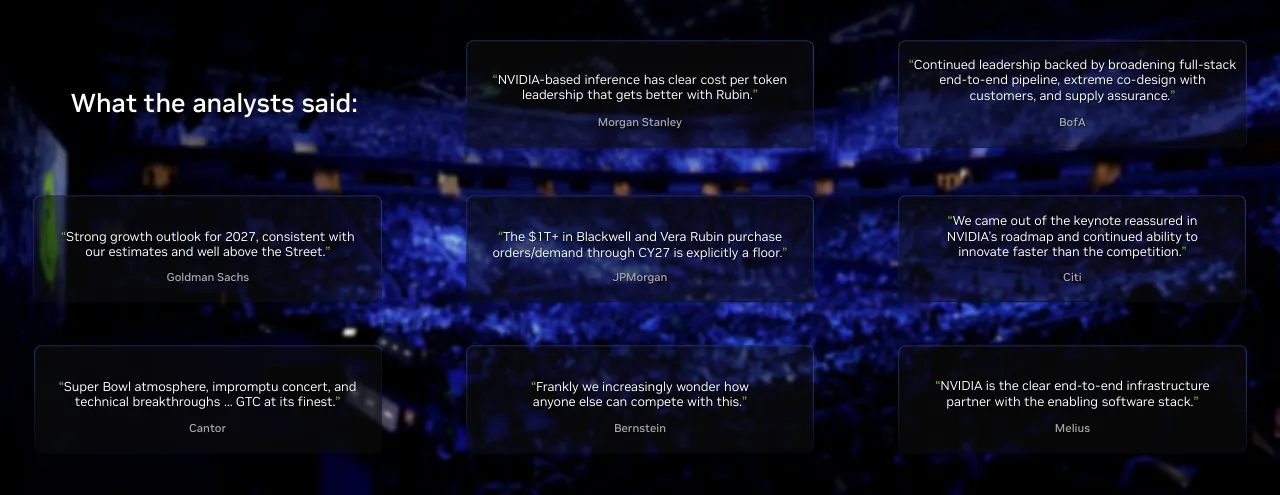
What the analysts said: / “NVIDIA-based inference has clear cost per token leadership that gets better with Rubin.” / Morgan Stanley / “Continued leadership backed by broadening full-stack end-to-end pipeline, extreme co-design with customers, and supply assurance.” / BofA / “Strong growth outlook for 2027, consistent with our estimates and well above the Street.” / Goldman Sachs / “The $1T+ in Blackwell and Vera Rubin purchase orders/demand through CY27 is explicitly a floor.” / JPMorgan / “We came out of the keynote reassured in NVIDIA’s roadmap and continued ability to innovate faster than the competition.” / Citi / “Super Bowl atmosphere, impromptu concert, and technical breakthroughs … GTC at its finest.” / Cantor / “Frankly we increasingly wonder how anyone else can compete with this.” / Bernstein / “NVIDIA is the clear end-to-end infrastructure partner with the enabling software stack.” / Melius
Visuals: Full-bleed photograph of a large arena or conference hall filling with a dense blue-lit audience, shot from an elevated wide angle with a central perspective receding into the distance; crowd and stage lights glow blue and violet with warm orange light points on the seating rows. The photo is cropped to the full slide, darkened by a black overlay (about 55 to 60 percent opacity) so the cards and text stand out. Each of the nine quote cards is a dark translucent rounded rectangle with a thin blue-violet border; no charts, tables, logos or icons.
Slide 30
What the press said:
“NVIDIA is sustaining its leadership
in the AI chip market.”
Reuters
“NVIDIA is the engine powering
the AI revolution.”
Lex Fridman Podcast
“Vera Rubin offers a stunning 40,000,000x
compute growth within a decade.”
Wccftech
“$1 trillion won’t be enough
to meet AI demand.”
Fortune
“NVIDIA remains at the forefront of the AI
demand curve for 2026 and beyond.”
Handelsblatt
“Every industry is here. Every tech company is here.
Every AI company is here.”
All-In Podcast
“NVIDIA is the default platform where
businesses build serious AI systems.”
The Street
“No other event has brought together as
many industries, companies, AI influencers,
VCs, and startups in one place.”
eWEEK
Visuals: Background photograph: a wide, full-bleed, heavily blurred (shallow depth of field) photograph of a dense crowd of conference attendees on a trade-show floor, with exhibition booths, screens and lanyards visible as soft shapes. The composition is a crowd seen from slightly above and in front, filling the whole frame, with bright white and warm highlights at the lower-left and right edges and darker areas in the centre and top. It is cropped to the full slide, with a dark overlay (black at about 55 to 65% opacity) darkening the top and centre. Dominant colours: near-black, charcoal grey, muted blue-grey and small warm white highlights. Card panels: nine text cards are not present; eight translucent rounded rectangles hold the quotes, each a dark grey fill with a thin light-grey outline; no icons, logos or charts.
Slides 31 to 76 continue in the full text file.
Download this deck
The hosted PDF of every library deck is free for readers of the SlideDeck Co newsletter. Join with your email and the viewer and download appear here.
Preparing a results presentation or business update of your own? The SlideDeck Co Standard Deck is a slide library for business reviews, updates and plans.