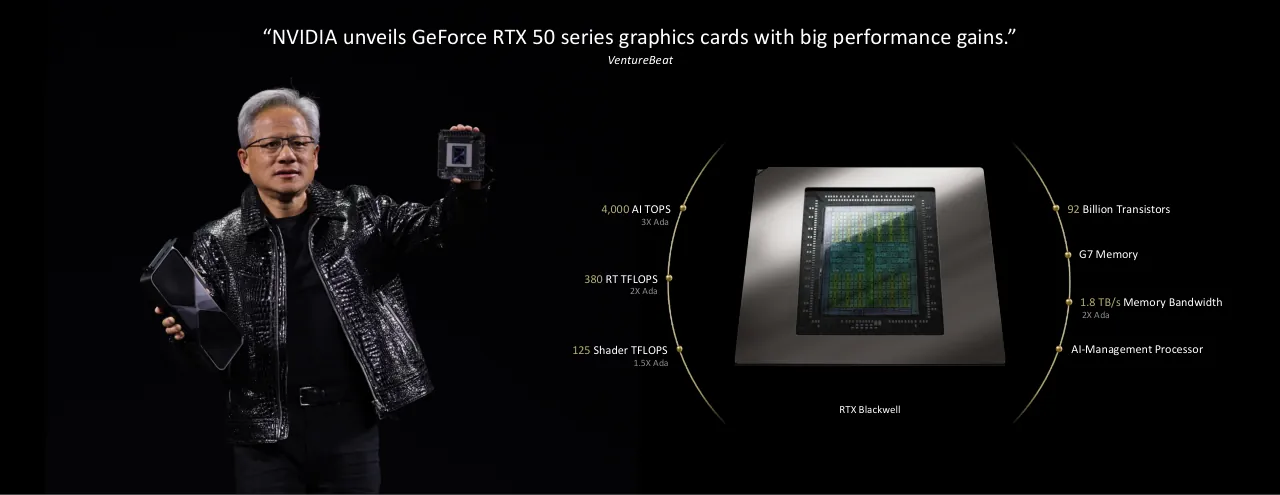
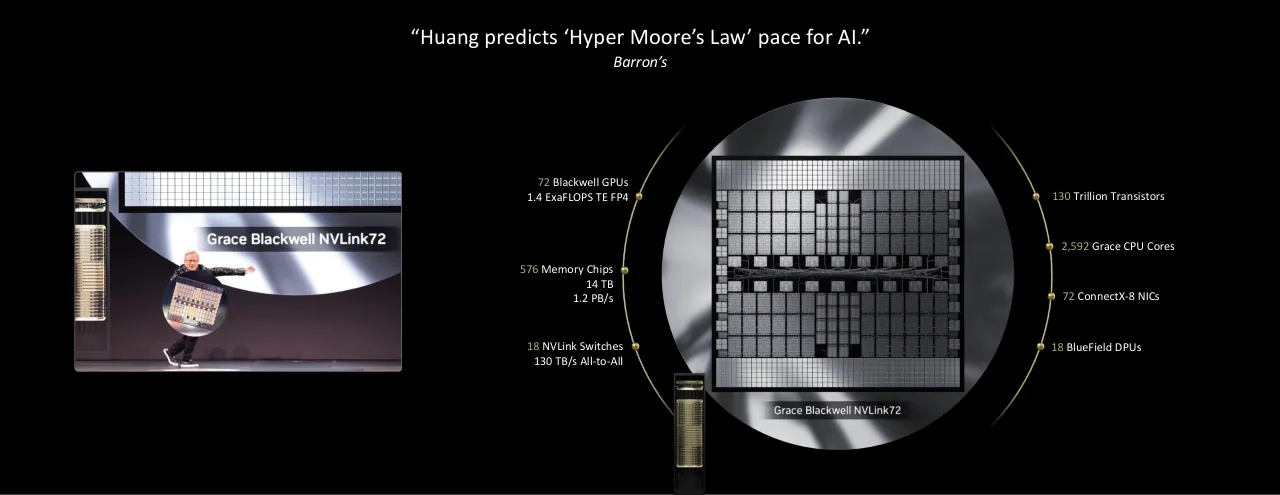
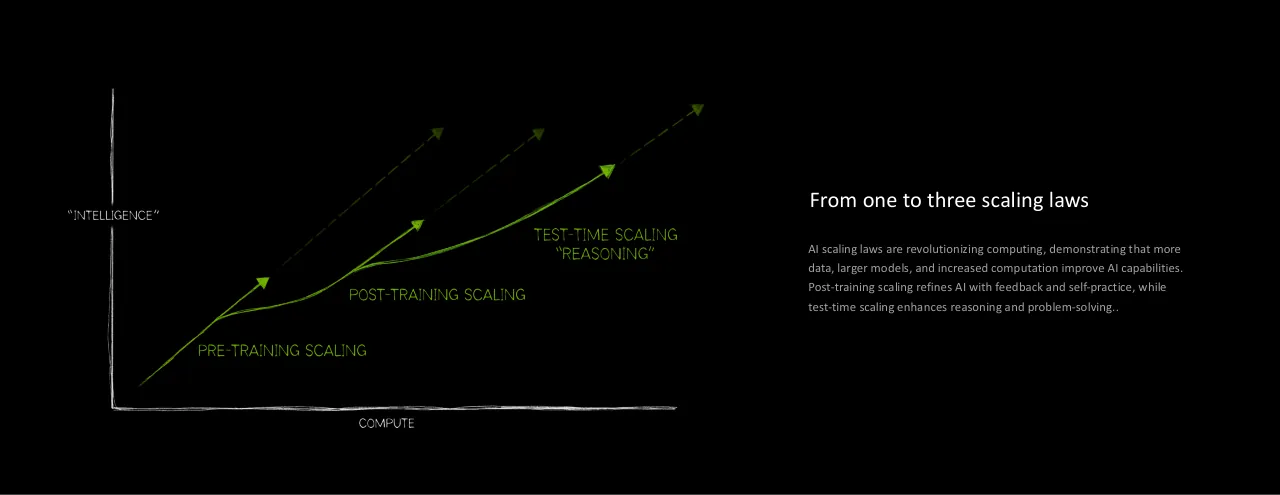
The deck is a recap of NVIDIA's announcements at CES 2025, built as a slide-by-slide highlights reel. It opens with a title slide and a run of press quotes from outlets such as Forbes, PCMag and CNET, which set the tone before any product detail. The main sections follow in order: consumer GeForce RTX 50 Series graphics and laptops, the evolution of AI from CUDA through generative AI to agentic AI, open-source AI agent blueprints, the Project DIGITS personal AI supercomputer with its GB10 specifications, Blackwell data center systems, scaling laws, and physical AI covering robotics, the Cosmos world model, and autonomous driving. Each product section pairs a headline claim with a short description and a spec or comparison graphic, such as the RTX 50 performance chart and the DIGITS spec breakdown. The deck closes on the physical AI theme and a summary of Blackwell production, with press quotes again at the end. Slides 4, 10 and 12 are the strongest examples of spec-led layouts, and slide 15 shows how a three-part system diagram can carry a whole argument.
Slides worth studying
Questions about this deck
What does NVIDIA's CES 2025 deck say about Project DIGITS?
Slide 9 describes NVIDIA Project DIGITS as a compact AI supercomputer that brings the power of the DGX platform to your desk. Slide 10 lists its GB10 Superchip with 1 PFLOP FP4 AI Compute, 128 GB of high-bandwidth unified memory and a 4 TB SSD.
How many slides does NVIDIA's CES 2025 highlights deck have?
The deck has 21 slides. Slide 1 is the title slide, and slide 21 is the final slide, a photograph of the NVIDIA headquarters building at night.
What does NVIDIA's CES 2025 deck say about Blackwell production?
Slide 11 states that Blackwell-based servers are in full production, with 200 different configurations now available. Slide 19 says NVIDIA is now in production with three new Blackwell systems.
What does NVIDIA's CES 2025 deck say about Cosmos?
Slide 16 describes NVIDIA Cosmos as the first World Foundation model, which understands the physical world and generates synthetic data and scenarios to train robotics and AI. The same slide says Cosmos is now open-source and accelerates advancements in physical AI.
Details
- Company: NVIDIA
- Year: 2025
- Type: Presentation
- Industry: Semiconductors and AI computing
- Pages: 21
More from NVIDIA
- NVIDIA investor presentation, September 2026 NDR
- NVIDIA investor presentation, Annual Stockholder Meeting June 2026
- NVIDIA investor presentation, Q2 FY27 quarterly presentation
- NVIDIA keynote, GTC Europe 2026
- NVIDIA presentation, 2026
- NVIDIA keynote, GTC 2026 Keynote
All NVIDIA decks in the library
Review score: 7 out of 10, Effective
Presentation quality, judged with the SlideDeck Co review heuristic. Ask, evidence and idea merit are not rated here.
The deck has a clear, consistent identity: black ground, green and gold accents, strong stage photography and a repeating quote-plus-visual layout that makes a 21-slide recap easy to follow. Slides 4, 12 and 13 are readable and focused, with the spec callouts on 4 and 12 and the three-curve scaling diagram on 13 each carrying one idea. The main weaknesses are that body text on the contact sheet slides (5, 7, 8, 9, 10, 14, 16, 18, 19) and many labels are tiny and low contrast, and some slides rely on press quotes as headlines instead of stating the point. Slide 12 has a stray duplicate image and an unexplained small product shot, and slides 11 and 17 are image walls with illegible labels, so the route reads as a keynote highlights reel rather than a document that can be read on its own.
Worth keeping: Keep the dark brand look, the large stage photography, and the spec-ring layouts on slides 4 and 12 and the clean scaling diagram on slide 13.
Most useful repair: Raise body and label text to a legible size and contrast on the text-heavy slides, and clean up slide 12 so the product image appears once and the callouts have a clear focus.
What would change the score: I would replace the quote-as-title pattern with short claim headlines, with the press quote as supporting evidence, and add labels or captions that make slides 11, 17 and 18 readable.
Confidence medium. 21 of 21 pages inspected on contact sheets, 4 at readable size. Reviewed 2026-11-08. Model-assisted review (claude-sonnet-5-5).
Full text of the slides (21 slides)
Every slide's words and a description of its charts and images, so the deck can be searched and rebuilt. Also available as Markdown.
Slide 1
CES 2025 / Highlights
Visuals: Photograph of a large, faceted, low-slung glass office building at night under a star-filled dark navy sky. The roof is a folded, angular dark-blue panel with small triangular skylights lit from below. The glass facade is fully lit from inside, revealing rows of office workstations, a central open atrium with a white staircase and balconies, and a few people and cars at ground level. Trees and shrubs flank the lower corners and a dark road runs along the bottom edge. Composition is a wide, centred, eye-level frontal view, cropped at the left and right edges. Lighting is night interior light against a cool dark sky. Dominant colours: deep navy #0B1F3A, charcoal #2A2F36, warm white #F2F2F2 and interior amber. The photograph is full-bleed with no border, no overlay or tint. Also a logo: the NVIDIA logo, a green eye-shaped emblem (#76B900) followed by white uppercase wordmark 'NVIDIA', centred on the roof line at about x 38 to 62 percent, y 47 to 56 percent.
Slide 2
“NVIDIA rocks CES”
Forbes
Visuals: Photograph of a large indoor arena during a conference: a dense audience fills the seating bowl from lower foreground to the far back, lit only by blue-violet stage and ceiling lights. Overhead, rows of small round blue-white spotlights hang across the top edge of the frame. Along the back walls, blue banners read 'UPCOMING EVENTS' and 'MANDALAY BAY' repeated. On the right, a brightly lit white rectangular stage platform with a single presenter in dark clothing standing and gesturing toward the audience; a dark stage monitor sits at the stage edge and stairs run up the right-side seating. Composition is a wide panoramic shot from an elevated side angle, with the audience in the foreground dark silhouettes and the stage at right third. Lighting is low-key, dominated by the bright white-lit stage and blue-violet ambient glow. Dominant colours are near-black, deep indigo #1A1A4A, and violet-blue #3B3BB0 with white highlights. The photo is full-bleed, uncropped at the frame edges, with no overlay or tint beyond the natural darkness of the scene.
Slide 3
Shin Fang Global
Courtesy of the Ladenburg Family
Why are tokens fundamental to AI?
Medical iSight
NVIDIA Tokkio
Visuals: Five photographs and one illustration, all unframed and cropped to rectangles. (1) Top-left, Shin Fang Global: two robotic arms with jointed metal links hold a copper bowl over a bright flame; white steam rises, with a brick wall behind and bottles and glassware on a wooden bench at left; warm amber and orange lighting with near-black surroundings; caption box at bottom centre. (2) Top-middle, Courtesy of the Ladenburg Family: a black-and-white archival photograph of an elderly seated woman in a light dress and a smiling man in a suit reading a paper, with other men in suits behind; the image is repeated as a stack of offset grey outlined frames fanning out behind it; caption box at bottom centre. (3) Bottom-left, Medical iSight: a surgical operating room with a bright ceiling lamp, a large dark monitor, and a surgeon in blue scrubs wearing a white VR headset pointing at equipment; a pink 3D rendered human brain with red blood vessels hangs over the left edge and extends down to the bottom; blue and white cool lighting; caption box at bottom left. (4) Bottom-middle, NVIDIA Tokkio: a head-and-shoulders studio portrait of a man with short dark hair, facing the camera with a red light on one side of his face and a blue-black background; he wears a dark high-collared top with thin glowing cyan light arcs at the neck; a rounded translucent white-outlined text box reading Why are tokens fundamental to AI? with a paper-plane send icon at its right end overlays his face; caption box at bottom centre. (5) Right, large photograph: a man with white hair seen from behind wearing a shiny metallic blue-black sequined leather jacket and dark trousers, standing on a raised illuminated stage edge, arm raised; a dark arena with rows of white and blue stage lights and three bright spotlights overhead; cool blue dominant lighting, full height and full width of the right half.
Slide 4
“NVIDIA unveils GeForce RTX 50 series graphics cards with big performance gains.”
VentureBeat
4,000 AI TOPS
3X Ada
380 RT TFLOPS
2X Ada
125 Shader TFLOPS
1.5X Ada
92 Billion Transistors
G7 Memory
1.8 TB/s Memory Bandwidth
2X Ada
AI-Management Processor
RTX Blackwell
Visuals: Photograph: a man with swept-back grey hair and thin-rimmed glasses, wearing a black glossy crocodile-embossed leather jacket over a black shirt and black trousers with a black belt, standing centre-left and looking towards the audience. In his right hand (image left) he holds a black angular graphics card with a silver-grey X-shaped fan shroud; in his left hand (image right, raised) he holds a small square black GPU module with a blue-lit die. Lit by a dark spotlight from above, with a near-black background; dominant colours black, silver-grey and glossy black. Full-length framing, not cropped at the bottom, presenter occupies roughly the left 46 percent of the slide. Photo blends into the black background with no visible border. Illustration/photo: a product photograph of the RTX Blackwell GPU die on a brushed silver-grey tray, viewed at a slight top-down angle; the die is black with a green-and-yellow grid of cores and a lighter upper-left region. Gold arc: a thin gold (#B7A870) curved line forming a partial circle, opening to the left and right at the top and bottom, with small gold dots marking six points: upper-left at the 4,000 AI TOPS label, middle-left at 380 RT TFLOPS, lower-left at 125 Shader TFLOPS, upper-right at 92 Billion Transistors, middle-right at G7 Memory and 1.8 TB/s Memory Bandwidth, lower-right at AI-Management Processor. Chart: none; the callouts are text with no numeric axes. Small raster fragments sit behind the callout labels and are unreadable; they are decorative.
Slide 5
RTX 5070 Laptop
4090 Performance,
Half the Power
“GeForce RTX 50-Series mobile GPUs
bring AI-based rocket fuel to
gaming laptops.”
PCMag
The GeForce RTX 50 Series brings the power of Blackwell
architecture to laptops, delivering unmatched performance in
models as thin as 14.9mm. With neural rendering and AI-driven
efficiency, these laptops redefine portable computing, starting
at $1,299.
ALAN WAKE II
Visuals: One photograph-style product render of a thin laptop, shown front-on and open, centred in the left half. The screen shows a still from the game Alan Wake II: a symmetrical, corridor-like interior with tall dark pillars, glowing amber ceiling panels and a warm golden light at the far end, with a small human figure walking toward a lit doorway and a wide carpeted floor in the foreground; the logo ALAN WAKE II is printed in white bold capitals at the lower left of the screen. The keyboard is backlit with green key glyphs, and a green glow sits on the trackpad hinge at the bottom centre. The chassis is dark grey metal with light grey edges. Lighting is dark and low-key, with the screen as the main light source. Dominant colours are black, amber, brown, grey and green. The render is not cropped, full-bleed or boxed; it sits directly on the black background with no frame or overlay. No charts, tables, logos or icons other than the game logo on screen.
Slide 6
“We were at the NVIDIA keynote and it was amazing.” / Overclocking.com
Visuals: Photograph, full-bleed, covering 100% of the slide. Subject: a single presenter in a dark jacket and dark trousers standing small at centre stage, facing the audience. Behind him is a large ornate golden-brown stage backdrop with gothic-style architecture: two tall fluted stone columns with lion-head bases flanking a central carved panel with gear-like medallions and a vertical golden cross-shaped motif, plus arched doorways with glowing ornate gold panels at far left and right and small flames burning at the base of the outer arches. The lower third shows a dense audience silhouetted in dark blue-black light, many people holding up smartphones to record. Composition: wide shot from the audience perspective, stage occupying the middle band, audience filling the bottom band. Lighting: warm amber and orange light on the stage architecture, cool dark blue shadowing on the audience. Dominant colours: amber, bronze and gold on stage; near-black and navy in the audience. The photo is not cropped inside a box and has no tint overlay beyond natural darkening of the audience area to improve text legibility.
Slide 7
“AI at CES 2025 was all about / NVIDIA.” / CNET / In 2012, deep learning discovered NVIDIA CUDA—the / language of accelerated computing—sparking the AI / revolution. Early models like CNNs and LSTMs solved / perception, driving massive AI research that led to GANs, / diffusion models, and transformers, culminating in the / generative AI moment with ChatGPT. Now, foundation / models, distillation, prompting, large context, and RAG are / unlocking Agentic AI. Next up: physical AI—models that / understand and interact with the physical world. And this / is just the beginning. / 2012 ALEXNET / PERCEPTION AI / SPEECH RECOGNITION / DEEP RECSYS / MEDICAL IMAGING / GENERATIVE AI / DIGITAL MARKETING / CONTENT CREATION / AGENTIC AI / CODING ASSISTANT / CUSTOMER SERVICE / PATIENT CARE / PHYSICAL AI / SELF-DRIVING CARS / GENERAL ROBOTICS
Visuals: Diagram: a single hand-drawn green (#76B900) arrow curve, drawn as a thick sketchy stroke, starts at about x 45% y 80% beside the 2012 AlexNet sketch, runs right and upward through the Perception AI, Generative AI and Agentic AI labels, and ends at an arrowhead near x 86% y 25% pointing up and right toward Physical AI. Stage labels sit beside the stroke at successive heights, each a green heading with white sub-items beneath. Illustrations: white hand-drawn line-art sketches, all in white on black, placed at the 2012 AlexNet label (lower-left, showing stacked memory-module and GPU-card style outlines) and as small fragments scattered around the arrow; no photographs, charts or logos.
Slide 8
NVIDIA AI Blueprints
Software Security AI Agent
“NVIDIA’s AI agent play is here with
new models, orchestration blueprints.”
VentureBeat
NVIDIA’s open-source blueprints empower enterprises to build and customize
digital AI agents for their unique needs. These blueprints provide ready-to-use
frameworks for various applications, enabling organizations to integrate and
scale agentic AI seamlessly into their operations.
NVIDIA NeMo
Curator
Customizer
Evaluator
Guardrails
RAG Retriever
NVIDIA NIM
Understanding &
Reasoning
Information Retrieval
AI Safety
Digital Human
Visual Content
Generation
Digital Biology
Physical AI
Visuals: Diagram with a portrait-style avatar at top centre, a horizontal row of five rounded rectangles connected by short lines, and a horizontal row of seven hexagonal icons with captions. Top: a circular avatar, 234 by 234 px image, of a stylised 3D cartoon man with grey swept-back hair, dark-rimmed glasses, a light smile and a grey crew-neck top, set in a thin light-grey circular ring (about 2 px) with a soft green outer glow; the circle is centred at about x 34.4%, y 28.9%, diameter about 11.1% of width. To its right, the text Software Security / AI Agent in white bold sans-serif, centred at about x 45%, y 11%. Behind the avatar is a large soft dark-green radial glow (341 by 341 px image, about x 26.4%, y 8.1%, w 16.1%, h 41.7%) fading into black, and a wider 819 by 461 px image (x 21.8%, y 7.8%, w 33.8%, h 49.1%) that is the same soft glow, not a boxed photo. Middle: five black rounded rectangles with a bright green (#76B900) bottom bar, each about 8.3% wide and 4.5% high, labelled Curator, Customizer, Evaluator, Guardrails and RAG Retriever in white; short grey connector lines join each box to the next at mid-height, forming a left-to-right chain. Bottom: seven hexagonal NVIDIA-style NIM badges, each a dark charcoal hexagon with a light-grey outline and a green (#76B900) base plate, containing a small emblem: chat bubbles (purple and green) for Understanding & Reasoning; a dark panel with coloured squares and a blue magnifier for Information Retrieval; a white hexagon with a green atom-like symbol for AI Safety; a photographic portrait of a smiling man in a dark jacket for Digital Human; a blue tree on a green hill for Visual Content Generation; a multicoloured tangle of loops on a dark ground for Digital Biology; and a photographic Earth globe for Physical AI. Captions sit under each hexagon in small white sans-serif. Nothing is cropped; no overlay or tint on the icons. Quote: no graphic device beyond the opening quotation mark glyph.
Slide 9
“NVIDIA’s project digits is a personal AI
supercomputer.”
TechCrunch
NVIDIA Project DIGITS is a compact AI supercomputer that brings the power
of the DGX platform to your desk. Powered by the Grace Blackwell GB110
chip, it supports NVIDIA’s full AI stack, operates as a cloud platform or
workstation, and enables seamless AI development for researchers, startups,
and professionals alike.
Visuals: One photograph occupying the left panel at x 0, y 0, w 57.6, h 100, full-bleed to the top, bottom and left edges, not boxed and not cropped to a shape. Subject: a desk workstation in a bright room. A dark flat-panel monitor on a black stand sits centre-left of the image; its screen shows a dark code-editor and file-browser interface, with a central dark pane containing a dense cloud of colourful particles or cluster visualisation (red, orange, yellow, teal, green and grey-white spray), and a right-hand pane of red, green and white code lines. In front of the monitor on a light wood desk are a black keyboard, a black mouse at right, and a small beige woven-fabric box with a green indicator light at left. Behind the desk are blurred windows letting in soft daylight, several potted green plants, a green climbing plant at right, and a bookshelf with blue and brown items. Lighting is soft natural daylight from the upper left; dominant colours are warm wood brown, black, beige and green. No overlay or tint is applied. The image has no captions.
Slide 10
“NVIDIA’s tiny computer for AI developers steals the / show at CES.” / CNBC / Fully compatible with NVIDIA’s AI ecosystem, DIGITS empowers / researchers, startups, and professionals to advance AI innovation / anywhere. / GB10 Superchip / Blackwell GPU / 1 PFLOP FP4 AI Compute / Connectivity / Wi-Fi, Bluetooth, USB / Grace CPU / 20 Arm Cores / ConnectX / NCCL, RDMA, GPUDirect / High-Bandwidth Unified Memory / 128 GB Low-Power DDR5X / 4 TB SSD
Visuals: Photograph of a presenter (grey-haired man with glasses, black crocodile-texture leather jacket over a black shirt) standing centrally, raising his right hand with a small black chip-sized module between his fingers and holding a small gold-and-black device in his left hand at lower right of the figure. Lit by a soft frontal key light against black; dominant colours black, silver-grey hair, gold-brown device. Cropped at the bottom edge of the slide, not boxed, sitting on the black background with no tint. Second image: exploded-view render of the NVIDIA DIGITS GB10 computer on black: a gold-brass top cover at upper centre, a perforated gold-brass foam-textured side bracket, a black circuit board with a small Blackwell GPU module (green-tinted package) at upper right of the board, a Grace CPU area, a ConnectX chip at centre-left, a black SSD area and connectivity ports at left, and a gold-brass base tray with NVIDIA logo at lower right. Callout leader lines (thin gold-grey, about 0.1% of slide height) run from each label to its component: Blackwell GPU, Grace CPU, Connectivity, ConnectX, 4 TB SSD, High-Bandwidth Unified Memory. Labels are text only and no arrows are used. A small third image (about 30% wide, 17% tall) sits at the bottom-left below the presenter and is part of the photo area.
Slide 11
“Blackwell-based servers are in full production — 200 different configurations now available.” / Tom’s Hardware / ASUS ESC AI POD / NVIDIA GB200 NVL72 / GIGABYTE / Microsoft Azure / Oracle Cloud Infrastructure / HPE / Foxconn / CoreWeave / Meta / Blackwell in / Full Production / ASUS / Aivres / ASRock Rack / AWS / Quanta/QCT / Inventec / Dell Technologies / Lenovo / Google / Wistron Wiwynn / Supermicro / PEGATRON
Visuals: One placed image, 3840 by 1080 pixels, shown as a mosaic of about 21 rectangular photographs of server racks, each with a small white-on-black label tag at its lower right. Photographs, left to right: AWS (tall rack with green, orange and yellow cables, full-height column); GIGABYTE (dark server chassis with blue-lit fans, top of a rack, cropped at left by a diagonal); CoreWeave (blue-lit rack with dense cabling); Quanta/QCT (grey server chassis stacked, front view); Foxconn (beige and white server trays with white cables); Inventec (two dark cabinets, one with a small screen); ASUS (black rack with grey chassis and a tan/gold frame, header sign ‘ASUS ESC AI POD NVIDIA GB200 NVL72’); Microsoft Azure (blue-tinted interior with white cable trays and grey panels); Aivres (grid of black fan modules over server trays); Dell Technologies (dark rack with blue cables and grey chassis); Lenovo (dark server chassis with fans); Google (dark rack with dense red, yellow and blue cables); ASRock Rack (angled grey server tray with fans); Oracle Cloud Infrastructure (two dark cabinets with red cables and grey modules); Meta (blue-purple lit rack with bundles of black and yellow cables); Wistron Wiwynn (rack with green fibre cables and blue-tipped modules); Supermicro (grey server units with orange and black accents); HPE (grey servers with blue and red cables); PEGATRON (tall dark rack of grey server units). Lighting is mostly ambient or LED-lit; the mosaic is full-colour photography with no tint or overlay, the photographs are rectangular, boxed, with straight edges and no rounding, and each is cropped to its cell.
Slide 12
“Huang predicts ‘Hyper Moore’s Law’ pace for AI.”
Barron’s
72 Blackwell GPUs
1.4 ExaFLOPS TE FP4
130 Trillion Transistors
2,592 Grace CPU Cores
576 Memory Chips
14 TB
1.2 PB/s
72 ConnectX-8 NICs
18 NVLink Switches
130 TB/s All-to-All
18 BlueField DPUs
Visuals: Photograph of a presenter on a stage, boxed with slight rounded corners, placed left. He wears a dark jacket and trousers, one arm extended to the right, and holds a round chip image in front of his body. Behind him is a large screen reading 'Grace Blackwell NVLink72' with a silver-white curved backdrop and a tall gold-lit server rack at the left edge. Stage floor is dark maroon-grey; lighting is stage spotlight. Circular chip diagram: a large grey metallic disc (about 28% of slide width) showing a top-down rendering of the Grace Blackwell NVLink72 package, with a square chip die in the centre. Beneath the disc a small plate reads 'Grace Blackwell NVLink72'. A thin gold arc surrounds the disc. A tall gold NVLink switch tower sits at the bottom centre, overlapping the arc. Gold dots mark the eight callout positions on the arc. Numbers are in gold #B7A870 and labels in white. No legend, chart or table.
Slide 13
"INTELLIGENCE" / COMPUTE / PRE-TRAINING SCALING / POST-TRAINING SCALING / TEST-TIME SCALING / "REASONING" / From one to three scaling laws / AI scaling laws are revolutionizing computing, demonstrating that more / data, larger models, and increased computation improve AI capabilities. / Post-training scaling refines AI with feedback and self-practice, while / test-time scaling enhances reasoning and problem-solving..
Visuals: Hand-drawn line chart in white and lime-green chalk-style strokes on black. Type: conceptual scaling-curve sketch, not a data chart. Y-axis labelled "INTELLIGENCE" (quoted, white, uppercase) with an upward arrow-less vertical line; X-axis labelled COMPUTE (white, uppercase) with a horizontal line, no tick values, no units, no numeric ranges. Three solid lime-green curves rising left to right, each ending in an arrowhead: the lowest curve labelled PRE-TRAINING SCALING (green label beneath its flat middle section), the middle curve labelled POST-TRAINING SCALING, and the top curve labelled TEST-TIME SCALING / "REASONING" (two lines, green, right of the curve). Each solid curve continues as a dashed dark-green extension with an arrowhead, fading toward the top right; three dashed extensions in total. No legend, no highlighted data points, no values printed. The sketch is a hand-drawn image placed over the left area.
Slide 14
“NVIDIA bets big on robots.” / The New York Times / NVIDIA is revolutionizing robotics with accelerated / computing and simulation technologies, enabling AI to / learn and refine tasks in physically-based virtual worlds. / By combining synthetic data with real-world scenarios, / this approach accelerates the development of / autonomous systems, from self-driving cars to humanoid / robots, transforming industries and unlocking / unprecedented possibilities. / Omniverse / 3D / Cosmos
Visuals: A single composite image, 2132 by 1113 pixels, containing two rounded-corner rectangular panels joined by a small connector. Left panel: a 3D render (Omniverse) showing a grey floor and a green-grey table edge, with a blue plastic crate holding three oversized bright green steering wheels, and a white robotic arm gripping a wheel; a white robot part is visible at the bottom right corner. Right panel: a photograph of a warehouse interior with stacks of cardboard boxes on wooden pallets along high shelving, polished grey concrete floor with yellow safety lines, and a dark grey cart holding three black steering wheels with a white robotic arm gripping one. The two panels are boxed with thin rounded corners and no visible border; the render is slightly darker and cooler than the warm, reflective photograph. Between the panels a thin grey horizontal line with a small arrow points right, with the label '3D' in white bold-looking small caps at its centre. Under the left panel, a bright green (#76B900) circular Omniverse logo sits centred, labelled 'Omniverse' in small white text below it. Under the right panel, a dark grey hexagonal Cosmos logo with a green base sits centred, labelled 'Cosmos' in small white text below it. Dominant colours: black, bright green, blue, grey, warm orange-brown of boxes.
Slide 15
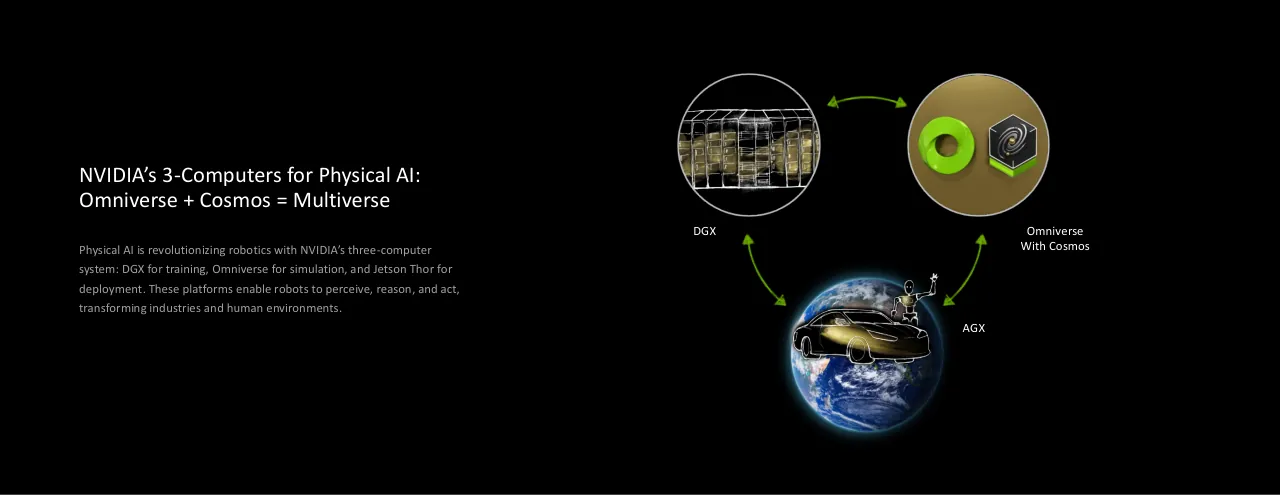
NVIDIA’s 3-Computers for Physical AI: / Omniverse + Cosmos = Multiverse / Physical AI is revolutionizing robotics with NVIDIA’s three-computer / system: DGX for training, Omniverse for simulation, and Jetson Thor for / deployment. These platforms enable robots to perceive, reason, and act, / transforming industries and human environments. / DGX / Omniverse / With Cosmos / AGX
Visuals: Diagram (triangle of three nodes with labels). Node 1 at top left: a light grey outlined circle (about 52.5% to 64.5% x, 14.6% to 45.3% y) containing a black-and-gold pen-and-ink sketch of a server rack (DGX) with stacked gold-tinted units. Label 'DGX' beneath it. Node 2 at top right: a gold-brown filled circle (about 70.8% to 82.1% x, 14.7% to 43.9% y) with a light grey outline, containing a green torus (ring) logo at left and a dark grey hexagonal chip-like icon with a galaxy swirl at right, the hexagon having a green base edge. Label 'Omniverse / With Cosmos' beneath it. Node 3 at bottom centre: a blue and white photographic Earth globe (about 61.5% to 72.9% x, 59.8% to 75.5% y) with a white-outlined sketch of a gold-and-black sports car over the Africa/Europe area and a white-outlined humanoid robot waving at the upper right of the globe. Label 'AGX' to the right of the globe. Connectors: three green (#76B900) curved double-headed arrows with arrowheads at both ends, one between the DGX and Omniverse circles at the top, one from DGX down to the Earth globe at lower left, and one from Omniverse down to the Earth globe at lower right.
Slide 16
“NVIDIA Cosmos - an AI platform to / change the future of robots and cars - / wins Best of CES 2025.” / ZDNET / NVIDIA Cosmos, the first World Foundation model, understands the / physical world, generating synthetic data and scenarios to train / robotics and AI. Now open-source, / it accelerates advancements in physical AI. / Autoregressive Model / Diffusion Model / Video Tokenizers / Video Processing and Curation Pipeline
Visuals: Four-panel diagram image, placed at x 40.1%, y 16.8%, w 56.5%, h 74.4%, with a black background. Top-left panel 'Autoregressive Model': a grey cube, a gold trapezoid encoder, a large gold square transformer block with grey pin rows above and below, then a horizontal line with small gold squares as output tokens. Top-right panel 'Diffusion Model': a grey cube, a gold trapezoid, a small grey noise grid with a circle node, a large gold transformer block with pins, a gold grid of tokens, a gold trapezoid decoder and a grey cube output. Bottom-left panel 'Video Tokenizers': outline rectangles of video frames at each end, gold trapezoid encoder and decoder, and a cluster of gold and grey cubes in the middle, with arrows between them. Bottom-right panel 'Video Processing and Curation Pipeline': a row of grey and gold rectangles, a dashed box above a grey box, a person icon and gold square connected by lines to a database icon, and a return loop below. Central logo: a black hexagon with a silver and gold galaxy/orbit emblem, lit from above, on a bright green (#76B900) hexagonal base. Lighting is flat, dominant colours are black, gold (#C8A951), silver grey and NVIDIA green. Not cropped, boxed in four rounded outline panels.
Slide 17
“NVIDIA calls robots ‘Multitrillion-Dollar’ opportunity.” / Financial Times / Apptronik Apollo / ROBOTERA Star1 / Agibot A2 / NEURA Robotics 4NE-1 / Fourier GR-2 / Boston Dynamics E-Atlas / Agility Robotics Digit / Figure Figure 02 / 1X NEO / Galbot G1 / Mentee MenteeBot / Unitree H1 / XPENG Iron / Sanctuary AI Phoenix
Visuals: Full-bleed photograph of a large dark stage event. On a black stage, fourteen humanoid robots stand in one evenly spaced row, each shown as a bright white or light blue figure with a text label above it reading company then model; the robots appear to be images on a stage screen or presented figures. At the centre of the row a presenter in a dark patterned jacket and dark trousers stands facing the audience. In the foreground the audience is seen as dark, blurred silhouettes of heads and shoulders in the lower 40 percent of the frame, lit only by faint blue stage light. Composition is a wide horizontal frame, the photograph is not cropped in a way that removes the row of robots, and it is not boxed. Lighting is low-key with a cool blue cast; dominant colours are black, deep navy and white. No overlay tint is visible beyond the darkness of the scene. Robot figures from left to right: Apptronik Apollo (white and black humanoid, full body, upright, hands at sides), ROBOTERA Star1 (white upper body with black legs), Agibot A2 (white and black humanoid), NEURA Robotics 4NE-1 (white body with black lower limbs and a teal chest panel), Fourier GR-2 (seated pose, blue and white), Boston Dynamics E-Atlas (blue and white, with a ring-shaped head marker), Agility Robotics Digit (cyan and white with a cyan head), presenter in centre, Figure Figure 02 (dark grey and white), 1X NEO (white and dark grey), Galbot G1 (white and grey), Mentee MenteeBot (white and grey), Unitree H1 (light blue and white), XPENG Iron (white), Sanctuary AI Phoenix (white and dark grey). No charts, tables, diagrams or logos are present.
Slide 18
“NVIDIA is taking over the autonomous driving market.” / AutoBlog / NVIDIA’s AV platform combines advanced training, simulation, and deployment systems, powered by the Thor robotics computer, to drive autonomous vehicle innovation. At CES, NVIDIA announced a partnership with Toyota to develop next-generation EVs.
Visuals: One illustration occupies about x 5.3%, y 5.6%, w 53.7%, h 78.1%. It contains a grid of 17 company logos in three rows above a band of line-drawn vehicles. Row 1, left to right: Waymo (W with WAYMO beneath), Zoox (ZOOX wordmark), Tesla (T emblem), Aurora (Aurora wordmark), BYD (oval BYD emblem), JLR (stylised JLR), Li Auto (Li Auto wordmark with leading mark). Row 2, left to right: Mercedes-Benz (three-pointed star in ring), Toyota (TOYOTA wordmark, white with soft glow), Nuro (nuro wordmark), Waabi (waabi wordmark), Wayve (circular Wayve emblem), Rivian (RIVIAN wordmark). Row 3, left to right: Xiaomi (mi in rounded square), Volvo (VOLVO wordmark, spaced letters), Lucid (LUCID wordmark, spaced letters), Zeekr (square Z emblem with ZEEKR wordmark). All logos are white on black. The vehicle band sits below the logos, about y 51% to 78%, and is drawn as dark teal-black filled silhouettes with bright white and green-yellow edge highlights. Left to right the vehicles are: a Cybertruck-style angular pickup, a sleek sedan, a boxy van-like EV, a sedan, a low sedan, two tall semi-trucks at the back, a large sleeper semi-truck with a rounded cab, a sedan, a robotaxi with roof sensor pod, a wagon-style car with roof sensors, a sensor-topped shuttle, and a boxy SUV-style pickup at the far right. The image is not cropped and has no overlay. Lighting is a soft front glow from the edges of each vehicle. Dominant colours are black, dark teal, white and yellow-green.
Slide 19
“It’s NVIDIA’s world, and we’re all just
living in it..”
Automotive News
NVIDIA is now in production with three new Blackwell systems.
Grace Blackwell supercomputers with NVLink72 are deployed
worldwide. Omniverse and Cosmos—the world’s first physical AI
foundation model—are open and ready to accelerate industries
like robotics. NVIDIA is also pushing the boundaries of innovation
with breakthroughs in humanoid robots and autonomous
vehicles.
Visuals: Photographic and rendered illustrations, all on black. (1) Left group of three circular badges: top badge shows a dark square NVIDIA-style processor chip (grey-silver metal package with a dark green-black die) in a circle with a thin green rim; lower-left badge shows an exploded view of a server/computer module with stacked grey-beige boards and a wooden-looking crate frame; lower-right badge shows a close-up of a black circuit board with a central grey heatsink-like chip and blue-green connector pins along the bottom edge. (2) Centre badge: a larger olive-gold (#8A7535) filled circle with a thin green rim containing two 3D icons side by side: a glossy bright-green torus/ring on the left and a black hexagonal tile with a white spiral galaxy-like graphic and a green base edge on the right. (3) Right group of three circular badges: top badge shows a 3D cartoon-style avatar of a smiling man with grey hair, round glasses, and a light blue shirt; lower-left badge shows a dark teal-lit concept car in wireframe-like rendering; lower-right badge shows a white and grey humanoid robot with blue lit chest panel and arms. (4) Two rows of small grey-white humanoid robot figures standing in front view on black, about 7 figures on the left (one holding a tray, one with a teal-highlighted torso) and about 7 figures on the right (one holding an object at its side, one with a sensor on its head, one seated on a grey base); figures are small, evenly spaced, lit softly from the front. All images are placed as rectangles with black backgrounds blending into the slide, not cropped, no overlay or tint; circular badges are masked to circles with thin green (#76B900) rims about 0.2% of slide width.
Slide 20
“NVIDIA hands-down won AI at CES 2025, / and also the show itself.” / CNET
Visuals: One photograph, full-bleed, a wide landscape crop of about 2000 by 774 px. Subject: a single adult man in dark silhouette, seen in profile facing right, standing on a dark stage floor. He is at about x 47 to 53%, y 25 to 92% of the slide. Behind him is a large, curved, glowing blue projection screen filling the left and centre of the frame, with fine horizontal streaks. On the right a bright white-blue radiating light burst sits at about x 75 to 82%, y 25 to 50%, and the screen edge angles down to the right. The far right, about x 85 to 100%, is almost black. Lighting: backlit by the screen, so the man is a silhouette. Dominant colours: deep navy #0A2A5E, electric blue #2E7FD0, near-black #05070D, bright highlight #DDF0FF at the burst centre. Composition: subject placed right of centre, quote in the open blue area on the left. No overlay or tint is visible, and no logos or icons.
Slide 21
NVIDIA
Visuals: Photograph of the NVIDIA headquarters building at night, shown as a wide panoramic exterior view from a low frontal angle. The building has a faceted, folded dark roof with triangular skylight openings and a glass-and-steel curtain wall; the lit interior shows rows of office workstations, a central open staircase and multiple floors. The night sky is deep navy with scattered white stars across the top third. Lighting is warm interior light against cool blue night ambience; the building is dark slate with small uplights along the base and clipped hedges at the ground level. Dominant colours: navy #0B1F3A-like sky, slate grey roof, warm white interior light, NVIDIA green. The photo is full-bleed and uncropped at the edges, with no overlay. The NVIDIA logo sits on top of the roof: a green (#76B900) eye-shaped mark in a green square at left, followed by the white wordmark 'NVIDIA' in a bold geometric sans-serif.
Download this deck
The hosted PDF of every library deck is free for readers of the SlideDeck Co newsletter. Join with your email and the viewer and download appear here.
Preparing a results presentation or business update of your own? The SlideDeck Co Standard Deck is a slide library for business reviews, updates and plans.