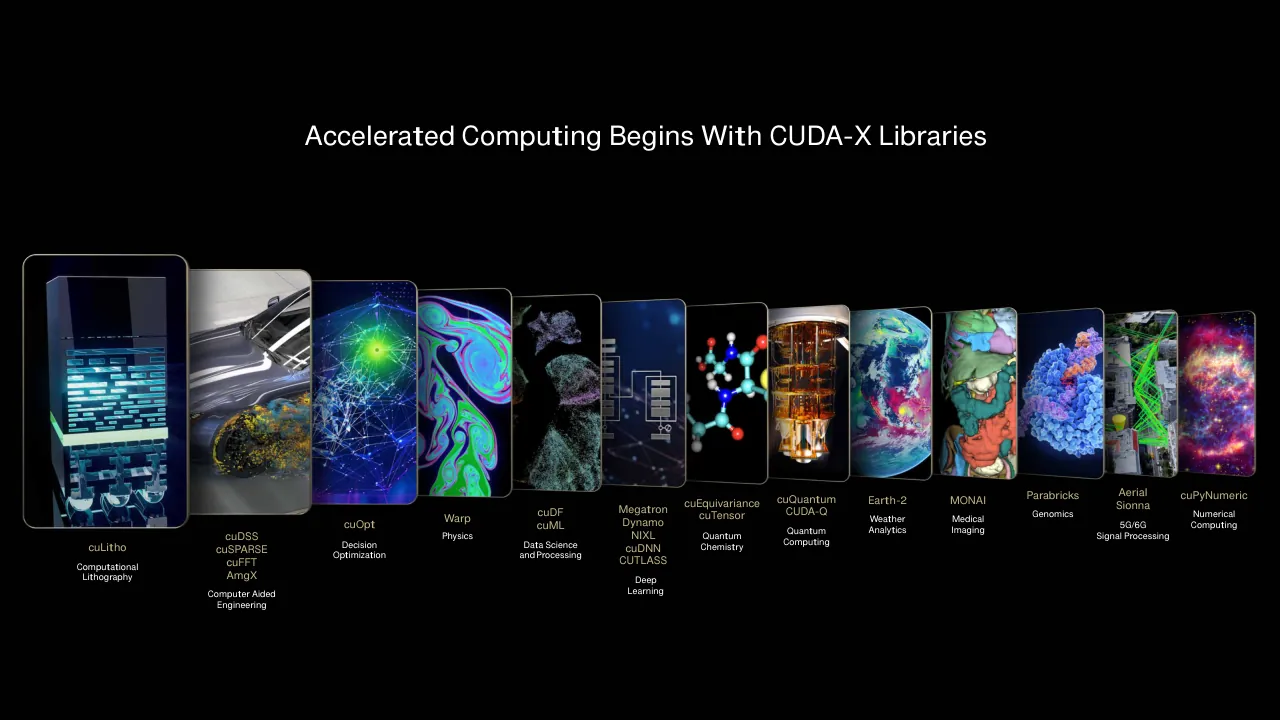
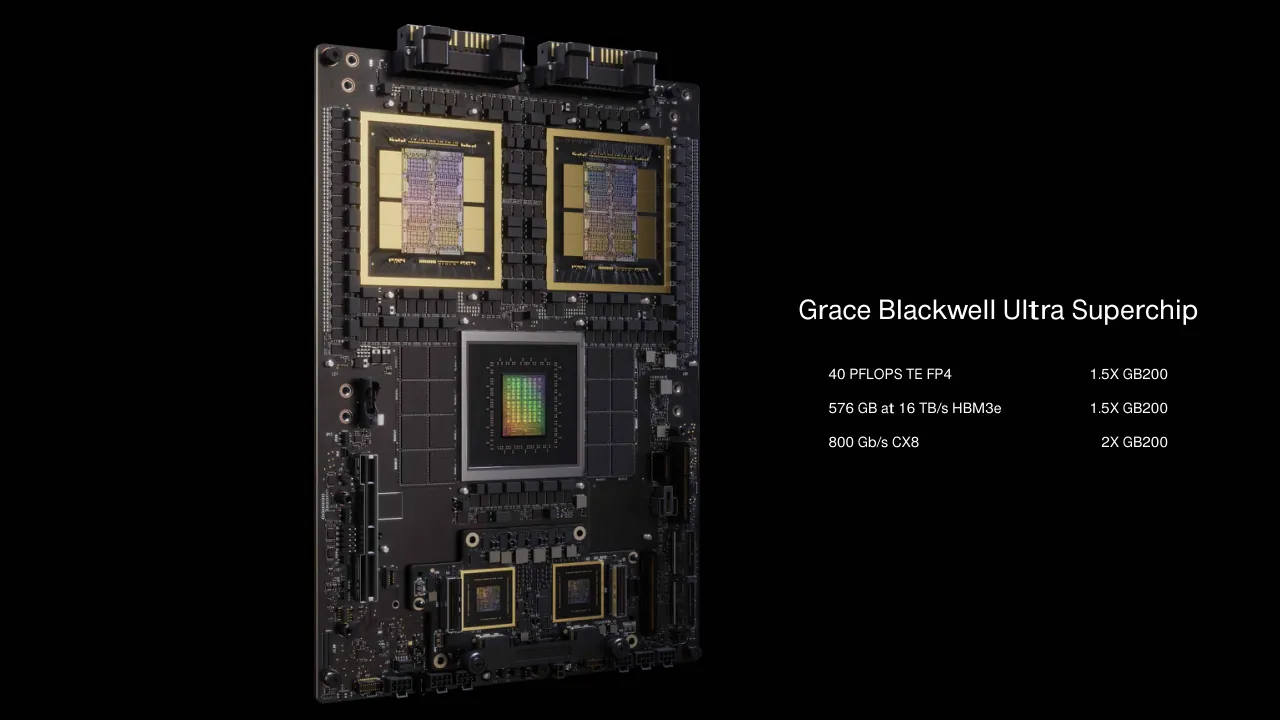
The deck opens with the NVIDIA transformation from GPU chip maker to AI infrastructure provider and then moves through its main sections in order. These cover the CUDA-X library stack, 6G and AI-RAN signal processing, quantum-GPU computing, agentic AI and reasoning workloads, physical AI and robotics, and the Grace Blackwell NVL72 rack-scale systems. Partner data center projects from CoreWeave, Oracle, xAI and Stargate are shown with their power capacity and locations, followed by the Taiwan AI infrastructure announcement with Foxconn, TSMC and NVIDIA. Product sections cover NVLink Fusion for custom ASICs and CPUs, the DGX Station and RTX PRO Server, and the enterprise AI platform. Later slides focus on Isaac GR00T humanoid robot models and Omniverse digital twins, including a Kaohsiung City twin. The deck closes with a single-line summary slide. Slides worth studying include the CUDA-X library map on slide 5, the rack-scale hardware reveal on slide 14, and the partner data center slides on 16 to 19, where each site is labelled with its power figure in one consistent layout.
Slides worth studying
Questions about this deck
How many slides does the NVIDIA presentation deck have and how is it structured?
The NVIDIA deck has 72 slides. It opens with the transformation from GPU chip maker to AI infrastructure provider on slide 3, then moves through CUDA-X libraries, 6G and AI-RAN, quantum-GPU computing, agentic AI, physical AI and robotics, Grace Blackwell NVL72 systems, partner data centers, the Taiwan announcement, and product sections, and closes with a single-line summary slide.
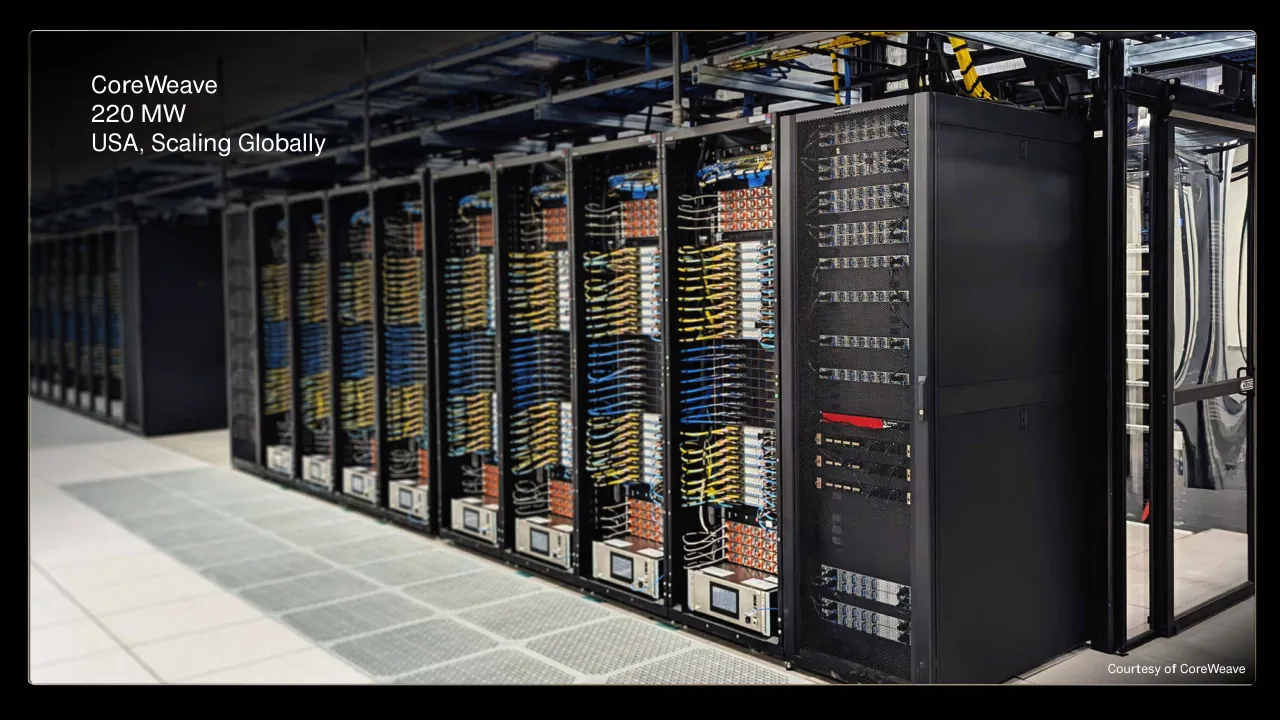
What power capacity does the NVIDIA deck list for the CoreWeave data center project?
Slide 16 labels the CoreWeave project as 220 MW in the USA, with the text 'Scaling Globally'. The slide credits the image as courtesy of CoreWeave.
What does the NVIDIA deck say about the Taiwan AI infrastructure announcement?
Slide 21 is titled 'Announcing Foxconn, Taiwan, TSMC and NVIDIA Build AI Infrastructure for Taiwan'. It shows the logos of FOXCONN, HON HAI TECHNOLOGY GROUP, NSTC, tsmc and NVIDIA.
What performance figures does NVIDIA give for the RTX PRO Server on slide 31?
Slide 31 lists 30 PFLOPS FP4 AI Performance and 8 x RTX PRO 6000 Blackwell Server Edition GPUs. It also lists 3 PFLOPS RTX Graphics Performance and 800 GB GPU Memory.
Details
- Company: NVIDIA
- Year: 2025
- Type: Keynote
- Industry: Semiconductors
- Pages: 72
More from NVIDIA
- NVIDIA investor presentation, September 2026 NDR
- NVIDIA investor presentation, Annual Stockholder Meeting June 2026
- NVIDIA investor presentation, Q2 FY27 quarterly presentation
- NVIDIA keynote, GTC Europe 2026
- NVIDIA presentation, 2026
- NVIDIA keynote, GTC 2026 Keynote
All NVIDIA decks in the library
Review score: 7 out of 10, Effective
Presentation quality, judged with the SlideDeck Co review heuristic. Ask, evidence and idea merit are not rated here.
This is a live keynote deck with a coherent black, gold and green identity, and strong hero slides: the CUDA-X map on 5, the superchip on 14 and the data center photos on 16 to 19 have clear subjects and a consistent label layout. The weaknesses are real for anyone reading it without the speaker. Slides 8 to 12 carry reasoning text so small and dim that it cannot be read. Slides 37 to 52 are dense partner architecture diagrams with tiny labels, and slides 13 and 15 are identical, as are the repeated Omniverse slides, so some pages add little. Many slides lack a statement of what the viewer should take away, and the slide 36 table is illegible.
Worth keeping: Keep the consistent dark identity with gold titles, the single-subject hero imagery on slides 5, 14 and 16 to 19, and the 3-line site labels with power figures.
Most useful repair: Enlarge or remove the unreadable reasoning text on slides 8 to 12 and the dim table on 36, and simplify the partner diagrams on 37 to 52 to one readable message each.
What would change the score: I would cut duplicate slides such as 13 and 15 and the near-identical build frames, and add short takeaway titles on the diagram and photo-only slides.
Confidence medium. 72 of 72 pages inspected on contact sheets, 4 at readable size. Reviewed 2026-11-08. Model-assisted review (claude-sonnet-5-5).
Full text of the slides (72 slides)
Every slide's words and a description of its charts and images, so the deck can be searched and rebuilt. Also available as Markdown.
Slide 1
NVIDIA
Visuals: Logo: the NVIDIA logo lockup. On the left, the green eye-shaped emblem (a stylised eye formed by concentric curved bands inside a square block, split vertically so the left half of the eye is green and the right half is black), followed on the right by the white wordmark 'NVIDIA' in a bold geometric sans-serif capitals. Emblem fill #76B900 green; wordmark fill #FFFFFF white. No photograph, no chart, no other graphics.
Slide 2
AAEON / Accton / acer / ADATA / ADLINK / ADVANTECH / aetina / AIMobile / AIRECO / aiXon / APMIC / APPRO PHO / ASRock Rack / ASUS / ATGENOMIX / AVALANCHE COMPUTING / AVC / AVerMedia / AXIOMTEK / BIZLINK / CATHAY FINANCIAL HOLDINGS / CHANG GUNG MEMORIAL HOSPITAL / CHENBRO / CHINA MEDICAL UNIVERSITY HOSPITAL / CLEVO / COMPAL / COLORFUL / COOLER MASTER / CTBC HOLDING / deeli / DELTA / EDOM / E.SUN BANK / EverFocus / FindingsTech / FOXCONN / FOXLINK / FSP / futurenet / GIGABYTE / Industrial Technology Research Institute / Inventec / iwin / I-Shou University / iStaging / JPC connectivity / KENMEC / King Slide / KYEC / Lanner / LEADTEK / Linker Vision / LITEON / LOTES / MEGMEET / MEDIATEK / MetAI / MITAC Computing / MOONSHINE / MORALE AI / msi / National Center for High-performance Computing / National Cheng Kung University / National Hsinchu University / National Chiao Tung University / National Taiwan Normal University / National Taipei University / National Taiwan University / National Taiwan University of Science and Technology / National Taipei University of Technology / National Tsing Hua University / National Yang Ming Chiao Tung University / NuncX / onyx / PALIT / P.D.M / PEGATRON / PHISON / POD / Quanta Computer / QCT / REALTEK / REPON / SOLOMON / Shih Hsin University / Super Micro / Taichung Veterans General Hospital / Taipei City Government / Taipei Medical University / National Taiwan University Hospital / TM / TREND / TSMC / TWS / TUNGHAI UNIVERSITY / TAMKANG UNIVERSITY / UBILINK / UMC / Unimicron / VAIDIO / Vecow / wistron / wiwynn / WENZAO URSULINE UNIVERSITY OF LANGUAGES / YUAN / YunTech / Yuan Ze University / ZOTAC
Visuals: A green textured map of the island of Taiwan on black, drawn in dark to bright green tones with a thin white-grey outline and white highlight streaks along the central mountain ridge. It is shown whole, not cropped, and sits in a boxed image region at x 43.5, y 29.7, w 13.0, h 39.7. Around it are approximately 130 white monochrome company, institution and organisation logos in rows, each rendered in white on black with no tint. The logos are AAEON, a circular emblem, Accton, acer, ADATA with a bird mark, ADLINK, ADVANTECH, aetina, AIMobile, AIRECO, aiXon, APMIC, APPRO PHO, ASRock Rack, ASUS, ATGENOMIX, a circular Aurora-style emblem, AVALANCHE COMPUTING, AVC, AVerMedia, AXIOMTEK, a Chinese-and-English BROADNA CORPORATION logo, BizLink, Cathay Financial Holdings, CHANG GUNG MEMORIAL HOSPITAL, CHENBRO, China Medical University Hospital, Chung Yuan Christian University, CLEVO, COMPAL, COLORFUL, COOLER MASTER, CTBC HOLDING, deeli, DELTA, EDOM, E.SUN BANK, EverFocus, FindingsTech, FOXCONN, FOXLINK, FSP, futurenet, GIGABYTE, Industrial Technology Research Institute, Inventec, iwin, I-Shou University, iStaging, a stylised 亮 mark, JPC connectivity, KENMEC, King Slide, KYEC, Lanner, LEADTEK, Linker Vision, LITEON, LOTES, MEGMEET, MEDIATEK, MetAI, MITAC Computing, MOONSHINE, MORALE AI, msi, National Center for High-performance Computing, a university emblem, National Cheng Kung University, a triangular emblem, a Chinese university emblem, National Taiwan University, National Taipei University, National Taiwan Normal University, National Taipei University of Technology, National Tsing Hua University, National Yang Ming Chiao Tung University, a mountain-shaped mark, NCDR, NEOUSYS TECHNOLOGY, NEXCOM, a circular NMM mark, NunoX, onyx, PALIT, P.D.M, PEGATRON, PHISON, POD, Quanta Computer, QCT, REALTEK, REPON, a circular emblem, Shih Hsin University, SOLOMON, a Chinese university logo, a circular emblem, SILICONWARE, SUPERMICRO, Taichung Veterans General Hospital, Taipei City Government, Taipei Medical University, National Taiwan University Hospital, TM, TREND, TSMC, TWS, TUNGHAI UNIVERSITY, Tamkang University, UBILINK, UMC, Unimicron, VAIDIO, Vecow, wistron, wiwynn, WENZAO URSULINE UNIVERSITY, YUAN, YunTech, Yuan Ze University, and ZOTAC.
Slide 3
NVIDIA Transformation
From GPU Chip to AI Infrastructure
CHIP
SYSTEM
DATA CENTER
INFRASTRUCTURE
Visuals: Hand-drawn, sketch-style line illustration with white outlines and gold-olive shading, shown as a chain of four stages connected by arrows. (1) CHIP, lower-left at about x 8.5%, y 83.7%, w 3.4%, h 3.5%: a small square GPU die drawn with thin white outlines and a glowing gold-olive centre. A horizontal white sketched line runs from the chip to the system (about x 13.5% to 25.5%, y about 85.6%), tapering at both ends. (2) SYSTEM, about x 27.2%, y 78.8%, w 10.1%, h 8.5%: a flat, wide server tray with rounded corners, white outline, ports and vents along its front, and gold-olive streak shading across its body. A sketched white arrow runs from the system's upper-right to the data center (about x 38.8% to 50%, y 79.5% to 68%). (3) DATA CENTER, about x 45.6%, y 53.8%, w 20.5%, h 12.5%: a long rectangular rack-like enclosure drawn as a white grid of vertical and horizontal lines with a central band of glowing gold-olive light. A sketched white arrow with a solid triangular head points up and right from the data center's upper-right corner (about x 59% to 67.5%, y 54% to 37%). (4) INFRASTRUCTURE, about x 54.2%, y 7.9%, w 45.8%, h 20.5%: a cluster of five or six flat, boxed server trays in an isometric arrangement, drawn in white outline with gold-olive streaks and a diagonal tilted panel running through the middle; the stack is arranged in three tiers in an oblique grid and the top-right tray extends to the slide edge with a faint gold smear. Labels are small uppercase, thin sans-serif, white, centred under each stage. Lighting is a soft glow of gold-olive highlights on black; no photographs, no cropping, no overlays other than the glow.
Slide 4
Visuals: One photograph with an overlay. Subject: the upper section of the Taipei 101 skyscraper, a tiered tower with a pagoda-style crown and a thin spire, rising from the lower right to the top edge of the frame. Action: hundreds of thin curved streamline strokes, dark navy (#2A3350) and blue-violet (#5A5FBF), sweep from right to left across the sky and over the tower, as if showing wind or airflow. The strokes are drawn on top of the photograph. Lower left: a low grey-brown mountain ridge along the bottom edge, partly hidden by strokes. Composition: tower placed right of centre, spire near the top edge, base cropped by the bottom edge of the frame. Lighting: flat, overcast daylight with no visible shadows. Dominant colours: sky grey-blue about #A3ADB8, tower teal-grey about #4F6B73, strokes navy #2A3350 and violet #5A5FBF. The photograph is boxed inside the black border, not cropped to a shape, and has a slight cool blue-grey tint.
Slide 5
Accelerated Computing Begins With CUDA-X Libraries / Computational Lithography / cuLitho / cuDSS / cuSPARSE / cuFFT / AmgX / Computer Aided / Engineering / cuOpt / Decision / Optimization / Warp / Physics / cuDF / cuML / Data Science / andProcessing / Megatron / Dynamo / NIXL / cuDNN / CUTLASS / Deep / Learning / cuEquivariance / cuTensor / Quantum / Chemistry / cuQuantum / CUDA-Q / Quantum / Computing / Earth-2 / Weather / Analytics / MONAI / Medical / Imaging / Parabricks / Genomics / Aerial / Sionna / 5G/6G / Signal Processing / cuPyNumeric / Numerical / Computing
Visuals: Thirteen rounded-rectangle picture cards in one row, each slightly tilted and overlapping its neighbour, decreasing in height toward the right edge. 1 cuLitho: lithography machine render, dark blue-black with glowing cyan chip rectangles and a bright cyan base light. 2 cuDSS: silver-grey car body in a studio with yellow and teal particle simulation at the lower edge. 3 cuOpt: glowing green node at the centre of a blue wireframe network mesh. 4 Warp: swirling multicolour fluid simulation in magenta, green, blue and white on black. 5 cuDF: dark background with scattered purple and teal point-cloud speckles. 6 Megatron: blue network diagram with grey stacked boxes, connectors and small nodes. 7 cuEquivariance: ball-and-stick molecule with cyan, blue, red and white atoms on black. 8 cuQuantum: gold-brown dilution refrigerator, a cylindrical cryostat with tiers lit from below. 9 Earth-2: Earth from orbit with white clouds and coloured weather-pattern overlays over blue ocean. 10 MONAI: multicolour 3D segmented anatomy in green, pink, orange, white and red on black. 11 Parabricks: blue protein surface with an orange ribbon structure. 12 Aerial Sionna: aerial city view with grey rooftops and green radio ray-tracing lines. 13 cuPyNumeric: galaxy nebula in magenta, blue, orange and white on black. The cards are photographic or rendered, shown as boxed tiles with rounded corners and a thin beige outline.
Slide 6
NVIDIA Building 6G on AI
Aerial
Sionna
5G/6G
Signal Processing
NVIDIA Grace CPU
NVIDIA PCIe GPU
NVIDIA ConnectX-7
Compact AI-RAN
Visuals: 1) Photograph/illustration of an aerial city view in a tall rounded-rectangle phone frame (841x1205 px, boxed, rounded corners, thin tan-gold border) at x 7.1 y 22.4 w 21.9 h 55.8. Subject: a dense European-style city block seen from above, with grey and red-tile rooftops, tree-lined streets and a road at the bottom, overlaid with bright green ray-tracing lines radiating from a red point near the top and a yellow cylinder (transmitter/antenna marker) at the lower left. Composition is top-down, fully cropped to the frame. Lighting is daylight; dominant colours are grey, green, red and yellow. 2) Photograph of NVIDIA server hardware (1625x1097 px) at x 22.6 y 42.9 w 26.9 h 32.3, unboxed and partly overlapping the phone frame at its left edge. Subject: a 2U chassis with a dark grey metal case, a large exposed circuit board with a central processor package and heatsinks, a vertical PCIe GPU card with a black heatsink, and a small add-in card at upper right, with two drive-bay style ports at the lower right. Lighting is studio, shot at an angle; dominant colours are black, dark grey and metallic silver. 3) Logos in white on black: SoftBank, T-Mobile, indosat ooredoo hutchison, vodafone, NOKIA, SAMSUNG, KYOCERA, FUJITSU, cisco. Row 1: SoftBank, T-Mobile, indosat ooredoo hutchison, vodafone. Row 2: NOKIA, SAMSUNG, KYOCERA. Row 3: FUJITSU, cisco. 4) A small image at x 28.0 y 73.5 w 22.4 h 7.7 (898x173 px) that carries the NVIDIA Grace CPU / NVIDIA PCIe GPU / NVIDIA ConnectX-7 caption block; its text is rendered in the gold colour listed below.
Slide 7
NVIDIA Building Hybrid / Quantum-GPU Computing / algorithmiq / ALICE & BOB / Anyon Technologies / ATLANTIC QUANTUM / atom computing / BlueQubit / CLASSIQ / diraq / equal 1 / FERMIONIQ / Infleqtion / IONQ / IQM / OQC / ORCA COMPUTING / Pasqal / PsiQuantum / qBraid / QCDESIGN / Q-CTRL / QUANTINUUM / QUANTUM BRILLIANCE / QUANTUM MACHINES / qci Quantum Circuits, Inc. / QuEra Computing Inc. / rigetti / seeqc / cuQuantum / CUDA-Q / Quantum / Computing / GB200 NVL72
Visuals: Photograph 1: cryostat dilution refrigerator, framed in a rounded rectangle at x 7.4 y 22.9 w 22.2 h 55.3 percent. Subject: a quantum computer cryostat with gold and copper tiers and cabling hanging from a silver top flange, viewed from the front and slightly above; the tiers narrow toward the base where a cylindrical metal shield sits. Composition: portrait, centred, filling the frame; not cropped at the edges. Lighting: warm directional light on the gold and copper parts against a dark, nearly black backdrop. Dominant colours: amber #B8731F, copper #8A4B1E, warm gold #C9A24A, near-black #0A0A0A. Photo is boxed inside a rounded rectangle with a thin tan-gold stroke. Photograph 2: NVIDIA GB200 NVL72 server rack at x 22.3 y 7.6 w 13.8 h 86.0 percent, tall narrow and standing on a dark plinth; it partly sits behind the cryostat frame on its left edge. Subject: a dark cabinet with horizontal compute trays and two lit gold-edged blades, with cable bundles on the sides. Lighting: soft warm highlights on the trays. Dominant colours: charcoal #1E1E1E, black #0B0B0B, gold highlights #C1B485. Not cropped; boxed, no frame. Logos: 27 company logos in white (monochrome) as listed in the elements, in the right block; no coloured logos.
Slide 8
Agentic AI / “Understand-Think-Act” is 100-1000X More Compute Than One-Shot / 你是我在台北的行程規劃師。 / 請從台北流行音樂中心出發,規劃一個三小時(18:30–21:30)的行程。捷運加步行。造訪台北五大夜市中的至少三個。品嚐六種不同的台灣特色街頭小吃,其中一種需來自米其林必比登或米其林入選的攤位。請列出詳細的時間表,包括抵達時間、攤位名稱、菜品、捷運路線與站名、步行距離、路線說明和每個資訊的出處。最後,請以約50個字摘要此行程的亮點。 / Reasoning / Okay, let's tackle this. The user needs three search queries to help plan the sections of their / Taiwan night market food tour report. The tour starts at Taipei Music Center, let’s say it takes / the MRT to Raohe, then Ningxia, and ends at Shilin by 21:30. Each stop has specific iconic foods. / The report sections probably break down each market visit, the foods, timing, etc. / The queries should help answer questions in the report's sections. Let's look at the plan's / components: locations (markets), specific foods, timing, transportation (MRT), and ensuring the
Visuals: Left: a thin light-grey rounded-rectangle outline panel (x 2.2–33.6%, y 36.1–67.3%) containing three paragraphs of Chinese text, the first a single line and the second a wrapped block. Centre: a tall rounded-rectangle card (about x 44–57%, y 31.6–71.8%) with a brushed-ink texture in pale yellow-gold (#D9C77A) fading to near-black at the edges; two dark ink-brush Chinese characters sit on the card, and a glowing white-edged outline frames it. Flanking the card are two vertical stacks of five small glowing rectangular blocks (left stack x 41–44.8%, right stack x 55–59.7%, y about 37–65%), drawn in white outline with gold glow. Below the card is a sketched open box with an upper gold-brushed lid edge, labelled 'AI FACTORY' in white capital letters, outlined in white on black, with a faint gold glow (about x 39.3–60.4%, y 69.5–86.1%). Connecting arrows: two thin grey horizontal lines with small filled arrowheads, one from the left panel to the centre stack at y 51% (x 34.9–41.2%), and one from the centre to the right panel at y 51% (x 59.7–66%). Right: a rounded-rectangle panel (x 66.7–98%, y 36.1–67.3%) holding a 3D-rendered cartoon avatar of an older woman with short swept grey hair, thin dark-rimmed glasses, a slight smile and a dark grey leather jacket, cropped at the bottom edge of the panel, lit softly from the front on a black background. A faint unlabelled image strip sits at about x 66.7–98%, y 73.6–84.9%, showing nothing distinct against the black. Shapes and images are not otherwise decorated.
Slide 9
Physical AI
The Foundation of Robotic Revolution
生成三個詳細且多樣化的場景,描述在接下來的
五秒內可能出現在攝影機視野中的事物。
AI FACTORY
Scenario 1
A shadow cast by a tree on the right briefly obscures a pedestrian stepping out from
between packed cars, causing the ego driver to slow further.
Visuals: Left: a rounded-rectangle card with a thin grey outline containing a Chinese prompt in two lines and a small rectangular dashcam thumbnail showing a sunny residential street with trees, parked cars and a house, with the car hood across the bottom, and a dark grey circular pencil edit button overlapping its bottom-right corner. Middle-left and middle-right: two arrows, thin grey lines with small triangular heads pointing right. Centre: a tall rounded chalk-outlined card painted with brushed yellow-gold to ochre texture and two black brush-ink ideographs resembling Chinese characters; a soft gold glow surrounds it, with about six small chalk-outlined gold rectangles stacked vertically on each side. Below the card is a sketched open box with a gold-lit top band and the lettering AI FACTORY. Right: a wide-angle dashcam photograph showing a parked grey SUV at left, a pedestrian in dark clothing stepping out between parked cars, a dark grey sedan at right, beige houses, trees with a red-leaved tree, a utility pole with power lines, a blue sky, and the car hood across the bottom in grey-green; daylight, not cropped, rounded corners.
Slide 10
Physical AI
The Foundation of Robotic Revolution
生成三個詳細且多樣化的場景,描述在接下來的
五秒內可能出現在攝影機視野中的事物。
AI FACTORY
Scenario 2
A car is stopped on a quiet suburban road, with a clear blue sky overhead and lush
green trees lining the streets. A pigeon enters the frame from the right, flying low over
the street with graceful, fluid movements. It gracefully glides past the parked cars,
then lands softly on one of the vehicles. The scene captures a serene moment, with
the pigeon's flight adding a touch of life to the tranquil neighborhood setting. A wide-
angle shot from inside the car, capturing both the bird and the surrounding
environment.
Visuals: Illustration: a central painted card (about 12% wide by 33% tall of the slide) with a warm yellow-to-black brushed glow, outlined by a thin white sketched border, bearing two large black brush-stroke Chinese-style glyphs; a glowing halo behind it. Two stacks of small vertical rectangles, each outlined in white sketch lines and lit yellow, flank the card on the left and right. Below the card is a sketched open box with a yellow-lit lid, labelled AI FACTORY in white capitals on its front. Photograph (left panel): a small thumbnail (about 13% wide) of a suburban street with a clear blue sky, trees, and parked cars, shot from inside a vehicle; a small dark circular pencil edit icon sits on its lower-right corner. Arrows: two thin light-grey horizontal lines with small arrowheads pointing right, one from the prompt panel to the central stack and one from the central stack to the photo. Photograph (right): full-width colour photograph inside a rounded frame, taken from inside a car through the windscreen: a quiet suburban street with a clear blue sky, lush green trees, a utility pole with wires, parked silver and dark cars on the left and centre, a single-storey house with a pitched roof in the centre background, and a grey pigeon with a pink-tinged leg standing on the car bonnet in the foreground; daylight, neutral colours with green and grey dominant. A dark gradient fades the bottom of the photo edge and the lower body text into black.
Slide 11
Physical AI
The Foundation of Robotic Revolution
生成三個詳細且多樣化的場景,描述在接下來的
五秒內可能出現在攝影機視野中的事物。
AI FACTORY
Scenario 3
The car is stopping on the road. Dogs barking and darting into the street from a
nearby yard.
Visuals: Four visual groups. (1) Left input card: a rounded outline box containing a Chinese instruction and a small dashcam street photo with a pencil edit icon. (2) Centre: a glowing gold painted rounded panel with two black Chinese-style glyphs, flanked by two columns of about six outlined rectangles each, above a hand-drawn white-outlined open box labelled AI FACTORY, which has a gold glow. (3) Right: a full-colour dashcam photograph of a suburban street in daylight, cropped to a rounded rectangle, showing a grey hatchback in the foreground left, a corgi-type dog crossing the road and a black dog running at right, parked cars, houses, trees and a utility pole with wires. Camera is low, at bumper height, looking down the street; natural daylight with blue sky; dominant colours green, grey asphalt and blue sky. (4) Two thin light-grey horizontal arrows with filled triangular heads pointing right, one from the input card to the centre stack and one from the centre stack to the photo.
Slide 12
General Robotics
Opens the Next Trillion-Dollar Industry
拿起由 NVIDIA 製造的物體,並輕輕地將其放入抽屜中。
在開始之前。解釋你將採取的每個步驟。
Reasoning
Okay, let's break down the problem. The task is to pick up the mug on the table. First, I need to
confirm that the "mug" shown is the same as the "water bottle" shown in the video. The user
might be using "mug" interchangeably with "water bottle." Let me check the video again. The
objects on the table are: Robot Arm 1 (left), Robot Arm 2 (right), a spray bottle (left center), a
water bottle (center), a black lid (right of the water bottle), and a purple container (far right). The
instruction is to pick up the mug. Since there's no explicit mention of a mug, but there's a water
AI FACTORY
Visuals: Left: a rounded-rectangle card outlined in light grey, containing a Chinese instruction and a rounded photo thumbnail of a top-down robotics workspace showing a round grey platform, two robot grippers at lower left and right, a spray bottle, a clear water bottle, a black lid, and a purple container on a light wood table; a small dark grey circular button with a white paperclip icon sits at the thumbnail's lower-right corner. Centre: a tall rounded panel with a brushed gold-yellow painted texture and a soft glow, bearing two large stylised black brush-ink calligraphic glyphs; on either side is a vertical stack of about six small sketch-outlined rounded rectangles with yellow glow, and below is a hand-sketched open-top tray outlined in white with a gold glow inside and the words AI FACTORY centred in white capitals. Right: a full-colour photograph, boxed with rounded corners, of a grey humanoid robot wearing a white hard hat with a small green logo, hands clasped at chest, standing behind a table with a white cup in a purple bin, a metal can, and a black shell part at right; background is a grey wire mesh wall, orange-red parts bins on shelves, and a yellow bin at upper right; lighting is even and neutral studio light; dominant colours are grey, orange-red, purple and yellow. A dark gradient fades the bottom of the paragraph into the black background. Arrows: two thin grey straight lines with small arrowheads pointing right, one from the left card to the centre panel and one from the centre panel to the photo.
Slide 13
GB300 NVL72
Grace Blackwell NVL72
“A Thinking Machine”
Visuals: One full-bleed photograph of two data-centre server racks in a dark room, shown from a slight three-quarter angle. The left rack is a tall black cabinet with two gold-brass NVIDIA-branded horizontal chassis: the upper one at about 7% to 27% of slide height and x 12% to 36%, the lower one from about 42% to the bottom edge and x 12% to 36%. Each chassis has rows of vents, ports and black cables plugged in at its right side. Below and behind the upper chassis are dark stacked modules. The right rack is a recessed black cabinet at about x 42% to 56% with horizontal slats and rows of small warm-white light strips and gold-lit components visible through the openings. Lighting is low-key, warm gold and amber from inside the chassis, with black surroundings and specular highlights on the brass panels. Dominant colours: black #000000, brass gold #B9A06A, warm cream highlights #F2E2B0. The photo is not cropped inside the slide and is not boxed; it covers the full slide, with the racks running off the bottom edge. No overlay or tint.
Slide 14
Grace Blackwell Ultra Superchip / 40 PFLOPS TE FP4 / 1.5X GB200 / 576 GB at 16 TB/s HBM3e / 1.5X GB200 / 800 Gb/s CX8 / 2X GB200
Visuals: Photograph of a Grace Blackwell Ultra Superchip compute board, shown as a dark printed circuit board tilted in three-quarter perspective, standing upright. Subject: at the top edge are two black connector blocks with gold pins; in the upper half are two large square GPU packages with gold frames and gold heatsink-like borders, each containing a multicoloured die (purple, blue, green and yellow tones). Between them are rows of black capacitors and small components. In the centre is a large square package with a grey metal frame containing a green, yellow and purple die, flanked by rectangular memory modules on the left and right. At the bottom are two smaller gold-framed chips with multicoloured dies, with connectors and heatsink mounts along the bottom edge. Lighting: soft studio lighting with specular highlights on the gold frames and metal. Dominant colours: black, dark grey, gold and yellow, with purple, blue and green on the dies. Framing: full board visible, not cropped, shown on a plain black background with no border or tint. No overlay.
Slide 15
GB300 NVL72
Grace Blackwell NVL72
“A Thinking Machine”
Visuals: Photograph of two NVIDIA GB300 NVL72 server racks in a dark data-centre setting. The large left rack is shown from a three-quarter angle, cropped at the left, top and bottom edges. Two gold-brass compute trays with NVIDIA logos sit near the top and at about 42% height; below them is a dense stack of horizontal server units with black power and network cables looping down the right side. The second, partly hidden rack stands behind and to the right, facing the viewer; its rear shows horizontal slots with warm light strips and dark cable bundles. Lighting is low-key and warm, with gold highlights on the trays and slot edges against black. Dominant colours are black, brass gold #B8975A and warm cream highlights. The photo is cropped and full-bleed on the left portion, with no overlay or tint.
Slide 16
CoreWeave
220 MW
USA, Scaling Globally
Courtesy of CoreWeave
Visuals: One photograph of a data-centre server hall. Subject: a long row of black server racks with dense blue, yellow and white fibre and Ethernet cabling, orange connectors, and small grey-white power or control units with small screens mounted at the base of several racks. The rack in the foreground right is a closed black cabinet with a perforated front panel and a single red cable visible. On the far right is a glass-fronted enclosure. Overhead, metal cable trays and bundled cables run along the ceiling. The floor is light grey-white tiles with a grey perforated floor grille running diagonally toward the viewer. Composition: one-point perspective from a low, slightly right-of-centre viewpoint, showing the rack row receding to the left. Lighting: even cool white overhead light with a dark ceiling, and highlights on the metal fixtures. Dominant colours: black, dark grey, white, blue, yellow and orange. The photo is not cropped and is not full-bleed; it is boxed inside the black frame with no overlay or tint, though the upper-left area is darkened slightly behind the text.
Slide 17
Oracle Cloud - Supercluster / 260 MW / Indonesia, Scaling Globally / Courtesy of Oracle
Visuals: Photograph of a data-centre server hall. In the foreground, a tall black server rack with yellow and red cable management and rows of networking hardware and cabling runs down the centre-left. To the right, a second rack shows dense rows of server units with grey and green-lit components and many coloured cables. Further back, a row of darker racks recedes to the left, a red and a blue panel stand at the back, and an orange traffic cone sits on the floor. Yellow warning labels hang on the racks, one reading 'Fiber optic cable' area text. The floor is light grey, glossy and reflective; ceiling trays and overhead lights are visible. Composition is a wide landscape shot with slight depth-of-field softening at the edges; lighting is cool overhead fluorescent with reflections on the floor. Dominant colours: black, dark grey, light grey, with red and yellow accents. The photo is cropped to a rounded-corner rectangle with a thin dark border, not full-bleed to the slide edge.
Slide 18
xAI - Colossus / 150 MW / Memphis, Tennessee / Courtesy of xAI
Visuals: Aerial photograph (drone-style, high oblique angle from the south-east looking north-west) of a large single-storey, long, cream-coloured data centre building with a flat light-grey metal roof studded with rows of small roof vents and skylights. In front of the building's long side, rows of grey industrial cooling units and white/grey rectangular containers sit on concrete pads, with pale blue-white tanker trucks parked on the right-hand lot and a white cylindrical tank at upper right. Left side shows a fenced electrical substation with transformers and a lattice pylon, a parking lot with cars at top, and a green flat field occupying the lower-left and bottom. Lighting is low-angle warm daylight casting long shadows toward the upper-left. Dominant colours: green field, light grey roof, cream walls, dark asphalt. The photograph is full-bleed within the frame, not cropped at the subject, with a subtle dark vignette at the corners and no tint or overlay beyond the white text.
Slide 19
Stargate
200 MW, Scaling to 1.2 GW
Abilene, Texas
Courtesy of Crusoe
Visuals: Aerial photograph of a large data-centre construction site in Abilene, Texas, shot from an oblique high angle looking down across the site. Subject: seven large, low, flat-roofed buildings with pale tan or beige roofs arranged in a staggered grid, linked by a smaller cross-shaped tan roofed block at centre. Along the long sides of several buildings run rows of grey cooling or mechanical units. Around the buildings are red-brown dirt roads, construction equipment, cranes, scaffolding, stacked materials, portable white tents and trailers, a large parking area full of parked vehicles at upper right, two white storage tanks at lower right, and a fenced substation-like area with grey pipes and equipment at lower left. Composition: wide landscape frame, the site fills the centre, with the camera tilted so the roofs recede toward the top. Lighting: bright, even midday sunlight with soft shadows. Dominant colours: rust-red earth, pale beige roofs, grey machinery, and some green scrub at the edges. The photograph is not cropped at the subject, is boxed with a thin light edge and slightly rounded corners, and has no overlay or tint; the title text is placed directly on the earth at top-left.
Slide 20
Visuals: One photograph, not cropped and not full-bleed, boxed inside a black surround with a thin light edge. Subject: two workers in anti-static smocks and grey gloves handle a beige-grey 1U server chassis with a perforated vent panel, held horizontally between them in front of an open server rack. The left worker is a young person with ear hoops, black-rimmed glasses, a green wristband, looking down at the chassis with both gloved hands on it. The right worker is an older man with glasses and a badge clipped to his smock, looking at the chassis, with one gloved hand raised in front of him. Behind them a tall black rack holds rows of blue-grey drive trays and cable-managed bays receding into depth, with a lower section of stacked grey crates. Composition: eye-level, medium shot, subjects at left and right edges, chassis at centre, symmetrical framing. Lighting: soft, cool overhead fluorescent light with some bright highlights on the rack and in the background. Dominant colours: white and light grey smocks, blue-grey and steel rack, beige chassis, black rack frames, touches of green on the wristband and gloves. Overlay or tint: none; no text overlaid.
Slide 21
Announcing Foxconn, Taiwan, TSMC and NVIDIA Build AI Infrastructure for Taiwan / FOXCONN® / HON HAI TECHNOLOGY GROUP / NSTC / tsmc / NVIDIA
Visuals: Full-bleed dark photograph of a data-centre server hall in one-point perspective, with three rows of rack units in a central bank and flanking banks receding to the left and right. The racks are dark grey-black metal with glowing warm gold-beige ventilation panels and small white highlights along the top edges. Lighting is low-key, with the warm glow from the rack modules as the main light source and the upper area fading into black. Dominant colours are black #000000, charcoal #1E1E22 and warm gold-beige #B8A574. The photograph is not cropped, boxed or tinted, and fades into black at the top of the rack section and along the bottom edge. Four logos sit above the racks: the Foxconn logo (a red #E4002B stylised h mark with white FOXCONN wordmark, registered marks, and HON HAI TECHNOLOGY GROUP beneath in white), the NSTC logo (a gold-orange #F39C12 swoosh arc above white bold italic NSTC letters), the TSMC logo (a white circular wafer grid with red #E60012 tsmc lettering across it and a red underline bar), and the NVIDIA logo (a green #76B900 eye mark beside white NVIDIA wordmark). A white filled shape forms the white NVIDIA wordmark letters.
Slide 22
Grace Blackwell NVL72
“One Giant GPU”
Visuals: One photograph, a top-down rendering of a large multi-die GPU package, cropped to a circle and set on black. Subject: a rectangular package with a dark outer frame. Along the top and bottom edges run silver-grey bump or heat-spreader strips with fine grid texture. Between them is a grid of gold-coloured compute blocks, arranged in columns with a central gold vertical block cluster on each side of the middle. A horizontal band of small gold square connector pads runs across the centre, with a bundle of gold fibre-like interconnect wires crossing the middle. Small gold pads line the left and right edges. Composition: centred, frontal, filling most of the circle. Lighting: directional studio light giving highlights on the metal strips and warm gold tones on the blocks. Dominant colours: gold #C8A24A, silver-grey #B4B8BE, black #000000. Circle background: grey-white silicon-like sheen with diagonal bright and dark streaks, roughly #9A9CA3 to #F0F0F2. Not cropped within the package; the circle masks the outer edges. Boxed as a circle on black, no overlay or tint.
Slide 23
Announcing NVLink Fusion
NVIDIA AI Factory Plus Custom ASIC
Custom ASIC with
NVLink Fusion IP
Visuals: Photograph of a large custom silicon die (ASIC) shown as a rectangular chip on a circular, grey-to-white blurred wafer-like backdrop. The die has a silver-grey row of small square cells along its top and bottom edges. Its central field holds rows of purple (#8A2BE2-like, magenta-violet) compute blocks alternating with rows of tan/gold (#C1B485-like) blocks, with a gold bundled-wire band running horizontally across the middle. A thin gold strip of small blocks runs down both left and right edges. One purple block near the upper-right of the die is outlined with a thin white rounded rectangle. Two dashed white leader lines run from this outlined block to a rounded white-bordered inset. The inset is a magnified, portrait-oriented view of the same block showing purple core arrays in four columns, a grey-white header band at the top and a gold IP/logic band at the bottom. The caption below the inset reads Custom ASIC with / NVLink Fusion IP in gold. Lighting is flat and even; the composition is centred on the die with the inset at the right. The die is not cropped; the circular backdrop is cut by the slide edges only at its lower and left parts.
Slide 24
Announcing NVLink Fusion
NVIDIA AI Factory Plus Custom CPU
Custom CPU with
NVLink Fusion IP
Visuals: One photograph of a custom CPU die, with an enlargement callout. Main photo: a top-down view of a large rectangular chip die, roughly 30% of the slide width, centred on the grey circular backdrop. The die has a black outer border; grey silicon I/O strips run along the top and bottom edges; the core area holds rows of gold-tan rectangular blocks, two vertical columns of blue-teal tiles (one upper-centre, one lower-centre), a horizontal band of gold interconnect wiring across the middle, and small gold blocks along the left and right edges. A small square at about 51% to 53% across and 41% to 45% down is outlined with a thin white rectangle, marking the area enlarged in the callout. Thin white dashed leader lines run from this square to the top-left and bottom-left corners of the callout box. Callout: a white-outlined rounded rectangle containing a magnified view of four blue-teal compute tiles arranged in a 2x2 grid, with a horizontal gold strip of interconnect logic running between the upper and lower pairs. Lighting: flat, even, top-down illumination of the die. Dominant colours: black, silver-grey, gold-tan #C1B485, teal-blue. Framing: full chip visible, not cropped. Backdrop: a circular crop of an abstract grey and white metallic swirl with soft black shadows, set on the black slide. Caption under the callout in gold #C1B485 text, two centred lines.
Slide 25
NVIDIA NVLink Fusion
Semi-Custom AI Infrastructure
NVIDIA Plus ASIC Hybrid AI Infrastructure
Proven Scale-Up and Scale-Out Ecosystem
Single Scalable Hardware Architecture
alchip
AsteraLabs.
MARVELL
MEDIATEK
FUJITSU
Qualcomm
cadence
SYNOPSYS
Visuals: One photograph of two dark server racks shown in perspective, with the left rack filling the frame and a second rack receding to the right. The left rack has two brass/gold NVIDIA-branded chassis units, one at the top and one at about mid-height, with dense black cabling looping through them. Lower in the left rack are rows of gold-toned 1U switch units with glowing light strips along the right edge. The right rack shows horizontal gold-lit shelves with warm light spilling from their edges. Lighting is low-key, warm amber/gold on black; dominant colours are black, brass gold #C1B485 and warm cream highlights. The photo is full-height and cropped at the slide edges, not boxed, with no overlay. A second image of 1359 by 327 px sits at x 61.0, y 40.5, w 34.0, h 14.5 and is not visibly distinct against the black background, so it appears to be a faint glow or blend layer. Logos, all in white or light grey on black: alchip (wordmark with a dotted triangular mark at left), AsteraLabs. (a triangle mark with bold wordmark), MARVELL (square 'M' emblem with spaced capitals and trademark), MEDIATEK (bold italic capitals), FUJITSU (wordmark with a small circle-ring emblem above the J), Qualcomm (lowercase wordmark with script-like swash), cadence (spaced lowercase with macron over the a), SYNOPSYS (bold capitals with registered mark).
Slide 26
One Architecture – from Cloud AI, Enterprise AI, Personal AI, to Edge AI
Arm Platforms
x86 Platforms
AI Storage
Server
DGX
RTX PRO
B200/B300
GB200 / GB300
RTX PRO
Server
DGX
Station
NVL72
Workstation
RTX PRO
DGX
Station
Laptop
Spark
Visuals: Photograph of NVIDIA-style hardware, a three-quarter studio render on a black background, shown as a single image spanning the slide. From left to right: DGX Spark, a small flat light-tan box at the bottom left; DGX Station, an open-faced light-tan cube with a recessed panel; a tall black rack labelled GB200 / GB300 NVL72 with glowing gold-lit modules and cabling in its front; a second black rack with a dotted gold LED strip and gold-lit vertical slots; RTX PRO Laptop, an open silver-white laptop on the floor; RTX PRO Workstation, a dark grey-black tower with gold-brushed drive trays; RTX PRO Server, a tall light-grey and beige cabinet with horizontal slats; DGX B200/B300, a dark rack with two gold-glitter blocks; AI Storage Server, a narrow beige cabinet with horizontal slats. Lighting is soft studio spotlighting with warm gold highlights on the Arm racks and the DGX B200/B300. Dominant colours are black, warm beige #C8B99A, light grey #D9D9D9 and gold #C1B485. Not cropped; full group visible within the slide, and it is not boxed or tinted.
Slide 27
Visuals: Photograph of a warm, sunlit modern room with a wooden dining or work table in the foreground. On the table, centre-left, is a silver laptop open toward the viewer, with its screen showing a dark-mode JupyterLab notebook titled 'Fine-tuning DeepSeek-R1-Distill-Qwen-32B', subtitle 'On DGX Spark using the NV-Code dataset', with sections 'Installation and Setup', 'Model Setup', 'Dataset Preparation', 'Training' and 'Evaluation' in the left navigation pane and code cells in the main pane. A small NVIDIA DGX Spark window overlay sits over the right half of the laptop screen, showing an NVIDIA DGX Spark logo, a JupyterLab launch card and a row of toolbar icons. To the right on the table is a silver-grey, textured DGX Spark desktop unit with green NVIDIA logo markings on its side. On the left of the table is a ceramic white-and-grey tiger figurine lying down and a potted green plant in a beige pot. Behind them are a dark kitchen counter with a warm amber LED strip, a white vase, a wooden shelf with small objects, and a large window on the right with sunlight streaming through. Lighting is warm, low-angle golden sunlight with amber highlights and deep shadows. Dominant colours are amber, ochre, warm brown and dark charcoal. Composition is wide landscape with the laptop centred and the window framing the right edge. The photo is not cropped and is boxed by the thin black border, with no overlay or tint.
Slide 28
Announcing DGX Station / 1 Trillion Parameter Models Personal AI Machine / 20 PFLOPS AI Performance / GB300 Grace Blackwell Ultra Superchip / 800 GB Unified System Memory / Up to 1T Parameter Models / ConnectX-8 SuperNIC / 800 Gb/s Network Connection / ASUS / BOXX / DELL Technologies / GIGABYTE / hp / Lambda / msi / SUPERMICRO
Visuals: One photograph: a open-side view of a DGX Station desktop tower chassis, shown in a near-black studio setting, lit from above and the left so the motherboard and the components are visible with low-key warm highlights. The board shows a large gold-rimmed GB300 Grace Blackwell Ultra Superchip module at upper centre (about x 36 to 48%, y 26 to 42%), a smaller square processor with gold-rimmed socket at left (about x 24 to 28%, y 28 to 33%), a second large square chip package at lower left (about x 24 to 35%, y 47 to 58%), memory modules along the top and centre of the board, PCIe slots at the lower left, a rear cooling fan array on the right (about x 83 to 90%, y 20 to 80%), and cable ports at the left edge. The photograph is not cropped, is full-bleed onto the black background, and has no overlay or tint. Dominant colours are black, charcoal and muted gold #C1B485. No charts or tables.
Slide 29
NVIDIA Enterprise AI Platform Accelerates Trillion-Dollar Global IT Investment
Agentic AI
$1T
Enterprise IT and Industrial Automation
Software Industry
AIOPS
NEMO
OMNIVERSE
AI Infrastructure
CUDA-X
AI-Q
DOCA
COMPUTE
STORAGE
NETWORKING
Visuals: Eight rounded-circle cartoon portraits of one man with grey hair and glasses, in a single row inside a dark panel at the top of the main column, left to right: (1) in a white shirt holding a yellow folder, (2) in a black t-shirt reading Hello World with black headphones, (3) in a navy suit with arms crossed, (4) in a white lab coat and safety goggles holding a green flask, (5) in a yellow hard hat and orange-yellow safety vest, (6) in a red traditional-style jacket, (7) in blue scrubs with a stethoscope holding a clipboard and a pill bottle, (8) in a green plaid shirt and navy beanie. Each figure sits inside a thin beige ring on a black circle. Logos: Agentic AI cluster accenture, Deloitte., EY, Infosys, TCS (Tata Consultancy Services), wipro; AI Infrastructure cluster Cisco, Dell Technologies, Hewlett Packard Enterprise, Hitachi Vantara, Lenovo, NetApp. All logos are white on black. Two small icons: a green faceted cube with a node network, placed on the top edge of the NEMO bar, and a green ring, placed on the top edge of the OMNIVERSE bar. Three-row diagram of gold bars: NEMO and OMNIVERSE on the top row, CUDA-X, AI-Q, DOCA in the middle row, COMPUTE, STORAGE, NETWORKING in the bottom row.
Slide 30
Visuals: One photograph, a studio render of an open server rack seen from the front and slightly above. Eight gold-bronze graphics accelerator cards are pulled partly out of their slots and fanned outward in two symmetric groups: four on the left leaning outward to the left and four on the right leaning outward to the right, each card's long edge running roughly toward the viewer. In the centre the cards sit upright in a row, with their gold-edged connector ends at the bottom of each card. Behind them the dark rack interior shows a row of four grey cable connector ports along the top edge and dark horizontal panels. Below the cards a dark grey server chassis tray spans the lower centre, with a long flat metal cover plate and beneath it a row of five dark grey drive bays along the bottom edge. Lighting is a single spotlight from above, with warm highlights on the gold card surfaces and deep shadows elsewhere. Dominant colours are black, bronze gold and dark charcoal grey. The photo is not cropped and is boxed inside the thin gold frame, with no overlay or tint.
Slide 31
Announcing NVIDIA RTX PRO Server
Enterprise AI and Industrial AI Computing Platform
30 PFLOPS FP4 AI Performance
8 x RTX PRO 6000 Blackwell Server Edition GPUs
3 PFLOPS RTX Graphics Performance
Real-Time Omniverse Digital Twin Simulation
800 GB GPU Memory
13 TB/s Bandwidth
ConnectX-8 SuperNIC Switch
800 GB/s All-to-All Bandwidth
Visuals: One product photograph of a NVIDIA RTX PRO Server, a dark grey rack chassis, shown at an angle from the front-left. Above the chassis, eight GPU cards stand upright in a row angled upward, each with a gold-tan heatsink shroud and black PCB edge connector. Behind them sits a black circuit board with four GPU packages and eight card-edge connectors along its front edge. The lower front of the chassis has three rows of mesh-front hot-swap bays and fan modules, with a row of dark drive trays in the middle row. Lighting is studio-style, with soft highlights on the metal and gold heatsinks against a pure black background. The subject is complete and not cropped, floating with no border. A pure black backdrop covers the whole slide. Dominant colours are black, dark grey, gunmetal, and gold-tan (#C1B485). Eight thin raster image strips (1008 to 1216 px wide, 55 to 62 px tall) sit behind the four stat lines and the title line. They are aligned with the text lines and are not separately visible.
Slide 32
Announcing NVIDIA RTX PRO Server
Enterprise AI and Industrial AI Computing Platform
Llama 70B 8K ISL / 256 OSL
Tokens Per Second
Per $5M
90,000
80,000
70,000
60,000
50,000
40,000
30,000
20,000
10,000
0
0
50
100
150
200
250
Tokens Per Second
For One User
RTX PRO
Hopper
1.7X
H100
TP2PP2, Batch 256, 83% Context
TP4PP4, Batch 224, 79% Context
TP4PP4, Batch 96, 75% Context
TP4PP16, Batch 56, 70% Context
TP8PP8, Batch 80, 66% Context
TP8, Batch 16, 45% Context
TP8, Batch 8, 30% Context
TP8, Batch 4, 20% Context
TP32, Batch 8, 11% Context
TP32, Batch 4, 7% Context
TP64, Batch 4, 4% Context
TP64, Batch 2, 2% Context
TP64, Batch 1, 1% Context
Visuals: Left: a photograph of the NVIDIA RTX PRO server, a 4U-style rack chassis in three-quarter view, with eight gold-bronze PCIe GPU cards standing upright at the top-left, a black motherboard carrying four processor chips and a row of eight card slots, and front hot-swap drive bays with perforated mesh fronts in the lower half. Grey-blue metal chassis. Dark studio lighting on black. Full-height, unboxed, uncropped. Right: a line chart titled 'Llama 70B 8K ISL / 256 OSL'. Y-axis 'Tokens Per Second Per $5M', range 0 to 90,000, ticks every 10,000. X-axis 'Tokens Per Second For One User', range 0 to 250, ticks every 50. Series 1 'RTX PRO' is a gold curve (#D9C56A) running from about (12, 84,000) down through labelled points: TP2PP2 Batch 256 at about (12, 84,000); TP4PP4 Batch 224 about (22, 80,000); TP4PP4 Batch 96 about (38, 76,000); TP4PP16 Batch 56 about (52, 70,000); TP8PP8 Batch 80 about (62, 65,000); TP8 Batch 16 about (88, 56,000); TP8 Batch 8 about (103, 46,000); TP8 Batch 4 about (140, 31,000); TP32 Batch 8 about (152, 20,000); TP32 Batch 4 about (165, 16,000); TP64 Batch 4 about (175, 9,000); TP64 Batch 2 about (185, 6,000); TP64 Batch 1 about (200, 2,000). Points are estimates marked about because the chart prints no values except the series labels. Series 2 'Hopper' is a flat gold-grey curve at about 32,000 from x 35 to 80, then about 29,000 at x 100, then about 26,000 at x 105 to 130 and joins the RTX PRO curve; estimates. Highlighted: a dashed rectangle from x 0 to about 125 at y about 44,000 down to about 28,000 with a darker olive fill (#2A2817) inside; a glowing gold highlight on the curve near x 100 to 103 and near x 125 to 135; the callout '1.7X' over 'H100' in white bold at about x 103 to 125, y 40,000 to 36,000. Data labels are coloured by series: orange #E8853A, gold #D9C56A, cyan #33C4D9, blue #3A7BE0, purple #6B4FD8, magenta #C8237E. Leader lines run from each point to its label. No legend box.
Slide 33
Announcing NVIDIA RTX PRO Server
Enterprise AI and Industrial AI Computing Platform
DeepSeek R1 128K ISL / 4K OSL
Tokens Per Second / Per $5M
25,000
20,000
15,000
10,000
5,000
0
0
50
100
150
200
250
300
Tokens Per Second / For One User
EP128, Batch 32, 78% Context
EP64PP4, Batch 96, 78% Context
EP128, Batch 16, 77% Context
EP128, Batch 8, 74% Context
EP128, Batch 4, 70% Context
EP128, Batch 2, 67% Context
RTX PRO
TEP2EP128, Batch 2, 60% Context
TEP2EP128, Batch 1, 53% Context
TEP4EP64, Batch 1, 39% Context
TEP8EP32, Batch 1, 24% Context
TP4TEP8, Batch 1, 8% Context
TP2TEP32, Batch 1, 4% Context
4X / H100 HGX
Visuals: Left: a photograph of an NVIDIA RTX PRO Server 4U chassis, shown at a three-quarter front-left angle, black-and-grey metal enclosure with a row of eight gold-finished RTX PRO graphics cards standing upright and angled above it, a black motherboard with four large heatsink-free GPU modules and rows of connectors, fan modules in the middle, and a front bay of drive or fan trays in dark grey mesh. It is lit by soft studio light from above on a black background, not cropped, boxed without border. Right: a line chart, title 'DeepSeek R1 128K ISL / 4K OSL', x-axis 'Tokens Per Second For One User' from 0 to 300 in steps of 50, y-axis 'Tokens Per Second Per $5M' from 0 to 25,000 in steps of 5,000. Two pale gold (#D8CC8A) curves with dot markers and leader-line labels. Upper curve (RTX PRO, EP128 configurations) about: 11 tokens/s at about 23,000; about 20,000 at about 45; about 19,000 at about 85; about 17,000 at about 130; about 14,000 at about 165; about 11,000 at about 220; about 4,500 at about 250 for TP2TEP32 Batch 1, 4% Context, with labels per point as in text. Lower curve (4X H100 HGX, pale gold markers) about: 8,000 at about 20; 8,000 at about 30; 7,500 at about 50; 7,200 at about 80; 6,000 at about 100; 5,000 at about 120; 3,500 at about 140; 2,800 at about 190. Two dashed grey guide rectangles highlight the region up to about 130 tokens/s and about 17,000 (upper) and about 80 tokens/s and about 7,000 (lower), with a dark brown tint in the lower-left box. Highlighted points are marked with a soft gold glow near about 130 tokens/s at about 17,000 and near about 80 tokens/s at about 7,200. Label colours vary: orange-red for EP128 Batch 32, yellow-green for EP64PP4 and EP128 batches, cyan for TEP2EP128 and TEP4EP64, purple for TEP8EP32, magenta for TP4TEP8, white-grey for TP2TEP32. No legend.
Slide 34
Announcing NVIDIA RTX PRO Server
Enterprise AI and Industrial AI Computing Platform
Available Now
CISCO
DELL Technologies
Hewlett Packard Enterprise
Lenovo
ADVANTECH
ASRock Rack
COMPAL
FOXCONN
HON HAI TECHNOLOGY GROUP
GIGABYTE
MiTAC
MiTAC Computing
msi
PEGATRON
wistron
SUPERMICRO
Inventec
QCT
ASUS
wiwynn
Visuals: Photograph of a black server rack (cabinet) at left, shown in three-quarter perspective with the cabinet top receding toward the upper right. Its front shows two network switch units near the top, then several stacked compute server chassis with perforated grey front panels and black drive bays, separated by dark blanking panels. The rack is lit softly with a neutral cool light, showing dark metal, grey highlights and small status lights. The photo is boxed at the left edge and bleeds off the top and bottom; it is cropped by the slide's bottom edge. Dominant colours: black #000000, charcoal #2A2A2A, grey #6B6B6B. No overlay or tint. Logos: 18 white wordmarks on black, in four rows: Row 1: Cisco, Dell Technologies, Hewlett Packard Enterprise, Lenovo (Lenovo wordmark in black on a white rectangle). Row 2: Advantech, ASRock Rack, Compal, Foxconn (with 'HON HAI TECHNOLOGY GROUP' line), Gigabyte. Row 3: MiTAC Computing (MiTAC wordmark with a globe emblem), msi, Pegatron, Wistron. Row 4: Supermicro (in an oval outline), Inventec, QCT (cloud icon), ASUS, Wiwynn. All logos are white on black except the Lenovo logo.
Slide 35
Compute
RTX PRO 6000 Blackwell Server Edition
NVIDIA BlueField
Networking
NVIDIA Spectrum-X
Storage
NVIDIA BlueField
NVIDIA AI Data Platform
Prompt
Critique
Plan
NVIDIA AI-Q Blueprint
Response
NVIDIA Llama
Nemotron Reason
Tool Use
Calculator
Web
Search
Semantic
Query
SQL
Query
Generate
Summary
ddn
DELL Technologies
Hewlett Packard Enterprise
Hitachi Vantara
H3C
IBM
NetApp
NUTANIX
PURE STORAGE
VAST
WEKA
Visuals: Left: a photograph of a black floor-standing server rack seen straight on, front view, full height, boxed (not cropped, no overlay). Top section is a compute stack of about 9 dark grey 1U/2U nodes with perforated grilles; the middle section is a single networking switch with two grey handles and a dense port panel; the bottom section is about 8 storage bays with dark drive faces. Soft studio lighting from the front, dominant colours near-black and charcoal grey. Gold bracket lines (#C1B485, about 1 px stroke) on the left of the rack mark Compute (top, about y 24 to 49%), Networking (about y 50.6 to 56.9%) and Storage (about y 58.3 to 83.3%). Right: a diagram. A circular white-outlined portrait of a man with grey hair and glasses in a dark top (illustrated avatar, about 51.3 to 56.2% x, 34.9 to 43.6% y) connects by two horizontal arrows labelled Prompt (top arrow, pointing right to the loop) and Response (bottom arrow, pointing left back to the portrait). The arrows run from the portrait's right edge to a thin white circular arc. The arc is open at the upper left and carries Critique (upper left, arrow head near the loop) and Plan (upper right, arrow head) as labels; the NVIDIA green cube icon sits at the centre of the arc above the label NVIDIA Llama / Nemotron Reason. The arc's bottom carries the label Tool Use with an arrowhead pointing right-up at its right end. A vertical white line drops from the Tool Use label down to a horizontal white bracket (thin stroke, small downward ticks) that splits into five drops, one to each of five icons: an orange calculator icon (Calculator), an orange database cylinder (Web Search), a green NVIDIA cube (Semantic Query), an orange database cylinder (SQL Query) and a green NVIDIA cube (Generate Summary). Icon fills: orange #EF4E1E, green #76B900 with darker green shading. Logos below: row 1 (y about 78 to 80%) reads ddn (white circular ring mark plus wordmark), DELL Technologies (white wordmark with a blue-free all-white logotype), Hewlett Packard Enterprise (white wordmark with a small rectangular mark above), Hitachi Vantara (white roundel mark plus wordmark), H3C (white wordmark), IBM (white block letters). Row 2 (y about 85 to 88%) reads NetApp (white mark plus wordmark), NUTANIX (white wordmark), PURE STORAGE (white mark plus wordmark with registered symbol), VAST (white inverted-triangle mark plus wordmark), WEKA (white slanted-stroke mark plus wordmark). All logos rendered white, in one line per row, evenly spaced.
Slides 36 to 72 continue in the full text file.
Download this deck
The hosted PDF of every library deck is free for readers of the SlideDeck Co newsletter. Join with your email and the viewer and download appear here.
Building a deck of your own? The SlideDeck Co Standard Deck is a slide library for business presentations: reviews, updates and plans.