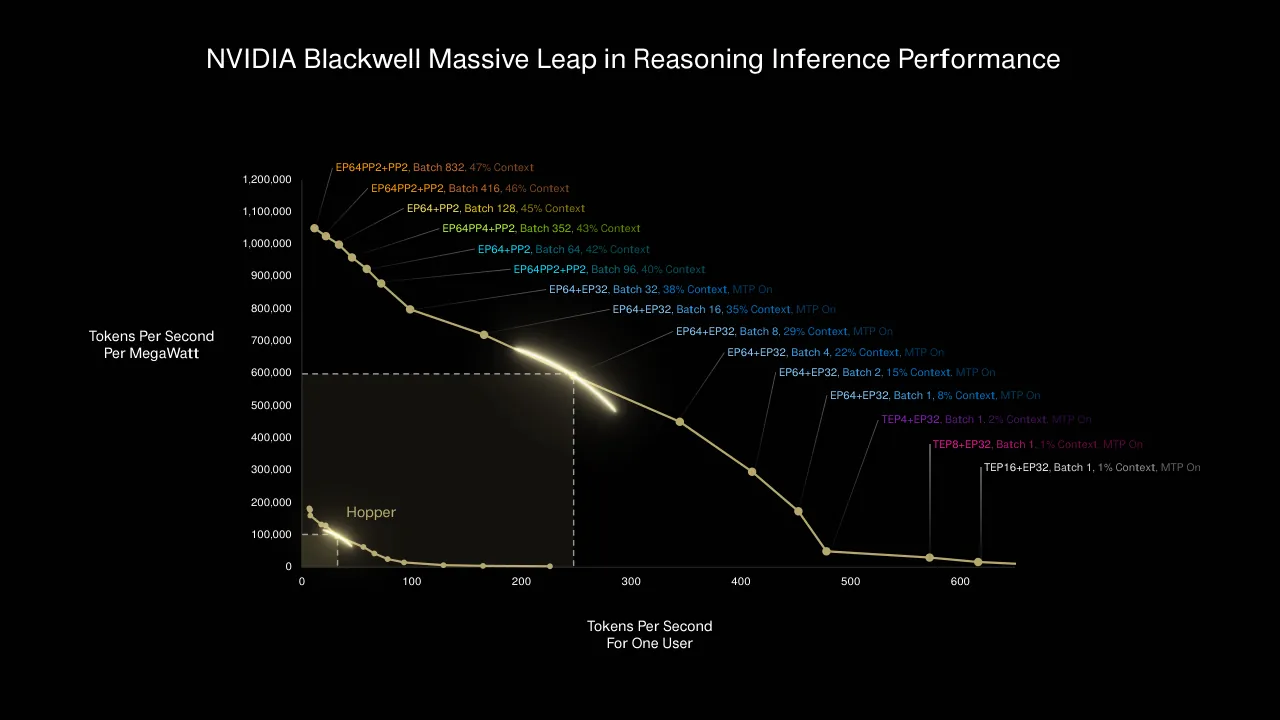
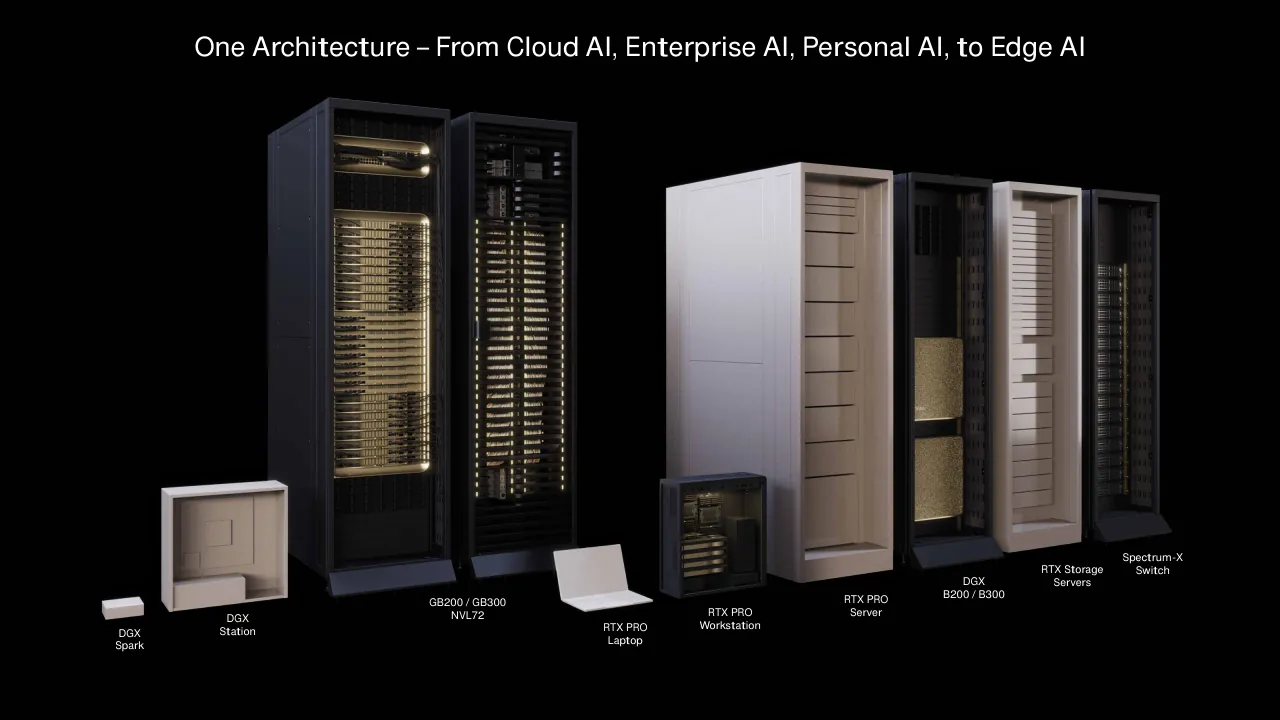
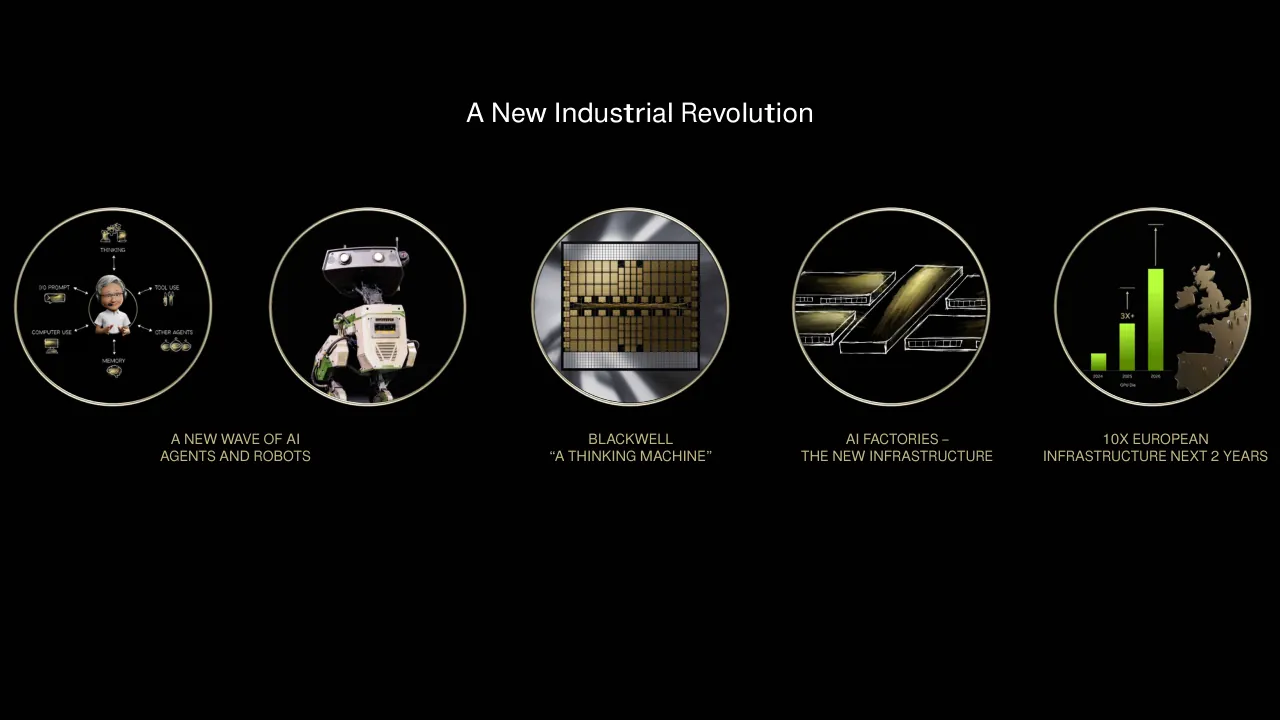
The deck is a keynote given at GTC Paris 2025 and opens with a quantum-GPU computing slide before moving to Blackwell hardware. It then covers reasoning inference performance, the production ramp of Grace Blackwell systems, and a single architecture spanning cloud, enterprise, personal and edge AI. Mid-deck sections address European AI infrastructure, with telcos, cloud providers, supercomputing centres and a list of EU AI factories, followed by open models such as Nemotron, a developer platform called DGX Cloud Lepton, and industrial AI and digital twins for European automotive makers. Autonomous vehicles and robotics follow, with photo-led slides that show partners and products. The deck closes with a summary slide listing its main claims: a thinking machine, AI factories as new infrastructure, tenfold European infrastructure growth over two years, and agents and robots. Slides worth studying include the bar-chart slide comparing tokens per second per megawatt, the regional country-by-country stack diagrams, and the closing summary, which compresses the talk into a few short phrases.
Slides worth studying
Questions about this deck
How many slides does the NVIDIA GTC Paris 2025 keynote deck have?
The NVIDIA deck has 70 pages. Its structure runs from the opening quantum-GPU slide (slide 4) through Blackwell hardware, European AI infrastructure, open models, autonomous vehicles and robotics, and a closing summary slide.
What does the NVIDIA deck say about European AI factories?
Slide 21, titled European Union Building 20 AI Factories, lists 13 named sites including Barcelona Supercomputing Center and CINECA. It also shows 2 AI Factories (Location TBD) and 5 Gigafactories (Location TBD).
What speedup figures does the NVIDIA deck show for quantum computing with CUDA-Q?
Slide 5, under the heading NVIDIA CUDA-Q Quantum-GPU Classical Computing, shows a 4,000X Speedup vs. CPU. The same slide also shows 800X, 1,200X, 1,300X and 500X figures.
What growth projection does the NVIDIA deck give for European AI infrastructure?
Slide 22 is titled 10X Growth Projection Pan-European AI Infrastructure. It is a column chart with bars for 2024, 2025 and 2026 and a 3X+ label, with GPU Die AI FLOPS as the measure.
Details
- Company: NVIDIA
- Year: 2025
- Type: Keynote
- Industry: Semiconductors and AI infrastructure
- Pages: 70
More from NVIDIA
- NVIDIA investor presentation, September 2026 NDR
- NVIDIA investor presentation, Annual Stockholder Meeting June 2026
- NVIDIA investor presentation, Q2 FY27 quarterly presentation
- NVIDIA keynote, GTC Europe 2026
- NVIDIA presentation, 2026
- NVIDIA keynote, GTC 2026 Keynote
All NVIDIA decks in the library
Review score: 7 out of 10, Effective
Presentation quality, judged with the SlideDeck Co review heuristic. Ask, evidence and idea merit are not rated here.
This is a keynote built for a live speaker, and the visual identity is consistent: black ground, gold and green accents, large product renders and photography, and one short title per slide. The route runs from hardware (6 to 15) through European infrastructure (16 to 27), open models (30 to 36), agents and developer platforms (37 to 48), industrial digital twins (49 to 60) and vehicles and robots (61 to 68), and the closing recap on slide 69 ties it together. Several pages cannot be read by themselves: the busy slide 10 chart with tiny multicolour labels, the small-type partner architecture diagrams on slides 38 and 42 to 48, and the dense logo walls on slides 2, 4 and 61. Slide 10 has no takeaway title, and many slides with a title and a picture rely on the speaker to carry the meaning, so the deck is competent and usable but not self-explanatory.
Worth keeping: Keep the consistent dark identity, the large hero renders on slides 13, 14 and 17, the Europe map series on slides 18 to 23 and the clean recap on slide 69.
Most useful repair: Enlarge or simplify the small-type architecture diagrams on slides 38 and 42 to 48, and reduce the logo walls on slides 2, 4 and 61 and the labels on slide 10 so they can be read at a glance.
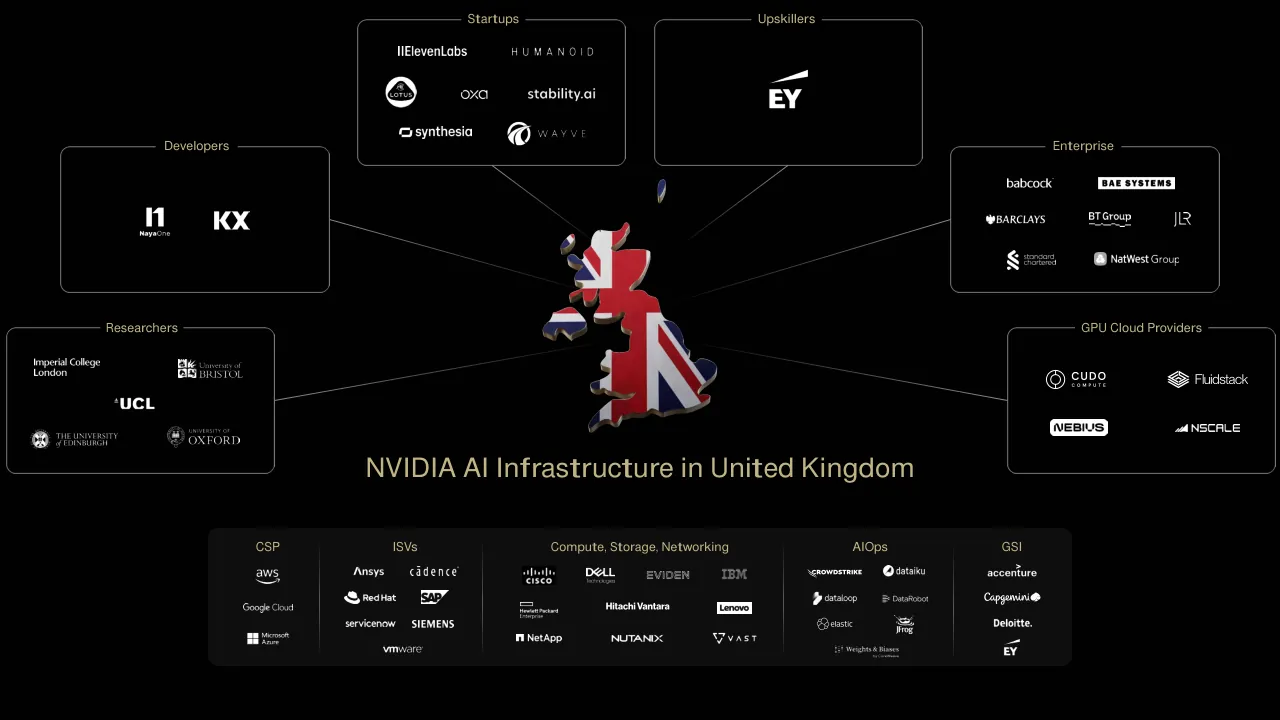
What would change the score: I would give slide 10 a stated conclusion and a clearer Hopper versus Blackwell comparison, and repeat the three UK, Germany, France and Italy stack diagrams with a larger shared template.
Confidence medium. 70 of 70 pages inspected on contact sheets, 4 at readable size. Reviewed 2026-11-08. Model-assisted review (claude-sonnet-5-5).
Full text of the slides (70 slides)
Every slide's words and a description of its charts and images, so the deck can be searched and rebuilt. Also available as Markdown.
Slide 1
NVIDIA
Visuals: One logo: the NVIDIA eye mark and wordmark. The eye mark is a stylised eye with concentric green and black arcs inside a solid green square, split vertically down the middle so the left half shows the arcs in green on black and the right half shows them in black on green. The wordmark is the word NVIDIA in heavy white capitals. No photographs, charts or other graphics.
Slide 2
IX / 42 / 2crsi / ABB / accenture / AGILE ROBOTS / Akila / ALICE & BOB / Ansys / aws / arrow / AstraZeneca / ASUS / Audi / AVEVA / BAE SYSTEMS / BSC / BARCLAYS / BCR / beyond.pl / Hot Chocolate / BMW GROUP / BNP PARIBAS / BOSCH / BOUYGUES / BT Group / Business Systems International / Capgemini / CHARM Therapeutics / CINECA / CISCO / CNRS / Computacenter / core42 / Continental / CoreWeave / Dassault Systèmes / DCAI / ddn / DeepL / Dell Technologies / Deloitte. / Deutsche Telekom / devoteam / Domyn / DREAM / E4 Computer Engineering / École Polytechnique / ECLAIRION / EDF / ElevenLabs / EPITA / EQUINIX / EVIDEN / Extend Robotics / EY / FASTWEB / f5 / FAU / finanz informatik / firebird / Fluidstack / Fraunhofer / Freistaat Bayern / ENCI / Google Cloud / Helsing / Helsing / Hitachi Vantara / HLRS / Hewlett Packard Enterprise / HUMANOID / Imperial College London / investor / IQM / JR / JÜLICH / KION / STORZ / KION GROUP / KIEFER / KUKA / KX / kyutai / L'ORÉAL PARIS / LEFDAL MINE DATA CENTERS / Lenovo / LEONARDO / Lighton / Leibniz-Rechenzentrum / Mercedes-Benz / Microsoft Azure / milestone / MIRAKL / Mistral AI / MUREX / NatWest / NayaOne / NEBIUS / nzc net zero compute / NEURA ROBOTICS / novo nordisk / noctua / NSCALE / omi / ORACLE CLOUD Infrastructure / orange / OrioraTech / OTTO / OVHcloud / OWKIN / SORBONNE UNIVERSITÉ / PEGATRON / Peptone / Photoroom / PHYSICS X / PIRELLI / PNY / Polarise. / PRIMA MENTE / PURE STORAGE / PolyAI / poolside / PORSCHE / Publicis Groupe / QUANDELA / RELATION / Revolut / Roche / SAAB / Sana / SAP / SARTORIUS / Scaleway / SCAN / SCC / SCHAEFFLER / Schneider Electric / SCHWARZ / Shell / SIA / SICK / SIEMENS / Siemens Energy / Siemens Healthineers / SLK / sky / SNCF / sopra steria / stability.ai / STELLANTIS / STELIA / SUPERMICRO / synthesia / TAIGA CLOUD / TD SYNNEX / telenor / TOTAL / TOYOTA MATERIAL HANDLING / Technische Universität München / UBISOFT / UiPath / UNIVERSAL ROBOTS / University of Bristol / The University of Edinburgh / University of Oxford / VAST / VERTIV / vespertec / Volkswagen / VORWERK / Wandelbots / WAYVE / WEKA / World Wide Technology / ZF / GTC25
Visuals: Full-bleed black background image with a white-on-black logo grid of about 190 company logos in 14 rows, all rendered as white or light grey wordmarks and marks. Centre: a white line-drawing sketch of the Eiffel Tower on the left beside a stadium-like glass and steel roof with radiating white structural lines, on a black ground, with the words GTC25 below in glossy green 3D letters with white highlights. Logos in row 5 and row 6 are partly hidden behind the central illustration edge; the illustration is boxed by black, not outlined. No photographs, charts or tables.
Slide 3
cuLitho / cuDSS / AmgX / cuOpt / Warp / cuDF / cuML / Dynamo / cuDNN / cuEquivariance / cuTensor / Aerial / Sionna / Earth-2 / MONAI / Parabricks / cuQuantum / CUDA-Q / cuPyNumeric
Visuals: Row of software library tiles, each a rounded rectangle with a thin pale gold-beige edge. Left to right: cuLitho tile shows a dark glowing blue-white rack of lithography or computing hardware with cyan light bars and a bright white horizontal strip, dark background, cropped tall. cuDSS AmgX tile shows a glossy dark grey car body with reflections and a scattering of yellow-and-teal particles at bottom. cuOpt tile shows a green glowing node at centre of a blue network of connected white lines and points. Warp tile shows swirling fluid streaks in green, magenta, cyan and blue on black. cuDF cuML tile shows a teal-and-white particle cloud forming a head-and-shoulders silhouette. Dynamo cuDNN tile shows a white flowchart-style block diagram of stacked rectangles and connectors on a deep blue background. cuEquivariance cuTensor tile shows a colourful nebula of pink, orange and blue space imagery. Aerial Sionna tile shows an aerial city view overlaid with bright green radio ray lines and a yellow object. Earth-2 tile shows the Earth from space with clouds and blue oceans. MONAI tile shows a multicoloured segmented medical volume in green, red, pink and yellow. Parabricks tile shows a blue-and-orange protein or DNA molecular structure. cuQuantum CUDA-Q tile shows a gold-toned cryogenic quantum processor cylinder with glowing amber tones. cuPyNumeric tile shows a colourful ball-and-stick molecule with red, blue, teal and white atoms on black. Beneath the row sits a gold-metallic chip package shown as two square dies on a black reflective surface, its reflection fading downward. Tiles are photographs or renders, full-bleed inside their frames, with slight perspective and overlap.
Slide 4
NVIDIA CUDA-Q
Quantum-GPU Classical Computing
Across Europe
QPU
GB200 NVL72
Barcelona Supercomputing Center Centro Nacional de Supercomputacion
CINECA
GENCI
IT4I
JÜLICH Forschungszentrum
lrz
PSNC
algorithmiq
ALICE & BOB
Anyon Technologies
ATLANTIC QUANTUM
atom computing
BlueQubit
CLASSIQ
diraq
equal 1
FERMIONIQ
Infleqtion
IONQ
IQM
OQC
ORCA COMPUTING
Pasqal
PsiQuantum
qBraid
QCDESIGN
Q-CTRL
QUANTINUUM
QUANTUM BRILLIANCE
QUANTUM MACHINES
qci Quantum Circuits Inc.
QuEra Computing Inc.
rigetti
SEEQC
Visuals: Photograph 1 (QPU): a tall rounded-rectangle photo with a thin gold-bronze border, at x 1.9 y 18.8 w 26.1 h 72.9. It shows a gold-lit quantum processor, a dilution-refrigerator stack of gold and amber tiered plates with dangling cabling, under a bright silver-white ring at the top, against a near-black background. It is framed straight-on, boxed rather than full-bleed, with warm amber key light and cool white highlights at the top. Photograph 2 (GB200 NVL72): a tall dark server rack, at x 19.9 y 6.2 w 13.8 h 86.0, seen front-on, cropped by the rectangle edges; its dark grey-black frame holds rows of gold-lit compute trays with cable loops at the top and bottom. It sits behind the QPU photo, which overlaps its left side. Logos: 34 partner logos listed in the elements, all in white or grey on black, no coloured logos. No charts, tables or diagrams.
Slide 5
NVIDIA CUDA-Q
Quantum-GPU Classical Computing
4,000X
Speedup
vs. CPU
800X
1,200X
1,300X
500X
QPU
GB200 NVL72
cuQuantum
Quantum Algorithm
Development
cuQuantum
Qubit Design
EDA
cuQuantum
Quantum Data
Generation
CUDA-Q
Hybrid
Applications
CUDA-Q
Quantum Error
Correction
Visuals: Photograph 1 (QPU): a dilution refrigerator, a cylindrical gold-and-copper stack of tiered plates with hanging wiring and a cold-plate base, shown on a near-black background under a white-grey mounting ring at the top. It is lit from within by warm amber light and sits in a rounded, gold-bordered frame (about 26 by 73 percent of the slide). It is not cropped, and it is a boxed image, not full-bleed. Photograph 2 (GB200 NVL72): a tall, dark server rack seen front-on, with horizontal gold-edged compute trays and dense rows of small black modules with fine gold edges, lit warmly from the sides. It is cropped at the top and bottom edges and the bottom of the rack ends on a dark plinth. Timeline: a thin gold horizontal line runs across the five icons at about y 78 percent. Five circular icons sit on it, each with a thin gold ring. Icon 1 (cuQuantum, Quantum Algorithm Development): a white-line quantum circuit diagram on black with boxed gates labelled Rx(0.107), Rz(0.699), Ry(0.8888) and X markers. Icon 2 (cuQuantum, Qubit Design EDA): a purple and blue isometric chip or qubit layout tilted on a dark ground. Icon 3 (cuQuantum, Quantum Data Generation): a small code screenshot on dark ground with green and yellow syntax text, including a line reading rng = np.random.default_rng. Icon 4 (CUDA-Q, Hybrid Applications): a dark isometric building with blue and green glowing outline paths. Icon 5 (CUDA-Q, Quantum Error Correction): a near-black disc with blue and teal waveforms and two clock-like dials. Above the icons are five values, each with a thin gold underline and a thin gold upward arrow with a small arrowhead: Speedup vs. CPU 800X (arrow from icon 1, the callout has the two-line label Speedup / vs. CPU above it), 1,200X (icon 2), 4,000X (icon 3, the tallest arrow, reaching about y 17 percent), 1,300X (icon 4), and 500X (icon 5). The arrows are about 1 to 2 percent of the slide wide, pale gold, and rise from the top of each icon ring.
Slide 6
"FIRST CONTACT"
2012 ALEXNET
PERCEPTION AI
SPEECH RECOGNITION
DEEP RECSYS
MEDICAL IMAGING
GENERATIVE AI
DIGITAL MARKETING
CONTENT CREATION
AGENTIC AI
CODING ASSISTANT
CUSTOMER SERVICE
PATIENT CARE
PHYSICAL AI
AUTONOMOUS VEHICLES
GENERAL ROBOTICS
Visuals: Five illustrations and one connecting arrow, all hand-drawn white line sketches with a soft glow on a black field. (1) Above the AlexNet label, a small sketch of stacked server racks with cable bundles, white line on black, about 11.8% from left and 75.6% from top, about 8.3% wide by 4.9% tall. (2) Below it, a sketch of a glowing gold-tinted cylindrical or lens-like device with a central circle, rendered in dark olive and gold tones, boxed in a white rounded outline, about 11.4% from left and 82.7% from top, about 9.1% wide by 5.6% tall. (3) A single white line arrow starts as a horizontal stroke at about 22% from left and 85.5% from top, runs to about 28.5% from left, then continues as a diagonal curved stroke rising through PERCEPTION AI and GENERATIVE AI and through the halo of the AGENTIC AI figure, ending in a solid white arrowhead at about 76% from left and 36.5% from top, pointing up and right. (4) A dim grey circular halo, about 59.5% from left and 40% from top, 13.5% wide by 27% tall, behind the AGENTIC AI figure. (5) A cartoon 3D-style avatar of an older man with grey swept-back hair, dark-framed glasses, a black headset with boom microphone, white open-collar shirt, gesturing with both hands, shown from the waist up, centred, in a thin white circular ring outline, about 62.8% from left and 44.4% from top, about 7.4% wide by 16.3% tall; lighting is soft frontal, colours are white, grey and skin tones on black. (6) A robot figure in a white thin-line circle, about 77.8% from left and 8.4% from top, 11.6% wide by 21% tall: a black humanoid torso with a rounded head bearing a blue circular light, two articulated arms, a central chest panel with a small blue light, and a faint blue accent; lighting is cool rim light, dominant colours black, grey and blue. No photograph, chart, or table.
Slide 7
Visuals: One photographic-style CGI illustration covering the whole slide. Subject: a large golden-brown horned dragon with spiked dorsal ridges, fins and a long curled tail, its open jaw with rows of teeth facing left toward a small human figure standing on a rocky outcrop at lower centre. The figure wears a dark cap, a tan top and trousers, and raises one arm. The dragon's head is in the upper-left, its body sweeps across the upper-right and its tail curls at upper-right. Below and around are eroded sandstone mesas and pillars rising out of pale mist. Composition: wide shot, full frame, no cropping of key subjects at the edges except the dragon body running off the top edge. Lighting: soft, diffuse, hazy daylight with low contrast. Dominant colours: warm ochre and rust browns on the dragon and rocks, with a pale blue-grey haze. Two red-pink thin lines (horns or whiskers) run diagonally at top-left. The image has no overlay or tint and is not boxed.
Slide 8
GB300 NVL72 / Grace Blackwell NVL72 / “A Thinking Machine”
Visuals: Photograph (left, about 62.3% of the width, full height, edge-to-edge, cropped at the left, top and bottom): two black server racks in a dark room. The left rack is a tall, dark cabinet with two gold-brass NVIDIA chassis: one horizontal trays near the top with black cables looping across it, and a larger block of stacked gold-tone compute trays lower down with many black power and data cables running down its right side. Small green indicator lights run down the left edge. The right rack is partly in shadow, with horizontal rails and rows of lit gold-tone slots in its lower two-thirds and dark units above. Lighting is warm and directional, with gold highlights on the chassis against a near-black ambient background. Dominant colours are black, dark charcoal and brushed gold/brass (about #C2A96A). No overlay or tint is visible. The photograph has a sharp focus with shallow depth. The NVIDIA logos on the gold trays are small and mirrored in reading.
Slide 9
Grace Blackwell NVL72
“One Giant GPU”
Visuals: One photographic-style render of a Grace Blackwell NVL72 GPU die, placed inside a circular grey-silver wafer backdrop. The die is a large square package (about x 34.9 to 65.1 %, y 29.3 to 79.7 % of the slide) with a silver grid-textured heat-spreader strip along its top and bottom edges and a near-black border. The interior is a grid of gold/brass compute blocks, with narrow rows of small square blocks along the left and right edges and a horizontal row of gold blocks across the middle. A bundle of fine golden traces runs horizontally through the centre. The wafer circle (about x 28.9 to 71.1 %, y 16.9 to 92.2 %) shows brushed chrome swirls with bright white highlights in the upper and lower areas and dark grey shadows at the edges. Lighting is directional and studio-like, with the highlights on the upper right. The image is not cropped; the circle is a clean round mask. No overlays or tints.
Slide 10
NVIDIA Blackwell Massive Leap in Reasoning Inference Performance
1,200,000
1,100,000
1,000,000
900,000
800,000
700,000
600,000
500,000
400,000
300,000
200,000
100,000
0
Tokens Per Second
Per MegaWatt
EP64PP2+PP2, Batch 832, 47% Context
EP64PP2+PP2, Batch 416, 46% Context
EP64+PP2, Batch 128, 45% Context
EP64PP4+PP2, Batch 352, 43% Context
EP64+PP2, Batch 64, 42% Context
EP64PP2+PP2, Batch 96, 40% Context
EP64+EP32, Batch 32, 38% Context, MTP On
EP64+EP32, Batch 16, 35% Context, MTP On
EP64+EP32, Batch 8, 29% Context, MTP On
EP64+EP32, Batch 4, 22% Context, MTP On
EP64+EP32, Batch 2, 15% Context, MTP On
EP64+EP32, Batch 1, 8% Context, MTP On
TEP4+EP32, Batch 1, 2% Context, MTP On
TEP8+EP32, Batch 1, 1% Context, MTP On
TEP16+EP32, Batch 1, 1% Context, MTP On
Hopper
0
100
200
300
400
500
600
Tokens Per Second
For One User
Visuals: Chart: connected line chart with circular markers, drawn in gold-beige #C1B485, showing the Blackwell inference performance curve. Title: none printed inside the chart; the slide title above applies. X-axis: 'Tokens Per Second For One User', linear, ticks at 0, 100, 200, 300, 400, 500, 600, with the axis extending to about 650 at its right end (ticks are not printed beyond 600). Y-axis: 'Tokens Per Second Per MegaWatt', linear, ticks every 100,000 from 0 to 1,200,000 with comma separators. Series 1 (Blackwell curve): labelled points are EP64PP2+PP2 Batch 832 at about x 13, y 1,050,000; EP64PP2+PP2 Batch 416 at about x 20, y 1,025,000; EP64+PP2 Batch 128 at about x 28, y 995,000; EP64PP4+PP2 Batch 352 at about x 37, y 955,000; EP64+PP2 Batch 64 at about x 48, y 920,000; EP64PP2+PP2 Batch 96 at about x 70, y 895,000 (the label placement suggests these points, values not printed); EP64+EP32 Batch 32 at about x 98, y 795,000; EP64+EP32 Batch 16 at about x 165, y 720,000; EP64+EP32 Batch 8 at about x 248, y 595,000; EP64+EP32 Batch 4 at about x 345, y 450,000; EP64+EP32 Batch 2 at about x 410, y 295,000; EP64+EP32 Batch 1 at about x 452, y 170,000; TEP4+EP32 Batch 1 at about x 478, y 50,000; TEP8+EP32 Batch 1 at about x 572, y 28,000; TEP16+EP32 Batch 1 at about x 615, y 15,000. Series 2 (Hopper curve, bottom left): a cluster of small markers from about x 8, y 180,000 falling to about x 225, y 2,000, with the lowest points near 0 to 50,000. Highlights: two dashed grey-white guide lines form a crosshair, one horizontal at about y 600,000 from the y-axis to x about 248 and one vertical at x about 248 down to the x-axis; a second short dashed pair at about x 31 and y 100,000. Glowing pale-gold light streaks sit on the curve around x 195 to 290 and near x 30 to 45 on the Hopper curve. Legend: none. Leader lines: thin grey diagonal lines connect each marker to its label.
Slide 11
Visuals: One photograph, boxed inside the slide with a thin dark edge. Subject: two factory workers in white anti-static striped smocks and pale grey gloves, handling a grey 1U server chassis between them in a data-centre area. The woman on the left, with short dark hair, ear hoops, dark-rimmed glasses and a green wristband, looks down at the chassis, which she holds with her gloved right hand and her left hand under it. The man on the right, with short dark hair and glasses, leans in toward the chassis with his gloved left hand raised, palm facing the camera, and his gloved right hand supporting the other end. Behind them stands a tall black server rack holding rows of grey drive trays with lit blue-white indicators, and below the chassis is a stack of grey bins. At the far left is a wire shelving unit and a blurred orange-and-white traffic cone. Composition: eye-level, wide 16:9 framing, the two people at the left and right edges and the chassis across the centre, with the rack as the depth background. Lighting: soft, even, cool overhead fluorescent light with no strong shadows. Dominant colours: white and light grey smocks, blue-grey and black rack, warm beige-grey bins, with small orange accents. The photo is not cropped and is not full-bleed; it is boxed by the black surround. No overlay or tint.
Slide 12
Grace Blackwell in Full Production
Lenovo / CoreWeave / Dell Technologies / Microsoft Azure / aws / Meta / Google Cloud / ORACLE CLOUD Infrastructure / Hewlett Packard Enterprise / AIVRES / ASUS / GIGABYTE / Engrasys / EVIDEN / Inventec / PEGATRON / Supermicro / QCT / wiwynn / wistron
Visuals: Photograph of 18 server racks standing side by side in a single row, each rack shown front-on in a tall narrow vertical format and cropped at the bottom edge of the slide. Each rack is filled with network cabling and stacked switch or compute units in grey, black and silver, with coloured cables (yellow, red, blue, green, orange) in some racks. Lighting is dark and even, with the racks lit against a black backdrop. Each rack has a vendor logo above it in white: Lenovo, CoreWeave, Dell Technologies, Microsoft Azure, aws, Meta, Google Cloud, Oracle Cloud Infrastructure, Hewlett Packard Enterprise, AIVRES, ASUS, GIGABYTE, Engrasys, EVIDEN, Inventec, PEGATRON, Supermicro, QCT, wiwynn and wistron. The racks are not boxed or framed and no overlay or tint is applied.
Slide 13
One Architecture – From Cloud AI, Enterprise AI, Personal AI, to Edge AI
DGX
Spark
DGX
Station
GB200 / GB300
NVL72
RTX PRO
Laptop
RTX PRO
Workstation
RTX PRO
Server
DGX
B200 / B300
RTX Storage
Servers
Spectrum-X
Switch
Visuals: A single rendered 3D product photograph covering the whole slide, with no framing or boxing. It shows, left to right: a small white DGX Spark box; a white open-faced DGX Station cube with a grey interior; a black GB200 NVL72 server rack with its door open, showing glowing gold-lit trays; a black GB300 NVL72 rack with its door slatted and gold lights along the side; a white RTX PRO Laptop shown open at a low angle; a dark RTX PRO Workstation tower with its side panel removed, showing gold-coloured GPU cards; a tall pale grey and beige RTX PRO Server cabinet with horizontal vents; a black DGX B200 / B300 rack with two gold-speckled modules; a beige RTX Storage Servers cabinet with vents; and a black Spectrum-X Switch rack with gold lights. Lighting is studio-style, with warm gold highlights and soft shadows on a black background. No overlays or tints.
Slide 14
One Architecture – From Cloud AI, Enterprise AI, Personal AI, to Edge AI / DGX / Spark / NEW / DGX / Station / NEW / GB200 / GB300 / NVL72 / RTX PRO / Laptop / NEW / RTX PRO / Workstation / NEW / RTX PRO / Server / NEW / DGX / B200 / B300 / RTX Storage / Servers / NEW / Spectrum-X / Switch
Visuals: Ten product photographs, all rendered in dark studio style, lit from within and from the left, on a pure black background. Left to right: (1) DGX Spark, a small gold-accented desktop box about 6.5% wide, shown in closed form on the far left. (2) DGX Station, a black tower chassis with a side panel open showing a motherboard with gold heatsinks and a GPU card, about 10% wide and 19.5% tall. (3) GB200 NVL72, a tall black rack, about 15.5% wide and 69% tall, with its front door open showing horizontal gold-lit compute trays and gold cable loops at the top. (4) GB300 rack, a narrower black rack with its door open showing dense rows of black networking and compute modules with small amber indicator lights, about 10% wide. (5) RTX PRO Laptop, an open black laptop with a grey-blue keyboard, about 7.5% wide and 7% tall, sitting on the baseline. (6) RTX PRO Workstation, a black tower with side panel open showing a gold-tinted GPU and stacked gold drive bays, about 8% wide and 16.5% tall. (7) RTX PRO Server, a black rack with open door showing four stacked grey server units and a vertical strip of amber lights. (8) DGX B200 / B300, a black rack with open door showing two large gold-brown textured blocks (gold-tinted modules) stacked in the middle, about 8.5% wide and 50% tall. (9) RTX Storage Servers, a black rack with open door showing stacked grey storage drives and sleds. (10) Spectrum-X Switch, a tall black rack with its door open showing rows of dark ports and a thin vertical gold light strip, about 7.5% wide and 49.5% tall. Racks are shown in three-quarter perspective, lit by soft warm gold highlights against black, with no cropping of the products; each sits on a dark plinth. Overlay: none.
Slide 15
NVIDIA RTX PRO Server / Enterprise AI and Industrial AI Computing Platform / Available Now / CISCO / DELL Technologies / Hewlett Packard Enterprise / Lenovo / ADVANTECH / ASRock Rack / ASUS / COMPAL / EVIDEN / FOXCONN HON HAI TECHNOLOGY GROUP / GIGABYTE / Inventec / MiTAC Computing / msi / PEGATRON / QCT / SUPERMICRO / wistron / wiwynn
Visuals: Full-bleed black background photograph of an NVIDIA RTX PRO Server 4U chassis, shown at an angle from the upper left, with a dark grey-blue sheet-metal chassis. Above the chassis stand eight gold-bronze RTX PRO graphics cards in a row, angled upright and fanned to the right. A black printed-circuit midplane board with gold-tinted heatsinks and eight small black cards sits in the middle. The lower front holds rows of black hot-swap drive bays with mesh grilles and latches, and fan modules sit between them. The subject is lit from above and the left, with a neutral white highlight on the chassis edges and dark shadows underneath. Framing is three-quarter view, unboxed and uncropped, sitting on the black background with no overlay. Dominant colours are black, gunmetal grey #3A4150 and gold-bronze #C1B485. Right side: 19 white partner logos in a grid, listed in the text order above, as flat monochrome white marks, except the Lenovo mark, which is a white rectangle with black lettering.
Slide 16
A NEW INDUSTRIAL REVOLUTION
AI FACTORY
$100T
TOKENS
"UNITS OF INTELLIGENCE"
SCIENCE
ENTERPRISE
HEALTHCARE
MANUFACTURING
Visuals: Hand-drawn chalk-style line illustrations in white on black, with gold-yellow painted highlights. (1) A factory building drawn as a box with a pitched roof, two door or window rectangles and a gold brush-stroke glow across the upper part of the wall. (2) A row of about 14 small outlined squares above a white arrow pointing right, with the token label above them. (3) Science: a white atom icon with three elliptical orbits and small gold electron dots around a central nucleus. (4) Enterprise: a dark grey rounded robot head with a white visor face and gold glow, with a stack of gold-lit slanted document sheets extending to its left. (5) Healthcare: a white outlined twisted ribbon or helix shape with a gold glow in its centre. (6) Manufacturing: a white outlined robotic arm with a gold-lit joint, holding a small box. (7) A white outlined car, side view, with a gold glow along its body. No photographs, no logos, no charts. All illustrations are unboxed and on a black ground.
Slide 17
Stargate / 200 MW, Scaling to 1.2 GW / Abilene, Texas / Courtesy of Crusoe
Visuals: Photograph: aerial oblique view of a large data-centre construction site in Abilene, Texas. Six long rectangular flat-roofed buildings with pale tan roofs form two rows of three, with two cross-shaped (plus-shaped) connecting buildings, one between the upper row and one between the lower row. Grey rows of cooling units run along the long sides of several buildings. Left and lower-left show bare red-brown earth with foundations, cranes and construction equipment. Upper-right shows a large parking lot with dozens of parked cars and trucks. Lower-right shows white storage tanks, containers, trucks and stacked materials. Daylight, warm orange-red earth and tan roofs dominate, with a few white and grey structures. The image is a full frame inside a box with a thin rounded border and no overlay, though a slight darkening sits behind the title at top-left.
Slide 18
European Telcos / Building AI Infrastructure With NVIDIA / FASTWEB / orange / swisscom / Telefónica / telenor
Visuals: Illustration: a dark-bronze 3D rendered map of Europe with raised country borders and beveled edges, lit from the upper right so the land surfaces show a gold-to-brown gradient that fades into black at the right edge. Visible territory includes Scandinavia, the British Isles, Ireland, Iberia, France, Germany, Italy, the Balkans and Greece. Five silver map pins mark Norway, France, Germany, northern Italy and Spain. The map is not boxed; it bleeds off the top and right edges and is cropped at the right. Four logos sit in the left column, listed in the elements. Dominant colours: black background, bronze/gold #8A7650 to #C1B485 map surfaces, silver pins, white logos.
Slide 19
European Cloud Service Providers
Building AI Infrastructure With NVIDIA
beyond.pl
CUDO COMPUTE
DataCrunch
OUTSCALE
Domyn
firebird
Fluidstack
GCORE
Mistral AI
NEBIUS
nebul N
net zero compute
NEXUS CORE SYSTEMS
NORTHERN DATA GROUP
NSCALE
OVHcloud
Polarise.
Scaleway
SESTERCE
Visuals: A 3D metallic bronze-gold map of Europe, rendered as a raised relief with a bevelled edge, shown from an angled perspective with Scandinavia at top and Iberia at bottom left. It is full-height and cropped at the right and top edges, with a black-to-gold fade toward the right edge. Light falls from the upper left, giving gold highlights and dark shadows. Country borders are etched into the surface. Small silver-white map pins with gold-tinted bases mark about 17 cities, including several in the UK, France, Germany, Italy, Spain, Poland, Sweden, Finland and Greece. Below the title, 19 white wordmark logos are arranged in a grid: row 1 beyond.pl, CUDO COMPUTE, DataCrunch, OUTSCALE, Domyn; row 2 firebird, Fluidstack, GCORE, Mistral AI, NEBIUS (white wordmark in a rounded white box with black text); row 3 nebul N, net zero compute, NEXUS CORE SYSTEMS, NORTHERN DATA GROUP, NSCALE; row 4 OVHcloud, Polarise., Scaleway, SESTERCE. All logos are monochrome white on black.
Slide 20
European Supercomputing Centers
Building AI Infrastructure With NVIDIA
Barcelona Supercomputing Center
Centro Nacional de Supercomputación
University of Bristol
CINECA
CSCS
GENCI
Le calcul intensif au service de la connaissance
JÜLICH
FORSCHUNGSZENTRUM
lrz Leibniz Supercomputing Centre
of the Bavarian Academy of Sciences and Humanities
CYFRONET
DCAI
grnet
KIT
LUX PROVIDE
MAX PLANCK
COMPUTING & DATA FACILITY
SURF
VEGA
Visuals: A three-dimensional rendered map of Europe in a brushed bronze/gold metallic finish with soft specular highlights and dark raised country borders, extending from Iceland-edge and Scandinavia at top to Iberia and Greece at bottom and cropped at the top, right and bottom edges. Scandinavia, the British Isles, France, Germany, Italy, Iberia and the Balkans are visible; borders are raised ridges. Approximately 16 map pins mark the supercomputing sites: silver/white pins at roughly Stockholm-area, Helsinki-area, Manchester-area, Paris-area, Frankfurt/Germany-area, Munich-area, Italy (Rome-area), Spain (Madrid-area) and Athens-area, and bronze/gold pins at roughly Oslo, Copenhagen-area, Edinburgh-area, Netherlands, Germany, Switzerland, Italy, Spain and Hungary-area. The map has a dark gradient fading into black at its right edge. Logos (white on black): BSC Barcelona Supercomputing Center logo with ring of arcs and small italic caption, University of Bristol crest with wordmark, CINECA wordmark, CSCS logo with diamond-cluster emblem and wordmark, GENCI wordmark with pixel-dot mark and small caption, JÜLICH logo with leaf/arc emblem and wordmark, Leibniz Supercomputing Centre logo with white 'lrz' box and text, CYFRONET oval logo, DCAI wordmark, grnet logo with star emblem, KIT Karlsruhe Institute of Technology logo, LUX PROVIDE logo with small emblem, MAX PLANCK Computing & Data Facility logo with emblem and caption, SC logo with caption, SURF logo with white rounded label, VEGA logo with stylised V and wordmark.
Slide 21
European Union
Building 20 AI Factories
Barcelona Supercomputing Center (Spain)
CINECA (Italy)
CSC (Finland)
GENCI/CEA (France)
GRNET (Greece)
Jülich Supercomputing Center (Germany)
Linköping University (Sweeden)
LuxProvide (Luxembourg)
Poznan Supercomputing Center (Poland)
Sofia Tech Park (Bulgaria)
University of Maribor (Slovenia)
University of Stuttgart (Germany)
Vienna Scientific Cluster (Austria)
2 AI Factories (Location TBD)
5 Gigafactories (Location TBD)
Visuals: One illustration: a 3D relief map of Europe in a bronze or gold metallic finish, seen at an oblique angle with raised country borders and coastlines, cropped at the top, right and bottom edges of the slide and fading into black on the right. About 16 small map pins are placed on cities across the map: about 11 bronze-gold pins and about 5 silver-white pins, with the silver-white pins at Scandinavia-east (Finland), central Sweden, Germany/Poland, Italy, the Balkans and Greece. No chart, table or photograph is present. The pin positions correspond to the institutions listed in the text column.
Slide 22
10X Growth Projection
Pan-European AI Infrastructure
3X+
2024
2025
2026
GPU Die
AI FLOPS – Ampere FP16, Ada/Hopper FP8, Blackwell FP4
Visuals: Column chart, three bars, no chart title beyond the slide title. Categories on the x-axis: 2024, 2025, 2026, with the axis caption GPU Die centred below. No y-axis, no tick labels, no gridlines, no numeric values printed on bars. Bar heights are relative: 2024 bar top at about 77.7 percent of slide height, 2025 bar top at about 64.9 percent, 2026 bar top at about 41.3 percent, all on a common baseline at about 85.2 percent, so the 2025 bar is about 3 times the 2024 bar height and the 2026 bar is about 3 times the 2025 bar height, matching the printed labels 3X+ and 10X. Each bar is a vertical rectangle with a lime green vertical gradient from about #AEF53C at the top to about #5C8C00 at the bottom. Bar widths are about 3.8 percent of slide width. Growth annotations: above the 2025 bar, a thin tan horizontal tick at about y 49.6 percent spanning x 21.2 to 24.9 percent, with a thin tan vertical arrow below it pointing up toward the tick from the top of the 2025 bar (arrow from about y 58.8 to 49.6 percent), and the label 3X+ centred under the tick at about y 60 to 63 percent. Above the 2026 bar, a thin tan horizontal tick at about y 22.3 percent spanning x 28.1 to 31.8 percent, with a thin tan vertical arrow pointing up from the top of the 2026 bar (arrow from about y 40.2 to 23.7 percent) at about x 30 percent. Arrowheads are small filled triangles, tan #C1B485. The chart baseline is a thin grey #7F7F7F horizontal line. No legend. No highlighted points beyond the annotated bars. Map: a 3D bronze relief map of Europe seen at an oblique angle, showing the British Isles, Ireland, Iberia, France, Italy, Scandinavia, Germany, Poland, the Balkans and the Baltic states, with national borders as thin dark lines and raised edges catching light. The map surface is bronze-tan from about #8C7A55 in shadow to about #C8B98A in highlights, fading to black on the right edge. Gold and silver-white teardrop pins are placed on about 40 cities, with gold pins about #B09A5E and silver-white pins about #D8D8D8, each with a soft drop shadow. The map is not cropped at the top and left, and bleeds off the right and bottom edges. Lighting is a single soft light from upper left. The map is not boxed and has no overlay. Right-edge strip: a dark gradient image from black to bronze that shades the right edge of the map.
Slide 23
NVIDIA Establishes / European AI Technology Centers / to Grow Regional Research and / Startup Ecosystem / FINLAND / SWEDEN / UNITED / KINGDOM / GERMANY / FRANCE / ITALY / SPAIN
Visuals: A 3D bronze/gold relief map of Europe, viewed at an angle, showing Scandinavia, the British Isles, Iberia, France, Germany, Italy, the Balkans, and Eastern Europe with national borders as thin raised ridges. Six-plus silver-white map pins with labels mark Finland, Sweden, United Kingdom, Germany, France, Italy and Spain; each pin is a small glossy silver teardrop with a soft shadow beneath it. The map is lit from the upper left, with bright highlights on the bronze surface fading to black at the right and top edges. Labels are white uppercase sans-serif text placed just above each pin. No chart, table or logo.
Slide 24
Startups / ElevenLabs / HUMANOID / LOTUS / oxa / stability.ai / synthesia / WAYVE / Upskillers / EY / Developers / NayaOne / KX / Enterprise / babcock / BAE SYSTEMS / BARCLAYS / BT Group / JLR / standard chartered / NatWest Group / Researchers / Imperial College London / University of Bristol / UCL / THE UNIVERSITY of EDINBURGH / UNIVERSITY OF OXFORD / GPU Cloud Providers / CUDO COMPUTE / Fluidstack / NEBIUS / NSCALE / NVIDIA AI Infrastructure in United Kingdom / CSP / aws / Google Cloud / Microsoft Azure / ISVs / Ansys / cadence / Red Hat / SAP / servicenow / SIEMENS / vmware / Compute, Storage, Networking / CISCO / DELL Technologies / EVIDEN / IBM / Hewlett Packard Enterprise / Hitachi Vantara / Lenovo / NetApp / NUTANIX / VAST / AIOps / CROWDSTRIKE / dataiku / dataloop / DataRobot / elastic / JFrog / Weights & Biases by CoreWeave / GSI / accenture / Capgemini / Deloitte. / EY
Visuals: Chart/table: none. Illustration: a 3D-rendered map of Great Britain and Northern Ireland, left-to-right composition centred on the slide, filled with a Union Jack pattern in red, white and navy blue (about #C8102E red, #FFFFFF white, #012169 navy), with a thick darker edge and drop-shadow beneath, lit from above so the top faces are bright and the side bevels darker. A small floating Union Jack pin sits above the map near x 51.5 to 52.5, y 25 to 28. Six outline frames (rounded rectangles drawn as images, thin light grey stroke about #8A8A8A, 1 px) hold grouped logos. Leader lines: thin grey (#6E6E6E, about 0.1 percent of slide height) straight lines running from each frame edge to the map edge. Logos (white or light-grey monochrome wordmarks and marks on black): Startups: ElevenLabs wordmark, HUMANOID spaced-caps wordmark, LOTUS round emblem, oxa wordmark, stability.ai wordmark, synthesia wordmark with rounded mark, WAYVE wordmark with stylised swoosh mark. Upskillers: EY logo (white mark and wordmark). Developers: NayaOne mark with wordmark, KX wordmark. Enterprise: babcock wordmark, BAE SYSTEMS block wordmark, BARCLAYS eagle mark with wordmark, BT Group wordmark with underline, JLR monogram, standard chartered mark with wordmark, NatWest Group wordmark with mark. Researchers: Imperial College London two-line wordmark, University of Bristol crest with wordmark, UCL wordmark, THE UNIVERSITY of EDINBURGH crest with wordmark, UNIVERSITY OF OXFORD shield with wordmark. GPU Cloud Providers: CUDO COMPUTE ring mark with wordmark, Fluidstack stacked-layers mark with wordmark, NEBIUS white-on-black block wordmark, NSCALE mark with wordmark. Bottom panel (white or grey logos on black): CSP: aws, Google Cloud, Microsoft Azure four-square mark with wordmark. ISVs: Ansys, cadence, Red Hat, SAP, servicenow, SIEMENS, vmware. Compute, Storage, Networking: CISCO bars mark, DELL Technologies, EVIDEN, IBM, Hewlett Packard Enterprise, Hitachi Vantara, Lenovo, NetApp, NUTANIX, VAST. AIOps: CROWDSTRIKE, dataiku, dataloop, DataRobot, elastic, JFrog, Weights & Biases by CoreWeave. GSI: accenture, Capgemini, Deloitte., EY. Logos are not cropped and are all placed on black with no overlays.
Slide 25
Startups
Upskillers
Developers
Enterprise
AGILE ROBOTS
Black Forest Labs
DeepL
Helsing
NEURA
aai initiative for applied artificial intelligence
T
KI BUNDESVERBAND
IPAI
MATERNA Information & Communications
finanz informatik
KION GROUP
SCHAEFFLER
SIEMENS energy
SIEMENS Healthineers
KUKA
SAP
SIEMENS
Researchers
GPU Cloud Providers
Fraunhofer IAIS
FAU Friedrich-Alexander-Universität Erlangen-Nürnberg
JÜLICH Forschungszentrum
H L R S
Leibniz-Rechenzentrum der Bayerischen Akademie der Wissenschaften
Technische Universität München
NORTHERN DATA GROUP
Polarise.
NVIDIA AI Infrastructure in Germany
CSP
ISVs
Compute, Storage, Networking
AIOps
GSI
aws
Google Cloud
Microsoft Azure
Ansys
cadence
Red Hat
SAP
servicenow
SIEMENS
vmware
CISCO
DELL Technologies
EVIDEN
IBM
Hewlett Packard Enterprise
Hitachi Vantara
Lenovo
NetApp
NUTANIX
VAST
CROWDSTRIKE
dataiku
dataloop
DataRobot
elastic
JFrog
Weights & Biases by CoreWeave
accenture
Capgemini
Deloitte.
EY
Visuals: Central illustration: a three-dimensional, bevelled map of Germany filled with the German flag stripes (top black, middle red, bottom gold #FFCE00-like yellow), with a thin dark edge and slight shadow, sitting on black; the map is not cropped and is unboxed. Six thin grey (#8C8C8C, about 1 px) leader lines run from the map edges to each panel: Startups bottom edge to the map top-left, Upskillers bottom edge to the map top-right, Developers right edge to the map left shoulder, Enterprise left edge to the map right shoulder, Researchers right edge to the map left, GPU Cloud Providers left edge to the map lower right. Six panels are rounded-rectangle outline boxes with grey stroke and gold headings set into the top border. Logos are white or light grey wordmarks on black, listed in the Element list. Bottom band: dark charcoal rounded rectangle with thin vertical grey dividers at about x 25, 37.7, 61.2 and 74.5 percent.
Slide 26
Startups
Upskillers
Developers
Enterprise
Researchers
GPU Cloud Providers
NVIDIA AI Infrastructure in Italy
CSP
ISVs
Compute, Storage, Networking
AIOps
GSI
accenture
Domyn
LEONARDO
CINECA
FASTWEB
aws
Google Cloud
Microsoft Azure
Ansys
cadence
Red Hat
SAP
servicenow
SIEMENS
vmware
CISCO
DELL Technologies
EVIDEN
IBM
Hewlett Packard Enterprise
Hitachi Vantara
Lenovo
NetApp
NUTANIX
VAST
CROWDSTRIKE
dataiku
dataloop
DataRobot
elastic
JFrog
Weights & Biases by CoreWeave
accenture
Capgemini
Deloitte.
EY
Visuals: Illustration: a 3D rendered map of Italy with the mainland shown in the Italian flag tricolour (green #009246 on the left, white #F1F2F1 in the centre, red #CE2B37 on the right) and a brownish-gold bevelled edge (#6B5A34) and a soft grey-brown shadow along its lower edge. Sardinia (green) sits below the western coast and Sicily (green, same tricolour treatment only as green) lies below the toe of the peninsula, and Malta (white top, red bottom) lies south-east of Sicily. The map is lit from the upper left, with the surface slightly textured like painted stone, set on a black background. Six outlined rounded boxes, each with a category label breaking the top edge, are connected to the map by thin grey lines: Startups (white K-shaped mark with a registered symbol), Upskillers (white accenture wordmark with a chevron), Developers (white Domyn logo), Enterprise (white LEONARDO wordmark with a radiating star), Researchers (white CINECA wordmark), and GPU Cloud Providers (white FASTWEB wordmark with a swoosh). The bottom panel holds these logos. CSP column: aws, Google Cloud, Microsoft Azure. ISVs column: Ansys, cadence, Red Hat, SAP, servicenow, SIEMENS, vmware. Compute, Storage, Networking column (three rows): CISCO, DELL Technologies, EVIDEN, IBM; Hewlett Packard Enterprise, Hitachi Vantara, Lenovo; NetApp, NUTANIX, VAST. AIOps column: CROWDSTRIKE, dataiku, dataloop, DataRobot, elastic, JFrog, Weights & Biases by CoreWeave. GSI column: accenture, Capgemini, Deloitte., EY. All bottom logos are white or light grey on dark, small and not cropped. The file also contains invisible duplicate image layers at about 38-53% x and 22-47% y, with no separately visible content.
Slide 27
Startups
Exotec
H
kyutai
LightOn
Mistral AI
Photoroom
Upskillers
Capgemini
sopra steria
Developers
AVEVA
Schneider Electric
UBISOFT
Enterprise
BNP PARIBAS
EDF
L'ORÉAL PARIS
Schneider Electric
SNCF
STELLANTIS
TOTAL
NVIDIA AI Infrastructure in France
Researchers
CNRS
EPITA
GENCI HPC at the service of knowledge
SORBONNE UNIVERSITÉ
UGA Université Grenoble Alpes
GPU Cloud Providers
orange
Mistral AI
OVHcloud
Scaleway
CSP
aws
Google Cloud
Microsoft Azure
ISVs
Ansys
cadence
Red Hat
SAP
servicenow
SIEMENS
vmware
Compute, Storage, Networking
CISCO
DELL Technologies
EVIDEN
IBM
Hewlett Packard Enterprise
Hitachi Vantara
Lenovo
NetApp
NUTANIX
VAST
AIOps
CROWDSTRIKE
dataiku
dataloop
DataRobot
elastic
JFrog
Weights & Biases by CoreWeave
GSI
accenture
Capgemini
Deloitte.
EY
Visuals: A three-dimensional France map in the tricolour (blue left, white centre, red right) with a gold-brown bevelled edge and shadow, centred at the middle top of the slide, and a separate small Corsica shape in dark red to its lower right. Six thin grey (#8C8C8C) connector lines run from the map edges to each of the six panels. Each panel is a thin-outlined rounded rectangle with a gold title on the top border and white logos inside. Startups panel: Exotec, H, a Hugging Face-style smiling face icon, kyutai, LightOn, Mistral AI, Photoroom. Upskillers: Capgemini, sopra steria. Developers: AVEVA, Schneider Electric, Ubisoft. Enterprise: BNP Paribas, EDF, L'Oréal Paris, Schneider Electric, SNCF, Stellantis, Total. Researchers: CNRS, EPITA, GENCI, Sorbonne Université, UGA. GPU Cloud Providers: orange, Mistral AI, OVHcloud, Scaleway. Footer strip logos: CSP: aws, Google Cloud, Microsoft Azure. ISVs: Ansys, cadence, Red Hat, SAP, servicenow, SIEMENS, vmware. Compute, Storage, Networking: CISCO, DELL Technologies, EVIDEN, IBM, Hewlett Packard Enterprise, Hitachi Vantara, Lenovo, NetApp, NUTANIX, VAST. AIOps: CROWDSTRIKE, dataiku, dataloop, DataRobot, elastic, JFrog, Weights & Biases. GSI: accenture, Capgemini, Deloitte., EY. All logos are white or light grey monochrome.
Slide 28
Schneider
Electric
NVIDIA
Planning | Concept / Reference Designs
1st Fully Integrated / AI Factory
EcoDataCenter
DeepL
Electrical Digital / Twin Simulation
Next Gen / DC Architectures
EcoStruxure IT Design CFD
Build
Visuals: Central backdrop: a full-bleed grayscale photograph rendered as white-on-black line art of a data-centre hall, showing rows of tall server racks with cable bundles running across the top, dark cabinets in the centre and gold/tan busbar-like panels to the right. Brightness is highest in the upper middle and the image fades to black at the top and bottom edges. Tile 1 (Planning | Concept Reference Designs): a light-grey isometric 3D rendering of an electrical switchboard/distribution unit with terminal blocks and breakers on a white background. Tile 2 (Electrical Digital Twin Simulation): a black-background single-line electrical diagram with red, green and blue equipment symbols, plus a row of grey switchgear cabinets in the lower left. Tile 3 (1st Fully Integrated AI Factory): a daytime aerial photograph of a large single-storey campus of grey and white industrial buildings with a forest and hills behind, lit by low golden-orange sunlight from the left, with a warm orange tint across the sky and a brown-green foreground; overlaid with the EcoDataCenter logo at lower left and the DeepL logo at lower right. Tile 4 (EcoStruxure IT Design CFD): a light-grey transparent 3D model of a room with black server blocks, red and blue airflow streamlines and a grey floor grid, on a white field. Tile 5 (Build): a 3D rendering of a prefabricated data-centre module with a white-walled interior, dark grey cabinets and a green stripe, shown on a black background at an angle. Tile 6 (Next Gen DC Architectures): a dark grey 3D rendering of a tall server rack/cabinet in front view on a black background. Connectors: thin grey orthogonal lines with small grey dots at junctions link each tile to the central photograph.
Slide 29
Mistral AI / NVIDIA / Announcing Mistral and NVIDIA Build AI Cloud
Visuals: Two logos and one thin vertical divider line. Left: Mistral AI logo, a pixel-style emblem of stacked blocks in yellow, orange and red (yellow top tips, orange middle band, red base blocks), followed by the words 'Mistral AI' in orange-red sans-serif. Divider: a thin vertical grey line, about 0.1% of slide width, running from about y 34 to y 46 of the slide height. Right: NVIDIA logo, a green (#76B900) square with a stylised eye mark cut in black, followed by the white bold wordmark 'NVIDIA'. No photographs, charts or other graphics.
Slide 30
Open-Source AI Models Are Unlocking Global AI Innovation / 100 / DeepSeek R1 0528 / GPT-4o / 90 / Gemini 2.5 Pro / Llama 3 405B / GPT-4 / Gemini 1.5 Pro / Mistral Large 2 / DeepSeek R1 671B / MMLU / Qwen 3 235B / Llama 3 70B / Llama Nemotron Ultra / 80 / Mixtral 8x22B / Mixtral 8X7B / 70 / GPT-3.5 / Llama 2 / Llama / 60 / 2022 / 2023 / 2024 / 2025
Visuals: Scatter-and-trend-line chart with no chart title inside the plot. Y axis labelled MMLU, linear, range 60 to 100, ticks at 60, 70, 80, 90 and 100. X axis is time in years, ticks at 2022, 2023, 2024 and 2025, with no unit printed. Three straight trend lines: a blue line from about (2021.7, 70.0) to about (2025.0, 94.8); a green line from about (2021.8, 69.2) to about (2025.0, 94.0); a gold line from about (2022.6, 64.8) to about (2024.9, 88.8). Grey markers (closed models, values about): GPT-3.5 at about (2022.3, 70); GPT-4 at about (2022.7, 86); Gemini 1.5 Pro at about (2023.6, 86); GPT-4o at about (2023.8, 89); Gemini 2.5 Pro at about (2024.6, 90). Gold markers (open models, values about): Llama at about (2022.6, 63); Llama 2 at about (2023.0, 69); Mixtral 8X7B at about (2023.4, 71); Mixtral 8x22B at about (2023.7, 77); Llama 3 70B at about (2023.7, 82); Llama 3 405B at about (2024.0, 87); Mistral Large 2 at about (2024.1, 84); DeepSeek R1 671B at about (2024.5, 85); Llama Nemotron Ultra at about (2024.7, 83); Qwen 3 235B at about (2024.8, 83); DeepSeek R1 0528 at about (2024.8, 93). No legend. No highlighted points beyond the colour difference between grey and gold markers. Horizontal grey baseline at the bottom of the plot.
Slide 31
NVIDIA Nemotron Further Advances Leading Open Models
Open Frontier / Model
NEURAL / ARCHITECTURE / SEARCH
KNOWLEDGE / DISTILLATION
CONTINUOUS / PRE-TRAINING
SYNTHETIC TRAINING / DATA GENERATION
DATA CURATION
SUPERVISED / FINE-TUNING
IMAGE / UNDERSTANDING
SAFETY / IMPROVEMENT
REINFORCEMENT LEARNING
LONG CONTEXT / EXTENSION
PACKAGE AS NIM
NVIDIA Nemotron
Visuals: One diagram, a process flow drawn as a single continuous smooth wave-shaped line with a sketchy, hand-drawn quality. It starts at the left as a faint dark-green lead-in from the Open Frontier Model icon, rises to a peak, drops to a trough, climbs, drops, climbs again and ends in an arrowhead pointing right into the NVIDIA Nemotron icon. Small circular dots mark eleven stages along the line in order: Neural Architecture Search (upper left peak slope), Knowledge Distillation, Continuous Pre-Training (lower slope), Synthetic Training Data Generation (lower trough left), Data Curation, Supervised Fine-Tuning (upper peak), Image Understanding, Safety Improvement (lower trough), Reinforcement Learning, Long Context Extension, Package as NIM (final upper peak). Dots and the early segments are dark olive green (about #3E5F12); the later segments from Data Curation onward and the final run to the arrow are brighter NVIDIA green (about #76B900) with a glow-free solid stroke about 0.4% of slide height wide. The arrowhead is a solid bright green triangle. Left icon: a white outlined hexagon with a small molecular/neural-network graph of nodes and connecting lines inside, a short vertical tick at its bottom vertex; it is on black, unboxed and uncropped. Right icon: a glossy green 3D cube-like badge with a dark grey network-node graph on its top face and a darker green lower base, unboxed, uncropped, lit from the top-left with highlights. No photographs, no overlays.
Slide 32
NVIDIA Nemotron Increases Open Model Efficiency and Accuracy
*Nemotron
Llama Nemotron
Ultra 253B
+21
Llama Nemotron
Super 49B
+16
Llama Nemotron
Nano 4B
+21
40
35
24
Artificial Analysis Intelligence Index
Llama 8B
Llama 70B
Llama 405B
Next Open
Model
MMLU-Pro, GPQA Diamond, Humanity's Last Exam, LiveCodeBench, SciCode, AIME, MATH-500
Visuals: Vertical bar chart with no axis ticks or scale. Four dark grey bars on a black background. Bars 1 to 3 are labelled Llama 8B (value 24), Llama 70B (value 35) and Llama 405B (value 40), printed inside the top of each bar. Bar 4 is labelled Next Open Model and prints no value; it is about 50 by estimate, scaled from the other bars. Each of the first three bars carries a tan upward arrow starting at the bar top and pointing to a tan horizontal rule above it, with a label above the rule: Llama Nemotron Nano 4B +21 over the 8B bar; Llama Nemotron Super 49B +16 over the 70B bar; Llama Nemotron Ultra 253B +21 over the 405B bar. The Next Open Model bar has a tan arrow to a rule labelled *Nemotron. Chart title: Artificial Analysis Intelligence Index, with the benchmark list MMLU-Pro, GPQA Diamond, Humanity's Last Exam, LiveCodeBench, SciCode, AIME, MATH-500 beneath it. No legend. No highlighted points beyond the tan arrows and rules.
Slide 33
NVIDIA Nemotron Achieves World-Class Benchmarks
#1
#1
#1
Datasets
Llama Nemotron Post-Training
Trending Reasoning Dataset
OpenCode
Trending Coding Dataset
Nemotron Personas
Represents Real-World Demographics
Models
Llama Nemotron Ultra
Leading GPQA-Diamond Accuracy
Llama Nemotron Nano
Math 500
Llama Nemotron Vision
OCRBench V2
AceReasoning Nemotron
Math, Coding SML
Nemotron-H
Fastest Inference LLM With
Leading Reasoning Accuracy
Agents
Nemotron-CORTEXA
Leading SWE-Bench Accuracy
Visuals: Three dark rounded-rectangle cards with thin gold-tan edge strokes, each carrying a gold laurel wreath around a large gold '#1' numeral. Left card (Datasets): laurel and #1 centred near x 24.7 to 35.4%, y 35.7 to 52.9%. Centre card (Models): laurel and #1 centred near x 44.8 to 55.5%, y 26.5 to 43.7%. Right card (Agents): laurel and #1 centred near x 65.2 to 75.9%, y 35.5 to 52.7%. Laurels are metallic gold gradient vector icons with leaves curving up and around the numeral, with stems meeting at the bottom. No photographs, charts or diagrams.
Slide 34
Model Builders Across Europe / Creating Sovereign LLMs with NVIDIA Nemotron / Barcelona Supercomputing Center / Centro Nacional de Supercomputación / BIELIK / DictaAI / Domyn / openGPT-X / Lighton / MINISTRY / OF EDUCATION, RESEARCH, / DEVELOPMENT AND YOUTH / OF THE SLOVAK REPUBLIC / NAISS / NLP / Technology / Innovation / Institute / UNIVERZA / V LJUBLJANI / UTTER
Visuals: Eleven white logos on black, with no photographs, charts or diagrams. Row one: Barcelona Supercomputing Center logo (white circular BSC emblem with stacked italic wordmark and small Spanish subtitle), BIELIK logo (white stylised bird silhouette with spaced capitals wordmark), DictaAI logo (white sound-bar icon with sparkle and bold wordmark), Domyn logo (white circular swirl icon with bold rounded wordmark). Row two: openGPT-X logo (grey-shaded globe icon with 'openGPT-X' wordmark, regular weight then bold GPT-X), an unlabelled white filled circle followed by a white bold letter H on a faint dark square, Lighton logo (bold white wordmark with a star in the letter o), Ministry of Education, Research, Development and Youth of the Slovak Republic crest (white shield with cross emblem and stacked caps text). Row three: NAISS logo (bold italic wordmark with stripe icon), NLP logo (white square outline with letters N, L, P and a small UCL mark), Technology Innovation Institute logo (white bold TII letters inside a white open arc), Univerza v Ljubljani logo (white line drawing of a building with a vertical divider and bold caps wordmark), UTTER logo (white stylised ü glyph with 'UTTER' below). All logos are flat, single-colour white with no shadows.
Slides 35 to 70 continue in the full text file.
Download this deck
The hosted PDF of every library deck is free for readers of the SlideDeck Co newsletter. Join with your email and the viewer and download appear here.
Building a deck of your own? The SlideDeck Co Standard Deck is a slide library for business presentations: reviews, updates and plans.