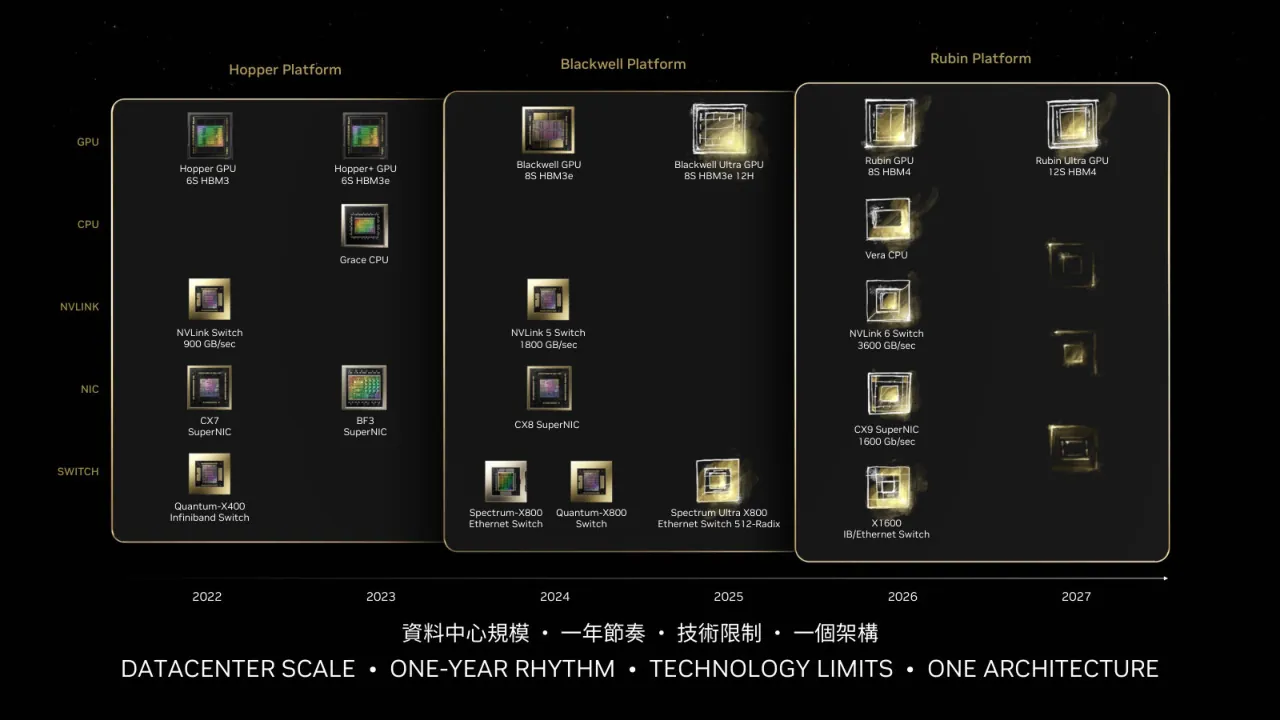
The deck opens with a forward-looking statements disclaimer, then moves into the keynote proper. It presents NVIDIA's CUDA libraries and their expansion into new markets, followed by generative AI use cases such as digital humans, customer service agents and regional language models. Product announcements come next, including new RTX AI PCs, the Blackwell GPU architecture, and a sequence of charts tracking AI compute gains, energy reduction per model training and per token generated over eight years. Networking is covered through NVLink switches and Spectrum-X Ethernet, with a roadmap slide running from Hopper through Blackwell, Blackwell Ultra and Rubin, each laid out as a platform of GPU, CPU, NVLink, NIC and switch. Robotics and simulation tools, including Isaac, Omniverse and GR00T, appear in the later sections. The deck closes with a sequence of product and partner logos and a final section divider. Several slides are wordless or text-light, leaving the visuals to carry the message. The strongest slides to study are the energy-reduction charts and the one-architecture platform roadmap, where repeated structure makes the generational comparison easy to read.
Slides worth studying
Questions about this deck
How many slides does the NVIDIA presentation deck have?
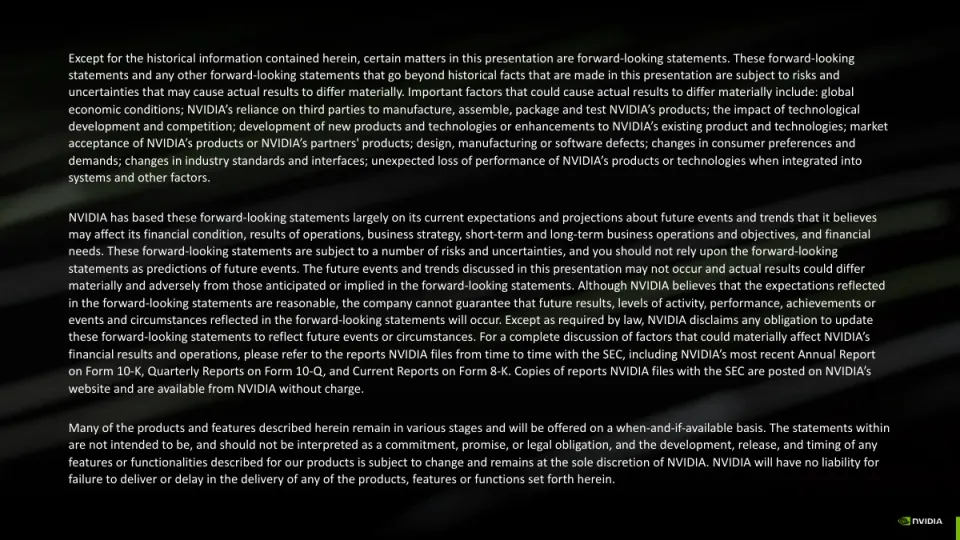
The NVIDIA deck has 61 pages. Slide 1 opens with a forward-looking statements disclaimer before the keynote content begins.
What does the NVIDIA deck say about energy reduction when training GPT4-1.8T?
Slide 28 shows a 350X energy reduction in 8 years to train GPT4-1.8T. The chart runs from Pascal at 1,000+ GWh to Blackwell at 3 GWh.
What does the NVIDIA deck say about AI compute growth?
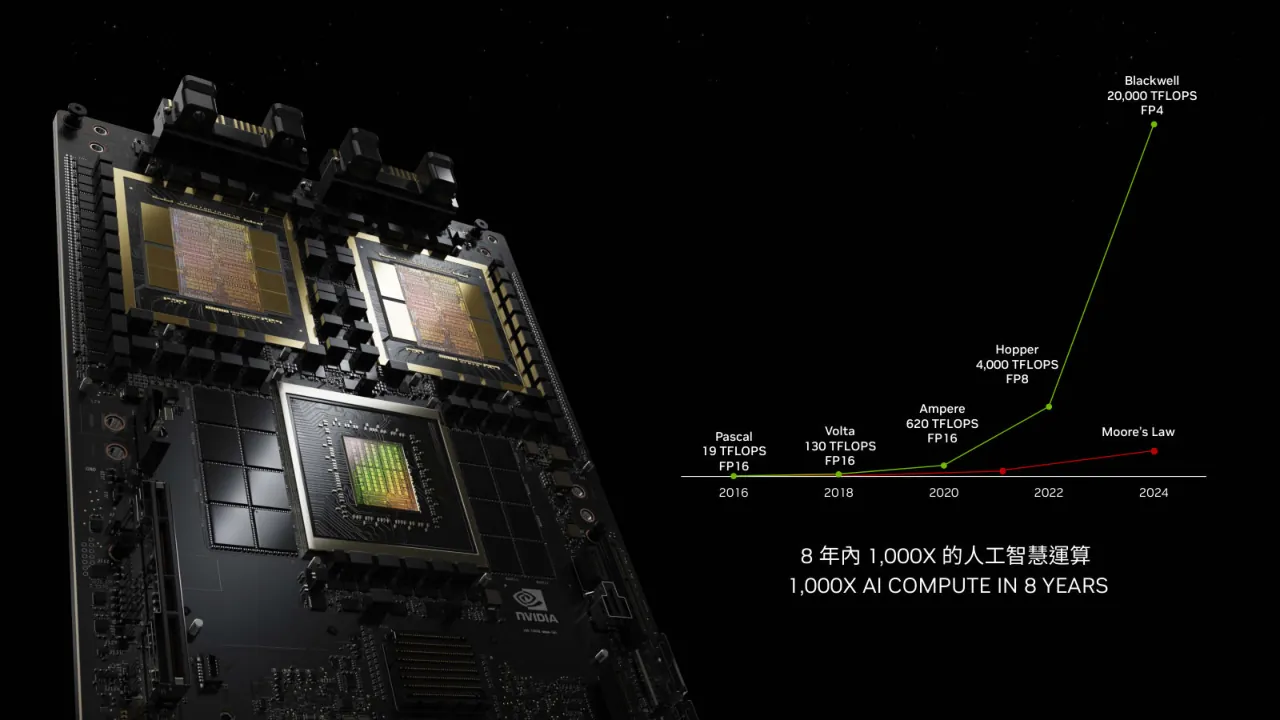
Slide 27 is titled 1,000X AI compute in 8 years. It charts Pascal at 19 TFLOPS FP16 rising to Blackwell at 20,000 TFLOPS FP4.
How does the NVIDIA deck structure its Hopper, Blackwell and Rubin platform roadmap?
Slide 40 lays out the Hopper, Blackwell and Rubin platforms as columns. Each platform is shown by component type in rows labelled GPU, CPU, NVLINK, NIC and SWITCH.
Details
- Company: NVIDIA
- Year: 2024
- Type: Keynote
- Industry: Semiconductors
- Pages: 61
More from NVIDIA
- NVIDIA investor presentation, September 2026 NDR
- NVIDIA investor presentation, Annual Stockholder Meeting June 2026
- NVIDIA investor presentation, Q2 FY27 quarterly presentation
- NVIDIA keynote, GTC Europe 2026
- NVIDIA presentation, 2026
- NVIDIA keynote, GTC 2026 Keynote
All NVIDIA decks in the library
Review score: 7 out of 10, Effective
Presentation quality, judged with the SlideDeck Co review heuristic. Ask, evidence and idea merit are not rated here.
This is a stage keynote deck built for live narration, and as a visual support it is strong: a consistent black ground with NVIDIA green accents, a strong lead object on most slides, and bilingual captions at a readable size. The charts on 27 to 29 and the platform roadmap on 37 to 41 build progressively and make the generational comparison easy to follow, and slide 30 is a clean table with green multipliers. The weaknesses are that many slides are wordless or very sparse (13 to 16, 32, 58), partner logo walls on 3 and 36 have tiny marks, chart labels on 27 and 28 are small beside a large product image, and the first-slide disclaimer is a dense wall of text. Read without the speaker, several sections (the history build on 13 to 18, the robotics videos on 44 to 52) would not carry their point alone.
Worth keeping: Keep the progressive build of the platform roadmap on 37 to 41 and the repeated chart structure with a single bold takeaway line on 27 to 29.
Most useful repair: Enlarge the chart labels and axes on 27 to 29 and give the logo walls on 3 and 36 a grouping or headline so the audience knows what they are seeing.
What would change the score: Add short anchor captions to the wordless and sparse slides (13 to 16, 32, 58) and trim the section of full-bleed factory footage (46 to 52) so the route does not rely on the speaker alone.
Confidence medium. 61 of 61 pages inspected on contact sheets, 4 at readable size. Reviewed 2026-11-08. Model-assisted review (claude-sonnet-5-5).
Full text of the slides (61 slides)
Every slide's words and a description of its charts and images, so the deck can be searched and rebuilt. Also available as Markdown.
Slide 1
Except for the historical information contained herein, certain matters in this presentation are forward-looking statements. These forward-looking / statements and any other forward-looking statements that go beyond historical facts that are made in this presentation are subject to risks and / uncertainties that may cause actual results to differ materially. Important factors that could cause actual results to differ materially include: global / economic conditions; NVIDIA’s reliance on third parties to manufacture, assemble, package and test NVIDIA’s products; the impact of technological / development and competition; development of new products and technologies or enhancements to NVIDIA’s existing product and technologies; market / acceptance of NVIDIA’s products or NVIDIA’s partners' products; design, manufacturing or software defects; changes in consumer preferences and / demands; changes in industry standards and interfaces; unexpected loss of performance of NVIDIA’s products or technologies when integrated into / systems and other factors.
NVIDIA has based these forward-looking statements largely on its current expectations and projections about future events and trends that it believes / may affect its financial condition, results of operations, business strategy, short-term and long-term business operations and objectives, and financial / needs. These forward-looking statements are subject to a number of risks and uncertainties, and you should not rely upon the forward-looking / statements as predictions of future events. The future events and trends discussed in this presentation may not occur and actual results could differ / materially and adversely from those anticipated or implied in the forward-looking statements. Although NVIDIA believes that the expectations reflected / in the forward-looking statements are reasonable, the company cannot guarantee that future results, levels of activity, performance, achievements or / events and circumstances reflected in the forward-looking statements will occur. Except as required by law, NVIDIA disclaims any obligation to update / these forward-looking statements to reflect future events or circumstances. For a complete discussion of factors that could materially affect NVIDIA’s / financial results and operations, please refer to the reports NVIDIA files from time to time with the SEC, including NVIDIA’s most recent Annual Report / on Form 10-K, Quarterly Reports on Form 10-Q, and Current Reports on Form 8-K. Copies of reports NVIDIA files with the SEC are posted on NVIDIA’s / website and are available from NVIDIA without charge.
Many of the products and features described herein remain in various stages and will be offered on a when-and-if-available basis. The statements within / are not intended to be, and should not be interpreted as a commitment, promise, or legal obligation, and the development, release, and timing of any / features or functionalities described for our products is subject to change and remains at the sole discretion of NVIDIA. NVIDIA will have no liability for / failure to deliver or delay in the delivery of any of the products, features or functions set forth herein. / NVIDIA
Visuals: A dark photographic-style background with diagonal grey and faint green light streaks crossing the slide from lower left to upper right. Bottom-right corner: NVIDIA logo (green eye-shaped mark with white wordmark 'NVIDIA') at about 94% x, 96% y. A thin vertical green bar along the right edge at the bottom. No charts, tables or photographs of subjects.
Slide 2
NVIDIA
Visuals: One NVIDIA logo lockup. The eye-shaped green mark is a stylised eye, split vertically into a light green half and a black half, sitting to the left of a solid green square of the same height. To its right is the white bold geometric wordmark 'NVIDIA'. The lockup is flat, with no shadow, gradient or overlay. Faint small white star-like specks are scattered across the upper part of the black background.
Slide 3
AAEON an ASUS associate co. / acer / ADLINK / ADVANTECH / aetina / AIMobile / aira / 安宏生醫 AnHorn Medicines / APMIC / AppWorks / ASE / ASRock Rack / ASUS / AVerMedia / AXIOMTEK / BIGGO / CHENBRO / ChaoZMo / 中原大學 Chung Yuan Christian University / COLORFUL / COMPAL / COOLER MASTER / Coretronic / DeepMentor / DeepRad.AI / DELTA / DMKTZ / EDOM TECHNOLOGY CO., LTD. / EverFocus / Footprint-AI / FORTUNE AI TECHNOLOGIES / FOXCONN HON HAI TECHNOLOGY GROUP / Garage+ / GIANT GROUP / GIGABYTE / GLIACLOUD / GMI / HOMEE.AI / 義守大學 I-Shou University / INFINITIES / ingrasys / INNO3D / Inventec / inwin / KENMEC / KYEC / Lanner / LEADTEK / LEDA TECHNOLOGY / 律果科技 Legal Tech Inc. / Linker Vision / LITEON / manli / MEDIATEK / MetAI / MiTAC / msi / 國立成功大學 National Cheng Kung University / 國立臺灣科技大學 National Taiwan University of Science and Technology / 國立陽明交通大學 National Yang Ming Chiao Tung University / NCHC 國家高速網路與計算中心 National Center for High-performance Computing / NEOUSYS TECHNOLOGY / NEXCOM / onyx / PALIT / PEGATRON / PROFET AI / QCT / Quanta Computer / SOLOMON / SPIL Siliconware / SPINGENCE / StarFab accelerator / Stream Tech / SUPERMICRO / TM / TRI innovation / thermaltake / TREND / tsmc / TUNGHAI UNIVERSITY 東海大學 / CTWS TAIWAN WEB SERVICES / UMC / Unimicron 欣興電子 / Vecow / wistron / wiwynn / YUAN / ZOTAC
Visuals: A green, textured silhouette of the island of Taiwan sits in the centre of the slide, spanning about x 44 to 57 percent and y 30 to 68 percent. Its outline is a thin light grey-white stroke, and its fill is a dark-to-bright green painted texture with pale light-green streaks along the central mountain ridge. About 110 white monochrome company logos and wordmarks are arranged in rows around it, with the left block of rows occupying the left side and the right block the right side; the centre rows leave a gap for the map. Logos are rendered in white or light grey on black, and the logos listed in text are all of these marks in reading order.
Slide 4
Visuals: Photograph of a bright yellow-orange lightning bolt striking downward through a glowing yellow-orange smoke or vapour cloud against black. The bolt enters at the upper right of the cloud near the top (around x 56%, y 13%), zigzags down through the centre-left of the cloud, and reaches the ground near x 52%, y 95% where it fades into a soft glow on a dark floor. The cloud is a billowing mass spanning roughly x 41% to 66%, y 20% to 68%, with its densest, brightest yellow-orange part on the left and centre. A small reddish-orange spark or ember sits at the top right near x 59%, y 6%. Lighting is self-luminous from the bolt and cloud; the background is pure black with no visible horizon. Dominant colours are black #000000, amber #F5A400, and bright yellow #FFD21F in the bolt core. The image is full-bleed, not cropped, not boxed, and has no overlay or tint.
Slide 5
1964
IBM S/360
1995
WINDOWS 95
PENTIUM
2007
IPHONE
2007
INTERNET
MOBILE CLOUD
新的運算時代正在開始
A NEW COMPUTING AGE IS STARTING
Visuals: Four hand-drawn white line illustrations linked by three green arrows, on a black field with faint scattered star specks at the top. (1) IBM S/360 mainframe: a cluster of cabinets, drives and boxy units drawn in white outline with orange-red glow highlights on the larger cabinets, roughly 13.5% to 27% of slide width. (2) 1995 Windows 95 desktop PC: a CRT monitor showing the four-colour Windows flag logo on a dark screen, with a keyboard and tower in front, drawn in white outline. (3) 2007 iPhone: a single upright smartphone outline with a home button at the bottom. (4) Internet mobile cloud: a white cloud outline with a teal-green filled lower-right area, surrounded by a Wi-Fi symbol, a globe, a cloud icon, a tablet, a phone, an envelope, a laptop, a monitor and a tablet, connected by thin white lines and arrows. Three bright green (#7DC62E) hand-drawn arrows with arrowheads point rightward between the units. Composition is a flat frontal view with no perspective; nothing is cropped, boxed or overlaid.
Slide 6
CPU SCALING SLOWS / ... AND / COMPUTE DEMAND GROWS / EXPONENTIALLY / GPU-ACCELERATED COMPUTING / 2006 / CUDA / GPU / CPU / DATA / CPU / GPU / 加速每個應用程式 / ACCELERATE EVERY APPLICATION
Visuals: Two hand-drawn, chalk-style line charts on a black background. Left chart: an L-shaped white axis pair (vertical axis at x about 20%, horizontal axis along the bottom), with no tick marks, no numeric labels, no axis titles and no units. Two curves: a blue (#1A8FD6) curve labelled CPU that rises slowly, bends and flattens toward the upper right; and a white curve labelled DATA that starts low and rises steeply, crossing the CPU curve near the upper right where both are about 60-70% of the axis height. Right chart: an L-shaped white axis pair with no tick marks, labels or units. Two curves: a dashed bright green (#76B900) straight-ish line labelled GPU rising steeply from lower left to top right, and a solid blue (#1A8FD6) curve labelled CPU that rises and levels off toward the right. Values are not printed; relative heights are about: GPU line reaches the top of the chart, CPU curve about 60% of the axis height at its plateau. No legend and no highlighted points. Lines are roughly 3 px wide with a rough chalk texture.
Slide 7
CPU / CPU + GPU / 1t / = ~100X SPEED-UP / ~3X POWER / ~1.5X COST / 60X PERF / $ OR 98% SAVINGS / 30X PERF / W OR 97% SAVINGS / 買越多 … 省越多 / "THE MORE YOU BUY...THE MORE YOU SAVE" / 1t / 100t
Visuals: Hand-drawn, sketch-style illustration. (1) Top row: a white sketched CPU chip icon (about 4 by 7 percent of slide) labelled CPU above it. To its right, a horizontal bar chart-like graphic with a white sketched outline; its left end, about 1 percent of width, is a small grey filled cell labelled 1t above the left end, and the remainder is a bright green (#76B900) painted fill running to the right end, labelled 100t above the right end. The bar spans about 75 percent of slide width. The bar is the scale of 1t to 100t. (2) Second row: a white sketched CPU chip labelled CPU, a plus sign, and a green sketched GPU chip (grid of small green squares, green outline) labelled GPU. To the right is a small bar icon labelled 1t, with a grey upper cell and a small green lower cell, at about 2.5 by 8 percent. An equals sign precedes three result lines. (3) No charts, photographs or logos. Lighting: none, flat black. Dominant colours: black, white, and green #76B900.
Slide 8
NVIDIA CUDA 函式庫開拓新市場 / NVIDIA CUDA LIBRARIES OPEN NEW MARKETS / cuDNN / Deep Learning / Modulus / AI Physics / Aerial RAN / AI Radio / cuLITHO / Computational Lithography / Parabricks / Gene Sequencing / cuOPT / Combinatorial Optimization / cuQUANTUM / QC Simulation / cuDF / Data Processing
Visuals: Eight illustrated or photographic cards, left to right: (1) cuDNN: a dark blue neural-network schematic with grey stacked layer blocks in two columns joined by white connector lines and circular nodes, over a blue-to-black background with glowing dots and network lines; (2) Modulus: a satellite-style photograph of ocean waves with white foam and a green-brown island or coastline, in blue tones; (3) Aerial RAN: a 3D render of a white car on a road beside a tower with a blue radio beam and cyan signal lines, grey-green roadside and a pale sky; (4) cuLITHO: a dark render of a lithography machine with cyan-lit circuit patterns and a lower mechanical stage; (5) Parabricks: a blue and purple molecular render of a protein with an orange DNA strand; (6) cuOPT: a warehouse scene with stacked cardboard boxes, a small grey robot vehicle and magenta path lines on the floor; (7) cuQUANTUM: a gold and copper cylindrical quantum computer cryostat with coiled tubing on black; (8) cuDF: a dark map of the United States with bright cyan and yellow-green data-flow lines. No logos or icons appear.
Slide 9
Faster pandas on Google Colab / CO / RAPIDS / Up to 50X acceleration using / RAPIDs cuDF with GPUs / G2 VMs / NVIDIA L4 Tensor Core GPUs / Up to 50X Faster pandas / CPU / GPU / Join / 4 mins 27 sec / 4 sec / Groupby / Advanced / 4 mins 34 sec / 12 sec / Seconds / https://developer.nvidia.com/blog/rapids-cudf-instantly-accelerates-pandas-up-to-50x-on-google-colab/ / Google Cloud / Google Cloud / NVIDIA 宣佈推出 GOOGLE COLAB 中的 PANDAS-CUDF / NVIDIA ANNOUNCES PANDAS-CUDF IN GOOGLE COLAB
Visuals: Bar chart titled 'Up to 50X Faster pandas' in green, boxed in a white rectangle with a faint drop shadow. Legend at top centre: blue square CPU, green square GPU. Horizontal grouped bars with no axis tick labels; x-axis title 'Seconds'. Category 'Join': CPU bar labelled '4 mins 27 sec' (about 267 s, long blue bar), GPU bar labelled '4 sec' (about 4 s, short green bar). Category 'Groupby Advanced': CPU bar labelled '4 mins 34 sec' (about 274 s, long blue bar), GPU bar labelled '12 sec' (about 12 s, short green bar). No highlighted points. Also a Colab logo (orange-yellow ring pair, 'CO' shape), the RAPIDS wordmark in purple, a Google Cloud wordmark in multicolour Google letters with grey 'Cloud', and a blue connector line with a dot linking the callout to the chart.
Slide 10
%%time / import pandas as pd / # Read the data / df = pd.read_parquet("nyc_parking_violations_2022.parquet") / %%time / # Which parking violation is most commonly / # commited by vehicles from various U.S states? / (df[["Registration State", "Violation Description"]] / .value_counts() / .groupby("Registration State") / .head(1) / .sort_index() / .reset_index() / ) / %%time / # Which vehicle body types are most frequently / # involved in parking violations? / (df / .groupby(["Vehicle Body Type"]) / .agg({"Summons Number": "count"}) / .rename(columns={"Summons Number": "Count"}) / .sort_values(["Count"], ascending=False) / ) / %%time / File Edit View Run Kernel Tabs Settings Help / regular-pandas.ipynb / Code / Python 3 (ipykernel) / Simple / Python 3 (ipykernel) | Idle / %load_ext cudf.pandas / %%time / import pandas as pd / # Read the data / df = pd.read_parquet("nyc_parking_violations_2022.parquet") / %%time / # Which parking violation is most commonly / # commited by vehicles from various U.S states? / (df[["Registration State", "Violation Description"]] / .value_counts() / .groupby("Registration State") / .head(1) / .sort_index() / .reset_index() / ) / %%time / # Which vehicle body types are most frequently / # involved in parking violations? / (df / .groupby(["Vehicle Body Type"]) / .agg({"Summons Number": "count"}) / .rename(columns={"Summons Number": "Count"}) / .sort_values(["Count"], ascending=False) / ) / Mode: Command / Ln 2, Col 1 / cudf-pandas-accelerator-mode.ipynb
Visuals: Two screenshots of the JupyterLab interface in light theme. Left window: menu bar File Edit View Run Kernel Tabs Settings Help, tab 'regular-pandas.ipynb', toolbar, four code cells beginning with %%time, status bar reading 'Simple' and 'Python 3 (ipykernel) | Idle'. Right window: tab 'cudf-pandas-accelerator-mo', a first cell containing %load_ext cudf.pandas highlighted in yellow, then four code cells beginning with %%time, status bar reading 'Mode: Command', 'Ln 2, Col 1' and 'cudf-pandas-accelerator-mode.ipynb'. Both windows are flat screenshots with no crop, no overlay and no tint, in cool blue-grey and white tones with syntax highlighting in red strings, green keywords and italic grey comments. A small text cursor appears in the right window near the third cell. Lighting is flat and even.
Slide 11
CUDA INSTALLED BASE
BIGGER SPEED-UP
R&D SCALE
CSPS & OEMS
END USERS
DEVELOPERS & APPLICATIONS
BIG SPEED-UP
CUDA 實現良性循環
CUDA ACHIEVES VIRTUOUS CYCLE
Visuals: Hand-drawn style diagram with no photographs. (1) Line chart titled 'CUDA INSTALLED BASE': white hand-drawn vertical y-axis and horizontal x-axis forming an L shape, with no tick marks, units or numeric ranges printed. A single bright green (#76B900) curve starts near the origin and rises steeply to the upper right, convex exponential shape, no data points, legend or highlights. (2) Green hand-drawn spiral/vortex narrowing downward: about 4 to 5 loops, widest at top-centre, ending in a fine tail near the bottom, with an arrowhead at its upper-right end pointing up-left. The spiral is labelled 'BIG SPEED-UP' beneath it. (3) Five white hand-drawn upward arrows with labels beside them: 'BIGGER SPEED-UP' (upper right), 'R&D SCALE' (upper left), 'CSPS & OEMS' (middle right), 'END USERS' (lower left), 'DEVELOPERS & APPLICATIONS' (lower right). No logos or icons.
Slide 12
Visuals: One photograph of the Earth seen from space, showing a full disc with a thin blue atmospheric rim. Subject: Asia, the Indian Ocean and Australia. The Himalayas and Tibetan Plateau are snow-capped and brown at the top, with the Indian subcontinent in tan and ochre, Arabia and the Horn of Africa at left, Southeast Asia and Indonesia in dark green, and Australia in red-brown at lower right. Clouds drift over dark blue ocean. Composition: the globe is centred, framed against pure black space, with north at top. Lighting: sunlit from the upper left, with the terminator falling near the right edge. Dominant colours: deep navy #0B1F3A-like ocean, ochre #B08A5A-like land, white cloud and snow, and a blue rim about #4A90D9. The image is not cropped; the disc is complete and not boxed, with no overlay or tint.
Slide 13
2012 / ALEXNET / "FIRST CONTACT" / DATA
Visuals: Diagram, hand-drawn chalk-like line sketch, white outlines on black. Top: a sketched server rack / cluster of stacked boxes with vertical bars at its right end (white outline, about 30% wide x 12% tall, centred near x 30%, y 22%). A downward white arrow with filled arrowhead runs from the rack to the GPU (line about x 30%, y 36% to 46%). Middle: a sketched graphics card / GPU drawn as a long rounded rectangle with a circular fan in the centre and dark-brown/ochre glow on its left and right ends, outlined in white (about x 22.5%–37%, y 52%–61%). Below: an upward white arrow with filled arrowhead from the label DATA to the GPU (about x 30%, y 62% to 76%). Arrows connect rack→GPU (down) and DATA→GPU (up). Dominant colours: black background, white line work, faint warm ochre highlight inside the GPU.
Slide 14
2016
FIRST DGX DELIVERED
DATA
Visuals: Photograph in a rounded white-outlined box: two men in an indoor room with white walls. The man on the left wears a black leather jacket and glasses, leaning over and pressing a grey rack-mounted DGX server on a dark table. The man on the right wears a dark suit with arms folded and stands beside a whiteboard covered in handwritten marker text, partly cut off at the edge. A red chair is at the far right. Lighting is soft indoor daylight, dominant colours are white, grey, black and red. The photo is boxed, not full-bleed. Below it is a hand-drawn chalk-style sketch of a server rack in white outline with a smoky olive-yellow (#8A7F3A) fill inside. Under the sketch, a white upward arrow with a triangular head points from DATA to the rack.
Slide 15
2017 / TRANSFORMER / DATA
Visuals: Chalk-style line drawing of a transformer model. (1) A long horizontal block, about 37% wide and 12% tall, with a grid of vertical divider lines and a top rim, drawn in white outline. Its interior is filled with glowing yellow-gold rectangles (blocks) across the length, with a lighter central column. (2) Above it, two small tower-like server or processor illustrations, each with stacked horizontal rectangles, small fan-like feet at the base and a connecting bent line between their tops, forming a branching diagram. (3) Beneath the block, a single white upward-pointing arrow with a filled triangular head, pointing into the block from the label 'DATA' below. No chart, table or logo. Lighting is self-lit, with the yellow glow the only colour; dominant colours are white line work on black with gold #C8A94A interior fill. The drawing is fully visible, not cropped, and sits on the background without a box or overlay.
Slide 16
ChatGPT 3.5
JE
Email for plumber quote
Make me a personal webpage
Overcome procrastination
Design a fun coding game
Message ChatGPT
ChatGPT can make mistakes. Check important info.
LLM
Large Language Model
2023
CHATGPT
"THE BIG BANG OF AI"
DATA
Visuals: Chalk-style line sketch of a server rack, drawn in white outline with gold-yellow glowing fill inside the cabinets, spanning about 19% to 41% of slide width, roughly 50% to 61% of slide height. Above it is the label 'LLM' over 'Large Language Model' in white sans-serif. Left of it is the handwritten label '2023 / CHATGPT / "THE BIG BANG OF AI"'. Below the rack is a white upward arrow with a thin shaft leading from the DATA label to the rack. To the right is a row of about 13 small outlined squares (tokens) above a white arrow pointing right, spanning about 44% to 55% of width. At the far right is a sketched dark laptop outline with white strokes, about 59% to 66% of width and 53% to 61% of height. Upper right is a screenshot of the ChatGPT 3.5 interface in a dark charcoal window with a lime-green border (about #9ACD32), containing the white OpenAI logo centred at top, four suggestion cards with small coloured icons (purple, red, teal, yellow), a grey message input bar, a small blue circle avatar with 'JE' at top right, and a mouse cursor over the input bar. The screenshot is boxed with a rounded-corner border, not cropped.
Slide 17
$100T
MANUFACTURING
TRANSPORTATION
HEALTHCARE
COMPUTING
AI FACTORY
新産業革命
“A NEW INDUSTRIAL REVOLUTION”
Visuals: Hand-drawn white chalk-style line illustration sequence on black. (1) A line sketch of a long, flat-roofed factory building with a chamfered top edge, a horizontal band, two rectangular doors or windows and a ground line, with a broad green brush stroke sweeping across its upper-middle section, labelled AI FACTORY above. (2) A conveyor-like row of about 13 small outlined squares above a right-pointing arrow, running from the factory to the icons. (3) A row of white line-drawn icons left to right: a cylinder-backed armchair-like seat, a smartphone, an arch-shaped scanner or magnet with a table, a sedan car, a robotic arm on a base holding a small box, and a humanoid figure with one arm raised. (4) A vertical white arrow pointing up toward the $100T label, with four stacked labels on a diagonal from lower left to upper right: COMPUTING, HEALTHCARE, TRANSPORTATION, MANUFACTURING. No chart axes, legend or table. Lighting is flat; the composition is a single horizontal band with the arrow for scale. Colours: white line work and text on black, green brush stroke (about #76B900). Not cropped; no photograph, tint or overlay.
Slide 18
SOFTWARE FACTORY / AI FACTORY / TOOLS / RETRIEVAL / INSTRUCTIONS / CPU / SKILLS / GENERATIVE / LLMS / GPU / 生成式人工智慧推動全棧重塑 / GENERATIVE AI DRIVES FULL STACK REINVENTION
Visuals: Two hand-drawn chalk-style line illustrations and one arrow. (1) Left: a tall, slightly perspective-drawn box, like a PC tower or cabinet, outlined in thin white sketchy strokes on black, with a dark interior. On its front face are four colour blocks arranged in a 2x2 grid, scribbled in the style of the Microsoft four-pane logo: top-left red, top-right green, bottom-left blue, bottom-right yellow. (2) Centre: a single thin white horizontal line with a solid white triangular arrowhead pointing right, connecting the left illustration to the right illustration. (3) Right: a wide, low, flat-topped box with a chamfered upper-left and upper-right corner, outlined in thin white sketchy strokes. Inside it, a large bright green (#76B900) brush-stroke band fills the upper half horizontally, with a fainter green smear at its upper-left. The lower half contains two thin-outlined rectangles (doors or cabinets) and a thin horizontal shelf line. No photographs, no gradients, no shadows; all artwork is line-and-scribble style with no fills except the coloured blocks and green stroke.
Slide 19
NVIDIA INFERENCE MICROSERVICE
Pre-Trained AI Models
Packaged and Optimized to Run Across CUDA Installed Base
Visuals: One icon: a three-dimensional black hexagonal cube with a thin white outline along its top and side edges, set on a glossy green (#76B900) hexagonal base slab. Inside the cube face is a network graph of seven glossy green spheres joined by straight green lines: one sphere at top centre, two at upper left and upper right, one at centre, two at lower left and lower right, and one at bottom centre. The lines connect every sphere to several others, forming a crossing lattice. The white outline breaks at the upper-left and upper-right edges and at the bottom centre. No photographs, charts or tables.
Slide 20
Industry-Standard APIs / Text, Speech, Image, Video Biology / Triton Inference Server / cuDF, CV-CUDA, DALI, NCCL, / Post-Processing Decoder / Cloud-Native Stack / GPU Operator, Network Operator / Enterprise Management / Health Check, Identity, Metrics, / Monitoring, Secrets Management / Kubernetes / TensorRT-LLM and Triton / cuBLAS, cuDNN, In-Flight Batching, / Memory Optimization, FP8 Quantization / Optimized AI Model / Single GPU, Multi-GPU, Multi-Node / Customization Cache / P-Tuning, LoRA, Model Weights / NVIDIA CUDA / Installed Base of 100s of Millions of CUDA GPUs
Visuals: Isometric illustration of a stacked technology architecture. From top to bottom: a translucent green cube lattice made of many small green and pale-green cubes inside a large semi-transparent dark-green cube; a central cluster of green cubes with a green molecular-style node icon (a network of small spheres joined by lines) in the middle; a flat blue (#1E6FE0) slab with a white outlined hexagon carrying the green Kubernetes wheel icon; and at the base a silver-grey square chip package with a dark-green border and a grid of grey pixels (the CUDA processor). Leader lines are grey dashed lines running from each label to the matching layer. Lighting is flat with soft shading on the cubes; the illustration is fully on-slide, not cropped, not boxed, with no overlay.
Slide 21
AI.NVIDIA.COM / Speech / Digital Human / Computer Vision / Biology / Simulation / Language / Regional Language / Vision Language / RAG / Screenshot text (not individually transcribed): NVIDIA, Artificial Intelligence, Instantly Run and Deploy Generative AI, Explore the latest community-built AI models with APIs optimized and accelerated by NVIDIA NIM, then deploy anywhere with NVIDIA NIM., Try Now, Watch Video, Experience Leading Open Models Now, meta llama3-70b-instruct, microsoft phi-3-vision-128k-instruct, google paligemma, ibm granite-34b-code-instruct, Say something like, Write a limerick about the wonders of GPU computing, What can I see at NVIDIA's GPU Technology Conference?, Type text here..., Python, Node, Shell, from openai import OpenAI, client = OpenAI(base_url='https://integrate.api.nvidia.com/v1', api_key='$API_KEY_REQUIRES_IF_EXECUTING_OUTSIDE_NGC'), completion = client.chat.completions.create(model='meta/llama3-70b-instruct', messages=[{'role':'user','content':''}], temperature=0.5, top_p=1, max_tokens=1024, stream=True), for chunk in completion: if chunk.choices[0].delta.content is not None: print(chunk.choices[0].delta.content, end='')
Visuals: Left: a screenshot of the NVIDIA AI web page (ai.nvidia.com) shown as a flat browser capture with a white top navigation bar and dark page below. The hero shows a warehouse photograph with a forklift and a chat panel reading 'Did any unusual situation occur in aisle 3?' answered with 'A shelf collapsed and the boxes fell from shelving at 3:30 PM, leaving boxes blocking the aisle.' Below are four green-bordered model cards (llama3-70b-instruct, phi-3-vision-128k-instruct, paligemma, granite-34b-code-instruct) with small photographs or abstract art, and below them a dark chat panel and a Python code panel in green, white and purple syntax colours. Dominant colours: black, dark grey, NVIDIA green #76B900. Full frame, boxed with a thin grey edge, not cropped on the left and right; the bottom is cut by the box. Right: eight hexagonal 3D icons with black faceted tops, white outline edges and a bright green #76B900 base band, each with a central illustration: Speech (green audio waveform on dark), Digital Human (3D cartoon head with glasses and jacket), Computer Vision (blue tree-like shape on green hill), Biology (yellow, purple and magenta protein ribbon), Simulation (blue and white Earth globe), Language (purple speech-window with code tag), Regional Language (purple and green speech bubbles), Vision Language (green forklift with orange accents), RAG (dark diagram with blue, yellow and green nodes). Icons are evenly lit from the front with no shadows; no overlays.
Slide 22
Hippocratic AI
— Do No Harm —
User
Speech
Agent
Audio2Face
LLM
Medical
Specialist Agent
Checklist
Specialist Agent
Privacy and Compliance
Specialist Agent
NeMo Retriever
Embedding Model
Vector
Database
Electronic Health
Records
Physician-Approved
Reference Tables
生成式人工智慧實現數位護士、客服、導師等
GENERATIVE AI ENABLES DIGITAL NURSE, CUSTOMER SERVICE AGENTS, TUTORS, ETC
Visuals: Diagram (architecture flow) on white panel. Left to right: a blue outline user icon (User) connects by a double-headed arrow to a photograph of a woman (Audio2Face avatar face). A single arrow runs from the photo to the Speech NIM cube. Speech has a double-headed arrow to the Agent square (orange, white node graph). Below the photo, an upward arrow runs from Audio2Face to the photo; an elbow connector runs from Speech down and left to Audio2Face with an arrowhead at Audio2Face. Agent has a double-headed arrow down to LLM, and a double-headed branching connector to three orange agent squares: Medical Specialist Agent (top), Checklist Specialist Agent (middle), and Privacy and Compliance Specialist Agent (bottom); the top connector is an elbow that rises from Agent to Medical Specialist Agent. Each agent square has a double-headed arrow to a green-and-grey NIM cube on its right. An elbow connector runs from Medical Specialist Agent upward to the NeMo Retriever cube, which has a dashed arrow to the Embedding Model cube on its right and a dashed double-headed arrow down to Vector Database. Vector Database is an orange cylinder with a red-orange circular badge at its lower left. Electronic Health Records (orange cylinder) has a solid arrow into Vector Database. Physician-Approved Reference Tables (orange cylinder with document badge) has an elbow connector up and left into Vector Database. Photo is a rounded-corner rectangle with a front-facing woman with dark hair in a bun, black-framed glasses, navy top, and a grey-blue background, framed head and shoulders, neutrally lit. Icons: NVIDIA-style green and grey cube icons with node-network glyphs.
Slide 23
Visuals: Photograph of a close-up, realistic digital rendering of a man's face, looking directly at the viewer with a neutral, serious expression. Short dark hair, close-cropped. Face fills the frame from forehead to chin, cropped at the top of the head and at the bottom by the dark collar of a dark jacket with a thin glowing light-blue piping line along the collar edge at lower right and a small blue light at lower left. Lighting is low-key: a warm red-orange key light from the right side of the face and a cool bluish rim light on the left edge of the face and jaw. The background is almost black with soft out-of-focus blurred shapes, faint warm bokeh points at right and left. Dominant colours are near-black, deep red-brown skin tones, and cool blue accents. The photograph is full-bleed, uncropped to a box, with no overlay or tint beyond the natural dark vignette.
Slide 24
發表新款 RTX AI 電腦
現已超過 200 款 RTX AI 筆記型電腦 | 高達 700 AI TOPS | 7X 生成式人工智慧
ANNOUNCING NEW RTX AI PCs
Now Over 200 RTX AI Laptops | Up to 700 AI TOPS | 7X Generative AI
ASUS TUF A14 / A16
ASUS Zephyrus G16
ASUS ProArt PX13 / P16
MSI Stealth A16 AI+
Visuals: Four laptop computer photographs, each shown open at a slight front-on angle with a dark reflection beneath. Left to right: (1) ASUS TUF A14 / A16 with a screen showing a man in a vest and a woman in a dark outfit at a mixing console in a warm, dimly lit studio; (2) ASUS Zephyrus G16 with a screen showing a figure holding a katana-like weapon in a neon-lit rainy city street, pink and cyan tones; (3) ASUS ProArt PX13 / P16 with a screen showing a video-editing application with a green-tinted clip, node graph, timeline and colour wheels; (4) MSI Stealth A16 AI+ with a screen showing a smiling woman with curly hair in a teal room with a floor lamp, a webcam-style inset of the same woman and an editing interface, with the msi logo on the lid below the screen. Behind the four laptops is a row of many blurred, out-of-focus laptop screens receding into darkness, showing game and video imagery in red, purple and blue tones. The laptops are not cropped; the background monitors are cropped by the frame edges. Lighting is a soft spotlight from above on black, producing faint reflections on a glossy black surface. No overlay or tint beyond the dark vignette.
Slide 25
ALEXNET / 2X/YR / TRANSFORMER / 2X/6 MON / PHYSICAL AI / 2X/3 MON / 運算模型規模呈指數級成長 / MODEL COMPUTE SCALE GROWS EXPONENTIALLY
Visuals: Hand-drawn chalk-style line diagram with no printed numeric axis values or units. Y-axis: white hand-drawn vertical line from about y 9% to y 76% at x about 22%. X-axis: white hand-drawn horizontal line from x about 20% to x 79% at y about 73%. Green (#76B900-like) trend line with dots at three points (about x 25%, y 64%; x 45%, y 59%; x 63%, y 43%) and an arrowhead at the top right (about x 75%, y 14%). Stage 1 icon pair near x 27-38%, y 46-52%: white outline of a person bust, double-headed white arrow, white outline of a server tower; label 'ALEXNET 2X/YR' beneath. Stage 2 icon pair near x 44-57%, y 33-42%: white outline of a globe, double-headed white arrow, white outline of a server rack; label 'TRANSFORMER 2X/6 MON' beneath. Stage 3 icon pair near x 48-71%, y 14-22%: two white outline server racks joined by a double-headed white arrow; label 'PHYSICAL AI 2X/3 MON' beneath. Lower caption in white: Chinese characters and English line, centred.
Slide 26
AI SUPERCHIP / 208B Transistors
TRANSFORMER ENGINE / FP4/FP6 Tensor Core
SECURE AI / Full Performance / Encryption and TEE
5th GENERATION NVLINK / Scales to 576 GPUs
RAS ENGINE / 100% In-System Self-Test
DECOMPRESSION ENGINE / 800 GB/sec
NVIDIA BLACKWELL 平台 / 兆級參數規模的生成式人工智慧
Visuals: Full-bleed photograph of an NVIDIA Blackwell computing board, viewed from a low three-quarter angle with soft depth-of-field blur toward the top and edges. Two large gold-lidded GPU dies sit side by side in the upper half, each flanked by rows of black memory modules, with heat-sink clamps on top. A central smaller processor sits in the middle foreground with a rainbow-tinted die window. Lighting is a soft warm highlight on the gold dies against a black background; dominant colours are black, dark charcoal and gold. The image is not cropped inside a box and has a dark overlay that fades the bottom edge into black. Below it are six gold line icons: (1) a chip with a gradient die inside a square frame, labelled AI SUPERCHIP; (2) a triangle-arrow-network-arrow-square glyph, labelled TRANSFORMER ENGINE; (3) a shield-shaped outline with a network inside, labelled SECURE AI; (4) four small squares joined by lines with a cross, labelled 5th GENERATION NVLINK; (5) a power symbol inside a circle, labelled RAS ENGINE; (6) a stack of coins with two circular arrows, labelled DECOMPRESSION ENGINE.
Slide 27
Blackwell / 20,000 TFLOPS / FP4 / Hopper / 4,000 TFLOPS / FP8 / Ampere / 620 TFLOPS / FP16 / Moore's Law / Volta / 130 TFLOPS / FP16 / Pascal / 19 TFLOPS / FP16 / 2016 / 2018 / 2020 / 2022 / 2024 / 8 年內 1,000X 的人工智慧運算 / 1,000X AI COMPUTE IN 8 YEARS
Visuals: Photograph: a black NVIDIA server board (labelled NVIDIA on the board, with a small NVIDIA logo near its lower-middle right) shown at a steep upward perspective, tilted so its left edge runs diagonally from top-left to bottom. Two large gold-edged GPU packages with heat sinks sit on the upper half, and a smaller square GPU module with a green-yellow die sits in the centre-lower area; surrounding memory modules and connectors are dark grey to black. Lighting is a soft spotlight from above, highlighting gold edges and metallic highlights against a black background with faint star-like specks; the board is cropped at the left, bottom and top edges. Chart: line chart, no title, no axis numbers. X axis: years 2016, 2018, 2020, 2022, 2024 at equal spacing. Y axis: no labelled scale; values shown by labelled points. Series 1 (green line, about #76B900): Pascal 19 TFLOPS FP16 at 2016, Volta 130 TFLOPS FP16 at 2018, Ampere 620 TFLOPS FP16 at 2020, Hopper 4,000 TFLOPS FP8 at 2022, Blackwell 20,000 TFLOPS FP4 at 2024, with green dots at each point. Series 2 (red line, about #E00000, thinner): Moore's Law, drawn with unlabelled points at about 2021 and 2024 with a red dot at 2024, rising gently. Series 2 has no printed numeric values. Legend: none. Highlighted points: green dots at each data point and a red dot on the Moore's Law line at 2024. Horizontal white baseline at the bottom of the chart.
Slide 28
Pascal / 1,000+ GWh
Volta / 140 GWh
Ampere / 40 GWh
Hopper / 13 GWh
Blackwell / 3 GWh
2016 / 2018 / 2020 / 2022 / 2024
8 年內節能至 1/350
訓練 GPT4-1.8T
350X ENERGY REDUCTION IN 8 YEARS
TO TRAIN GPT4-1.8T
Visuals: Left: a photograph of an NVIDIA GPU server board (black printed circuit board with two large gold-edged GPU modules with heatsinks at upper left and upper centre, a smaller gold-edged GPU module with a green-lit die at lower centre, black memory blocks, connectors and capacitors), shown at a steep low-angle perspective, cropped at the bottom and left edges, lit from above with specular highlights on the gold frames and heatsinks; dominant colours black, gold and green. Right: a line chart titled by its caption, with a green line (#76B900) connecting five data points, each labelled with a generation name and value: Pascal 1,000+ GWh at 2016 (highest point, top left), Volta 140 GWh at 2018, Ampere 40 GWh at 2020, Hopper 13 GWh at 2022, Blackwell 3 GWh at 2024 (lowest point, at the axis). X axis: years 2016, 2018, 2020, 2022, 2024 with a thin white horizontal baseline; no y-axis scale or units are printed; the values are printed on the chart, so no estimates are needed. Points are small filled green dots; no legend; no highlighted point other than the endpoints marked by dots.
Slide 29
Pascal / 17,000 Joules/Token / Volta / 1,200 Joules/Token / Ampere / 150 Joules/Token / Hopper / 10 Joules/Token / Blackwell / 0.4 Joules/Token / 2016 / 2018 / 2020 / 2022 / 2024 / 8 年內節能至 1/45,000 / 生成 GPT4-1.8T 詞元 / 45,000X ENERGY REDUCTION IN 8 YEARS / TO GENERATE GPT4-1.8T TOKENS
Visuals: Photograph: a close-up of an NVIDIA server board on a black background, tilted so it rises diagonally from lower left to upper centre. Two gold-framed GPU modules with heatsinks sit at the top, and a central square chip with a green-yellow die and a black heatsink and NVIDIA logo sits lower in the middle. The board is lit by warm highlights on the gold frames and cool grey edges; dominant colours are black, gold and green. It is cropped by the slide edges and not boxed. Line chart: green line with green point markers, no chart title and no y-axis labels or scale; x-axis years 2016, 2018, 2020, 2022, 2024 are printed below a thin white horizontal baseline. Series values as labelled: Pascal (2016) 17,000 Joules/Token; Volta (2018) 1,200 Joules/Token; Ampere (2020) 150 Joules/Token; Hopper (2022) 10 Joules/Token; Blackwell (2024) 0.4 Joules/Token. The line drops steeply from Pascal to Volta, then flattens along the baseline through Ampere, Hopper and Blackwell. No legend and no highlighted points beyond the markers. Logo: NVIDIA wordmark and eye logo in white on the board, about x 40 to 44 percent, y 82 to 87 percent.
Slide 30
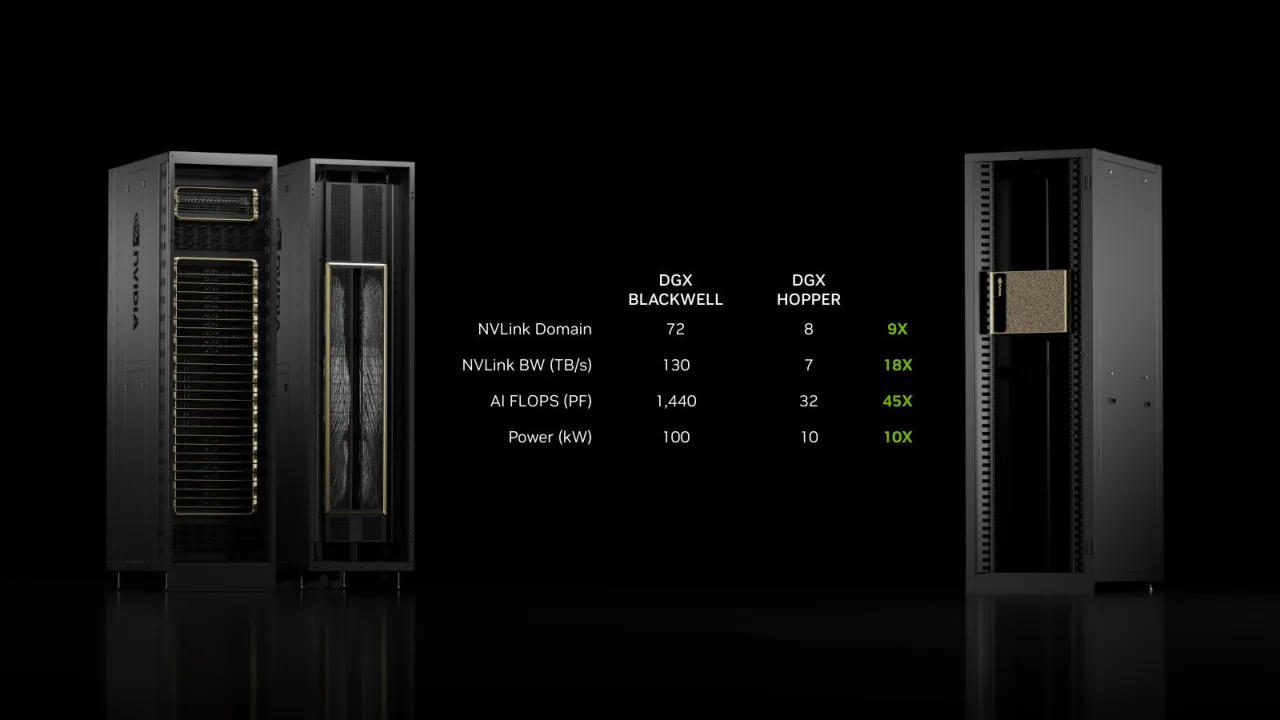
DGX / BLACKWELL / DGX / HOPPER / NVLink Domain / 72 / 8 / 9X / NVLink BW (TB/s) / 130 / 7 / 18X / AI FLOPS (PF) / 1,440 / 32 / 45X / Power (kW) / 100 / 10 / 10X
Visuals: Photograph of NVIDIA DGX server racks on a black studio background with a glossy black reflective floor. Left group: two dark grey racks, the front one open to show a gold-edged compute tray near its top, a dense stack of gold-trimmed horizontal compute trays in its middle, and a black fan/switch section at its base; the rear rack shows a vertical gold-framed module with mesh fan panels. Right: a single closed-front dark grey rack with a partly open front bay showing a gold-coloured compute unit with a green NVIDIA logo. Lighting is low-key, with soft highlights on the gold trim and rack edges. Dominant colours: black, charcoal grey, gold/brass and small bright green accents. Full-bleed background; the racks are not cropped and sit on the floor with reflections below. No overlay. Table: no ruled lines, no boxes. Columns: row label, DGX BLACKWELL, DGX HOPPER, unlabelled multiplier column. Rows: NVLink Domain 72 / 8 / 9X; NVLink BW (TB/s) 130 / 7 / 18X; AI FLOPS (PF) 1,440 / 32 / 45X; Power (kW) 100 / 10 / 10X. The three multipliers are highlighted in green.
Slide 31
I/O (SERDES)
36 PORTS
MANAGEMENT LOGIC
CORE LOGIC
MANAGEMENT LOGIC
36 PORTS
I/O (SERDES)
NVLink Switch
Chip
50B Transistors in TSMC 4NP
72-Ports 400G SerDes
4 NVLinks at 1.8TB/sec
7.2TB/sec Full-Duplex Bandwidth
SHARP In-Network Compute – 3.6 TFLOPS FP8
Visuals: One illustration: a photorealistic 3D render of an NVLink Switch chip package, a square gold-coloured substrate (about 37% of slide width, 66% of height) seen in slight perspective, rotated so its right edge recedes. At its centre is a dark circuit-board die (black with fine gold pads along its edges) carrying labelled blocks with iridescent teal, violet and gold tints: 'I/O (SERDES)' at top and bottom, '36 PORTS' above and below the centre, 'CORE LOGIC' in the middle, and vertical 'MANAGEMENT LOGIC' blocks on the left and right. Lighting is a soft key light from upper left, producing a bright gold gradient on the left of the package and darker gold at the right. The subject is fully visible, not cropped, boxed or tinted, with a faint mirrored reflection of the package on a glossy black floor below it (about 83% to 100% of height). No overlay.
Slide 32
Visuals: One photograph of a tall dark server rack, shown as a narrow vertical object at bottom centre. The subject is a two-bay rack viewed from the front. The left bay has a short top unit with a glowing gold-edged strip, a large lit panel of stacked horizontal rows of small components with gold/amber edge lighting, and a lower perforated section. The right bay is an open cabinet with a mesh-like grey-white glowing panel in its middle section and dark framing above. Lighting is low-key, with warm gold/amber highlights on the left bay and cool grey-white light on the right bay. Dominant colours are black, charcoal grey and warm gold. The image is cropped by the bottom edge of the slide and is not framed by a box; its black surround blends into the slide background. No overlay or tint.
Slide 33
BlueField-3 / 400G SuperNIC
Spectrum-X800 / Ethernet Switch
1.6X
Effective / Bandwidth
NVIDIA SPECTRUM-X
為生成式人工智慧推進乙太網路
Supercharging Ethernet for Generative AI
Visuals: Photographic product renders on a black background. (1) Left: a fanned stack of about five black BlueField-3 400G SuperNIC PCIe cards, each with a green-and-blue lit processor die and gold edge connectors, overlapping diagonally, spanning about x 11-30%, y 25-46%. (2) Centre: a Spectrum-X800 Ethernet switch chassis shown in an angled top-down view, with a metal lid revealing a large gold heatsink, a central green-blue lit ASIC, fan modules along the rear, and a front panel of rows of black QSFP ports, sitting on a faint reflection, spanning about x 39.5-60%, y 14-51%. (3) Right: a mirrored stack of about five identical SuperNIC cards spanning about x 70-90%, y 25-46%. (4) Two thin white double-headed horizontal arrows, one between left stack and switch at about x 31-37%, y 38%, and one between switch and right stack at about x 63-69%, y 38%, each with arrowheads at both ends. Lighting is soft studio spot lighting producing highlights on metal and dark reflections; dominant colours black, grey, gold and green. Nothing is cropped; all objects are fully visible.
Slide 34
Spectrum-X1600 / 102.4T – 512 Radix / CX9 1600G SuperNIC / Millions of GPUs / Spectrum-X800 Ultra / 51.2T – 512 Radix / CX8 800 SuperNIC / 100's of Thousands of GPUs / Spectrum-X800 / 51.2T – 256 Radix / BF3 400G SuperNIC / 10's of Thousands of GPUs / 2024 / 2025 / 2026 / 年度 SPECTRUM-X 節奏 / 擴展到數百萬個 GPU / ANNUAL SPECTRUM-X RHYTHM / SCALING TO MILLIONS OF GPUS
Visuals: Line chart with no axis titles and no unit labels. Horizontal axis: years 2024, 2025, 2026 marked as tick labels at the points, no numeric range printed. Vertical axis: no scale or labels printed. One series drawn as a bright green (#76B900) polyline with round markers: point at 2024 at the baseline (lowest), point at 2025 slightly higher (about one-fifth of the way up), point at 2026 at the top right (about 90 percent of the height). Each point is annotated with a three-line label: 2024 Spectrum-X800 / 51.2T – 256 Radix / BF3 400G SuperNIC / 10's of Thousands of GPUs; 2025 Spectrum-X800 Ultra / 51.2T – 512 Radix / CX8 800 SuperNIC / 100's of Thousands of GPUs; 2026 Spectrum-X1600 / 102.4T – 512 Radix / CX9 1600G SuperNIC / Millions of GPUs. The green last line of each label is the scale phrase. A thin light-grey horizontal baseline runs under the years. Photograph on left: a dark rack-mount networking switch chassis viewed from front-left above, shown open at the top with four black cooling fan modules along the back, a large gold-tinted heatsink over a central ASIC package showing a green and purple die, and a row of front ports: two rows of QSFP-style cages in four groups along the bottom front, a small RJ45 management port at the bottom left and a NVIDIA logo badge at bottom right. The lighting is soft, from above, with copper and gold highlights on the heatsinks and a faint reflection of the chassis on a black floor. Composition is a three-quarter view, unboxed, not cropped, sitting on the black background with no border. Dominant colours: black, gold-bronze, green accents. No overlay.
Slide 35
Visuals: One photograph, a rendered image of a large data centre hall shown in one-point perspective. Two large blocks of black server racks stand on the polished floor, one on the left and one on the right of a wide central aisle. Each block is made of rows of tall black cabinets with blue and green network cables in bundles across their front faces. Further rows of similar racks recede toward the back wall on both sides, creating repeated rows. Lighting comes from long white linear ceiling light strips arranged in angled trapezoid and diagonal shapes, with glossy reflections on the floor. The walls are pale grey with faint panel lines, and the ceiling is brushed grey metal. Dominant colours are grey and near-white, with black racks and small blue and green accents. The image is full-bleed, uncropped at the frame edges, with no overlay or tint.
Slide 36
aws / Google Cloud / Microsoft Azure / ORACLE CLOUD Infrastructure / ADEPT / AI21 labs / Character.AI / cohere / essential AI / Hugging Face / Inflection / Meta / MISTRAL AI / OpenAI / perplexity / Recursion. / Tesla / together.ai / X / AIVRES / APPLIED DIGITAL / ASRock Rack / ASUS / CISCO / CoreWeave / Crusoe / DELL Technologies / EVIDEN / FOXCONN / FUJITSU / GIGABYTE / Hewlett Packard Enterprise / IBM Cloud / indosat / Inventec / Lambda / Lenovo / NEXGEN CLOUD / NORTHERN DATA GROUP / PEGATRON / QCT / Scaleway / Singtel / SoftBank / SUPERMICRO / wistron / wiwynn / YOTTA / YTL Communications / zt Systems
Visuals: Grid of 50 rounded-rectangle logo tiles, each a near-black navy panel with a faint outline containing a white or light-grey company logo. Row 1: AWS (smile arrow wordmark), Google Cloud, Microsoft Azure (four-square Windows mark), Oracle Cloud Infrastructure. Row 2: Adept, AI21 labs, Character.AI, cohere, essential AI, Hugging Face (emoji mark), Inflection. Row 3: Meta, Mistral AI (M mark), OpenAI, perplexity, Recursion (hexagon mark), Tesla (T mark), together.ai, X. Row 4: AIVRES, Applied Digital, ASRock Rack, ASUS, Cisco, CoreWeave, Crusoe (diamond mark), Dell Technologies. Row 5: EVIDEN, Foxconn, Fujitsu, GIGABYTE, Hewlett Packard Enterprise, IBM Cloud, indosat, Inventec. Row 6: Lambda, Lenovo (white box with black text), NEXGEN Cloud, Northern Data Group, PEGATRON, QCT, Scaleway, Singtel. Row 7: SoftBank, Supermicro, wistron, wiwynn, YOTTA, YTL Communications, zt Systems. No photographs; all logos are monochrome white on black.
Slide 37
Hopper Platform / GPU / CPU / NVLINK / NIC / SWITCH / Hopper GPU / 6S HBM3 / Hopper+ GPU / 6S HBM3e / Grace CPU / NVLink Switch / 900 GB/sec / CX7 / SuperNIC / BF3 / SuperNIC / Quantum-X400 / InfiniBand Switch / 資料中心規模 • 一年節奏 • 技術限制 • 一個架構 / DATACENTER SCALE • ONE-YEAR RHYTHM • TECHNOLOGY LIMITS • ONE ARCHITECTURE
Visuals: Diagram-style grid of chip icons inside one rounded dark panel. Five row labels in gold run down the left edge: GPU, CPU, NVLINK, NIC, SWITCH. Column 1 holds Hopper GPU 6S HBM3 (row GPU), NVLink Switch 900 GB/sec (row NVLINK), CX7 SuperNIC (row NIC), and Quantum-X400 InfiniBand Switch (row SWITCH). Column 2 holds Hopper+ GPU 6S HBM3e (row GPU), Grace CPU (row CPU), and BF3 SuperNIC (row NIC). Each chip is a small square photographic render of a processor die with a gold or metallic frame, shown front-on with soft top lighting, on black. Chip colours vary: green/orange/purple heat-map dies for the GPUs, Grace CPU and BF3; gold-toned packages for the NVLink switch and Quantum-X400. No chart, table, or connecting arrows; labels sit directly beneath each icon.
Slide 38
Hopper Platform
Blackwell Platform
GPU
CPU
NVLINK
NIC
SWITCH
Hopper GPU (caption blurred, illegible)
Hopper GPU (caption blurred, illegible)
Grace CPU (caption blurred, illegible)
NVLink Switch (caption blurred, illegible)
CX7 SuperNIC (caption blurred, illegible)
BF3 SuperNIC (caption blurred, illegible)
Quantum-X800 InfiniBand Switch (caption blurred, illegible)
Blackwell GPU
8S HBM3e
NVLink 5 Switch
1800 GB/sec
CX8 SuperNIC
Spectrum-X800
Ethernet Switch
Quantum-X800
Switch
資料中心規模 • 一年節奏 • 技術限制 • 一個架構
DATACENTER SCALE • ONE-YEAR RHYTHM • TECHNOLOGY LIMITS • ONE ARCHITECTURE
Visuals: Diagram of a hardware matrix on a black starfield. Left panel labelled Hopper Platform (blurred, dimmed) contains: GPU row with two Hopper GPU chip icons (captions blurred); CPU row with one Grace CPU chip icon at the second column; NVLINK row with one NVLink Switch chip icon at the first column; NIC row with a CX7 SuperNIC chip icon at the first column and a BF3 SuperNIC chip icon at the second column; SWITCH row with one Quantum-X800 InfiniBand Switch icon at the first column. Right panel labelled Blackwell Platform (sharp) contains: GPU row with a Blackwell GPU 8S HBM3e chip icon captioned 'Blackwell GPU / 8S HBM3e'; NVLINK row with an NVLink 5 Switch icon captioned 'NVLink 5 Switch / 1800 GB/sec'; NIC row with a CX8 SuperNIC icon captioned 'CX8 SuperNIC'; SWITCH row with a Spectrum-X800 Ethernet Switch icon and a Quantum-X800 Switch icon side by side. Chip icons are small square gold-framed chip photographs with multicoloured rainbow-tinted dies, shown on black. No arrows or connecting lines. Hopper icons are blurred and dimmed; Blackwell icons are sharp.
Slide 39
Hopper Platform
Blackwell Platform
GPU
CPU
NVLINK
NIC
SWITCH
Hopper GPU 80 HBM2 (blurred)
Hopper GPU 96 HBM3e (blurred)
Grace CPU (blurred)
NVLink Switch 900 GB/sec (blurred)
CX7 SuperNIC (blurred)
BF3 SuperNIC (blurred)
Quantum-X800 InfiniBand Switch (blurred)
Blackwell GPU
8S HBM3e
Blackwell Ultra GPU
8S HBM3e 12H
NVLink 5 Switch
1800 GB/sec
CX8 SuperNIC
Spectrum-X800
Ethernet Switch
Quantum-X800
Switch
Spectrum Ultra X800
Ethernet Switch 512-Radix
資料中心規模 • 一年節奏 • 技術限制 • 一個架構
DATACENTER SCALE • ONE-YEAR RHYTHM • TECHNOLOGY LIMITS • ONE ARCHITECTURE
Visuals: Grid of chip and switch icons on a black field. Hopper Platform (left panel, blurred and dimmed): GPU row has two Hopper GPU chips (80 HBM2 and 96 HBM3e labels, illegible); CPU row has one Grace CPU chip under the second column; NVLINK row has one NVLink Switch chip in the first column; NIC row has CX7 SuperNIC in the first column and BF3 SuperNIC in the second column; SWITCH row has one Quantum-X800 InfiniBand Switch chip in the first column. Blackwell Platform (right panel, sharp): GPU row has Blackwell GPU 8S HBM3e (left column) and Blackwell Ultra GPU 8S HBM3e 12H (right column, highlighted with a bright gold glow and smoke-like haze); NVLINK row has NVLink 5 Switch 1800 GB/sec centred in column two; NIC row has CX8 SuperNIC in column two; SWITCH row has Spectrum-X800 Ethernet Switch (left), Quantum-X800 Switch (centre) and Spectrum Ultra X800 Ethernet Switch 512-Radix (right, highlighted with a gold glow). Each chip is a small square die-package icon with a gold-bordered metal frame, rendered in gold, purple and green tones; icons are roughly equal size with labels centred beneath. No charts, arrows or connecting lines.
Slide 40
Hopper Platform
Blackwell Platform
Rubin Platform
GPU
CPU
NVLINK
NIC
SWITCH
Hopper GPU 8S HBM3
Hopper GPU 8S HBM3e
Grace CPU
NVLink Switch 900 GB/sec (blurred)
CX7 SuperNIC
BF3 SuperNIC
Quantum X800 InfiniBand Switch (blurred)
Blackwell GPU 8S HBM3e (blurred)
Blackwell Ultra GPU 8S HBM3e 12H (blurred)
NVLink 5 Switch 1800 GB/sec (blurred)
CX8 SuperNIC (blurred)
Spectrum-X800 Ethernet Switch (blurred)
Quantum-X800 Switch (blurred)
Spectrum-X800 Ethernet Switch 1.6 Radix (blurred)
Rubin GPU 8S HBM4
Rubin Ultra GPU 12S HBM4
Vera CPU
NVLink 6 Switch / 3600 GB/sec
CX9 SuperNIC / 1600 Gb/sec
X1600 / IB/Ethernet Switch
資料中心規模 • 一年節奏 • 技術限制 • 一個架構
DATACENTER SCALE • ONE-YEAR RHYTHM • TECHNOLOGY LIMITS • ONE ARCHITECTURE
Visuals: Illustration-style diagram of about 30 chip and switch icons arranged in a grid by platform (columns) and component type (rows). Hopper panel: Hopper GPU 8S HBM3 (GPU row, column 1), Hopper GPU 8S HBM3e (GPU row, column 2), Grace CPU (CPU row, column 2), NVLink Switch (NVLINK row, column 1), CX7 SuperNIC (NIC row, column 1), BF3 SuperNIC (NIC row, column 2), Quantum X800 InfiniBand Switch (SWITCH row, column 1). Blackwell panel: Blackwell GPU 8S HBM3e (GPU row, column 1), Blackwell Ultra GPU 8S HBM3e 12H (GPU row, column 2), NVLink 5 Switch (NVLINK row), CX8 SuperNIC (NIC row), Spectrum-X800 Ethernet Switch, Quantum-X800 Switch and Spectrum-X800 Ethernet Switch 1.6 Radix (SWITCH row). Rubin panel: Rubin GPU 8S HBM4 (GPU row, column 1), Rubin Ultra GPU 12S HBM4 (GPU row, column 2), Vera CPU (CPU row, column 1), unlabelled chip (CPU/NVLINK rows, column 2), NVLink 6 Switch 3600 GB/sec (NVLINK row), CX9 SuperNIC 1600 Gb/sec (NIC row), X1600 IB/Ethernet Switch (SWITCH row), unlabelled chips at column 2 in NVLINK, NIC and SWITCH rows. Icons are small square chips with gold-tinted edges and blurred glow; Hopper and Blackwell icons are dimmed and blurred, Rubin icons are sharper and rendered as white line sketches with gold fills. No photographs, no arrows, no legend.
Slides 41 to 61 continue in the full text file.
Download this deck
The hosted PDF of every library deck is free for readers of the SlideDeck Co newsletter. Join with your email and the viewer and download appear here.
Building a deck of your own? The SlideDeck Co Standard Deck is a slide library for business presentations: reviews, updates and plans.