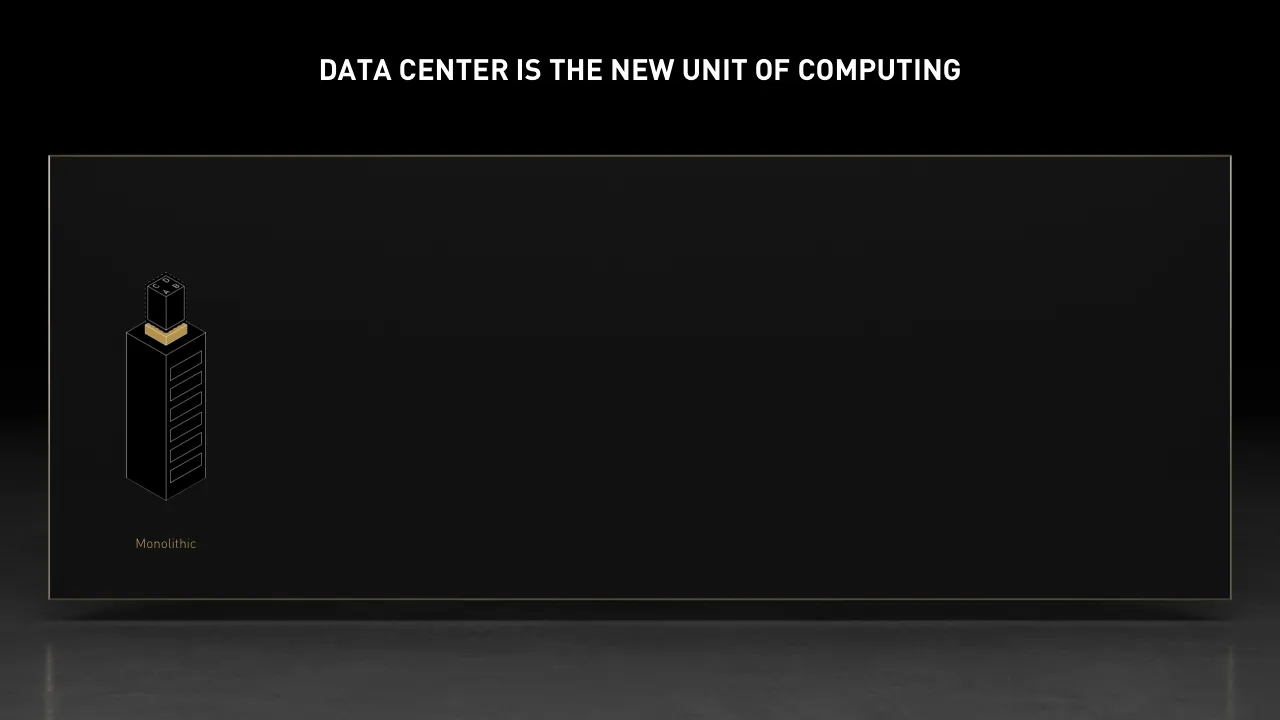
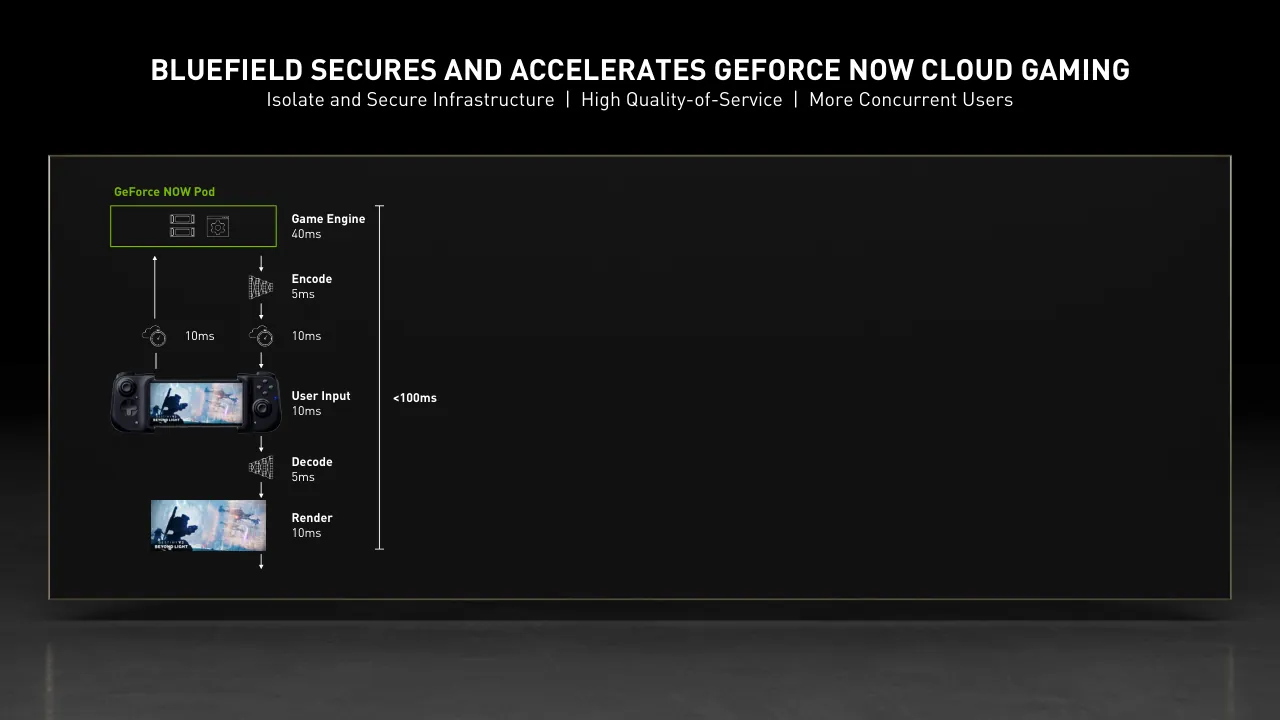
The deck is the slide set for NVIDIA's GTC 2021 keynote by Jensen Huang. It opens with a list of the five themes of the talk: accelerated computing, the data center as the new unit of computing, AI as software that writes software, AI-on-5G, and autonomous systems. A slide of new technology names follows, then a platform overview with adoption figures such as CUDA downloads, developers and GPU apps. The middle sections cover scientific computing and the Omniverse collaboration platform, then data center architecture with BlueField DPUs, DGX systems and Grace CPUs. Later sections address AI software and frameworks including NGC, TAO, Jarvis, Merlin and Triton, followed by 5G and edge, security with Morpheus, and automotive with DRIVE, Orin and Atlan. It closes with a recap slide listing the new technologies, which the deck repeats at the end. Slides worth studying include the 'Data Center is the New Unit of Computing' build sequence (slides 17 to 21), which adds one layer per slide, and the BlueField GeForce NOW latency breakdown (slides 22 to 24).
Slides worth studying
Questions about this deck
How many slides does the NVIDIA GTC 2021 keynote deck have?
The deck has 95 slides in total. Slide 1 is the NVIDIA title slide, and slide 2 lists the five themes of the talk.
What CUDA adoption figures does the NVIDIA platform overview give?
Slide 4, titled NVIDIA IS A COMPUTING PLATFORM, lists 1B CUDA GPUs, 24M CUDA Downloads, 2,000 GPU Apps and 2.5M Developers. The same slide also lists 250 ExaFLOPS in the Cloud, 150 SDKs and 7,500 AI Startups.
How much does the NVIDIA DGX Station 320G cost according to the deck?
Slide 29, ANNOUNCING NVIDIA DGX STATION 320G, gives the price as $149,000 or $9,000/Month Subscription. The same slide lists 2.5 petaFLOPS and 320 GB at 8 TB/sec.
How is the NVIDIA GTC 2021 deck structured?
Slide 2 gives the five themes of the talk and slide 3 lists the new NVIDIA technologies. Slide 4 gives the platform overview, slides 17 to 21 build the data center as the new unit of computing one layer per slide, and slides 22 to 24 cover the BlueField GeForce NOW latency breakdown.
Details
- Company: NVIDIA
- Year: 2021
- Type: Keynote
- Industry: Semiconductors and computing platforms
- Pages: 95
More from NVIDIA
- NVIDIA investor presentation, September 2026 NDR
- NVIDIA investor presentation, Annual Stockholder Meeting June 2026
- NVIDIA investor presentation, Q2 FY27 quarterly presentation
- NVIDIA keynote, GTC Europe 2026
- NVIDIA presentation, 2026
- NVIDIA keynote, GTC 2026 Keynote
All NVIDIA decks in the library
Review score: 8 out of 10, Strong
Presentation quality, judged with the SlideDeck Co review heuristic. Ask, evidence and idea merit are not rated here.
This is a keynote built to be spoken over, and the visuals fit that: a consistent dark identity with green and gold accents, one idea per slide, large titles, and strong product renders and diagrams. The build sequences carry real explanatory value, such as the one-layer-per-slide data center evolution (17 to 21), the latency breakdown that gains a traditional-versus-BlueField comparison (22 to 24), the Omniverse buildup (8 to 10) and the Grace memory bandwidth contrast (43 to 45). The weaknesses are small text inside many diagrams and panels, near-invisible gold-on-black labels on the icon slides (2, 17, 36, 54), and several chart slides such as 5 and 27 whose detail only works if the speaker narrates.
Worth keeping: Keep the incremental build sequences (17 to 21, 22 to 24), the high-contrast titles, the single dark visual system and the clean product renders such as slides 46 and 47.
Most useful repair: Raise the contrast and size of the gold captions on slides 2, 17 to 21, 36 and 54, and enlarge the labels and footnotes inside the diagrams on slides 5, 27, 29 and 33.
What would change the score: I would split or simplify the dense panels (slides 5, 6, 33, 59) and cut the repeated DGX SuperPOD backdrop clutter behind the text-heavy announcement slides.
Confidence medium. 72 of 95 pages inspected on contact sheets, 4 at readable size. Reviewed 2026-11-08. Model-assisted review (claude-sonnet-5-5).
Full text of the slides (95 slides)
Every slide's words and a description of its charts and images, so the deck can be searched and rebuilt. Also available as Markdown.
Slide 1
NVIDIA
Visuals: One logo: the NVIDIA eye mark (green square with a stylised eye in black cut-outs) followed by the white bold sans-serif wordmark 'NVIDIA' and a small registered-trademark symbol. The logo is placed on a full-bleed dark background photograph of a black studio floor fading upward into black. Lighting is a soft spotlight from above, so the floor is lightest near the bottom edge and the top is pure black. Dominant colours are black, dark grey and NVIDIA green. The logo is not cropped, boxed or tinted.
Slide 2
Accelerated Computing / is the Path Forward / AI is Software that / Writes Software / Data Center is the / New Unit of Computing / AI-on-5G Kickstarts the / 4th Industrial Revolution / Autonomous Systems in / Real and Virtual Worlds
Visuals: Five thin gold line-art illustrations on black, left to right. (1) Accelerated Computing: a stacked hardware unit drawn as a tall rectangle at top, four horizontal bars below, and three boxed panels along the base, the middle one holding a grid of small squares. (2) AI is Software that Writes Software: two tower shapes of different heights, the taller one stacked with rectangular cells and linked to the shorter tower by an orthogonal connector line, with circular symbols at the bases. (3) Data Center is the New Unit of Computing: three vertical server racks of equal height, each with rows of small rectangular units carrying circle and dash marks, joined at the top by a horizontal bus line with square nodes. (4) AI-on-5G Kickstarts the 4th Industrial Revolution: a cellular mast with a central vertical pole and two side panel arrays, surrounded by two pairs of concentric arcs on each side, standing on a base line. (5) Autonomous Systems in Real and Virtual Worlds: a wireframe sphere of triangulated mesh lines containing a six-axis industrial robot arm with circular joints and a gripper, mounted on a base plate. All icons are drawn in the same gold outline with no fills. Nothing is cropped, boxed or tinted. Below the icons, a dark reflective floor shows faint vertical gold reflections of each icon.
Slide 3
NEW NVIDIA TECHNOLOGIES
Omniverse
Isaac
Megatron
Drug Discovery
Quantum Computing
Jarvis
Merlin
Maxine
Morpheus
NVIDIA AI
DRIVE
RTX
DGX
Grace
BlueField
DOCA
EGX
5G
Hyperion
Atlan
Orin
Visuals: Eight dark rectangular panels arranged in a 4 by 2 grid, each with a thin bronze-grey outline and a soft shadow on the floor beneath the bottom row. Each panel holds centred white sans-serif labels: top row Omniverse/Isaac, Megatron/Drug Discovery/Quantum Computing, Jarvis/Merlin/Maxine/Morpheus/NVIDIA AI, DRIVE; bottom row RTX, DGX/Grace/BlueField/DOCA, EGX/5G, Hyperion/Atlan/Orin. Behind them is a dark studio-stage backdrop: pure black upper area fading into a dark grey reflective floor with faint vertical light streaks under each panel column, lit from above and centred.
Slide 4
NVIDIA IS A COMPUTING PLATFORM
1B
CUDA GPUs
250
ExaFLOPS
in the Cloud
2,000
GPU Apps
24M
CUDA
Downloads
150
SDKs
7,500
AI Startups
2.5M
Developers
AN INSTRUMENT OF SCIENCE
ASTRONOMY &
ASTROPHYSICS
CLIMATE &
WEATHER
SCIENTIFIC
VISUALIZATION
MEDICAL
IMAGING
MOLECULAR
DYNAMICS
GENOMICS
GAME
DEVELOPMENT
RENDERING &
RAY TRACING
AR / VR
Leeza SOHO, Beijing
By ZAHA HADID ARCHITECTS
Visuals: Seven circular stat badges, each a near-black disc with a thin gold-brass rim and soft bevel. Upper row, left to right: 1B CUDA GPUs; 250 ExaFLOPS in the Cloud; 2,000 GPU Apps; 24M CUDA Downloads. Lower row, left to right: 150 SDKs; 7,500 AI Startups; 2.5M Developers. No charts, tables or logos. The right panel contains nine photographs in a 3 by 3 grid, each labelled with white capitals across its lower part: Row 1: Astronomy and astrophysics (a dense star field of gold and white stars on black); Climate and weather (a blue satellite-style weather map of the globe with cloud bands and isobars); Scientific visualization (a satellite or spacecraft body trailing through a pink-and-blue plume of cloud against deep blue). Row 2: Medical imaging (grey X-ray-style lungs with green and blue airway highlights); Molecular dynamics (a rendered protein complex in yellow, blue and orange ribbon and surface form); Genomics (a twisted DNA double helix in red, orange and blue on dark grey). Row 3: Game development (a fantasy landscape with a floating island, blue sky and clouds); Rendering and ray tracing (a pile of glossy reflective spheres in red, pink, blue and chrome); AR / VR (a hand holding a tablet in front of a window with a translucent architectural model overlay). Photo tiles are pale-to-dark gradient-darkened at the bottom edge so the white labels read clearly. Composition is an evenly spaced square grid with no cropping of the tile frames.
Slide 5
GIVING SCIENTISTS A TIME MACHINE | FULL-STACK OPTIMIZATION | 13x in 5 years | Chroma | GROMACS | Quantum Espresso | Random Forest | TensorFlow | PyTorch | VASP | Amber | MILC | NAMD | 1X (100 hrs) | 2X (42 hrs) | 3X (32 hrs) | 4X (27 hrs) | 9X (11 hrs) | 13X (8 hrs) | P100 (2016) | V100 (2017) | V100 (2018) | V100 (2019) | A100 (2020) | A100 (2021) | MULTI-GPU MULTI-NODE SCALE | NAMD Version 3.0 | 2.14 baseline | 3.0a7 En | 120 | 80 | 40 | 0 | ns/day (higher is better) | 0 | 2 | 4 | 6 | 8 | GPUs | LARGEST AI + MD SIMULATION | 305 Million Atoms | EXASCALE HPC AI | HPL-AI and HPL Performance | HPL-AI | Leonardo | Perlmutter | Summit | JUWELS | Sierra | Fugaku | HPL | PFLOPS | 10000 | 1000 | 100 | 2018 | 2019 | 2020 | 2021
Visuals: Panel 1: vertical bar chart titled FULL-STACK OPTIMIZATION, subtitle 13x in 5 years. Bars in order: P100 (2016) 1X (100 hrs), V100 (2017) 2X (42 hrs), V100 (2018) 3X (32 hrs), V100 (2019) 4X (27 hrs), A100 (2020) 9X (11 hrs), A100 (2021) 13X (8 hrs). Bar heights are about 8%, 15%, 23%, 31%, 69% and 100% of the tallest bar; no numeric axis or scale is printed. Bars 1X to 9X are light grey #CCCCCC; the A100 (2021) 13X bar is green #76B900 and highlighted. Multiplier labels sit above each bar in bold-medium, hours in brackets beneath. Panel 1 also has a text list of applications at top-left (Chroma, GROMACS, Quantum Espresso, Random Forest, TensorFlow, PyTorch, VASP, Amber, MILC, NAMD). Panel 2: line chart titled MULTI-GPU MULTI-NODE SCALE, subtitle NAMD Version 3.0. X axis GPUs, 0 to 8, ticks 0, 2, 4, 6, 8. Y axis ns/day (higher is better), 0 to 120, ticks 0, 40, 80, 120. Series 3.0a7 En is green #76B900 with circle markers joined by straight lines, values about 14 at 1 GPU, 27 at 2, 54 at 4 and 109 at 8 (estimated, not printed). Series 2.14 baseline is light grey #CCCCCC with triangle markers, about 7, 11, 14 and 14 at 1, 2, 4 and 8 GPUs (estimated). Legend above plot: grey triangle line marker 2.14 baseline, green circle line marker 3.0a7 En. No highlighted points. Panel 3: full-panel photograph, see element list. Panel 4: scatter/line chart titled EXASCALE HPC AI, subtitle HPL-AI and HPL Performance. Y axis PFLOPS, logarithmic, ticks 100, 1000, 10000; X axis years 2018 to 2021 at equal spacing. Green #76B900 straight trend line labelled HPL-AI rising from about 550 PFLOPS in 2018 to about 14800 at the right end; green points: Summit about 2240, Sierra about 1660, JUWELS about 1660, Perlmutter about 2700, Leonardo about 9100 (all estimated). Teal dot near Fugaku about 1480 (estimated). Grey #CCCCCC HPL line with grey dots at 2018 about 87, 2019 about 110, 2020 about 330, 2021 about 355, extending to about 450 (estimated). No legend box; series identified by direct labels.
Slide 6
FOR THE DA VINCIS OF OUR TIME / SCIENTISTS AT GTC / Yoshua Bengio / University of Montreal / Quebec AI Institute / Yann LeCun / Facebook / New York University / Geoffrey Hinton / University of Toronto / Google / Vector Institute / Daphne Koller / Insitro / Coursera / Stanford / Jϋrgen Schmidhuber / Dalle Molle Institute for / AI Research / Raquel Urtasun / University of Toronto / Alvy Ray Smith / Pixar / Altamira / Abhay Parasnis / Adobe / Kim Libreri / Epic Games / Rommie Amaro / University of / California, San Diego / Soumith Chintala / Facebook / Rose Yu / University of / California, San Diego / TALKS AT GTC / AI / 5G / IOT & EDGE / QUANTUM / COMPUTING / SPEECH / NLU / RECOMMENDERS / SELF-DRIVING / CARS / CYBERSECURITY / DIGITAL TWINS / ROBOTICS / LEADERS AT GTC / Adobe / Alibaba Cloud / arm / aws / Baidu / Baker Hughes / BAYER / BMW / EPIC GAMES / ERICSSON / FACEBOOK / Ford / Google / INDUSTRIAL LIGHT & MAGIC / Kroger / Microsoft / NASA / NTT / ORACLE Cloud Infrastructure / PayPal / Pinterest / Pfizer / PIXAR / Red Hat / SIEMENS Healthineers / Snapchat / Spotify / Tencent Cloud / TESCO / TSMC / Twitter / verizon / vmware / Volkswagen / Walmart / WELLS FARGO
Visuals: Left panel: twelve head-and-shoulders portraits in a 4 by 3 grid, each captioned with name and affiliation, with thin gold horizontal rules under the first two rows of photos. Centre panel: a 3 by 3 grid of nine square gold tiles, each holding one white uppercase topic label. Right panel: a grid of about 37 white monochrome company logos in 7 rows, listed in the text above. No charts, tables or diagrams.
Slide 7
Black Myth: Wukong by Game Science
Visuals: One full-bleed photograph (a rendered 3D still of the character Sun Wukong from Black Myth: Wukong by Game Science). Subject: a monkey-faced warrior with dark fur on the cheeks, jaw and neck, shown in left-facing profile, brow furrowed, eye looking left past the frame. He wears a dark, worn, riveted metal shoulder pauldron on the right side of the frame, and his clenched right fist is raised in the lower centre-right foreground, slightly out of focus. Action: he is mid-motion, turning to the left, with small dark debris specks scattered across the air. Composition: tight medium close-up cropped at the top of the head and at the bottom of the chest, subject placed right of centre with the face in the upper-left third. Lighting: warm, soft, directional light on the face and armour. Dominant colours: warm browns and umber on the left and in the face, dark charcoal-brown in the armour and fur, and pale grey-white bokeh at the upper right and left edges. The image is full-bleed, uncropped at the edges of the slide, with no overlay or tint, and the photograph is shown at 16:9.
Slide 8
NVIDIA OMNIVERSE / AI / MESHES / GEOMETRY / ANIMATION / SHADING / MOTION / NURBS / RTX / RENDERING / LIGHTS / PHYSICS / AI / Path-Tracing / USD / Materials / Physics
Visuals: Illustration: a translucent teal-green wireframe sphere (about 24% of slide width, 43% of slide height) with a glowing node network. Inside it is a silver-white humanoid robot bust, centre-lit, with a faceted dark teal background. Twelve small gold-bracketed keyword labels sit on the sphere: AI, MESHES, GEOMETRY, ANIMATION, SHADING, MOTION, NURBS, RTX, RENDERING, LIGHTS, PHYSICS. RTX and PHYSICS are set larger than the others. Inset photograph (boxed, sharp square corners, thin light-grey border about 1px, lower-right of the sphere, overlapping its edge): two white-and-blue armoured humanoid robots standing side by side in a blue-lit corridor, one white on the left and one blue on the right, looking forward. Lighting is cool blue. Icon row: five circular icons about 2.5% of slide width each. AI: dark teal sphere with a constellation of dots. Path-Tracing: a round photo of colourful pastel spheres. USD: a solid blue disc with a white USD logo. Materials: a round photo of grey and tan spheres. Physics: a round photo of a bright orange fire-like burst on black. Below the icons is a soft dark elliptical shadow.
Slide 9
NVIDIA OMNIVERSE
ANIMATION
MESHES
GEOMETRY
MOTION
NURBS
RENDERING
RTX
LIGHTS
PHYSICS
AI
AI
Path-Tracing
USD
Materials
Physics
Visuals: Full-bleed dark studio photograph of a grey floor and black backdrop, lit from above, forming the background. Left column: three square boxed photographs with thin light-grey borders and slightly rounded corners. Top: a grey monochrome sculpted humanoid head and shoulders on a dark background. Middle: a purple and copper-visored armoured figure facing front, lit from the right. Bottom: a grey metallic circular turntable or device inside a machine-like enclosure with bright highlights. Three gold (#C8A24A) double-headed arrows connect each left thumbnail to the sphere: the top arrow runs diagonally from the top thumbnail to the sphere's upper-left, the middle arrow is horizontal, and the bottom arrow runs diagonally from the sphere's lower-left to the bottom thumbnail. Central illustration: a translucent wireframe sphere with teal and dark-green faceted surfaces, pale green and white network nodes and lines, and a white-and-gold armoured humanoid figure at its centre. Gold-bracketed labels are placed on the sphere: AI (top), MESHES (upper right), GEOMETRY (right of centre), ANIMATION (left), REFLECTIONS (centre, blurred), MOTION (right), NURBS (lower left), RENDERING (lower left), RTX (lower right, larger), LIGHTS (lower right), PHYSICS (bottom, larger). Right of the sphere: a boxed photograph with light-grey border showing two armoured figures standing side by side, one white and one blue with glossy armour, in a blue-lit corridor. Bottom centre: a row of five round icons with labels beneath: AI (dark teal starfield sphere), Path-Tracing (multicoloured spheres on dark ground), USD (blue circle with white USD logo), Materials (grey and brown spheres), Physics (orange fire-like burst on black).
Slide 10
NVIDIA OMNIVERSE
ANIMATION
RAYTRACE
NURBS
RENDERING
AI
GEOMETRY
MESHES
MOTION
RTX
LIGHTS
PHYSICS
AI
Path-Tracing
USD
Materials
Physics
Visuals: Photograph and illustration mix. (1) Three square thumbnails stacked at left, each about 6.7% wide with rounded corners and a thin grey border. Top: a grey monochrome sculpted head and torso of a faceless figure on dark grey, front-facing, centred. Middle: a purple and copper-accented helmeted figure on a warm brown background, lit from the left. Bottom: a silver-grey mechanical turntable stage in a white studio, seen from an angle with a curved disc and rails. (2) Three gold thin-line double-headed arrows, each about 1 pixel stroke, linking the thumbnails to the sphere: one diagonal from top thumbnail to upper sphere edge, one horizontal from middle thumbnail to sphere, one diagonal from bottom thumbnail to lower sphere edge. (3) A large sphere, about 24% of the width, made of a faceted translucent wireframe mesh with teal and green glowing nodes and lines over a dark teal volumetric interior. A white and grey humanoid robot figure with a metallic sheen sits at the centre. Gold square bracket tags label the sphere: ANIMATION at left, RAYTRACE partly hidden behind the robot, NURBS at lower left, RENDERING at bottom left, AI at top, GEOMETRY at upper right, MESHES at upper right, MOTION at right, RTX larger at right, LIGHTS at lower right, and PHYSICS largest at bottom. The tags are white-gold with thin bracket corners. (4) A small square photo of two humanoid robots, one white and one blue, standing side by side in a dark blue studio, boxed with a thin gold outline. A thin gold ring of two curved arrows encircles it, with arrowheads at upper right and lower left. (5) A large circular photo, about 20% of the width, with a thin gold ring border. It shows a wooden table top with a tablet propped up displaying two small robots on a grid, a hand holding a stylus over the screen, two small robot figures standing on the table at upper left, a red coffee cup at lower left, a dark glossy surface and a plant in the upper right. Soft natural daylight from the window, warm wood and red tones. (6) A row of five circular icons, each about 2.5% wide: AI is a dark blue starfield sphere; Path-Tracing is a glossy multicolour sphere cluster; USD is a bright blue circle with a white stacked-layers logo and the letters USD; Materials is a cluster of grey and brown spheres; Physics is a golden glowing particle burst on black.
Slide 11
Visuals: Photograph (rendered 3D-style image of an interior corner room). Subject: a tall freestanding sculptural assemblage of everyday objects (paint cans, a brass trophy-like vase, a guitar-shaped disc, a red box, a cymbal-like disc, metal tins, tubes, a teapot-like shape, brushes and bottles) mounted on thin black rods on three legs, standing in front of the room corner. On the right wall a large dark silhouette shadow of a dancer with both arms raised overhead, body leaning, one leg extended down toward the floor. At bottom left a dark metal wire cart/crate holding a tilted tin with a small light glint; at bottom right a stack of four weathered wooden crates. Composition: full-frame, wide landscape, the sculpture at about 36 to 54 percent of width, the shadow occupying the upper right quadrant, the corner of the room running vertically at about 49 percent of width. Lighting: a single warm directional light from the upper left casting the dancer shadow onto the right wall; soft bright pool of light on the floor at bottom left. Dominant colours: warm beige and tan wall tiles (about #B9A588), mid-brown floor (about #7A6A56), dark charcoal shadow (about #3A3430), with multicoloured accents of red, teal and gold on the sculpture. Not cropped; full-bleed; no overlay or tint.
Slide 12
COLLABORATING AND SIMULATING IN OMNIVERSE
Foster + Partners
INDUSTRIAL LIGHT & MAGIC
WPP
BMW
ECMWF
ERICSSON
ACTIVISION
Bentley
10M DESIGNERS | 20M CREATORS | 1M SCIENTISTS | 2M DEVELOPERS | 40M ENGINEERS
Image Courtesy of Industrial Light & Magic.
© and TM Lucasfilm Ltd. All Rights Reserved.
Visuals: Eight rectangular photographs in a 4x2 grid, each boxed with a thin dark-grey edge and no corner radius. Top row, left to right: (1) Foster + Partners: aerial night view of illuminated glass skyscrapers with warm amber lights and a dark blue sky, with the white Foster + Partners wordmark over the upper area. (2) Industrial Light & Magic: a still of the Baby Yoda character beside a Mandalorian in a dark helmet in a dim control-room setting with small red and green indicator lights; white ILM emblem and wordmark at top centre. (3) WPP: a person seen from behind at a multi-monitor workstation in a forest of trees with autumn-coloured foliage, with a white WPP wordmark at top. (4) BMW: a grey monochrome factory interior showing car bodies hanging on an overhead conveyor, with a white BMW roundel at top right. Bottom row, left to right: (5) ECMWF: Earth seen from orbit, curved horizon with a thin blue atmosphere edge over dark clouds, with the white ECMWF logo at top. (6) Ericsson: a rendered city street intersection with a green bus, a crosswalk and red and yellow laser-like lines, with the white Ericsson wordmark and three-bar symbol at top. (7) Activision: a female character in tactical gear leaping through an orange fireball and debris, with the white Activision wordmark and registered mark at top. (8) Bentley: a rendered elevated railway station with a curved blue-grey roof and track in a light grey sky, with the white Bentley wordmark at top and a small white 'D-STAR' label near the right centre. Logos are white and sit over the photographs. Tagline: plain white uppercase text with vertical bar separators, no icons.
Slide 13
Visuals: Photograph-like 3D render: a polished dark-metal cylindrical object (two cylinders joined by a rounded U-shaped bridge, seen from a three-quarter angle with the left cylinder's flat circular face toward the viewer) with a bright yellow-orange fabric or sheet draped over and through the top of the object, its folds rippling. The object floats above a grey reflective floor casting a soft diffuse shadow below and to the lower-left. Lighting is soft studio lighting with specular highlights on the metal; dominant colours are charcoal/gunmetal grey, steel, and saturated yellow-orange (about #F5B400). The image is full-bleed, not cropped, not boxed, with no overlay or tint; the background grades from mid grey at left to near-black at upper right.
Slide 14
NVIDIA ISAAC DIGITAL TWIN IN OMNIVERSE
Visuals: Three small rounded-square photographs stacked vertically on the left, each linked by a gold double-headed arrow to the central sphere. Top: an aerial view of a factory floor with dark shelving units, purple crates and a blue vehicle. Middle: a white six-axis robot arm on a black surface with small coloured cubes at its base, shown in a studio close-up. Bottom: a yellow automated guided vehicle carrying a grey pallet top, shown from an angled view against a blue floor. Above the top photo sit three round black icons overlapping: the Blender logo, a stylised R (Revit-like) mark, and the 3ds Max logo. Centre: a large translucent sphere with a gold wireframe mesh, containing a rendered warehouse scene with a worker in orange hi-vis clothing and a blue wall, a grey cart, a blue pallet lift with a yellow AGV and a white robot arm, and a blue-yellow hazard floor marking. Right of the sphere: a small square black tile with a grey icon of four monitors above a user silhouette, ringed by a thin gold circle with two curved gold arrows. Far right: a circular photograph of a white and light-blue UR-style collaborative robot arm in a warehouse, with purple plastic crates stacked at the bottom right and two workers in orange hi-vis clothing in the background; the photo is cropped to a circle and has a soft grey-white light tone.
Slide 15
PathTracing: 872/0 sp
(text is cut off at the right edge of the slide)
Visuals: One full-bleed photograph of the interior of an automotive assembly plant, shown in a one-point perspective view. Steel overhead conveyor gantries and trusses run along the left and right edges and across the ceiling, with a sawtooth truss roof and skylights. Yellow power and service conduits and hoses run along the ceiling and gantries. White robotic or tool arms hang from the ceiling at the upper left and centre. On the left, a black car with a light badge on its grille sits at the lower left edge. Magenta wire-mesh carts on blue bases stand on the left floor and along the mid-ground on both sides. On the right, red and white car bodies sit on the conveyor at the lower right, and a dark blue-black storage unit stands near the centre right. A dark grey rubber walkway runs diagonally across the lower right floor. The floor is polished grey concrete with bright specular reflections of the skylights. Lighting is diffuse daylight from the skylights and fluorescent strips, with a bright vanishing point at the far end. Dominant colours are steel grey, charcoal black, white, with yellow and magenta accents. The photograph is not cropped, boxed or tinted. A small white render counter overlays the top-right corner.
Slide 16
CONNECTING AND CREATING WITH OMNIVERSE
SOFTWARE
Adobe
Autodesk
Bentley
Blender
CLO Virtual Fashion
esri
FOUNDRY
golaem
GRAPHISOFT
ipolog
MathWorks
NETALLIED SYSTEMS
onshape
ParaView
PIXAR
Pixologic
makers of ZBRUSH
REALLUSION
Rhinoceros
SIDEFX
SOLIDWORKS
Trimble
UNREAL ENGINE
wrnch
SYSTEMS
ASUS
BOXX
CISCO
DELL Technologies
hp
Lenovo
PNY
SUPERMICRO
PIONEERS
BMW GROUP
ERICSSON
Foster + Partners
FRAMESTORE
IBI
Gensler
INDUSTRIAL LIGHT & MAGIC
KITESTRING
KPF
Lightcraft TECHNOLOGY
TANGENT
TURBOSQUID
W-B WOODS BAGOT
WPP
VOLVO
Visuals: Logos and wordmarks only, all rendered in white or near white on black. Software: Adobe, Autodesk, Bentley (Advancing Infrastructure), Blender, CLO Virtual Fashion, esri (The Science of Where), FOUNDRY, golaem (human ex machina), GRAPHISOFT, ipolog, MathWorks, NETALLIED SYSTEMS, onshape, ParaView, PIXAR Animation Studios, Pixologic (makers of ZBRUSH), REALLUSION, Rhinoceros (design, model, present, analyze, realize), SideFX, SOLIDWORKS, Trimble, UNREAL ENGINE, wrnch. Systems: ASUS, BOXX, CISCO, DELL Technologies, hp, Lenovo (white box with black wordmark), PNY, SUPERMICRO (oval outline). Pioneers: BMW GROUP, ERICSSON, Foster + Partners, FRAMESTORE, IBI (outlined brackets), Gensler, Industrial Light & Magic, KITESTRING, KPF, Lightcraft Technology, TANGENT, TURBOSQUID, W-B Woods Bagot, WPP, VOLVO. A dark reflective studio floor with a soft shadow beneath the panels sits in the lower part of the image; it is a full-bleed photograph with no visible people, with a slightly lit centre and vignetted edges.
Slide 17
DATA CENTER IS THE NEW UNIT OF COMPUTING / Monolithic
Visuals: One illustration: an isometric monolithic compute unit at about x 9.9%, y 37.9%, 6.2% wide by 31.6% high. It is a tall black rectangular block with a thin white outline, with a gold (#BD9F63) band across its top and a small black cube sitting on the band. The cube's top face carries small white letters (C, D, A, B). The block's front face shows six thin outlined horizontal slots. Lighting is a soft top light on a black stage. Composition is a side-on isometric view, uncropped and boxed only by the slide background. No photograph, chart, table or logo beyond this icon.
Slide 18
DATA CENTER IS THE NEW UNIT OF COMPUTING / Monolithic / Software-Defined / Data Center
Visuals: Two isometric line-art illustrations of server racks on a black panel, with no chart, table or photograph inside the panel. Left: a monolithic rack, a tall black box with thin white outline edges and six slanted slot outlines on its front face, topped by a small gold (#BD9F63) tray and a black cube with dashed white outline whose faces carry the letters A, B, C and D. Right: a software-defined data center rack of the same black construction and slot pattern, but taller, topped by a taller solid gold (#BD9F63) block and the same black lettered A, B, C, D cube. The gold colour is the only accent in the illustrations. Lighting is a soft spotlight on a dark stage floor with a faint reflection beneath the panel.
Slide 19
DATA CENTER IS THE NEW UNIT OF COMPUTING / Monolithic / Software-Defined / Data Center / Disaggregated, / Micro-Services, Scaled Out
Visuals: Three isometric line-and-block illustrations of data-centre towers, drawn in black with thin white outlines and gold #BD9F63 accents. Left, Monolithic: one black tower with thin horizontal slot outlines on its front face, a gold plate on top, and one black cube labelled A, B, C, D on its top face. Centre, Software-Defined Data Center: one taller black tower with the same slot outlines, a taller gold block on top, and a black cube labelled A, B, C, D above it. Right, Disaggregated, Micro-Services, Scaled Out: a cluster of four towers of different heights, with gold blocks on their tops and black cubes stacked on them. Cubes are labelled C (left), D (top centre), A (centre, in front), and B (right). White arrows connect them: one arrow runs from C up-right to D, one runs from D down-right to B, and one runs from B down-left to A. Cubes carry faint dotted outlines. No photographs and no logos.
Slide 20
DATA CENTER IS THE NEW UNIT OF COMPUTING
Monolithic
Software-Defined
Data Center
Disaggregated,
Micro-Services, Scaled Out
GPU-Accelerated
Computing
Visuals: Four isometric line-art illustrations of data-centre towers, read left to right. (1) Monolithic: one tall black tower with white outline rack slots and a short gold base plate, topped by a single black cube labelled A, B, C, D on its faces. (2) Software-Defined Data Center: one taller black tower with a larger gold block on top, carrying a black cube labelled A, B, C, D. (3) Disaggregated, Micro-Services, Scaled Out: a cluster of four black towers of differing heights, each with a gold block, carrying black cubes labelled A, B, C and D, with white arrows running from C to D, D to B and B to A. (4) GPU-Accelerated Computing: a cluster of towers with gold blocks carrying stacked black slabs labelled A, B, C and D, with white arrows connecting them in the same pattern, and a small flat black chip package with a gold-and-silver die sitting on a flat platform in front of the towers. Lighting is a soft spotlight from above, with the illustrations rendered in black with thin off-white edge lines and gold accents.
Slide 21
DATA CENTER IS THE NEW UNIT OF COMPUTING / Monolithic / Software-Defined / Data Center / Disaggregated, / Micro-Services, Scaled Out / GPU-Accelerated / Computing / DPU-Accelerated / Data Center Infrastructure
Visuals: Five isometric illustrations of black data-centre towers with thin white outline detailing, gold (#BD9F63) plinths and white-outlined slatted vents on the faces, drawn as stacked blocks labelled A, B, C, D. From left to right: (1) Monolithic: one short black tower with a single gold plinth and a single black cube labelled A, B, C, D on top. (2) Software-Defined Data Center: a taller black tower with a gold block and one black cube labelled A, B, C, D. (3) Disaggregated, Micro-Services, Scaled Out: four black towers of differing heights, each with a gold top block, carrying separate black cubes labelled A, B, C, D, with white arrows linking cube C to cube D, cube D to cube B, and cube B to cube A. (4) GPU-Accelerated Computing: towers topped by stacks of thin black layered slabs (dashed outlines) in place of cubes, with the same white arrows linking C, D, B and A, and a flat black box with a small chip on the lower right of the group. (5) DPU-Accelerated Data Center Infrastructure: towers topped by tall stacks of thin black slabs with the same white arrows linking C, D, B and A, and a flat black box with two small chips on the lower right. Lighting is a soft spotlight from above on a near-black ground. Composition is a straight frontal row with isometric perspective, all fully visible and not cropped. No photographs or tints overlay the illustrations.
Slide 22
BLUEFIELD SECURES AND ACCELERATES GEFORCE NOW CLOUD GAMING
Isolate and Secure Infrastructure | High Quality-of-Service | More Concurrent Users
GeForce NOW Pod
Game Engine
40ms
Encode
5ms
10ms
10ms
User Input
10ms
<100ms
Decode
5ms
Render
10ms
Visuals: Diagram: a vertical flow of stages connected by small downward arrows. Top: a green-outlined rectangle (labelled GeForce NOW Pod above it) containing two game-cartridge-like icons and a settings window icon with a gear, representing Game Engine (40ms). Arrow down to an Encode icon (stacked film-strip/triangle glyph) labelled Encode 5ms. Arrow down to a cloud-with-stopwatch icon labelled 10ms. Arrow down to a black handheld controller with a phone-style screen showing a Destiny 2 Beyond Light key art (blue-tinted sky, dark silhouetted soldier and figures, pink light trails) labelled User Input 10ms. Arrow down to a Decode icon labelled Decode 5ms. Arrow down to a small rectangular image of the same Destiny 2 Beyond Light key art labelled Render 10ms. A thin upward arrow on the left runs from the controller up to the Game Engine box, and a second cloud-stopwatch icon sits beside it labelled 10ms, linking the controller back to the pod. A vertical white bracket on the right spans from Game Engine to Render and is labelled <100ms. Photograph-like image: dark silhouettes against bright blue and white sky with pink light, full-colour, boxed (not cropped in the render area), no overlay.
Slide 23
BLUEFIELD SECURES AND ACCELERATES GEFORCE NOW CLOUD GAMING
Isolate and Secure Infrastructure | High Quality-of-Service | More Concurrent Users
GeForce NOW Pod
Game Engine
40ms
Encode
5ms
10ms
10ms
User Input
10ms
<100ms
TRADITIONAL CLOUD
GAMING SERVER
Game
Graphics
Driver
Video
SDDC
Security
Telemetry
NAT | DDOS | Reverse Proxy
Ethernet NIC
Decode
5ms
Rrender
10ms
Visuals: Diagram on the left, a vertical latency pipeline. From top: a green-outlined rectangle labelled GeForce NOW Pod containing two small outline icons (a server/memory stack and a settings window with a gear); a downward arrow labelled Encode 5ms with a small mesh-triangle icon; a downward arrow with a stopwatch-cloud icon labelled 10ms; a downward arrow to a black handheld gamepad with a phone-style screen showing a Destiny 2 Beyond Light key-art image labelled User Input 10ms; a downward arrow with a mesh-triangle icon labelled Decode 5ms; a downward arrow to a rectangular thumbnail of the same Destiny 2 Beyond Light image labelled Render 10ms; a downward arrow exits below. A return arrow runs upward from the stopwatch-cloud icon at the left column to the top Game Engine box. A vertical bracket with tick ends sits to the right of the chain, labelled <100ms. Diagram on the right: a large royal-blue rounded-corner rectangle labelled TRADITIONAL CLOUD GAMING SERVER above it; inside it, two rows of eight white outline gamepad icons (16 total); below them three darker-blue boxes Game, Graphics Driver, Video; below them three mid-blue boxes SDDC, Security, Telemetry; below them one wide mid-blue box NAT | DDOS | Reverse Proxy; beneath the blue block a grey bar labelled Ethernet NIC. The Destiny 2 images show a blue-tinted sky with silhouetted figures and a scoped gun-like shape; the composition is landscape, unboxed except for the thin white-outline thumbnail edge, and the Pod phone image is shown in landscape orientation with the device rendered in black.
Slide 24
BLUEFIELD SECURES AND ACCELERATES GEFORCE NOW CLOUD GAMING
Isolate and Secure Infrastructure | High Quality-of-Service | More Concurrent Users
GeForce NOW Pod
Game Engine
40ms
Encode
5ms
10ms
10ms
User Input
10ms
<100ms
TRADITIONAL CLOUD
GAMING SERVER
Game
Graphics
Driver
Video
SDDC
Security
Telemetry
NAT | DDOS | Reverse Proxy
Ethernet NIC
BLUEFIELD-ACCELERATED
CLOUD GAMING SERVER
Game
Graphics
Driver
Video
BLUEFIELD-2 DPU
Driver Accelerator
Streamer Accelerator
SDDC
Security
Telemetry
NAT | DDOS | Reverse Proxy
Decode
5ms
Render
10ms
Visuals: Diagram on the left: a vertical flow with a green-outlined rectangle at top labelled GeForce NOW Pod containing two icons (a stacked-server or GPU icon and a window-with-gear icon) and the label Game Engine 40ms beside it. Arrows point down the right side from Game Engine to Encode (a fan/encoder icon, 5ms) to a stopwatch-cloud icon labelled 10ms, down to a smartphone-style game controller photo (a handheld device with thumbsticks showing a game screenshot of a soldier-style shooter scene), labelled User Input 10ms, then down to Decode (a fan/decoder icon, 5ms), then down to a rectangular game screenshot labelled Render 10ms (Destiny 2 Beyond Light artwork with a figure and a sky scene). An arrow runs from the lower stopwatch-cloud icon back up to Game Engine on the left column, with a stopwatch-cloud icon on the left side beside 10ms. A vertical bracket on the right of the flow spans the whole chain, labelled <100ms. Centre diagram: a large blue rectangle titled Traditional Cloud Gaming Server containing two rows of eight white outline gamepad icons (16 in total), then three dark-blue boxes labelled Game, Graphics Driver, Video, then three mid-blue boxes labelled SDDC, Security, Telemetry, then a full-width mid-blue bar labelled NAT | DDOS | Reverse Proxy; below it a grey bar labelled Ethernet NIC. A bracket with an arrow on its right edge connects this server to the purple DPU block. Right diagram: a large blue rectangle titled Bluefield-Accelerated Cloud Gaming Server containing three rows of eight white outline gamepad icons (24 in total), then three dark-blue boxes labelled Game, Graphics Driver, Video. Below it a purple rectangle titled Bluefield-2 DPU containing two purple boxes labelled Driver Accelerator and Streamer Accelerator, then three purple boxes labelled SDDC, Security, Telemetry, then a full-width purple bar labelled NAT | DDOS | Reverse Proxy. A thin white elbow arrow runs from the traditional server's bracket down and right to the DPU block's left edge. Photograph lower centre-right: a black NVIDIA Bluefield-2 DPU PCIe card, shown at an angle, with a grey heatsink and a square chip labelled NVIDIA, overlapping the bottom of the DPU box and the panel edge; lit from above with dark grey and black tones and a soft reflection on the dark floor below.
Slide 25
ANNOUNCING
DOCA 1.0 AND BLUEFIELD
PARTNER ECOSYSTEM
Data Center on a Chip Architecture
Software Development Framework for BlueField DPUs
Offload, Accelerate, and Isolate Infrastructure Processing
Support for Hyperscale, Enterprise, Supercomputing and
Hyperconverged Infrastructure
Transparent Offload and Acceleration of VMware ESX
Software Compatibility for Generations of BlueField DPUs
SOFTWARE-DEFINED
INFRASTRUCTURE
STORAGE
CYBER
SECURITY
EDGE
CANONICAL
Red Hat
vmware
ddn
Excelero
NetApp
VAST
WEKA
Check Point
FORTINET
Guardicore
paloalto
BROADBRIDGE NETWORKS
CLOUDFLARE
Juniper
F5
DOCA
ORCHESTRATION
SECURITY
NETWORKING
STORAGE
MANAGEMENT
ACCELERATION LIBRARIES
TELEMETRY
Visuals: Four dark vertical cards: Software-Defined Infrastructure (Canonical, Red Hat, VMware), Storage (DDN, Excelero, NetApp, VAST, WEKA), Cyber Security (Check Point Software Technologies Ltd., Fortinet, Guardicore, Palo Alto Networks), and Edge (Broadbridge Networks, Cloudflare, Juniper Networks, F5), each with its heading and logos in white. Below them is a green DOCA panel with a DOCA heading over a grid: Orchestration, Management and Telemetry stacked in the left column; Security, Networking and Storage across the top right; Acceleration Libraries spanning the bottom right. Overlapping the lower edge of the panel is a photographic render of a black NVIDIA BlueField DPU card (PCIe card with a central grey NVIDIA-branded heatsink chip, black PCB, silver cages and gold edge connector), angled slightly, lit from above with a soft shadow on a dark floor. The card is not cropped and is not boxed.
Slide 26
ANNOUNCING
NVIDIA BLUEFIELD-3
400 Gbps Data Center Infra Processor
Offloads and Accelerates Data Center Infrastructure
Isolates Application from Control and Management Plane
Powerful CPU – 16x Arm A78 Cores
Process Networking, Storage, and Security at 400 Gbps
22 Billion Transistors
DATA PATH ACCELERATOR
DDR5 MEMORY INTERFACE
CONNECTX-7
ARM CORES
PCIe GEN 5.0
ACCELERATION
ENGINES
Visuals: A tilted, perspective photograph of a single NVIDIA BlueField-3 processor die, a dark rectangular package with a thin grey-black bevelled frame, seen at a slight angle with its lower edge reflected faintly on a dark glossy floor. The die shows a dense colour-mapped micrograph-like layout: blocks of gold, orange, magenta, purple, green and yellow-green circuitry, with regular grid patterns of cores and memory arrays. Six callouts with thin white leader lines: DATA PATH ACCELERATOR (line from label at top-left of chip to the upper-centre purple/blue block); CONNECTX-7 (line from label at left to the upper-left yellow block); PCIe GEN 5.0 (line from label to the lower-left orange I/O strip); DDR5 MEMORY INTERFACE (line from label to the top edge of the chip near the green strip); ARM CORES (line from label to the magenta-purple core array on the right); ACCELERATION ENGINES (line from label to the green lower-right block). Lighting is a dark studio spotlight on the die with soft highlights; the surrounding background is near-black to dark grey.
Slide 27
EXPONENTIAL GROWTH IN DATA CENTER INFRASTRUCTURE PROCESSING
Cloud-Native | Disaggregation | Micro-Services | AI | Zero-Trust Security
100X
10X
BlueField-4
64 Billion Transistors
160 SPECint
1000 TOPS
800 Gbps
1X
BlueField-3
22 Billion Transistors
42 SPECint
1.5 TOPS
400 Gbps
2020
2022
2024
BlueField-2
DOCA — ONE ARCHITECTURE
7 Billion Transistors
9 SPECint
0.7 TOPS
200 Gbps
SPECrate2017_int
Visuals: Timeline diagram with a vertical scale axis and three chip photographs. Vertical scale axis at about x 20.7%: an arrow at the top (about y 29.6% to 33.3%) points up. Labelled tick text 100X (about y 36%), 10X (about y 56%) and 1X (about y 76%) sit on the line, each with a thin white vertical line segment above and below it. The line segments run from about y 40.8% to 53.8%, 61.3% to 73.9%, and 81.5% to 85.9%. They are 1 px-equivalent white strokes (about 0.1% of slide width), and no numeric values are plotted. Horizontal timeline: a thin white line from about x 21.4% to x 77.3% at y 86.7%, ending in a small solid white arrowhead pointing right at x 77.3%. The gold DOCA bar is placed over the line between x 40.8% and 60.5%, so the line passes behind it. Chip photographs (each a small square-cornered rendering of a processor die, with a thin light grey border; the dies are dark olive-green and brown with bright amber and yellow specks and grid-like blocks): 1. BlueField-2 die, about x 29.1%, y 74.9%, 3.0% by 4.8%, portrait-oriented, next to the spec block for 2020. 2. BlueField-3 die, about x 46.9%, y 54.7%, 4.5% by 6.1%, next to the spec block for 2022. 3. BlueField-4 die, about x 62.9%, y 31.5%, 7.5% by 6.8%, landscape-oriented, with a more purple-brown tint, next to the spec block for 2024. Each die is shown straight-on, full die, not cropped, lit evenly, with no overlay. DOCA bar: a flat gold rectangle (#A68A4F) with white uppercase text, placed at about x 40.8%, y 84.8%, 19.7% by 3.8%, sitting on the timeline. No logos or icons.
Slide 28
NVIDIA DGX
The Computer of AI Researchers
9 of 10
Top
Universities
8 of 10
Top
Global Telcos
7 of 10
Top
U.S. Hospitals
7 of 10
Top
Consumer
Companies
6 of 10
Top
U.S. Banks
7 of 10
Top
Car Makers
10 of 10
Top
Aerospace
Companies
DGX SUPERPOD
AI Data Center As-a-Product
DGX A100
AI Data Center
Building Block
DGX STATION A100
AI Data Center-in-a-Box
Visuals: Photograph (CGI-style studio render) filling the whole slide. Subject: a long row of about fifteen black server racks with gold-beige front panels (the DGX SUPERPOD, AI Data Center As-a-Product), with two racks showing glowing blue-violet indicator lights near the centre-right. In the lower right are two DGX products: a DGX A100 building block, a stacked rack-mount unit of three beige-gold chassis with black side handles and NVIDIA logo on the left end, and a DGX Station A100, a tall beige-gold tower with a darker top cap and a silver-grey stripe, carrying an NVIDIA logo near its base. Composition: wide shot from a low eye-level angle, racks receding to the right, products in the foreground at the right. Lighting: low-key, soft top and side light, with a reflective dark grey floor showing soft reflections. Dominant colours: black, dark grey, champagne gold and beige. Not cropped; full-bleed. No overlay or tint. Also seven circular badges (shapes) on the left, each with a number in gold and 'of 10' in white, plus a label beneath, as listed in elements.
Slide 29
ANNOUNCING NVIDIA DGX STATION 320G
Workgroup AI Supercomputer-in-a-Box
Plug-into-the-Wall Instant AI Infrastructure
2.5 petaFLOPS
320 GB at 8 TB/sec
7.68 TB NVMe
28 MIGs
1500W and < 37db
$149,000 or $9,000/Month Subscription
Visuals: Photograph (rendered product image) of an NVIDIA DGX Station 320G with a row of server racks behind it. Subject: a row of about 18 tall black server racks with tan/gold perforated panels receding across the upper-middle of the frame, two racks in the centre showing blue indicator lights. In the lower right foreground, a stacked tower of three tan/gold rack-mounted units (NVIDIA logo on the left face) sits beside a taller tan/gold workstation unit with a flat top and 'DGX STATION' badge and NVIDIA logo on its front, its side panel open showing internal components. Composition: wide landscape framing, camera level, subjects placed right of centre; floor is a dark reflective grey surface. Lighting: soft studio spotlight from above, dark moody falloff. Dominant colours: black, charcoal grey, tan/gold (about #B8A98A). Full-bleed, not cropped. Overlay: a semi-opaque near-black (about #0E0E0E) rectangular panel with thin tan outline (about #6B5E4A) sits over the left side of the image.
Slide 30
NVIDIA
Visuals: Photograph of an NVIDIA DGX Station workstation standing upright on a silver-framed black glass pedestal platform. The tower has a brushed champagne-gold metal body with a textured, speckled top panel, a black horizontal band near the top carrying the printed text DGX STATION, a small circular power button, and the NVIDIA logo (green-black eye emblem with the word NVIDIA) printed in black near the bottom front. The camera is at a slight low angle, three-quarter view from the front-left, showing the front face and right side. The pedestal has a rounded silver rim and a glossy black top with a small rectangular slot at the right end; its base shows warm yellow-amber light strips. The background is pure black fading to a dark grey floor. Lighting is soft studio key light from above and front, with a small rainbow-coloured reflection on the glossy black surface beneath the tower. The image is full-bleed, not cropped, with no overlay or tint.
Slide 31
ANNOUNCING THE NEW DGX SUPERPOD
World’s First Cloud-Native Supercomputer | Secured by NVIDIA BlueField | Multi-Tenant Bare-Metal Performance
A100 80GB
BLUEFIELD-2
BASE COMMAND
Visuals: Full-slide dark photograph of a data-centre floor: a long horizontal row of about 18 black server racks running from about x 44% to x 97% at y 36% to 59%, with tan-gold perforated server units in the racks and two racks in the middle showing blue indicator lights. Immediately in front and right, a stack of three tan-gold DGX A100 chassis (each with a small NVIDIA logo on a black side panel) sits at about x 77% to 88%, y 55% to 81%, and a taller DGX Station tower with a black top band and small NVIDIA logo sits in front at about x 86% to 95%, y 65% to 92%. The floor is dark grey and glossy with soft reflections. Lighting is a single soft key light from the upper right, giving a moody low-key look. Three circular icons on the left, each a black disc with a thin bronze-gold rim: (1) A100 80GB: a silver-grey GPU board with gold chips and a gold heatsink strip, centred at about x 10%, y 57%; (2) BLUEFIELD-2: a silver PCIe network card with a gold chip and gold edge connector, centred at about x 21%, y 57%; (3) BASE COMMAND: a gold-and-white neural-network node graph above a horizontal gold-and-grey memory bar, with four white curved arrows around it and a small grey server unit below, centred at about x 33%, y 57%. No logos other than the small NVIDIA marks on the DGX units.
Slide 32
NVIDIA MEGATRON TRAINS TRANSFORMERS
100 TRILLION PARAMETERS MODELS BY 2023
1000
100
10
1
GPT-3 (175B)
Model Size (Trillions of Parameters)
0.1
Megatron-LM
(8.3B)
Turing-NLG (17.2B)
0.01
T5 (11B)
GPT-2
0.001
(1.5B)
BERT-Large (340M)
0.0001
ELMo (94M)
2018
2019
2020
2021
2022
2023
Visuals: Chart: log-scale line chart titled '100 TRILLION PARAMETERS MODELS BY 2023'. Y axis: 'Model Size (Trillions of Parameters)', logarithmic, labelled ticks 0.0001, 0.001, 0.01, 0.1, 1, 10, 100, 1000 (bottom to top, each step is a factor of 10). X axis: years 2018 to 2023, labelled at 2018, 2019, 2020, 2021, 2022, 2023 with a thin light-grey horizontal axis line beneath them; no unit printed. Series: one green (#76B900) solid line with dot markers running from about 2018 (ELMo) up to about 2020.5 (GPT-3), then continuing as a green dashed projection line from about 2020.5 up to about 2023 near 1000 (about 1000 trillion parameters, estimated). Data points, labelled as printed: ELMo (94M) near 2018, BERT-Large (340M) about 2018.8, GPT-2 (1.5B) about 2019.0, Megatron-LM (8.3B) about 2019.6, T5 (11B) about 2019.7, Turing-NLG (17.2B) about 2020.2, GPT-3 (175B) about 2020.5 at about 0.2 trillion parameters. No legend; no highlighted points beyond the green markers. Diagram: on the right of the panel, gold-outline (#B8A06A) line drawings: two tall stacked neural-network-style block diagrams joined by an elbow connector line; each has rectangles stacked vertically with small circle-and-sine symbols at the bottom; below them a horizontal gold bracket connecting three identical unit icons, each showing a square gold-tile chip with a silver sphere cluster on top and a small gold side panel on each side. Photograph elements: background shows a row of about six black server racks with beige-grey mesh panels (right of the panel, x 72.5% to 97%); foreground shows a stack of three beige-gold NVIDIA DGX-style server units (x 76.9% to 88.5%, y 55.3% to 80.9%) with the NVIDIA logo on the front face, and a tall beige DGX Station tower to the right (x 86.1% to 94.8%, y 64.7% to 92.4%) with an NVIDIA logo near its base. The slide is black with a dark charcoal floor.
Slide 33
NVIDIA MEGATRON TRITON
Query
Response
Megatron
NVIDIA
Dev Tech
Megatron Triton
Inference Server
RUN GPT-3 BASED CHATBOTS
16 QUERIES
1 Second
DGX A100
1 QUERY
>1 Minute
Dual Socket CPU Server
Input sequence length=128 tokens (average of 102 words), Output sequence length=8 tokens (average of 6 words)
GPU: Megatron GPT-3 on DGX-A100-80GB, Batch size=16, FP16, FasterTransformer 4.0, Triton 2.6
CPU: OpenAI GPT-3 on Xeon Platinum 8280 2S, 755GB System memory, Batch size=1, FP32, TensorFlow 2.3
Visuals: Diagram: three green rectangles (#76B900) in a horizontal row, labelled Megatron, NVIDIA Dev Tech and Megatron Triton Inference Server, joined by short white right-pointing arrows. Above the third box, a vertical white double arrow pair: a downward arrow labelled Query and an upward arrow labelled Response. Below the third box, a single white down arrow leads to a thin orange-brown bracket (#B5793A) that splits into five branches, each ending in a small GPU icon: a gold-and-grey processor die with a grey dome-shaped heat element and gold side memory modules, shown in a fading pixelated style. Gauges: two white-outlined stopwatch icons (outer ring and inner ring, crown button on top). Left gauge: a green (#76B900) wedge/needle pointing almost straight up, meaning the fastest result, labelled 16 QUERIES, 1 Second, DGX A100. Right gauge: a solid blue (#0071C5) filled disc covering about 85 percent of the dial with a white needle near 12 o'clock, labelled 1 QUERY, >1 Minute, Dual Socket CPU Server. Photograph at right: a dark server room with rows of black server racks with perforated grey-beige front panels, receding into darkness, cropped at the right edge of the slide and fading to black at top. In front on the right: an NVIDIA DGX A100 stack of three beige-grey rackmount units with NVIDIA logos on their left edges (about x 76.9 to 88.4, y 55.3 to 80.9), and beside it a taller beige-grey tower NVIDIA DGX Station with a lighter top cap and the NVIDIA logo near its base (about x 86.1 to 94.8, y 64.7 to 92.4). Lighting is a soft studio key light from the upper left, with dark charcoal floor reflections. Dominant colours: black, charcoal, beige-grey, green and blue accents.
Slide 34
ANNOUNCING
NAVER ADOPTS DGX
SUPERPOD TO CREATE
LANGUAGE UNDERSTANDING
AI SERVICES
#1 Internet Tech Platform in Korea
Construct AI R&D Belt Across Asia and Europe
Develop Giant AI Language Models
DGX SuperPOD to Build Global-Scale
AI Supercomputing Infrastructure
Visuals: Full-bleed dark photograph (3840 by 2160 px, rendered twice as stacked full-slide layers). Subject: a long row of about 20 black NVIDIA DGX SuperPOD server racks, receding to the right, with tan/gold perforated panels, some racks showing blue indicator lights in the middle. In the lower right foreground are three stacked tan DGX systems (about 15% to 20% of slide width) with the NVIDIA logo on their dark side handles, and a taller tan DGX Station tower with an NVIDIA logo near its base. Composition: wide shot, horizon of racks at about 40% of slide height, subjects weighted to the right, floor reflecting in dark grey. Lighting: low-key, dim with directional highlights on the tan panels. Dominant colours: black #000000, charcoal #2A2A2A, tan/gold #C8B48A. Not cropped; full-bleed. No overlay or tint beyond the darkening. Also a green NAVER wordmark logo (768 by 139 px) in bold sans capitals, boxed at x 60.7, y 21.1, w 15.1, h 4.9.
Slide 35
NVIDIA CLARA DISCOVERY
MegaMolBART
ATAC-Seq
AlphaFold1
GatorTron™
CHEMICAL COMPOUNDS
Search
DISEASE TARGET
DRUG TARGET
Genomics
Structure
Docking
Simulation
Imaging
LITERATURE
NLP
REAL WORLD
DATA
Visuals: Diagram and photographs. Left column icons (top to bottom): a thin white line drawing of two molecules on an open book labelled MegaMolBART; a pink and purple cell nucleus with a DNA strand labelled ATAC-Seq; a rainbow-coloured spiral ring labelled AlphaFold1; a white line drawing of a gator with a document labelled GatorTron™. Main flow: five square image boxes in a row labelled Genomics (orange and grey-blue DNA double helix on black), Structure (red and grey spiky virus particle on black), Docking (white and pink protein ribbon structure on black), Simulation (red and cyan molecular stalk on a cyan-dotted membrane surface on black), and Imaging (red fluorescent cell staining on dark red and magenta). Above Docking is a square box labelled Search showing a colourful splash of cyan, green, yellow, magenta and red strokes on black, with a small white arrow pointing down into Docking. Below Docking is a small square box labelled NLP showing a dark screenshot of text passages with green, yellow, pink and cyan highlights. Thin white arrows run left to right between the five main boxes. From Genomics a white line runs down and right to the LITERATURE label then on to the NLP box; from the NLP box a line runs right to the REAL WORLD DATA label then up to Imaging. Right side photograph: a dark data-centre floor with a row of black server racks in the background and three stacked tan NVIDIA DGX stations with a tall tan DGX station beside them in the foreground, lit from above with soft grey light, dominant colours black, charcoal and tan; not cropped, full-bleed behind the panel.
Slides 36 to 95 continue in the full text file.
Download this deck
The hosted PDF of every library deck is free for readers of the SlideDeck Co newsletter. Join with your email and the viewer and download appear here.
Building a deck of your own? The SlideDeck Co Standard Deck is a slide library for business presentations: reviews, updates and plans.