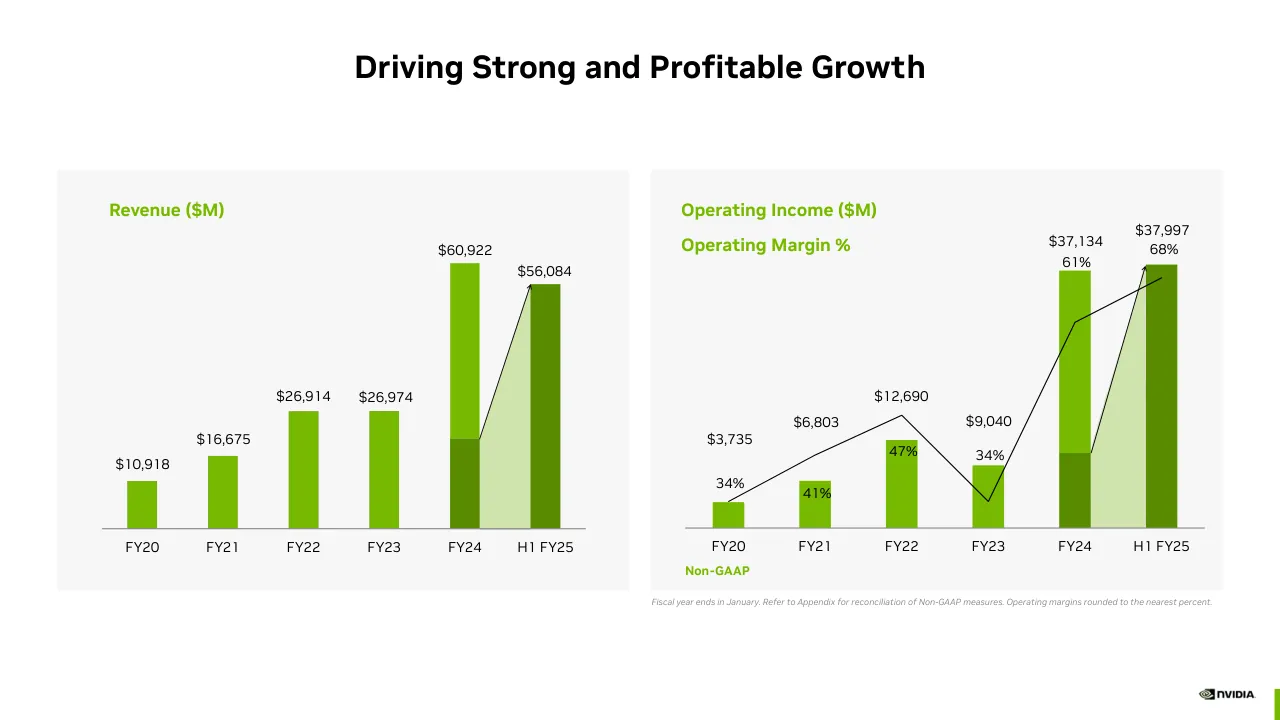
The deck opens with a forward-looking statements disclaimer and a non-GAAP notice, then a company overview stating NVIDIA's installed base and developer reach. It moves through the GPU's history, the shift to accelerated computing, and the idea of AI factories as a new class of data center. Core sections cover the full-stack platform, networking for scale-up and scale-out, CUDA libraries with speedup figures, energy efficiency per token, and scaling laws for training and inference. A roadmap slide sets out a one-year product cadence, followed by market reach across industries, enterprise and industrial AI adoption, and sovereign AI partners. The financial section shows revenue, operating income and margin, cash flow, capital allocation, and a market platform breakdown, with reconciliation tables in the appendix. The closing slides are reconciliation tables. Slides 5, 6 and 14 are good examples of headline-led framing, and slides 9, 16 and 26 show how charts carry the argument.
Slides worth studying
Questions about this deck
How many slides does the NVIDIA investor presentation from October 2024 have?
The NVIDIA investor presentation has 32 pages, and slide 1 is the title slide reading "NVIDIA Investor Presentation October 2024." Slide 2 contains the forward-looking statements disclaimer and the non-GAAP notice.
What does the NVIDIA deck say about the reach of its installed base and developers?
Slide 3 says NVIDIA's platform is installed in several hundred million computers, is available in every cloud and from every server maker, and powers over 75% of the TOP500 supercomputers. It also says NVIDIA has close to 5.5 million developers.
What does the NVIDIA deck say about energy efficiency per token on slide 11?
Slide 11 states that LLM energy efficiency improved 100,000X in the past 10 years. For GPT-MoE-1.8T energy per token, it lists Kepler at 42000 Joules/Token and Blackwell at 0.4 J/Token.
What does the NVIDIA deck say about its one year product rhythm and roadmap?
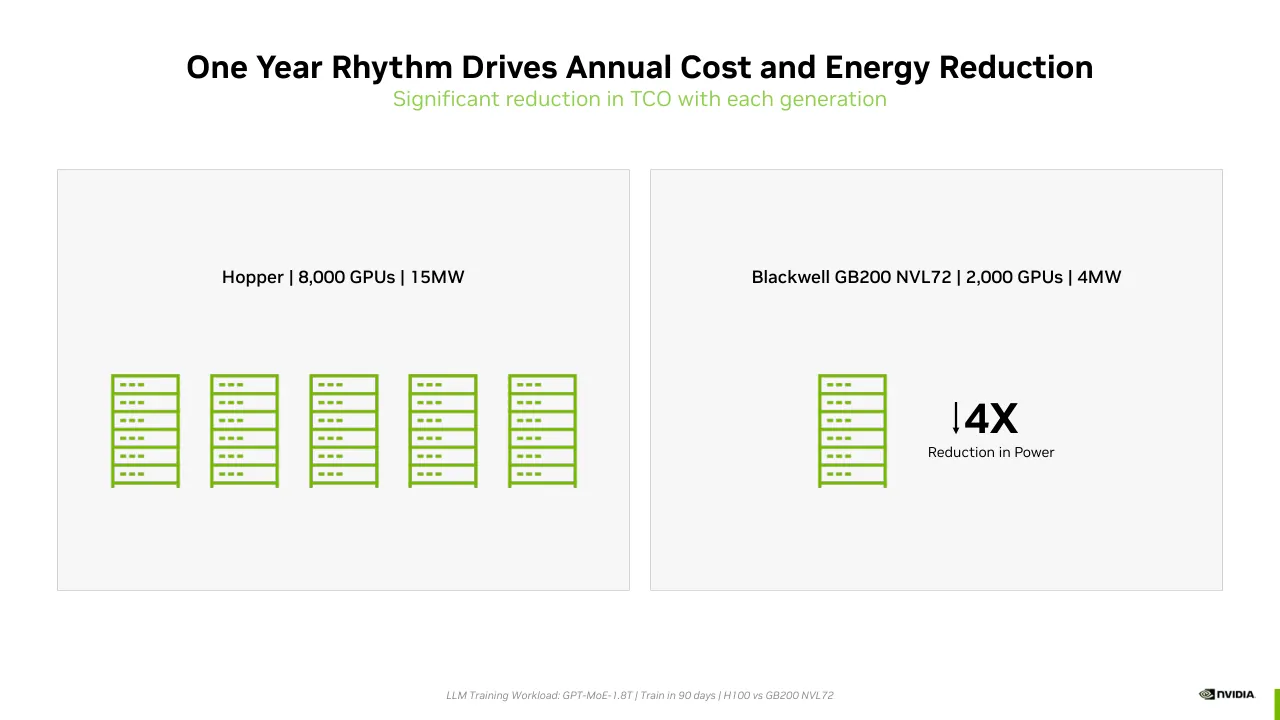
Slide 14 says NVIDIA's newest architecture, Blackwell, is an AI infrastructure platform that integrates seven chips, and that NVIDIA can update the entire AI infrastructure on a One Year Rhythm. Slide 16 adds that for a GPT-MoE-1.8T training workload, GB200 NVL72 gives a 4X reduction in power compared with Hopper.
Details
- Company: NVIDIA
- Year: 2024
- Type: Investor presentation
- Industry: Semiconductors
- Pages: 32
More from NVIDIA
- NVIDIA investor presentation, September 2026 NDR
- NVIDIA investor presentation, Annual Stockholder Meeting June 2026
- NVIDIA investor presentation, Q2 FY27 quarterly presentation
- NVIDIA keynote, GTC Europe 2026
- NVIDIA presentation, 2026
- NVIDIA keynote, GTC 2026 Keynote
All NVIDIA decks in the library
Review score: 7 out of 10, Effective
Presentation quality, judged with the SlideDeck Co review heuristic. Ask, evidence and idea merit are not rated here.
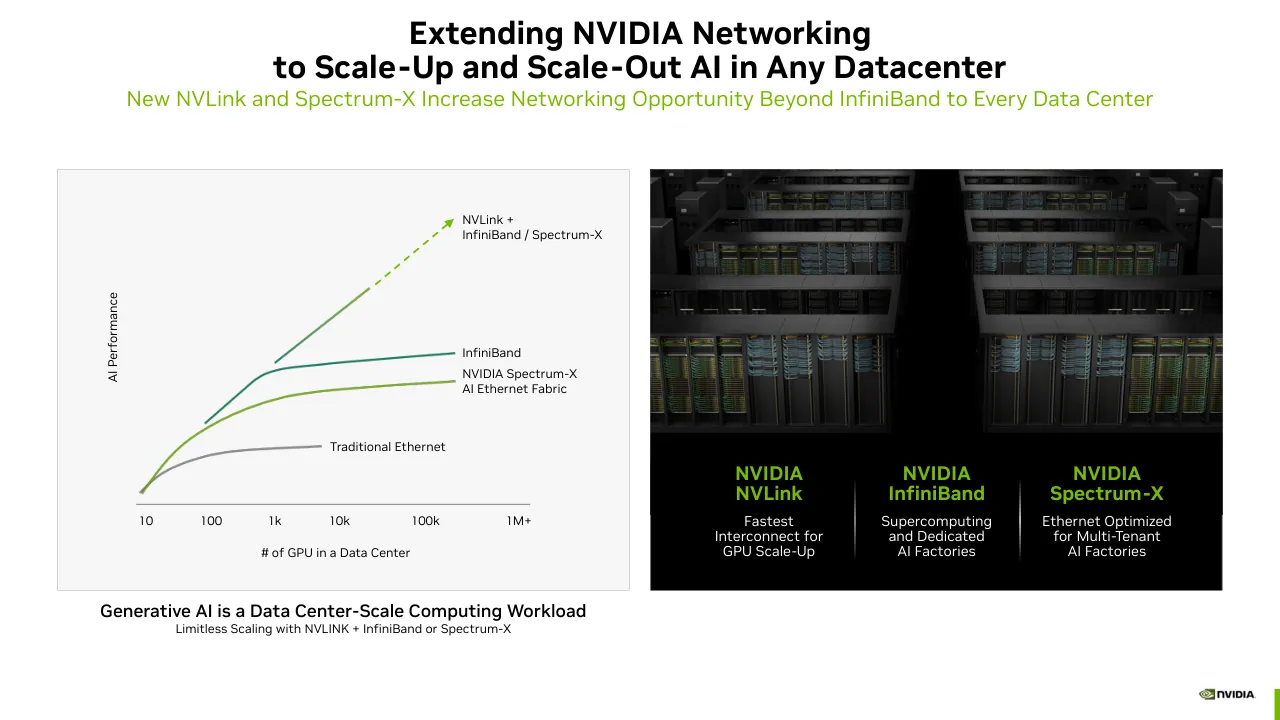
The deck has a consistent, recognisable identity (green accent, black headlines, logo footer) and a logical route from company overview through AI factories, platform, networking, roadmap, markets and financials, and many headline-and-subhead slides state the point clearly (9, 16, 26). Several pages have real craft, such as the networking curve on slide 9 and the bar charts on slide 26. Consequential weaknesses hold it at competent: slide 2 is an unreadable wall of disclaimer text on the second page, slide 3 has tiny text over a busy photo, and many body slides (5, 7, 10, 14, 18, 20) are small, dense paragraphs with little hierarchy. Slide 16's comparison is weak, since five rack icons against one icon do not match the 8,000 versus 2,000 GPU claim visually, and slide 26 uses overlaid H1 bars and a margin line that are hard to read, with tiny labels on slides 11, 12 and 15.
Worth keeping: Keep the consistent green and black identity, the headline plus green subhead pattern, the slide 9 scaling curve with its labeled lines, and the clean branded cover on slide 1.
Most useful repair: Move the disclaimer to the appendix or shrink it to a short notice, and rewrite the text-heavy slides 5, 7, 10, 14, 18 and 20 into a few large statements with a visual, and enlarge the tiny labels on slides 11, 12 and 15.
What would change the score: Redraw slides 16 and 26 so the visuals show the proportion and the trend directly, for example scaled icons or a bar for the power drop, and separate H1 FY25 from full-year bars with a simpler margin treatment.
Confidence high. 32 of 32 pages inspected on contact sheets, 4 at readable size. Reviewed 2026-11-08. Model-assisted review (claude-sonnet-5-5).
Full text of the slides (32 slides)
Every slide's words and a description of its charts and images, so the deck can be searched and rebuilt. Also available as Markdown.
Slide 1
NVIDIA
Investor Presentation
October 2024
1
Visuals: Full-bleed abstract 3D illustration of stacked, curved green ribbon-like layers sweeping from the lower right toward the upper left. The layers are glossy lime-green (#8CC800 to #76B900 range) with dark forest-green (#1E4A0C) shadowed recesses in the lower right where the layers curve inward into a spiral opening. Thin pale light lines run diagonally across the upper left, fading into white. The composition is framed with the spiral mass occupying the right and bottom half, and the upper left is white and open. Lighting is soft, from the upper left, producing bright highlights along the top edges of the ribbons. The image is not cropped in a boxed sense; it fills the whole slide. One logo: the NVIDIA logo (green eye emblem #76B900 followed by black NVIDIA wordmark #000000) in the top-left corner.
Slide 2
Except for the historical information contained herein, certain matters in this presentation including, but not limited to, statements as to: our financial position; our markets and market opportunity; demand and supply; demand / and growth drivers; the benefits, impact, performance, features and availability of our products and technologies; Blackwell platform being in full production – expanding to support x86 and NVIDIA Grace, air and liquid cooling, / NVLink 8-GPU to NVLink 72-GPU, InfiniBand and Ethernet, CSP, regional AI factories, and enterprise platforms; AI training continuing scaling law; the $1T installed base of general-purpose CPU data center infrastructure being / modernized to a new GPU accelerated computing paradigm; AI Factories expanding the data center footprint to $2T and beyond in the coming years; companies in every industry operating AI factories as the digital twin of their / workforce, manufacturing plants, and products; every company producing digital intelligence; tokens being the transformed into intelligent responses and actions of digital nurses, tutors, customer service agents, and chip / designers, manufacturing robots and autonomous cars, and weather prediction agents to warn us of storms; some companies building and operating AI factories, while others renting; countries awakening to the need to treat its / data as a national resource and AI factories as an essential national infrastructure; data being able to be transformed into the sovereign AI for its companies, startups, universities and governments; NVIDIA being able to address / many major workloads across a wide range of industries; accelerated computing enabling full-stack optimization from algorithm to GPU architecture; AI scaling laws driving exponential demand for compute; NVIDIA being the / leading inference platform; inference compute scaling exponentially with “long thinking”; compute demand for AI scaling exponentially; model size, multi-modality, synthetic data generation and reinforcement learning scaling / computing capacity by ~4x per year; NVIDIA NVLink enabling new level of AI training & inference scaling; NVIDIA addressing the entire AI market; NVIDIA being able to address every industry from healthcare, manufacturing, and / transportation to retail, CSPs, and telecommunications; NVIDIA AI platform and ecosystem reaching every market; AI driving investment cycle and significant returns; AI accelerating scientific discovery, creativity, and productivity / across industries; AI agents being able to generate documents, review contracts, help code and debug software, operationalize marketing campaigns, and review medical images; social media, search and e-commerce apps using / deep recommenders; creators being able to generate stunning, photorealistic images or 3D objects with a single text prompt; call center agents augmented with AI chatbots being able to scale to deliver customer care during / peak times, run in-the-loop with customer support to provide better service, and capture every interaction to build institutional knowledge in high turnover industries; drug discovery seeing order-of-magnitude workflow / acceleration using generative for candidate drug generation and target selection; manufacturing using generative AI to generate ideas to inspire designers, accelerate the planning and layout of factories and warehouses, and for / self-learning robots that can handle diverse tasks in changing work environments; climate tech scientists using AI to discover new materials for better batteries, emulate complex physics to predict long-range weather, estimate / carbon-capture sites, optimize wind farm output; companies leveraging AI to unlock new monetizable applications, enhance employee productivity, and transform their business models; industrial AI applications serving large / markets – including 10M factories, 200K warehouses, billions of humanoid robots, and 100M autos manufactured each year; specialized AI co-pilots collaborating with employees, being given access to necessary data, using / platform tools like SAP, Snowflake, or ServiceNow, and collaborating with other AI agents; the world’s companies hiring billions of AI agents in its workforce; NVIDIA AI Enterprise enabling IT ecosystem with state-of-the-art AI / models and libraries to build agentic AI; physical AI embodying robotic systems; nations are awakening to the imperative to produce artificial intelligence using their own infrastructure, data, workforces and business networks; / and nations building domestic computing capacity through various models are forward-looking statements. / These forward-looking statements and any other forward-looking statements that go beyond historical facts that are made in this presentation are subject to risks and uncertainties that may cause actual results to differ / materially. Important factors that could cause actual results to differ materially include: global economic conditions; our reliance on third parties to manufacture, assemble, package and test our products; the impact of / technological development and competition; development of new products and technologies or enhancements to our existing product and technologies; market acceptance of our products or our partners' products; design, / manufacturing or software defects; changes in consumer preferences and demands; changes in industry standards and interfaces; unexpected loss of performance of our products or technologies when integrated into systems / and other factors. NVIDIA has based these forward-looking statements largely on its current expectations and projections about future events and trends that it believes may affect its financial condition, results of operations, / business strategy, short-term and long-term business operations and objectives, and financial needs. These forward-looking statements are subject to a number of risks and uncertainties, and you should not rely upon the / forward-looking statements as predictions of future events. The future events and trends discussed in this presentation may not occur and actual results could differ materially and adversely from those anticipated or implied in / the forward-looking statements. Although NVIDIA believes that the expectations reflected in the forward-looking statements are reasonable, the company cannot guarantee that future results, levels of activity, performance, / achievements or events and circumstances reflected in the forward-looking statements will occur. Except as required by law, NVIDIA disclaims any obligation to update these forward-looking statements to reflect future events / or circumstances. For a complete discussion of factors that could materially affect our financial results and operations, please refer to the reports we file from time to time with the SEC, including our most recent Annual Report / on Form 10-K, Quarterly Reports on Form 10-Q, and Current Reports on Form 8-K. Copies of reports we file with the SEC are posted on our website and are available from NVIDIA without charge. / Many of the products and features described herein remain in various stages and will be offered on a when-and-if-available basis. The statements within are not intended to be, and should not be interpreted as a commitment, / promise, or legal obligation, and the development, release, and timing of any features or functionalities described for our products is subject to change and remains at the sole discretion of NVIDIA. NVIDIA will have no liability for / failure to deliver or delay in the delivery of any of the products, features or functions set forth herein. / NVIDIA uses certain non-GAAP measures in this presentation including non-GAAP operating income, non-GAAP operating margin, and free cash flow. NVIDIA believes the presentation of its non-GAAP financial measures / enhances investors' overall understanding of the company's historical financial performance. The presentation of the company's non-GAAP financial measures is not meant to be considered in isolation or as a substitute for the / company's financial results prepared in accordance with GAAP, and the company's non-GAAP measures may be different from non-GAAP measures used by other companies. Further information relevant to the interpretation of / non-GAAP financial measures, and reconciliations of these non-GAAP financial measures to the most comparable GAAP measures, may be found in the slide titled “Reconciliation of Non-GAAP to GAAP Financial Measures”. / 2
Visuals: The NVIDIA logo (green and black wordmark, bottom right, boxed at 93.1% x, 94.8% y, 5.5% wide, 3.4% high) is the only non-text graphic. Behind the text, a full-bleed pale white-to-lime-green gradient with soft curved light-green swooshes fills the lower two-thirds of the slide; it has no photograph, chart or diagram.
Slide 3
NVIDIA
NVIDIA’s invention of the GPU in 1999 sparked the growth of the PC gaming market, redefined computer graphics, revolutionized accelerated computing, ignited the era of modern AI, and is fueling industrial digitalization across markets.
Today, two transitions are occurring simultaneously—accelerated computing and generative AI—transforming the computer industry and every other industry worldwide, and NVIDIA is enabling these transitions with our full-stack computing platform and data-center-scale offerings.
NVIDIA’s platform is installed in several hundred million computers, is available in every cloud and from every server maker, powers over 75% of the TOP500 supercomputers, and has close to 5.5 million developers.
Headquarters: Santa Clara, CA | Headcount: 30,000+
Visuals: Full-bleed photograph of the NVIDIA headquarters campus, shown from an elevated angle. A large white steel lattice canopy with integrated solar panels spans the top of the frame diagonally. Below it, a curved glass-walled office building is on the left, two white-railed wooden elevated rings and a white walkway bridge cross the centre and right, and dense green trees, lawns, paved paths and wooden benches fill the lower half. Two people walk on the paved path near the centre, and a black umbrella with tables and chairs sits at the lower right of centre. Lighting is warm low-angle sunset sunlight with a clear pale-blue sky at top left. Dominant colours are white, green, warm amber and pale blue. The photo is not cropped, boxed or tinted, and no overlay is visible; the text sits directly on the foliage and path area at lower right.
Slide 4
World’s First GPU Turns 25 / NVIDIA released GeForce 256, the world’s first GPU, 25 years ago. / This marked a milestone in computing by providing gamers with / higher frame rates, smoother gameplay, and life-like graphics. / NVIDIA's GPU set the foundation for the big bang of modern AI, / a decade later. The parallel processing power of NVIDIA GPUs and / the invention of a revolutionary programming model “CUDA” / attracted researchers who recognized the opportunity to / accelerate computationally-demanding applications like physical / and chemical simulations and deep learning. / NVIDIA released the GeForce RTX series in 2018, reinventing / computer graphics once again with real-time ray tracing and neural / rendering, applying AI to generate pixels at quality and speed no / one thought possible. / Today, the world recognizes GPUs not only for reshaping gaming / but also for powering the AI industrial revolution. NVIDIA GeForce / 256 started an era where gaming, computing, and AI evolve / together, fundamentally advancing entertainment, technology, / and society. / NVIDIA
Visuals: Photograph of Times Square, New York, seen from street level, looking up at an angle. A tall blue-glass skyscraper rises through the upper left, with a pale cloudy sky behind it. The left side holds a large billboard reading “BEAUTIFULLY CRAFTED VISION” on a black-and-white image of a rock or wave, and a red vertical sign with partially visible lettering. A curved green billboard in the centre shows a close-up of a man's face covered in small square tiles, with the text “World’s First GPU Turns 25”, “2024” and an NVIDIA logo; a Nasdaq logo sits below it. Beside it is a narrow vertical green billboard reading “GeForce 256 / The World's First GPU Turns 25 / Inspiring what's next since 1999” with a column of years from 1999 to about 2015 and an NVIDIA logo at the bottom. Lower in the frame are a red-and-black “ALL NIGHT” LED sign and a red, white and blue LED American flag on a kiosk. Lighting is daylight; dominant colours are blue glass, green, white sky, red and grey. The photo is full-height and cropped at its right edge at x 44.9%, with no border. A light grey #F2F2F2 tint at 61% opacity sits behind the photo's left area.
Slide 5
NVIDIA Scaling with AI Scale-Up and Scale-Out / NVIDIA’s chips and systems supply chain expanded significantly in 2024, while demand continues to exceed supply. / NVIDIA Blackwell platform in full production – expanding to support x86 and NVIDIA Grace, air and liquid cooling, / NVLink 8-GPU to NVLink 72-GPU, InfiniBand and Ethernet, CSP, regional AI factories, and enterprise platforms. / One Year Rhythm at full infrastructure scale. / AI training continues AI scaling law. OpenAI o1 starts inference-time scaling law. Inference is driving significant / workload growth and demand. / Regional and sovereign clouds start up around the world. / NVIDIA AI Enterprise and Omniverse set the foundations for enterprise and industrial AI.
Visuals: None apart from decorative elements: a solid green vertical bar on the left edge (#76B900, from the top edge down to about 33% of the slide height, about 1.5% of width) and a small solid green vertical bar at the bottom-right edge (#76B900). The NVIDIA logo at bottom right is the NVIDIA wordmark in black with the green stylised eye emblem to its left in #76B900, placed on the white background with no boxing or tint.
Slide 6
Accelerated Computing and / Generative AI Create / Trillion-dollar Opportunities / / The $1T installed base of general-purpose CPU data / center infrastructure is being modernized to a new / GPU accelerated computing paradigm. / / The entire computing stack has been reinvented – / from CPU to GPU, from coding to machine learning, / from software to generative AI. Computers generate / intelligence tokens, a new commodity. / / A new type of data center, AI Factories, is expanding / the data center footprint to $2T and beyond in the / coming years. Eventually, companies in every / industry will operate AI factories as the digital twin / of their workforce, manufacturing plants, and / products. A new industrial revolution has begun. / General-Purpose / Computing / Accelerated / Computing / AI / AI Factories / Traditional / Data Centers / GPU-Accelerated / Data Centers
Visuals: Diagram (bar and curve chart, no axes labels or numeric scale). Shapes, back to front: (1) a solid blue #0070C0 rectangle at the left with a slightly sloped top edge, higher at its left end, labelled 'Traditional / Data Centers' in white centred text. (2) A dashed blue #0070C0 curve starting flat at the top of the blue block and falling to the right, ending near the lower middle of the chart, labelled 'General-Purpose / Computing' above it. (3) A solid green #76B900 thin line rising steeply from lower left to upper right, labelled 'AI' in black small type near its top end. (4) A solid green #76B900 thin curve starting flat at lower left, rising to the right toward the tall green block, labelled 'Accelerated / Computing' above it. (5) A tall solid green #76B900 shape on the right with a sloped top edge rising from left to right, split by a diagonal white stripe into an upper block labelled 'AI Factories' in white and a lower block labelled 'GPU-Accelerated / Data Centers' in white. (6) A thin grey horizontal baseline under all shapes. The four lines do not connect to the blocks with arrows; the curves cross each other. Flat white rectangles mask parts of the curves and are invisible against the white background.
Slide 7
AI Factories—A New
Class of Data Centers
Production of digital intelligence tokens
AI factories are a new form of computing infrastructure. Its
purpose is not to store user and company data or run ERP and CRM
applications. AI factories are highly optimized systems purpose-
built to process raw data, refine it into models, and produce
monetizable tokens with great scale and efficiency.
In the AI industrial revolution, data is the raw material, tokens are
the new commodity, and NVIDIA is the token generator in the AI
factory.
Data
Tokens
Every company will produce digital intelligence. Tokens will be
transformed into intelligent responses and actions of digital
nurses, tutors, customer service agents, and chip designers,
manufacturing robots and autonomous cars, and weather
prediction agents to warn us of storms. Some companies will build
and operate AI factories, while others will rent.
AI Factory
Countries are awakening to the need to treat its data as a national
resource and AI factories as an essential national infrastructure.
Data encodes a nation's history, knowledge, and culture, and can be
transformed into the sovereign AI for its companies, startups,
universities and governments.
NVIDIA builds the complete AI system and licenses NVIDIA AI
Enterprise, the AI stack and operating system for AI factories.
Visuals: Diagram: a rounded rectangle outline (black stroke, about 1 px, corner radius about 2% of slide width) labelled AI Factory on its bottom edge, where the outline is broken by a gap around the label. Inside the box, from top to bottom: a green neural-network icon (a node cluster of 1 central and 6 outer circles connected by lines) centred at about x 77.5%, y 44%; and three green server-rack icons side by side at x 72.5%, 75.3% and 78.1%, each about 4.6% wide and 8.2% tall, centred at y about 54%. A black arrow runs from the text Data (left of the box) into the box's left edge at y about 49%. A black arrow runs from the box's right edge out to the text Tokens at y about 49%. Both arrows are simple lines with a filled triangular head, about 1 px. No chart, table or photograph. Colours: green #76B900 for icons; black #000000 for outlines, arrows and labels.
Slide 8
NVIDIA’s Accelerated
Computing Platform
Data center scale innovation across chips,
networking, systems, software, and algorithms
NVIDIA has accelerated software and compute
by a 1,000,000X in the last decade, far
surpassing Moore’s law.
Accelerated computing requires full-stack
innovation—optimizing across every layer
of computing—from chips and systems to
software and algorithms, demanding deep
understanding of the problem domain.
Our platform extends from the cloud and
enterprise data centers to supercomputing,
edge computing, PCs, and robotics.
CUDA-X
Libraries
Accelerated
Software Stack
CUDA • DOCA • NCCL
Cluster-Scale Software
System Software
Chip Software
NIM CUDA-
Accelerated
“All in-a-
Container”
NeMo
CUDA-Accelerated
Agentic AI Libraries
Omniverse
CUDA-Accelerated
Physical AI Libraries
Transceivers
& Cables
NVLink Switch
GB200 NVL72
SuperPOD
NVLINK
Switch & Spine
Quantum
&
Spectrum
Switch
Blackwell
HGX-Node
Chips Purpose-Built for AI Supercomputing
GPU | CPU | DPU | NIC | NVLINK Switch | IB Switch | ENET Switch
Grace
Blackwell
MGX-Node
Visuals: Diagram of the NVIDIA accelerated computing stack, all rendered as photographic product or software images on a light grey background, arranged in rows. (1) Top left: a horizontal strip of ten rounded-square CUDA-X library thumbnails at x 11.6 to 33.4%, y 21.3 to 26.9%, each showing a different colourful scientific or software visualisation (blue data-grid, blue ocean-like wave, purple and green simulation, green cube wireframe, purple molecule, orange and teal rendering, green terrain, grey vehicle-like render, and a dark blue app window). (2) Below it: four stacked full-width black bars with thin white labels, from top: “CUDA • DOCA • NCCL”, “Cluster-Scale Software”, “System Software”, “Chip Software”, spanning x 11.6 to 33.4%, y 28.9 to 37.8%. (3) Top centre: a dark rectangular screen at x 39.9 to 48.7%, y 28.4 to 37.7%, showing a close-up portrait of a man’s face inside a green-outlined box on the left and a small cluster of green and white node diagram on the right, above which sit three dark hexagonal icons with green bases at x 41 to 49%, y 25 to 29%. (4) Top right: a grey-framed screen at x 50.7 to 59.5%, y 28.5 to 37.5%, showing a grey 3D render of a white plaza with small humanoid robots, with a dark side panel. (5) Centre left: a block of ten tall black server racks in a row at x 8.7 to 37.0%, y 40.9 to 60.6%, each with fine green-yellow edge lighting, forming the GB200 NVL72 SuperPOD. (6) Centre: a tall narrow black switch and spine module at x 39.7 to 42.2%, y 44.9 to 60.4%, with grey-white cable bundles on its front. (7) Centre right: a bundle of light blue-grey cable ends curving downward at x 45.4 to 48.4%, y 48.0 to 55.5%, labelled Transceivers & Cables. (8) Right of that: a dark grey NVLink Switch box with cross-shaped green-teal connectors at x 51.9 to 58.5%, y 48.2 to 54.8%. (9) Bottom left: a dark Blackwell HGX-Node board with gold-coloured heatsinks at x 8.0 to 11.6%, y 70.2 to 77.3%. (10) Bottom left-centre: a tall dark Grace Blackwell MGX-Node chassis at x 13.2 to 17.3%, y 65.3 to 77.3%. (11) A row of seven square chip packages with gold or grey heat-spreaders, each about 3.5 to 4.5% wide, at x 18.7 to 48.7%, y 70.5 to 75.4%, labelled Chips Purpose-Built for AI Supercomputing. (12) Lower right: a tall dark two-socket compute unit with two gold chips at x 50.3 to 54.4%, y 65.2 to 77.6%, and a horizontal dark grey Quantum/Spectrum switch unit at x 55.8 to 61.8%, y 65.5 to 71.6%. Lighting is soft and diffuse from above, with each object casting a soft grey drop shadow toward the lower right. Framing is a flat, slightly elevated, full-slide arrangement with nothing cropped; no overlays or tints apply.
Slide 9
Extending NVIDIA Networking / to Scale-Up and Scale-Out AI in Any Datacenter
New NVLink and Spectrum-X Increase Networking Opportunity Beyond InfiniBand to Every Data Center
NVLink + / InfiniBand / Spectrum-X
InfiniBand
NVIDIA Spectrum-X / AI Ethernet Fabric
Traditional Ethernet
AI Performance
10
100
1k
10k
100k
1M+
# of GPU in a Data Center
Generative AI is a Data Center-Scale Computing Workload
Limitless Scaling with NVLINK + InfiniBand or Spectrum-X
NVIDIA / NVLink
Fastest / Interconnect for / GPU Scale-Up
NVIDIA / InfiniBand
Supercomputing / and Dedicated / AI Factories
NVIDIA / Spectrum-X
Ethernet Optimized / for Multi-Tenant / AI Factories
Visuals: Line chart in the left box titled none, with the Y axis labelled AI Performance (no units, no tick values, no range printed) and the X axis labelled # of GPU in a Data Center on a log-style scale with ticks 10, 100, 1k, 10k, 100k, 1M+ (no numeric values printed). Series: Traditional Ethernet, solid grey #8C8C8C curve from about 10 to about 10k, rising steeply then flattening (about). NVIDIA Spectrum-X AI Ethernet Fabric, solid green #76B900 curve from about 10 to about 100k (about). InfiniBand, solid teal #13826B curve from about 1k to about 100k, flattening above the Spectrum-X curve (about). NVLink + InfiniBand / Spectrum-X, light green #76B900 solid line from about 10 to about 1k, then dashed continuing up to an arrowhead pointing upper right; no legend box and no highlighted data points. Right: photograph of rows of data-centre server racks in dark aisles with blue and green lit cables and switches, viewed head-on in one-point perspective, two aisle blocks split by a dark central gap; cropped by the panel edges and overlaid by #151617 at 61% opacity; dark, low-key lighting with small green and blue LED accents; dominant colours near-black #151617, grey #3A3A3A, green #76B900, blue #3E8FB0. Three column text blocks sit on a solid black band. NVIDIA logo bottom right.
Slide 10
Accelerated Computing / Starts with CUDA Libraries / Delivering up to 200X Speedup / Across Major Workloads / Unlike CPU general-purpose computing, GPU-accelerated computing requires software and algorithms to be re-designed. Software is not automatically accelerated in the presence of a GPU or accelerator. / NVIDIA CUDA libraries encapsulate NVIDIA-engineered algorithms that enable applications to be accelerated on NVIDIA’s installed base. They deliver dramatically higher performance—compared to CPU-only alternatives—across application domains, including AI and high-performance computing significantly reducing run time, cost, energy, while increasing scale. / With over 400 CUDA libraires NVIDIA can address many major workloads across a wide range of industries. As new libraries become available, they unlock new markets adding to our long-term opportunity. / ~200X / Data Processing / cuVS, cuDF-Spark, cuDF-pandas, cuDF-Polars, cuGraph, cuML, XGBoost, RAPIDS, NeMo Curator, cuSOLVER, cuIO / ~200X / Computer Vision / CV-CUDA, Deepstream, TAO, Holoscan, cuCIM, TensorRT, Triton Inference Server, DALI, nvImageCodec, cuDNN, nvJPEG, nvJPEG2000, nvTIFF, NPP, Video Codec SDK, Magnum IO, NCCL, cuVS, DALI / ~100X / Science / Earth-2 CorrDiff, Holoscan, Parabricks, Monai, Modulus, Warp, cuLitho, cuQuantum, CUDA-Q, AmgX, cuDSS, cuFFT, cuSOLVER, cuBLAS, cuSPARSE, cuTENSOR, cuGraph, Magnum IO, NCCL, NVSHMEM, RAFT, cuNumeric, Sionna / ~100X / Deep Learning / cuDNN, CUTLASS, Megatron, TensorRT, TRT LLM, NCCL, NV-Triton, CUDA-optimized PyTorch, Tensorflow, Triton, Jax / ~50X / Recommender Systems / Merlin, HugeCTR, TensorRT, Triton Inference Server, cuBLAS, cuDNN, cuFFT, cuSPARSE, CUTLASS, Magnum IO, NCCL, cuVS / ~30X / Speech AI / Riva, TensorRT, Triton Inference Server, NeMo, cuBLAS, cuDNN, cuFFT, CUTLASS / ~100X / Agentic & Physical AI / ACE, Riva, Nemo, Tokkio Digital Human, Holoscan, Metropolis, Omniverse, Isaac, DRIVE, cuLitho, cuMotion, cuOpt, Aerial CUDA-accelerated RAN, Sionna, fVDB, PhysX, Warp, NVblox
Visuals: Seven stacked rectangular stat panels, each a light grey (#F7F7F7) box with a thin light grey border, no shadow, square corners, arranged top to bottom: (1) '~200X' Data Processing; (2) '~200X' Computer Vision; (3) '~100X' Science; (4) '~100X' Deep Learning; (5) '~50X' Recommender Systems; (6) '~30X' Speech AI; (7) '~100X' Agentic & Physical AI. Each multiplier is set in bold-medium bright green (#76B900) at about 4.1 percent of slide height, with a small tilde prefix. No photographs, charts or icons. A thin grey horizontal rule (about #8C8C8C, roughly 0.2 percent of slide height thick) runs from the left edge to about 47 percent of the width below the subtitle. Small NVIDIA wordmark logo in black at bottom-left. A small green vertical bar at the bottom-left edge, about #76B900.
Slide 11
Accelerated Computing Is Sustainable Computing
Order-of-Magnitude More Energy-Efficient
Accelerated computing requires higher peak power consumption than CPUs, however, completes workloads significantly faster and consumes less total energy
Energy Usage in AI Inference
Server TDP (kW)
NVIDIA
CPU
Time(sec)
Accelerated computing enables full-stack optimization from algorithm to GPU architecture, such as Tensor Core Transformer Engine; LLM energy-efficiency improved 100,000X in the past 10 years
GPT-MoE-1.8T energy per token
Kepler
42000 Joules/Token
Pascal
17640 J/Token
Volta
1200 J/Token
Ampere
150 J/Token
Hopper
10 J/Token
Blackwell
0.4 J/Token
2014
2024
Visuals: Left panel: a clustered bar chart titled 'Energy Usage in AI Inference' with vertical axis labelled 'Server TDP (kW)' and horizontal axis labelled 'Time(sec)'; no numeric axis ticks or values are printed. Series NVIDIA (green bar, tall, about 27.6% of slide height) and CPU (blue bar, short, horizontal, about 12.3% of slide width) drawn as bars with no printed values; legend box at right with green square 'NVIDIA' and blue square 'CPU'. Right panel: a line chart titled 'GPT-MoE-1.8T energy per token' with year labels 2014 at the left and 2024 at the right on a horizontal grey baseline; green line with circular markers at Kepler 42000 Joules/Token, Pascal 17640 J/Token, Volta 1200 J/Token, Ampere 150 J/Token, Hopper 10 J/Token, Blackwell 0.4 J/Token, falling steeply from left to right and flattening near the baseline. No highlighted points beyond the green markers. NVIDIA logo bottom right in black and green.
Slide 12
AI Scaling Laws Drive Exponential Demand for Compute
New OpenAI o1 Long “Thinking Time” Creates a New Way to Scale
Training compute scales exponentially with larger models, multi-modality, reinforcement learning, and synthetic data generation
Training Compute
Inference compute scales exponentially with larger models, multi-modality, large context, low latency, and now long “thinking time”
Inference Compute
o1
12
Visuals: Diagram: a two-axis chart drawn with thin lines, with no printed numeric scale, ticks or units. The origin is at the lower left of the panel. The vertical axis runs from the origin up to about 35 percent of slide height and the horizontal axis runs right from the origin for about 35 percent of slide width. Dark green (#008564) arrow, about 4 px stroke, runs from the origin diagonally up and right to an arrowhead, labelled Training Compute (bold, placed above-left of the arrow) and described by the text Training compute scales exponentially with larger models, multi-modality, reinforcement learning, and synthetic data generation. Grey line (about #888888, about 3 px) runs from the origin to a green circle labelled o1 (white text), then a light green arrow (#92D050, about 4 px) continues from the circle up and right to an arrowhead; this arrow is labelled Inference Compute (bold, placed above-left of the arrow) and described by the text Inference compute scales exponentially with larger models, multi-modality, large context, low latency, and now long thinking time. The o1 circle is solid #76B900, about 2.7 percent of slide width in diameter, sitting on the grey and light green lines where they meet. No legend, no highlighted points beyond the o1 circle, no photographs. Logo: NVIDIA wordmark with eye symbol in black, bottom right.
Slide 13
NVIDIA is the Leading Inference Platform
Inference Compute Scales Exponentially with “Long Thinking”
Hopper inference performance
increased 5X in 1 Year
with rapid algorithm innovations
enabled by rich NVIDIA CUDA ecosystem
Flash Attention
KVCache PageAttention
Distillation
Pruning & Quantization
Neural Architecture Search
Disaggregated Serving
Speculative Decoding
Multi-GPU, Multi-Node
Installed base & CUDA ➔ rapid software innovation
➔ performance ➔ lower inference cost ➔
increase demand ➔
increase installed base
Inference compute scaling exponentially with
large multi-modal models, Chain-of-Thought,
reasoning, agents, and low latency responses
GB200 NVL72
NVLink Switches
130 TB/s All-to-All BW
One Giant Blackwell
1.44 EF FP4
576TB/s HBM3e
13
Visuals: Three graphics. (1) Left panel: a line chart drawn as a curve with no printed numeric axis labels. The vertical axis is a thin grey line at about x 9.3% from y 45.7% to 76.4%; the horizontal axis is a thin grey line at about y 76.4% from x 9.3% to 29.1%. A green (#76B900) curve, about 3 pt wide, starts at the origin near x 10.7%, y 76.4%, rises gently then steepens into an exponential-looking climb, and ends in a solid green arrowhead pointing up and to the right at about x 27.5% to 28.5%, y 45.5% to 48.5%. Nine labelled terms are centred over the curve in dark text: Flash Attention, KVCache PageAttention, Distillation, Pruning & Quantization, Neural Architecture Search, Disaggregated Serving, Speculative Decoding, Multi-GPU, Multi-Node. (2) Centre panel: a green (#76B900) spiral illustration, about 3 pt stroke, made of stacked ellipse loops that shrink downward like a tornado or coil, starting at the bottom near x 48%, y 86% and widening to the top right, ending in a solid green arrowhead pointing up-left at about x 52.2% to 54.7%, y 43.2% to 47.3%. No labels. (3) Right panel: a stylised GPU chip diagram. A central green (#76B900) square chip body at x 74.3% to 87.7%, y 49.3% to 73.2%, with thin orange (#F58B00-like) grid lines drawn across its edge and a lighter inner green rectangle at x 75.6% to 86.7%, y 52.6% to 69.5%. Around it are green rectangular pin blocks: a top row and a bottom row of about 14 small squares each (top at y 45.7% to 48.9%, bottom at y 73.6% to 76.8%, both spanning x 74.5% to 87.6%), and left and right columns of about 10 squares each (left at x 72.4% to 74.2%, right at x 87.9% to 89.8%, both spanning y 49.6% to 73.1%). White text on the inner rectangle reads GB200 NVL72 / NVLink Switches / 130 TB/s All-to-All BW, then a gap, then One Giant Blackwell / 1.44 EF FP4 / 576TB/s HBM3e. The NVIDIA logo is small, black with a green mark. No photographs; all graphics are flat with no shadows.
Slide 14
NVIDIA AI Infrastructure Roadmap at One Year Rhythm
NVIDIA’s newest architecture – Blackwell – is an AI infrastructure platform and integrates seven chips,
each contributing to performance at data center-scale.
Compute demand for AI is scaling exponentially. Model size, multi-modality, synthetic data generation and
reinforcement learning is scaling computing capacity by ~4x per year. And new inference-time technologies like
multi-modality, Chain-of-Thought, reasoning, and agents have introduced an exponential scaling law to inference.
NVIDIA has the scale and ability to update the entire AI infrastructure on a One Year Rhythm as we can engineer
and optimize across the full stack and the entire infrastructure.
The cadence and breadth of our innovation brings more performant AI infrastructure to the market each year,
delivering exceptional TCO, energy efficiency, and ROI to our customers.
Visuals: None apart from the NVIDIA logo at bottom right, which is a green-and-black eye-shaped mark followed by the black wordmark NVIDIA with a small trademark dot; it is not a photograph, chart or diagram.
Slide 15
One Year Rhythm | Supercluster Scale | Full-Stack | CUDA Everywhere / “Supercharge AI Scaling Law” / X-Factors / Hopper / Blackwell / Blackwell-Ultra / Rubin / X-Factors / X-Factors / Hopper GPU / 6S HBM3 / Hopper+ GPU / 6S HBM3e / Grace CPU / NVLink Switch / 900 GB/sec / CX7 / SuperNIC / BF3 / SuperNIC / Quantum-X400 / Infiniband Switch / GB200 NVL72 / HGX Blackwell / NVLINK Switch / GB200 Superchip / Compute Node / Quantum X800 Switch / ConnectX-8 SuperNIC / Spectrum X800 Switch / BlueField-3 SuperNIC / Blackwell Ultra GPU / 288GB HBM3e / More AI FLOPS / CX8 / SuperNIC / Spectrum Ultra X800 / Ethernet Switch 512-Radix / Rubin GPU / 8S HBM4 / Vera CPU / NVLink 6 Switch / 3600 GB/sec / CX9 SuperNIC / 1600 Gb/sec / X1600 / IB/Ethernet Switch / Rubin GPU / 12S HBM4 / 2022 / 2023 / 2024 / 2025 / 2026 / 2027
Visuals: Infographic-style product roadmap on a black panel. Hopper column (2022-2023): small gold-framed chip icons for Hopper GPU 6S HBM3, Hopper+ GPU 6S HBM3e, Grace CPU, NVLink Switch 900 GB/sec, CX7 SuperNIC, BF3 SuperNIC and Quantum-X400 Infiniband Switch, arranged in two loose columns. Blackwell column (2024): a large photographic render of the GB200 NVL72 rack, dark grey racks with blue and gold cable runs, on a dark studio floor with soft spotlight, framed inside the box; below it are small product photos labelled HGX Blackwell, NVLINK Switch, GB200 Superchip Compute Node, Quantum X800 Switch with ConnectX-8 SuperNIC, and Spectrum X800 Switch with BlueField-3 SuperNIC. Blackwell-Ultra column (2025): a vertical strip with a Blackwell Ultra GPU chip image, a CX8 SuperNIC chip and a Spectrum Ultra X800 Ethernet Switch 512-Radix chip, all gold-tinted icons on black. Rubin column (2026-2027): gold-tinted chip icons for Rubin GPU 8S HBM4, Vera CPU, NVLink 6 Switch, CX9 SuperNIC, X1600 IB/Ethernet Switch on the 2026 side, and three further faint chip icons plus Rubin GPU 12S HBM4 on the 2027 side. Three gold arrows labelled X-Factors point upward above the Blackwell, Blackwell-Ultra and Rubin columns at increasing heights. A thin white horizontal timeline arrow runs left to right beneath the columns with year labels. Lighting on the chips is a soft gold rim glow; the NVIDIA logo is the only brand mark.
Slide 16
One Year Rhythm Drives Annual Cost and Energy Reduction / Significant reduction in TCO with each generation / Hopper | 8,000 GPUs | 15MW / Blackwell GB200 NVL72 | 2,000 GPUs | 4MW / 4X / Reduction in Power / LLM Training Workload: GPT-MoE-1.8T | Train in 90 days | H100 vs GB200 NVL72
Visuals: Left panel: five identical server-rack icons in a single row, each a tall rectangle outlined in NVIDIA green (#76B900) with six horizontal shelf dividers and three short dash marks per shelf, drawn as simple line icons with no fill; they are evenly spaced, bottom-aligned on one baseline at about y 49.8 to 69.6, and represent the Hopper configuration. Right panel: one server-rack icon of the same style at the left-centre (x 61.0, y 49.8, w 11.1, h 19.8), with to its right a small black downward arrow (a thin vertical line with an arrowhead, about x 73.8, y 55.8, h 4.5) followed by the large bold figure '4X' and the caption 'Reduction in Power' centred beneath it. No chart, photograph or table. Logo: NVIDIA wordmark in black with the green eye symbol at bottom right (x 93.1, y 94.8, w 5.5, h 3.4).
Slide 17
NVIDIA NVLink Enables New Level of AI Training & Inference Scaling / NVLink Switch / GB200 NVL72 / NVLink Switches / 130 TB/s All-to-All BW / One Giant Blackwell / 1.44 EF FP4 / 576TB/s HBM3e / 17
Visuals: 1) Photograph of an NVLink Switch tray, horizontal, shown open from the front-left at a slight angle: a silver/grey chassis with exposed black circuit board, blue and white cabling, copper-coloured heatsinks and black coolant hoses curving off the right side; lit evenly by studio light, full-colour, boxed with no border, no overlay, with a soft fading shadow at the bottom edge. Label 'NVLink Switch' sits above it. 2) Black arrow (thin line with small arrowhead pointing right) running from the right edge of the switch photo to the left edge of the rack. 3) Two dark rack images side by side, both tall portrait: the left is a front view of a black server rack with a small switch unit near the top and rows of gold-edged compute trays stacked down the middle, with a translucent white rectangle outlined in green #76B900 (about 0.2% stroke) highlighting one unit at about 52% height; the right is a rear view of the same rack, black, with a central vertical panel of grey cabling/ribbons between two gold-edged frames and vent grilles at top and bottom; both racks have feet at the base. Lighting neutral, no tint. 4) Curly right brace in thin black line, spanning from the top of the rear rack to its base, pointing right to the chip graphic. 5) Green chip graphic: a square green #76B900 die with a dense ring of small green square pins on all four sides (about 8 rows per side), with thin orange/red lines grid inside the square border; central text in black on the die. Crisp flat vector, no shadow, no gradient.
Slide 18
NVIDIA Addresses The Entire AI Market
NVIDIA’s accelerated computing platform encompasses a complete computing stack
and infrastructure required for customers to build and run AI at scale.
CUDA-X libraries and microservices leverage the programmability of CUDA to enable thousands
of applications across a wide range of use cases to run on NVIDIA infrastructure, including AI
training and inference, data processing, robotics, drug discovery, and consumer internet services.
NVIDIA has a rich ecosystem of partners who have integrated NVIDIA platform technologies and
joined our go-to-market. Each industry and market segment may include different domain-
specific software stacks, ODMs, OEMs, CSPs, 3rd party software platforms, system integrators,
and system integrations/solution development partners.
The completeness of the NVIDIA platform for each industry and workload lets us address every
industry from healthcare, manufacturing, and transportation to retail, CSPs, and
telecommunications.
Visuals: Two non-text elements. (1) A solid green vertical bar at the top-left edge, x 0 to 1.5%, y 0 to 32.9%, filled #76B900, flush with the left edge of the slide and ending at the title's vertical level. (2) The NVIDIA logo at bottom right, x 93.1%, y 94.8%, w 5.5%, h 3.4%: the black NVIDIA eye mark followed by the black NVIDIA wordmark with a small trademark dot, on a white ground. A short solid green bar sits at the bottom-right corner, about x 99.4%, y 95%, w 0.6%, h 4.2%, filled #76B900. No charts, photographs or diagrams.
Slide 19
NVIDIA AI Platform and Ecosystem Reaches Every Market / Accelerate Every Workload / Full-Stack, Entire AI Infrastructure / Every Workload to / Address the World's Industries / Data / Pre- / Processing / Training / Post / Training / e.g., SDG / Agentic AI / Inference / Robotic AI / Inference / Full-Stack / Compute-to-Networking / Ecosystem / AI Technology / Software / AI Infrastructure / Every Cloud / OEMs / & / ODMs / PC & Workstations / Edge & Robotics / SaaS / Social Media / Platforms / Heavy / Industries / AI / Startups / Enterprises / Auto, Healthcare, Logistics, / Energy, FSI, etc. / Internet / Services / Public / Cloud / Regional / CSP / Sovereign / AI / Telcos
Visuals: Top left: a horizontal process flow of five light grey (#F2F2F2) square-cornered rectangles, each with centred black labels, joined by small grey arrows pointing right: Data Pre-Processing, Training, Post Training e.g., SDG, Agentic AI Inference, Robotic AI Inference. Bottom left: a Full-Stack column of four stacked green (#76B900) rectangles labelled Ecosystem, AI Technology, Software, AI Infrastructure, and a Compute-to-Networking 2x2 grid of green rectangles: Every Cloud (tall, left top), OEMs & ODMs (right top), PC & Workstations (left bottom), Edge & Robotics (right bottom). A thin black curly brace opens to the right, spanning from the top of the process flow to the bottom of the grids. Right side: a cluster of overlapping green circles (#76B900) of different sizes: a large circle labelled Enterprises (Auto, Healthcare, Logistics, Energy, FSI, etc.) containing a white-outlined inner circle labelled Heavy Industries; a medium circle labelled Public Cloud containing a white-outlined inner circle labelled Internet Services; and smaller circles labelled SaaS, Social Media Platforms, AI Startups, Regional CSP, Sovereign AI and Telcos. Circles are flat with no shadow; the white inner outlines are thin, about 1 px. Bottom right: the NVIDIA wordmark logo in black with eye symbol in green.
Slide 20
AI Driving Investment Cycle / and Significant Returns
AI is accelerating scientific discovery, creativity, / and productivity across industries
AI Agents, or copilots and AI teammates, automate tasks at superhuman / speed, increase employee productivity and accelerate businesses. Agents / can generate documents, review contracts, help code and debug software, / operationalize marketing campaigns, and review medical images
Social media, search and e-commerce apps are using deep recommenders / to offer more relevant content and generative AI to hyper-customize ads to / their customers, increasing engagement and monetization
Creators can generate stunning, photorealistic images or 3D objects with a / single text prompt—compressing workflows that take days or weeks into / minutes in industries from advertising to game development
Call center agents augmented with AI chatbots can scale to deliver / customer care during peak times, run in-the-loop with customer support / to provide better service, and capture every interaction to build institutional / knowledge in high turnover industries
Drug discovery is seeing order-of-magnitude workflow acceleration using / generative AI for candidate drug generation and target selection
Manufacturing is using generative AI to generate ideas to inspire designers, / accelerate the planning and layout of factories and warehouses; and for / self-learning robots that can handle diverse tasks in changing work / environments
Climate Tech scientists are using AI to discover new materials for better / batteries, emulate complex physics to predict long-range weather, estimate / carbon-capture sites, optimize wind farm output
AI Agents & Copilots / Over 1B / knowledge workers
Search & Social Media / $700B in / digital advertising annually
AI Content Creation / 50M creators / globally
Legal Services, / Education / 1M legal professionals in the US / 9M educators in the US
AI Software / Development / 30M software developers / globally
Financial / Services / 678B annual / credit card transactions
Customer Service / 15M call center agents / globally
Drug Discovery / 10¹⁸ molecules in chemical space / 40 exabytes of genome data
Manufacturing / $50T / of Heavy Industry
Source: Goldman Sachs, Cowen, Statista, Capital One, Wall Street Journal, Resource Watch, NVIDIA internal analysis
Visuals: Nine icon tiles in a 3 by 3 grid, each a solid #76B900 square with a white outline icon. Row 1: AI Agents and Copilots (outline of a person bust with tie above a rectangular audio waveform box); Search and Social Media (two speech-bubble outlines with text lines, a play-button bubble and a picture bubble linked by circular arrows); AI Content Creation (monitor showing a paint palette beside a tower PC). Row 2: Legal Services, Education (outline gavel with a block); AI Software Development (stacked chip and server outlines with circuit nodes); Financial Services (rising line over bar chart with a dollar coin). Row 3: Customer Service (headset-wearing agent bust); Drug Discovery (outline of a stacked molecular capsule shape); Manufacturing (outline factory with smokestacks and windowed hall). Icons are line art, about 1 pt white strokes, centred in each tile. The NVIDIA logo is a small black wordmark with green eye mark. A thin green bar sits at the bottom-left edge.
Slide 21
The Enterprise and Industrial AI Wave / of Adoption Has Started / AI brings computing into the core of the $100T global industries. Companies will leverage AI to / unlock new monetizable applications, enhance employee productivity, and transform their / business models. / NVIDIA AI Enterprise platform, which includes NVIDIA NeMo agent on-boarding and operating / software platform, NVIDIA NIM “model-in-a-container” microservices, and AI Foundry custom-AI / service, enables enterprises to build and run custom agentic AI applications. / Industrial AI applications will serve large markets – including 10M factories, 200K warehouses, / billions of humanoid robots, and 100M autos manufactured each year. / NVIDIA Omniverse provides a platform for building and deploying autonomous machine / applications. Omniverse connects to leading design, simulation, and factory control software and / enables virtual integration of factories and warehouses into operational digital twins. / NVIDIA logo (bottom right)
Slide 22
Enterprise AI Wave is Here
Co-Pilots, AI Teammates, and Agents are the New Digital Workforce to Revolution Enterprise Productivity
Mayfield People First.
Our Founders / Our Team / Our Perspectives / Our Product
Our AI Teammates Family
Data Engineer / ITOps Engineer / Sales Engineer / Security Teams / Support Engineer / Sales Development Rep / Healthcare Professional / Finance Manager / Security Analyst / Chip Engineer
REVEFI / NEUBIRD / Docket / Balbix / DevRev / Outreach / Qventus / Scma4.ai / STEALTH / STEALTH
This is Mayfield's webpage of AI companies in their portfolio. The illustration and description provide a framework of enterprise AI – agents are a new digital workforce that will collaborate and accelerate the work of employees.
Specialized AI co-pilots, teammates, or agents will collaborate with employees, be given access to necessary data, use platform tools like SAP, Snowflake, or ServiceNow, and even collaborate with other AI agents.
In time, the world's companies will hire billions of AI agents in its workforce.
NVIDIA AI Enterprise offers the IT and services ecosystem, NVIDIA-optimized NeMo agent lifecycle libraries, NIM pre-trained models, and DGX Cloud infrastructure to build and deploy enterprise AI.
Enterprises license NVIDIA AI Enterprise at $4500 per-GPU per-Year to run NIM and NeMo libraries.
NVIDIA
Visuals: One illustration: a screenshot of Mayfield's webpage 'Our AI Teammates Family', shown inside a thin light-grey bbordered box (about 2617 by 1725 pixels, not cropped). Top strip is a light grey (#F5F5F5) navigation bar with the Mayfield 'People First.' script logo at left, a boxed nav group reading 'Our Founders', 'Our Team', 'Our Perspectives', 'Our Product' with a search magnifier icon at centre-right. Below, a white panel with a serif heading 'Our AI Teammates Family' centred. Ten stylised 3D cartoon teammate avatars (head and shoulders in dark grey-black suits with glowing cyan chest cores) each surrounded by a green (#4CAF50 to #2E7D32 gradient) partial ring arc open on one side, arranged in three rows: row 1 has four (red-haired woman, black-haired man, red-haired man, dark-haired woman), row 2 has four (dark-haired woman, blond man, blond woman, dark-haired man), row 3 has two (brown-haired man, dark-haired woman). Under each avatar is a company logo and a role label: REVEFI (Data Engineer); NEUBIRD (ITOps Engineer); Docket (Sales Engineer); Balbix (Security Teams); DevRev (Support Engineer); Outreach (Sales Development Rep); Qventus (Healthcare Professional); Scma4.ai (Finance Manager); STEALTH in green capitals (Security Analyst); STEALTH in green capitals (Chip Engineer). Lighting is flat and even on the white panel; dominant colours are white, grey, green and cyan.
Slide 23
NVIDIA AI Enterprise Enables IT Ecosystem with State-of-the-Art
AI Models and Libraries to Build Agentic AI
NVIDIA AI Enterprise Ecosystem
User
AI Agent
Database
NVIDIA NIM
Action
NVIDIA NeMo Retriever
Vector Database
Data
Flywheel
NVIDIA NeMo
System Integrators
accenture
Deloitte.
. . .
Enterprise ISVs
amdocs
cadence
SAP
servicenow
SYNOPSYS
. . .
Data Platforms
CLOUDERA
Dropbox
NetApp
ORACLE
VAST
. . .
Cloud and On-Prem Infrastructure
aws
DELL Technologies
Google Cloud
Hewlett Packard Enterprise
Microsoft Azure
ORACLE CLOUD Infrastructure
. . .
Visuals: Left: a flow diagram. A user icon (blue-outlined circle containing a blue person silhouette, about x 27.9 y 20.4 w 3.5 h 6.2 percent) sits above the word User. Two thin black arrows run vertically between User and the AI Agent: one pointing down and one pointing up. The AI Agent is a light grey (#E6E6E6) circle with a thin green outline containing a green robot-head glyph, a green atom-like icon and a green audio-waveform bar; it overlaps the top edge of a large rounded rectangle. Inside the rounded rectangle: a Database icon (stacked orange cylinders with a small orange database-settings badge) with a small green-pixelated cube at its upper right; a black elbow connector runs from the database and vector icons on the left to the NVIDIA NIM hexagonal cube, with arrowheads pointing at the database (top) and at the vector database (bottom) and an arrow pointing right into NIM. The NVIDIA NIM icon is a green-and-grey isometric cube with green nodes; a black arrow runs right from NIM to an Action icon (a square with a thin tan border containing an orange gear cluster). NVIDIA NeMo Retriever Vector Database: an orange-outlined square with an orange node-graph glyph, plus a small green-and-grey isometric cube. Below the rounded rectangle, a Data Flywheel icon (a grey-green faceted cube) sits at the centre of four curved green arrows forming a circular cycle; the lower arrow loops into the NVIDIA NeMo hexagon icon (green outline hexagon with a green node-tree glyph, lime green #76B900 strokes). Right: a green (#76B900) rectangle with four dark olive (#598B00) full-width header bars, each with white centred text, and white vendor logotypes beneath each header: accenture (wordmark with a chevron above the e), Deloitte. (bold wordmark), and an ellipsis; amdocs (a-shaped mark plus wordmark), cadence (wordmark with macron accents), SAP (white box with stylised wordmark), servicenow (wordmark), SYNOPSYS (wordmark), and an ellipsis; CLOUDERA (spaced capitals), Dropbox (diamond mark plus wordmark), NetApp (mark plus wordmark), ORACLE (spaced capitals), VAST (inverted triangle mark plus spaced capitals), and an ellipsis; aws (wordmark with smile arrow), DELL Technologies (wordmark), Google Cloud (cloud mark plus wordmark), Hewlett Packard Enterprise (rectangular mark plus two-line wordmark), Microsoft Azure (four-square Windows mark plus two-line wordmark), ORACLE CLOUD Infrastructure (stacked wordmark), and an ellipsis. All logos are white. The NVIDIA logo is a dark green-grey wordmark with eye mark at bottom right.
Slide 24
NVIDIA Omniverse and AI Revolutionizing Manufacturing & Robotics
OMNIVERSE
AI
ROBOT
The next AI wave is physical AI - models that can perceive, understand, and interact with the physical world. Physical AI will embody robotic systems – from autonomous vehicles to industrial robots and humanoids, to warehouses and factories.
Three computers and software stacks are required to build physical AI:
NVIDIA AI on DGX to train the AI model, NVIDIA Omniverse on OVX to teach, test, and validate the AI model's skills, and NVIDIA AGX to run the AI software on the robot.
Enterprises license NVIDIA Omniverse at $4500 per-GPU per-Year.
100M Cars
Billions in Future
10M Factories
200K Warehouses
24
Visuals: Diagram: a thin grey ellipse outline with three nodes on it. At the top centre, a circular photo labelled OMNIVERSE shows a kitchen scene with a robotic arm and a cup, with a faint blue-white glow edge. At the lower left, a beige NVIDIA DGX computer chassis (rectangular box with a black front panel and green NVIDIA logo, with a stacked GPU top) is labelled AI. At the lower right, a silver-white humanoid robot standing on a black NVIDIA Jetson-style AGX module is labelled ROBOT; the robot has a purple glowing chest light. Photo 1 (top right, 100M Cars): a red electric SUV in three-quarter front view on a black background, lit from above, full circle crop. Photo 2 (top far right, Billions in Future): a silver humanoid robot in a grey kitchen reaching to a shelf with a cookware and a pot on a marble counter, warm soft lighting, full circle crop. Photo 3 (bottom left, 10M Factories): white industrial robot arms with green joints over a conveyor and tray system in a bright white factory, a blue FI logo on a panel at lower left, full circle crop. Photo 4 (bottom right, 200K Warehouses): a digital-twin render of a warehouse with yellow racks, blue and yellow bounding boxes around pallets and forklift-like vehicles on a grey floor, full circle crop. Logo: NVIDIA wordmark in black with eye mark at bottom right.
Slides 25 to 32 continue in the full text file.
Download this deck
The hosted PDF of every library deck is free for readers of the SlideDeck Co newsletter. Join with your email and the viewer and download appear here.
Preparing a results presentation or business update of your own? The SlideDeck Co Standard Deck is a slide library for business reviews, updates and plans.