The deck opens with OpenAI's mission statement, describing itself as a research and deployment company working to ensure artificial general intelligence benefits all of humanity. It then explains foundation model development, covering pre-training, post-training with techniques such as reinforcement learning from human feedback, and safety systems including usage policies, system cards and monitoring. Next it shows how people use foundation models through a dense slide listing use cases grouped into ideation, coding and data work. A section on the short term argues for gradual deployment so that people, policymakers and institutions can adapt over time. A slide on AI for science maps application areas such as climate modeling, fusion energy, materials design and advanced manufacturing, followed by a long-term note on AI accelerating science. The deck closes with a slide on safe and beneficial AI for science, energy and security, listing commitments to safety research, best practices, cross-industry collaboration and societal applications. Slides worth studying include the opening mission slide, the foundation model explainer, and the science application map, which uses a central theme with radiating sub-topics.
Full text of the slides (7 slides)
Every slide's words and a description of its charts and images, so the deck can be searched and rebuilt. Also available as Markdown.
Slide 1
OpenAI is a research and deployment company. / Our mission is to ensure that artificial general intelligence (AGI) benefits all of humanity.
Visuals: One logo: the OpenAI wordmark with its interlocking knot symbol to the left of the word 'OpenAI', rendered in white on black. The logo is a monochrome white mark, not a photograph or chart. No other visual elements.
Slide 2
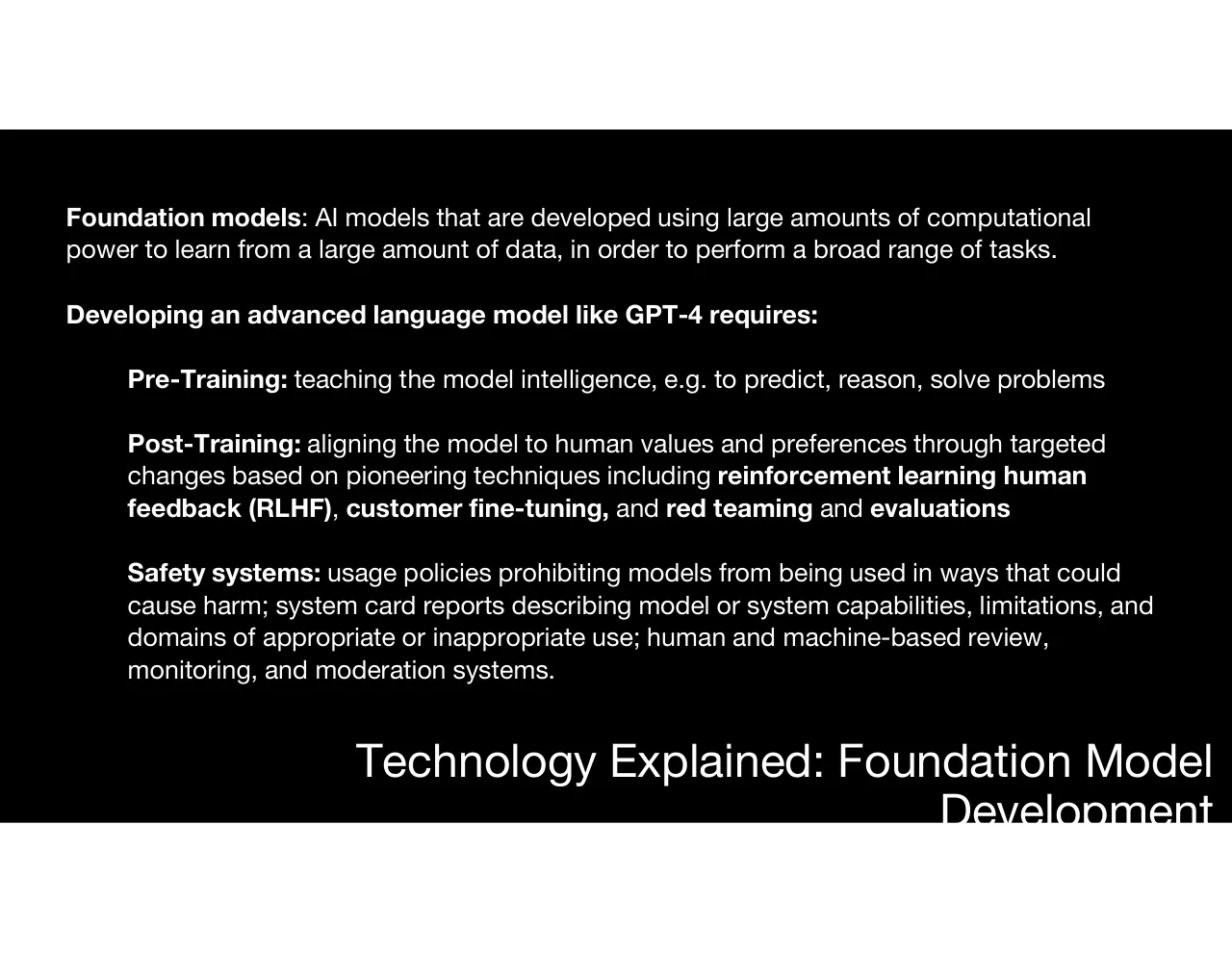
Foundation models: AI models that are developed using large amounts of computational
power to learn from a large amount of data, in order to perform a broad range of tasks.
Developing an advanced language model like GPT-4 requires:
Pre-Training: teaching the model intelligence, e.g. to predict, reason, solve problems
Post-Training: aligning the model to human values and preferences through targeted
changes based on pioneering techniques including reinforcement learning human
feedback (RLHF), customer fine-tuning, and red teaming and evaluations
Safety systems: usage policies prohibiting models from being used in ways that could
cause harm; system card reports describing model or system capabilities, limitations, and
domains of appropriate or inappropriate use; human and machine-based review,
monitoring, and moderation systems.
Technology Explained: Foundation Model
Development
Slide 3
OpenAI Technologies
Users
First-party consumers
Ex: Students, coders, professionals
Third-party developers
Ex: Khan Academy building Khanmigo
Services
OpenAI ChatGPT
Free
Plus
Enterprise
OpenAI API
Chat
Finetuning
Embeddings
...
Technology
Foundation models
Ex: GPT-3.5, GPT-4, DALL-E 2, Whisper
Technology Explained: How People Use Foundation Models
Visuals: One boxed diagram (a flow-style layered diagram, image 1606 by 1067 pixels, not cropped, not full-bleed, with a light blue panel fill #E8F0FD and no photograph or overlay). Shapes and labels: the top row has two grey #E5E5E5 rectangles, 'First-party consumers' with sub-label 'Ex: Students, coders, professionals' and 'Third-party developers' with sub-label 'Ex: Khan Academy building Khanmigo'. The middle row has two teal #7DA399 rectangles: 'OpenAI ChatGPT' containing three light green #DDFBDD boxes labelled 'Free', 'Plus', 'Enterprise', and 'OpenAI API' containing four light green boxes labelled 'Chat', 'Finetuning', 'Embeddings', '...'. The bottom row has one grey #E5E5E5 rectangle 'Foundation models' with sub-label 'Ex: GPT-3.5, GPT-4, DALL-E 2, Whisper'. Arrows: two upward grey #666666 arrows connect the ChatGPT box to the First-party consumers box and the API box to the Third-party developers box; two upward grey arrows connect the Foundation models box to the ChatGPT box and to the API box. No axes, legend or highlighted points.
Slide 4
A small sampling of what’s possible today
Idea Generation & Exploration
Text Generation
Question Answering
Language Translation
Summarization
Market Research
Mathematical Problem Solving
Event or Meeting Planning
Scientific Explanation
Value Innovation
Brainstorm & Strategize
Educational Research & Personalized Tutoring
Conversational Engagement
Sentiment, Emotion & Tone Recognition
Philosophical Discussion
Cultural and Social Context Understanding
Ethical Consideration and Guidance
Write & Explain Code
Translate Code
Optimize Code
Code Refactoring
Syntax Checking
Analyze Code Complexity
Code Testing
Code Documentation
Code Conversion to Pseudocode
Code Review and Feedback
Code Integration with APIs
Code Security Analysis
Code Compatibility Check
Code Deployment Guidance
Database Query Generation
Text to SQL or Spark
ML Model Implementation
Data Extraction
Data Transformation
Data Loading
ETL Pipeline Creation
Data Cleaning
Data Analysis
Data Visualization
Interactive Dashboard Creation
ML Preprocessing
Data Aggregation & Processing
Geospatial Data Visualization
Time Series Analysis
Data Anonymization
Data Integration
Data Mining
Data Quality Assessment
Sample Data Generation
Slide 5
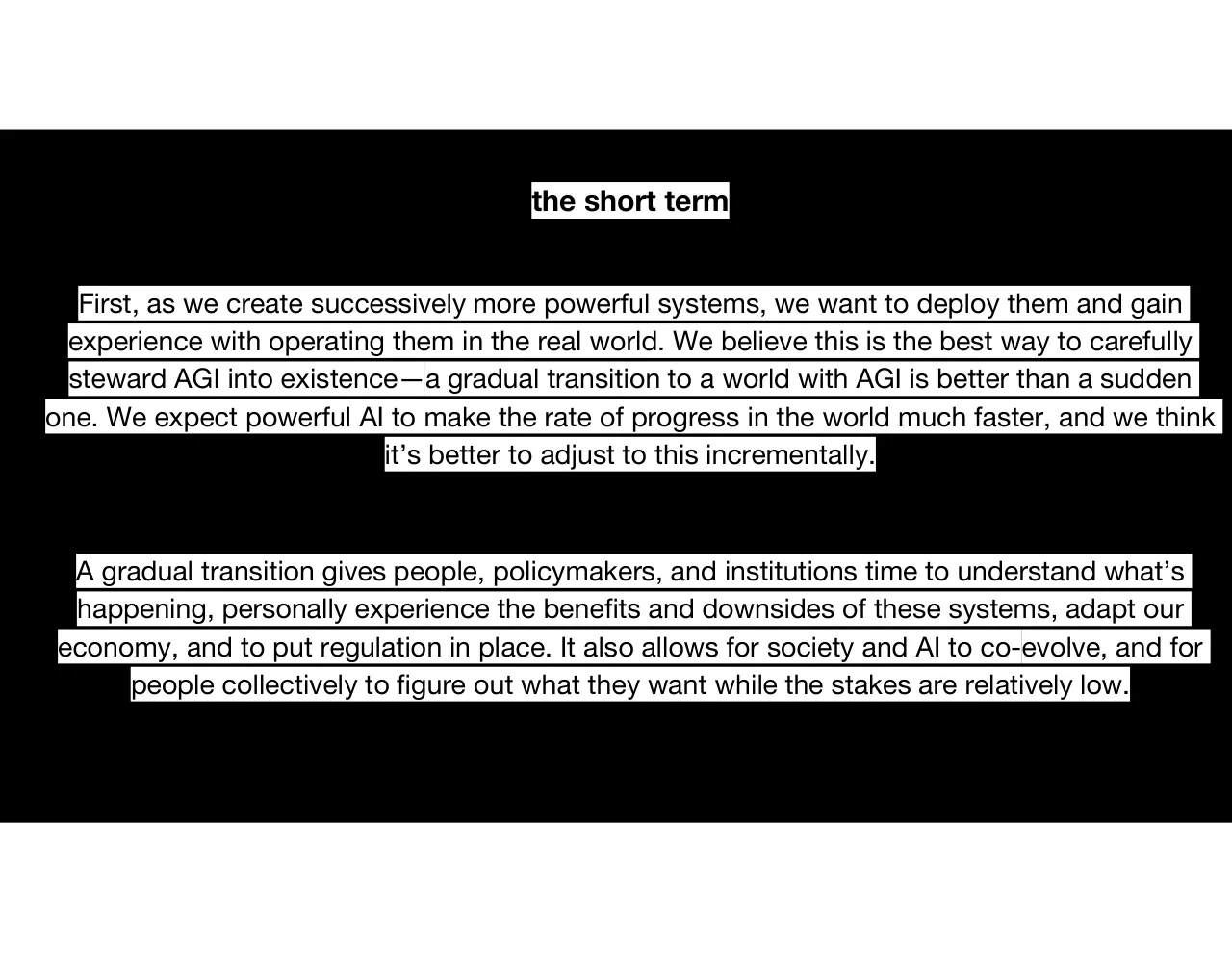
the short term / First, as we create successively more powerful systems, we want to deploy them and gain / experience with operating them in the real world. We believe this is the best way to carefully / steward AGI into existence—a gradual transition to a world with AGI is better than a sudden / one. We expect powerful AI to make the rate of progress in the world much faster, and we think / it’s better to adjust to this incrementally. / A gradual transition gives people, policymakers, and institutions time to understand what’s / happening, personally experience the benefits and downsides of these systems, adapt our / economy, and to put regulation in place. It also allows for society and AI to co-evolve, and for / people collectively to figure out what they want while the stakes are relatively low.
Slide 6
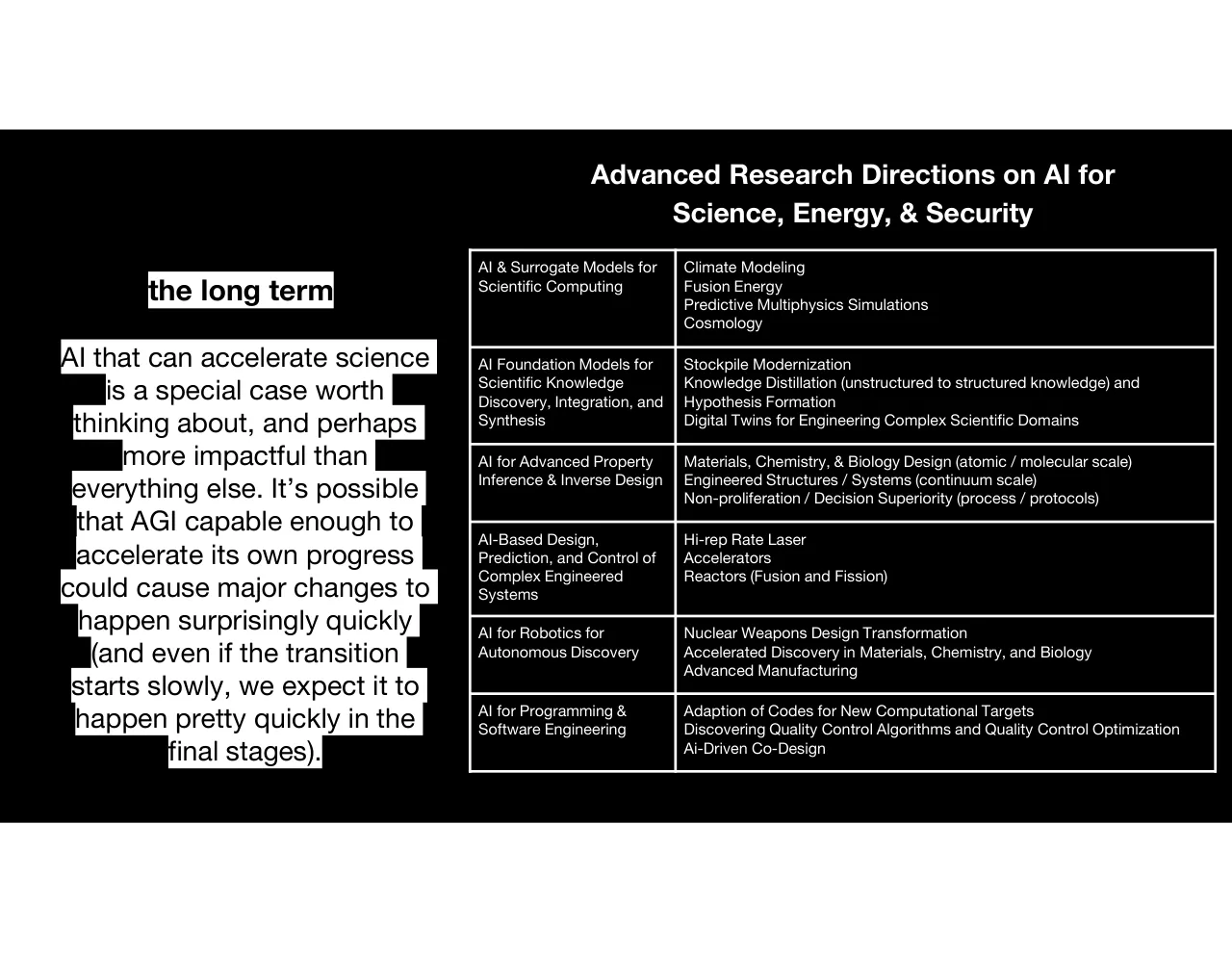
Advanced Research Directions on AI for / Science, Energy, & Security / the long term / AI that can accelerate science / is a special case worth / thinking about, and perhaps / more impactful than / everything else. It’s possible / that AGI capable enough to / accelerate its own progress / could cause major changes to / happen surprisingly quickly / (and even if the transition / starts slowly, we expect it to / happen pretty quickly in the / final stages). / AI & Surrogate Models for Scientific Computing / Climate Modeling / Fusion Energy / Predictive Multiphysics Simulations / Cosmology / AI Foundation Models for Scientific Knowledge Discovery, Integration, and Synthesis / Stockpile Modernization / Knowledge Distillation (unstructured to structured knowledge) and / Hypothesis Formation / Digital Twins for Engineering Complex Scientific Domains / AI for Advanced Property Inference & Inverse Design / Materials, Chemistry, & Biology Design (atomic / molecular scale) / Engineered Structures / Systems (continuum scale) / Non-proliferation / Decision Superiority (process / protocols) / AI-Based Design, Prediction, and Control of Complex Engineered Systems / Hi-rep Rate Laser / Accelerators / Reactors (Fusion and Fission) / AI for Robotics for Autonomous Discovery / Nuclear Weapons Design Transformation / Accelerated Discovery in Materials, Chemistry, and Biology / Advanced Manufacturing / AI for Programming & Software Engineering / Adaption of Codes for New Computational Targets / Discovering Quality Control Algorithms and Quality Control Optimization / Ai-Driven Co-Design
Visuals: One table with two columns and six rows, no header row, black cells (#000000) with thin white (#FFFFFF) rules on all sides and between cells. Column 1 holds topic labels in white sans-serif; column 2 holds the listed items, one per line, in white sans-serif. Row 1: 'AI & Surrogate Models for Scientific Computing' / 'Climate Modeling', 'Fusion Energy', 'Predictive Multiphysics Simulations', 'Cosmology'. Row 2: 'AI Foundation Models for Scientific Knowledge Discovery, Integration, and Synthesis' / 'Stockpile Modernization', 'Knowledge Distillation (unstructured to structured knowledge) and', 'Hypothesis Formation', 'Digital Twins for Engineering Complex Scientific Domains'. Row 3: 'AI for Advanced Property Inference & Inverse Design' / 'Materials, Chemistry, & Biology Design (atomic / molecular scale)', 'Engineered Structures / Systems (continuum scale)', 'Non-proliferation / Decision Superiority (process / protocols)'. Row 4: 'AI-Based Design, Prediction, and Control of Complex Engineered Systems' / 'Hi-rep Rate Laser', 'Accelerators', 'Reactors (Fusion and Fission)'. Row 5: 'AI for Robotics for Autonomous Discovery' / 'Nuclear Weapons Design Transformation', 'Accelerated Discovery in Materials, Chemistry, and Biology', 'Advanced Manufacturing'. Row 6: 'AI for Programming & Software Engineering' / 'Adaption of Codes for New Computational Targets', 'Discovering Quality Control Algorithms and Quality Control Optimization', 'Ai-Driven Co-Design'. No chart, photograph, logo or icon. The left column has no image; it is solid white highlight blocks behind black text.
Slide 7
●
Advancing AI safety research to promote responsible development of frontier models,
minimize risks, and enable independent evaluations of capabilities and safety.
●
Identifying best practices for the responsible development and deployment of frontier models,
helping the public understand the nature, capabilities, limitations, and impact of the
technology.
●
Collaborating across industry, policymakers, academics, civil society and companies to share
knowledge about trust and safety risks.
●
Supporting efforts to develop applications that can help meet society’s greatest challenges,
such as climate change mitigation and adaptation, early cancer detection and prevention, and
combating cyber threats.
Safe & Beneficial AI for Science, Energy, & Security
Visuals: none (the four round white bullet dots are text glyphs, not separate graphics; there are no photographs, charts, diagrams, logos, or icons).