This deck is the keynote from Intel Innovation 2023, presented by CEO Pat Gelsinger. It opens with a forward-looking statements disclaimer, then introduces Gelsinger and the theme of bringing AI everywhere, from client and edge to network and cloud. A guest segment with ai.io, a sports science company, shows Intel hardware running a performance application, followed by a QR code for further information. The middle section covers the scale of the silicon industry, framed as a $574B silicon industry powering an $8 trillion global tech economy, and the idea of Siliconomy, with a growth figure for connected devices. It then moves to Intel Developer Cloud, Intel's process and foundry roadmap from Intel 7 through Intel 18A, a list of UCIe ecosystem partners, and a comparison of packaging technology. Later sections cover the Core Ultra and Xeon launches, quantum and neuromorphic research, and the Project Strata software initiative. The closing slides recap the roadmap, introduce a guest speaker, and present a notices page.
Slides worth studying


Questions about this deck
How many slides does the Intel Innovation 2023 keynote deck from Intel have?
The deck has 66 slides. Slide 1 is the forward-looking statements disclaimer and the later slides close with a notices page.
What does the Intel deck say about the size of the silicon industry?
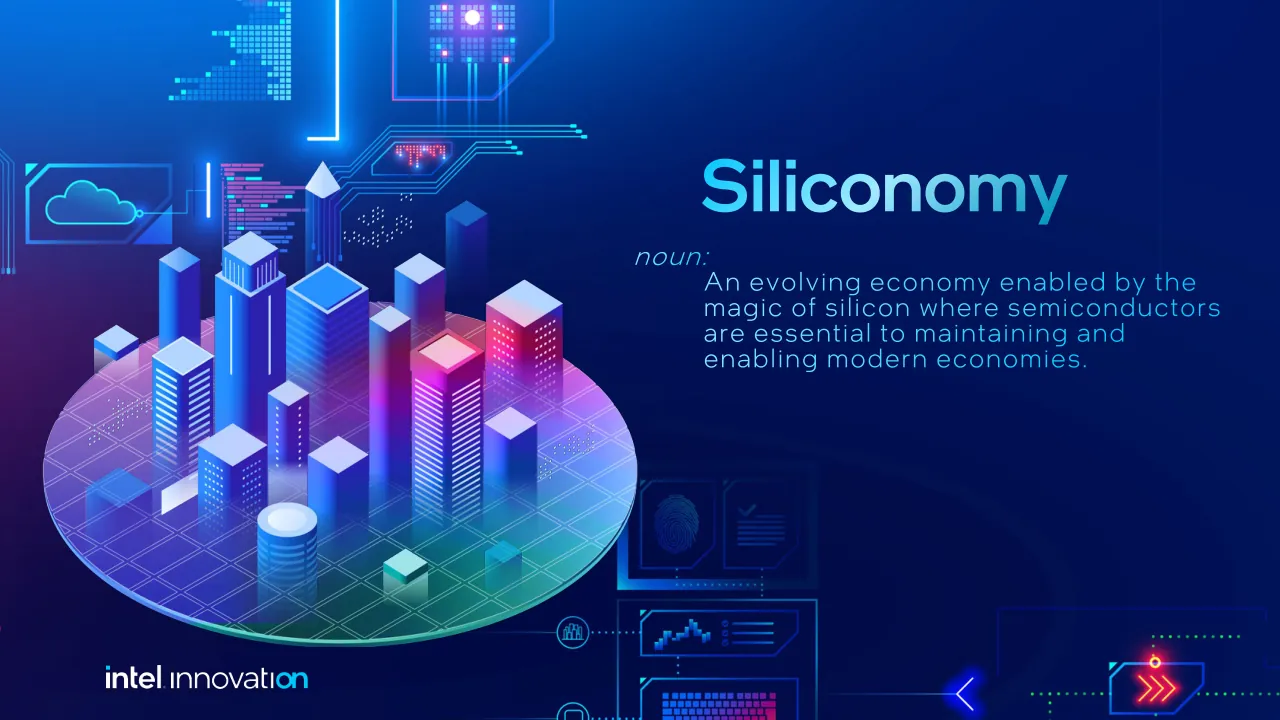
Slide 8 describes a $574B Silicon Industry powering an $8 Trillion Global Tech Economy. Slide 9 introduces the idea of Siliconomy as an evolving economy enabled by silicon.
What growth figures does the Intel deck give for connected devices?
Slide 10 states a 4x increase in connected devices over the past 5 years and a 15x growth in connected devices in 10 years. The source is a commissioned study by Forrester Consulting on behalf of Intel, December 2022.
What process roadmap does the Intel deck show for its manufacturing nodes?
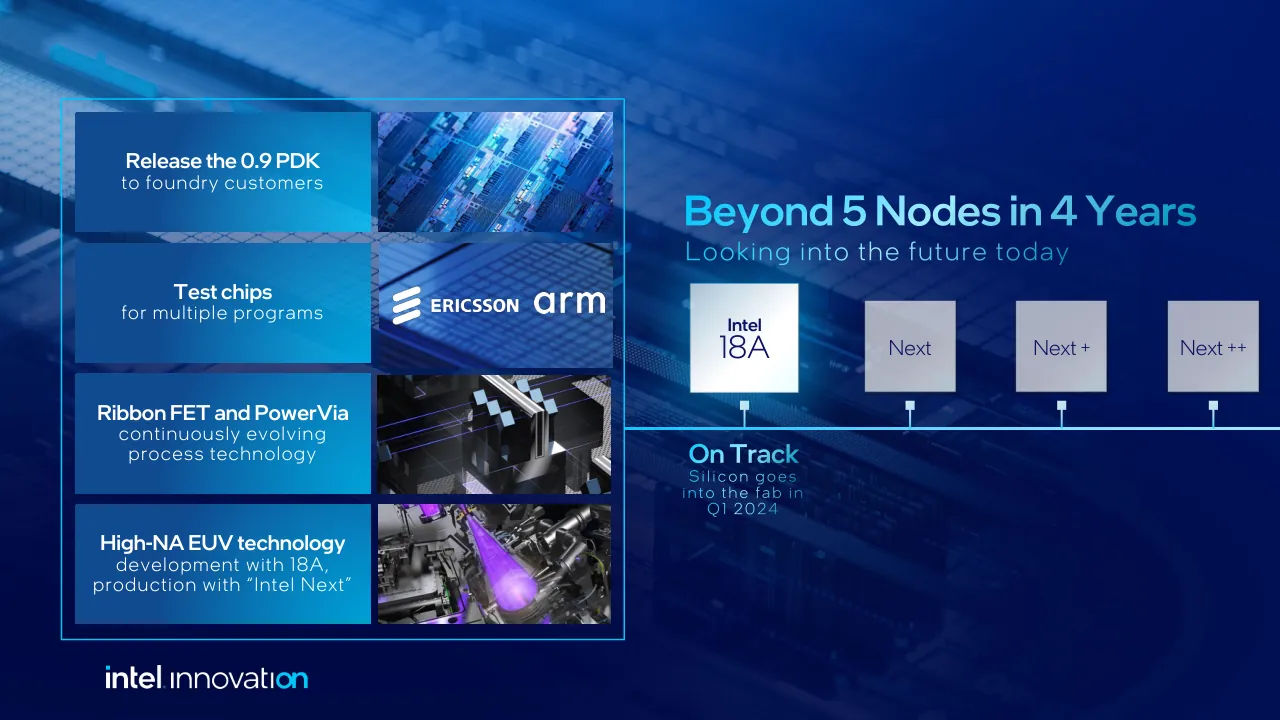
Slide 52 lists Intel 7 as in high volume manufacturing now, Intel 4 as in high-volume ramp now, and Intel 3 as manufacturing ready and sampling in 2H 2023. It also shows Intel 20A on track for manufacturing in 2024 and Intel 18A on track, with silicon going into the fab in Q1 2024.
Details
- Company: Intel
- Year: 2023
- Type: Keynote
- Industry: Semiconductors
- Pages: 66
More from Intel
All Intel decks in the library
Review score: 7 out of 10, Effective
Presentation quality, judged with the SlideDeck Co review heuristic. Ask, evidence and idea merit are not rated here.
This is a keynote stage deck with a strong, consistent visual identity: dark blue field, bold cyan headlines, one idea per slide, large illustrations and clear partner logo slides (5, 20, 29, 30). The route is easy to follow, from AI everywhere to Siliconomy, developer cloud, process roadmap and closing recap (64), and the roadmap timelines on 52 and 53 and the Moore's Law chart on 23 are clear. Weaknesses are consequential: small light captions on dark art on slides 12, 14, 34, 36 and 52 and the dense logo and member lists on 56 and 64 would be hard to read, and the chart on 23 has tiny axis labels. Many slides are decorative title cards with little standalone content, and the partner and guest pairs (4, 5, 6, 29, 30, 31) repeat, so the deck depends on the speaker.
Worth keeping: Keep the consistent blue identity, the one-message headline slides such as 8, 10 and 13, and the clean timeline format on 52.
Most useful repair: Enlarge the small captions and sub-labels on slides 12, 34, 36, 52 and 62 and raise their contrast against the busy art, and simplify the member list on 56.
What would change the score: I would cut repeated guest title and logo pairs and the duplicated build slides (such as 34 and 36, 53 and 52) to tighten the pace.
Confidence medium. 66 of 66 pages inspected on contact sheets, 4 at readable size. Reviewed 2026-11-08. Model-assisted review (claude-sonnet-5-5).
Full text of the slides (66 slides)
Every slide's words and a description of its charts and images, so the deck can be searched and rebuilt. Also available as Markdown.
Slide 1
Forward-Looking Statements / This presentation contains forward-looking statements, including with respect to Intel’s business plans and strategy, process and product roadmaps, and current and future technologies, / as well as the anticipated benefits therefrom. Such statements involve many risks and uncertainties that could cause our actual results to differ materially from those expressed or implied, / including: changes in demand for our products; changes in product mix; the complexity and fixed cost nature of our manufacturing operations; the high level of competition and rapid / technological change in our industry; the significant upfront investments in R&D and our business, products, technologies, and manufacturing capabilities; vulnerability to new product / development and manufacturing-related risks, including product defects or errata, particularly as we develop next generation products and implement next generation process / technologies; risks associated with a highly complex global supply chain, including from disruptions, delays, trade tensions, or shortages; sales-related risks, including customer / concentration and the use of distributors and other third parties; potential security vulnerabilities in our products; cybersecurity and privacy risks; investment and transaction risk; / intellectual property risks and risks associated with litigation and regulatory proceedings; evolving regulatory and legal requirements across many jurisdictions; geopolitical and / international trade conditions; our debt obligations; risks of large scale global operations; macroeconomic conditions; impacts of the COVID 19 or similar such pandemic; and other risks / and uncertainties described in our earnings release dated July 27, 2023, our most recent Annual Report on Form 10-K and our other filings with the U.S. Securities and Exchange / Commission. All information in this presentation reflects Intel management views as of the date hereof unless an earlier date is specified. Intel does not undertake, and expressly disclaims / any duty, to update such statements, whether as a result of new information, new developments, or otherwise, except to the extent that disclosure may be required by law. / Product, service and technology performance varies by use, configuration and other factors. Reference to research results, including comparisons to products, services or technology / performance are estimates and do not imply availability. The products and services described may contain defects or errors which may cause deviation from published specifications. / It / Starts / Here / intel innovation
Visuals: Full-slide background illustration of abstract glowing blue light streaks and horizontal bars. Decorative bars: at top-left a purple bar, a blue bar followed by a coral bar, a lime-green bar, and a cyan bar with a small white square; a faint blue fading bar lies below them. At bottom, a cyan bar runs into the coral block, a navy bar with a white square and a lime-green bar, a blue bar with a coral bar, and a purple bar. Coral block at bottom-right holds the text It Starts Here. Intel innovation logo (white wordmark with cyan final letters) at bottom-left. Dominant colours are deep blue, cyan, lime, coral and purple; no photograph, chart or table.
Slide 2
intel® / innovation / Pat Gelsinger / Intel CEO / It / Starts / Here
Visuals: Decorative graphic only, no photographs or charts. Right edge: a red bar (#FF5662, about 88% x, 0% to 28% y, about 1% wide), a dark blue bar (#00377C, 88% x, 30% to 65% y), a purple bar (#5E3170, 86.3% x, 36% to 58% y), a green bar (#B1D272, x 89.7%, y 18% to 58.1%, 1% wide), a cyan bar (#00C7FD, 91.2% x, 15.3% to 48.2% y), and small white squares at about 91.2% x, 12.5% y and 89.6% x, 59.2% y. Bottom: a cyan bar (#00C7FD, x 47.1% to 72.9%, y 75.7%, 1.8% high), a green bar (#B1D272, x 14% to 81.2%, y 78.5%, 1.8% high) starting from a small white square at x 12.2%, a red bar (#FF5662, x 39% to 69.3%, y 81.4%), a dark blue bar (#00377C, x 0% to 37.6%, y 81.4%), and a purple bar (#5E3170, x 0% to about 22%, y 84.3%). Faint blue streaks fade across the left edge at about 15% to 21% y and across the lower left. The background is a soft glow of brighter blue at the top left, fading into darker navy toward the bottom right.
Slide 3
Bringing AI Everywhere / from client and edge / to the network and cloud
Visuals: Full-bleed illustration covering the whole slide. Top-left: a large cyan outline cloud (about 20% to 31% of width, 0% to 17% of height) with a pixel-grid rain column falling from its base down the left third, the squares fading from light cyan #3FD3F5 at the top to deep blue #1D4FB8 at the bottom. Top-centre: a vertical stack of blue-to-cyan pixel-bar graphics, a bright white-cyan L-shaped neon line, and a small purple-and-white chip with three cyan traces descending from it. Centre-top: a rounded-corner outline panel (about 42% to 56% of width, 22% to 30% of height) holding a cyan cloud icon with a small cyan node on its right, a glowing cyan vertical bar beside it, and a blue code-line thumbnail. Right: a dark laptop (screen about 73% to 100% of width, 5% to 42% of height, keyboard base about 71% to 100%, 42% to 49%) with cyan, pink and violet code-line panels in three stacked windows on its right edge, connected by cyan bracket lines to a tall vertical teal-to-blue pixel column (about 77% to 86% of width, 34% to 82% of height). Circuit-trace lines run across the upper centre-right. Bottom-left: a small glowing blue-outlined cloud with two white chevrons, a green dotted line with a green ring, and a pink-orange-red code-line panel. Lighting is a self-lit neon glow; dominant colours are cyan #22C5F0, royal blue #1C5BD6, magenta-pink #E8436E and deep navy #00104D. Not cropped inside the slide except at the right edge where the code panels run off the canvas.
Slide 4
ai.io / Rich Felton-Thomas / Director of Sports Science / & Chief Operating Officer, ai.io / intel innovation / Balance / 89.9° / Distance / 14.6M / 30m Sprint / 4.18S / Reactions / 397MS / Fatigue / 88% / Agility / 760MS
Visuals: Full-bleed photograph of a male sprinter in a monochrome lavender-grey treatment, mid-stride and leaning forward to the right, one arm raised high at upper left and the other arm bent forward at right, with a glowing blue data HUD panel at far right edge. Overlaid on the athlete are thin white circular reticles with small mint-green (#3DE0B0) dot markers at the shoulder, elbow, hip, knee and hand, with the numeric readouts listed in the elements. Background behind the athlete carries concentric thin arcs and a tick-marked dial in teal and magenta. Bottom right has neon line icons: a cyan outline cloud, red-orange double chevrons in a blue rounded rectangle, cyan and white chevrons, and orange and magenta horizontal data bars. Lighting is cool and dark with the athlete highlighted. Composition is full-bleed with no crop border. Dominant colours are navy #0A1A5C, royal blue #1E4FD8, cyan #2FD3F5 and magenta #C2185B accents.
Slide 5
ai.io / + / intel / intel innovation / Balance / 89.9° / Distance / 14.6m / 30m Sprint / 4.18s / Reactions / 397ms / Fatigue / 88% / Agility / 760ms
Visuals: Full-bleed photographic and graphic background: a sprinter in a short-sleeved shirt and shorts, in mid-stride and leaning forward, with the right arm raised over the head and the left arm bent forward, rendered in grayscale with a blue-violet tint. The figure runs from the upper right toward the lower left. Translucent circular tracking rings sit on the shoulders, elbows, hip, knee and hand, each with a small glowing green-teal dot at its centre. Small white data callouts sit beside the figure: Balance 89.9° above the raised arm, Distance 14.6m beside the upper right hand, 30m Sprint 4.18s at mid-left, Reactions 397ms below the torso, Fatigue 88% beside the knee, and Agility 760ms (faint) at lower left. A vertical blue HUD bar graph with horizontal bars and a white highlight line runs down the far right edge. Concentric dark-blue and magenta-tinted arcs, a dashed tick-mark dial and a teal segmented ring surround the figure. Along the bottom right are neon line icons: a cyan cloud outline, a red and yellow double-chevron inside a blue rounded rectangle, green dotted circuit lines, and a vertical stack of red and orange horizontal bars. The composition is cropped at the top edge and right edge; the photo is full-bleed with a dark navy tint and overlay. Lighting is a cool, even key on the figure with blue rim glow. Dominant colours are navy #0A1450, violet-grey #8A8DBF and electric blue #1E6BFF. Logos: ai.io wordmark in white with a green dot #2BD97C replacing the dot of the i; a light-blue plus sign #3DC8F0; the Intel logo in white with a cyan square #00C7FD above the i; the intel innovation wordmark in white with the on in cyan #00C7FD.
Slide 6
ai.io / Intel technology powers every / touchpoint across the ai.io experience / Balance / 89.9° / 30m Sprint / 4.18S / Reactions / 397MS / Distance / 14.6M / Agility / 760MS / Fatigue / 88 (partly hidden) / Xeon / Cloud / Computing / Core i9 / Desktop, Laptop & / Tablet / PC Compute / Connected / Devices / Networking / End-to-end / Optimization / AI Models / Optimized on / OpenVINO / Intel 3D AI / Trained with / Intel® Gaudi / intel innovation
Visuals: Full-bleed photograph of a male sprinter in a grey-scale-tinted pose, mid-stride and leaning forward with arms extended, shown from the right side of the frame with the head at upper right (about x 75% to 88%, y 7% to 42%). Teal-green dot markers sit on the joints (shoulders, elbows, hip, knee, ankle) with thin white circular outlines around them. Overlaid white numeric readouts: Balance 89.9°, 30m Sprint 4.18S, Reactions 397MS, Distance 14.6M, Agility 760MS, Fatigue value partly obscured. A vertical blue data-bar graphic with horizontal white and blue bars sits at the far right edge (x 88% to 98%, y 6% to 43%). The overall lighting is cool blue with a dark navy vignette; a blue-to-violet tint covers the photo. Six product images: an Intel Xeon processor package (dark grey with blue edge, white intel and XEON wordmarks); an Intel Core i9 package (royal blue with white intel and CORE wordmarks, i9 in lower right); an Intel evo package (black with white intel and evo wordmarks, cyan corner accent); a 5G wordmark with a white radiating Wi-Fi-style arc symbol; an OpenVINO wordmark in white with two ring symbols; an Intel Gaudi AI accelerator package (blue-grey with white intel and GAUDI wordmarks). Bottom-right neon illustration: a glowing blue cloud outline with chevrons, a red-orange double-chevron inside a blue outlined hexagon, green dotted circuit paths, a blue vertical glowing bar, and a red-to-orange horizontal bar-chart stack; blue chevron arrows point left at the bottom centre.
Slide 7
Balance / 89.9° / Distance / 14.6M / 30m Sprint / 4.18S / Reactions / 397MS / Fatigue / 88% / ai.io / Scan to learn more / intel innovation
Visuals: Background: a full-bleed monochrome photograph of a male sprinter in a short-sleeved shirt, mid-stride and leaning forward in a low start, moving from upper-right to lower-centre. The photo is desaturated to lavender-grey and blue-grey tones (about #B8BCE0 highlights, #3A3F78 shadows) with a navy tint over it. Thin glowing circles and green dots (#1ED760 approx.) mark joints on the arms, hip, knee and head. Labels float beside the markers: Balance 89.9° (top centre-right), Distance 14.6M (right, beside a vertical HUD of blue data bars), 30m Sprint 4.18S (left of the runner), Reactions 397MS (centre-right), Fatigue 88% (lower right). Glowing blue data bars run down the right edge. A teal-and-magenta concentric arc graphic curves around the runner. Along the bottom right, neon line icons appear: a blue chevron, a cloud outline in cyan, a red-yellow double-chevron badge in a blue outlined rectangle, a green dotted circuit line, and a vertical stack of orange and magenta bars. QR code: black-on-white square matrix (rendered as pale cyan #D6F4FF modules on navy) with standard three finder squares; placed as two identical 295 by 295 pixel images at the same position. ai.io logo: white bold geometric sans wordmark 'ai.io' with the dot of the 'i' in the second position replaced by a green (#1ED760) circle. intel innovation logo: white 'intel' wordmark in bold sans with a small registered mark, followed by 'innovation' in lighter weight, with the final 'on' in cyan (#00C7FD). Nothing is cropped; the photo is full-bleed; the QR and logos are unboxed.
Slide 8
$574B
Silicon Industry
powering
$8 Trillion
Global Tech Economy
intel innovation
Visuals: Photograph/illustration composite across the full slide. Left half: three overlapping silicon wafers seen as large discs, partly cropped by the slide edges. The upper-left wafer is blue-green with a grid of rectangular dies, the lower-centre wafer is magenta-pink and purple with a dense die grid and coloured speckles, and the lower-right wafer is amber, orange and red with vertical bands. Lighting is neon, with glowing cyan and magenta highlights. Centre-top: a vertical glowing cyan-white neon line forming an L-shaped circuit trace, a dotted cyan pixel-bar column, and a circular chip icon with a fingerprint icon in a rounded square at top right. Below it, a square-outlined processor chip with magenta-violet glow and a 3x3 grid of small dies with a white centre dot, and a small red LED chip with circuit traces. Bottom-right: a cyan outline cloud icon with two chevrons pointing left, a green dotted line, and a blue-outlined box with red triple chevrons. Bottom-left: thin cyan chevron. No charts, tables, or photographs of people. Overlay: dark navy gradient darkening the right side.
Slide 9
Siliconomy / noun: / An evolving economy enabled by the / magic of silicon where semiconductors / are essential to maintaining and / enabling modern economies. / intel innovation
Visuals: Full-bleed dark navy circuit-board background illustration. Main visual is an isometric 3D city of glowing towers and blocks on a circular silicon wafer, with a grid pattern on the wafer surface. Towers are blue, violet, magenta and pink with white window stripes; a cylindrical tower sits in the foreground. The wafer is lit in violet, teal and blue, and its rim is pale green-teal. Smaller stylised elements include a cloud icon in a rounded outlined panel at top left, a microchip with glowing dots at top, a glowing white circuit trace at top, a fingerprint icon in a panel and a document-with-checkmark icon in a panel at lower right, a bar-chart panel with checkbox list, a grid of blue and magenta squares at bottom, a circular icon near the bottom centre, a red and yellow double-chevron button at bottom right and a blue chevron at bottom centre-right. The Siliconomy title and definition text are rendered as raster images.
Slide 10
Siliconomy / 4x / Increase / in connected devices / over past 5 years / 15x / Growth / in connected devices / in 10 years / Base: 641 security decision-makers at consumer electronic device organizations / Source: A commissioned study conducted by Forrester Consulting on behalf of Intel, December 2022 / intel innovation
Visuals: Isometric illustration of a city built on a circular platform. The platform is a translucent lilac-to-teal disc with a fine grid of lines. Tall glowing skyscrapers in blue, magenta and pink rise from it, with lit window stripes and rooftop cubes. A cylindrical storage tower sits at lower centre-left and a small glowing cube sits near the platform edge. Above the city are circuit-board motifs: a cloud icon in a rounded rectangle at upper left, a microchip with pins at top centre, a glowing pixel grid at top left, and traces with dots running to the right. Along the lower right, dashboard panels show a fingerprint icon, a document with a checkmark, a bar chart with check-list rows, a keyboard-like grid of blue and magenta bars, and a red chevron button. The palette is deep blue with cyan, magenta and violet glows; the lighting is neon and the framing is wide. No chart axes or data series are present beyond the decorative bars.
Slide 11
intel® / Developer Cloud / cloud.intel.com / access to our latest / accelerated hardware and software / intel innovation
Visuals: Full-bleed digital illustration: an isometric city of glowing blue, violet and magenta office towers and cylinders rising from a circular, grid-lined platform in the left half, with a glowing cyan-to-violet gradient base. Surrounding circuit-board motifs in cyan and magenta line art: a cloud icon in a rounded box at upper left, a fingerprint and document cards in the lower centre, a dashboard card with bar chart and checklist lower centre, a chevron arrow icon and a red and yellow double-chevron icon lower right, and dotted connector lines. Behind the text, a large outlined cloud shape with a gradient stroke running from cyan on the left through blue to red-pink at the top right, about 4 px wide with a soft glow. Lighting is neon-style, dark-background, emissive. Dominant colours: navy #001A6E, electric blue #1E5BFF, cyan #22D3EE, magenta #E0307A. Not cropped; the illustration covers the whole slide.
Slide 12
Build and test for / best performance / efficiency
Advanced AI / capabilities / toolkits
Multiplatform / systems and / clusters
intel Developer Cloud
cloud.intel.com
Available to all
intel innovation
Visuals: Full-bleed background illustration of dark navy circuit-board graphics with glowing cyan and magenta chip and trace patterns across the top and bottom edges. Row 1, Build and test for best performance efficiency: five 3D product renders in a row on a light blue gradient panel, each a dark chip package with a white intel logo: Intel XEON (x 18.5), Intel XEON MAX SERIES (x 23.4), Intel DATA CENTER GPU (x 28.3), Intel DATA CENTER GPU MAX SERIES (x 33.4), Intel GAUDI (x 39.1); all at y about 17 to 34. Row 2, Advanced AI capabilities toolkits: oneAPI logo (white stylised numeral 1 with a cyan square and the word oneAPI in white) and OpenVINO logo (white wordmark with two stylised eye-like o letters, trademark mark at upper right). Row 3, Multiplatform systems and clusters: three white line icons on the blue panel: a hand-with-pen and grid icon, a cloud-with-bar-chart icon, and a gear icon. Behind the cloud, at lower right of the panel area, is a dark navy illustration of UI cards with a fingerprint icon, a checklist card, a bar and line chart card and a grid of blue and magenta bars, all outlined in glowing cyan-blue strokes. Small dotted cyan connector line runs from the left panel edge to the cloud at y about 63.8. Bottom-right, a magenta and yellow chevron arrow tag. Cloud is a thick outlined shape with a gradient stroke from cyan on its left to coral red on its upper right, with a navy fill.
Slide 13
cloud.intel.com
Intel-optimized
AI Software
supported by the latest
CPUs, NPUs and GPUs
1 week free
of Intel Developer Cloud access
for every in-person attendee
it
Starts
Here
import webbrowser as siliconomy
accessibleDevelopment = “https://cloud.intel.com”
devNeeds = {"Open": True, "Choice": True,
"Trust": True, "AI": True,
"Client": True, "Edge": True,
"Cloud": True }
if any(x is True for x in devNeeds.values()):
siliconomy.open(accessibleDevelopment)
Visuals: Illustration: a large glowing cloud silhouette formed by a thick luminous ring stroke, running from the lower-left edge up over the top and down the right side, with its bottom sweeping across the lower part of the slide. The ring is a gradient from bright cyan #00C8FF through violet #8A4FD0 to coral red #FF5662, with soft outer glow. Top-right: a cyan outline cloud icon (about 88% to 97% x, 3% to 9% y) with a glowing blue chevron to its left, a small octagonal tech tile with orange chevrons '>>>' (about 75% to 82% x, 9% to 16% y), thin green dotted lines and a green glowing ring dot to the right; a faint blue circuit outline frames the top-right. Left edge (about 0% to 13% x, 63% to 100% y): a stylised code-minimap graphic of stacked horizontal bars in orange, red, pink, magenta and cyan on dark navy, with a glowing vertical blue bar at about 2% x and a glowing yellow vertical bar near 4% x, lit by neon glow. Dominant colours are electric blue, cyan, coral red and violet. Full-bleed, no cropping or boxing, no tint overlay beyond the glow. Code panel is monospace text with no syntax image.
Slide 14
intel® ignite / FUEL YOUR FIRE / Artificial Intelligence / Next Generation Systems / Platforms and Edge to Cloud / intel innovation
Visuals: Three square icon tiles, each a blue gradient box with a white and cyan line icon: (1) Artificial Intelligence: a white hexagon-like bracket on the left, a cyan circuit-patterned human brain profile on the right, with cyan dashed connector lines. (2) Next Generation Systems: a cyan and white circuit-line pattern ending in a white box with a right-pointing arrow, and a white gear at the bottom. (3) Platforms and Edge to Cloud: a cyan cloud outline at top with a circuit line running down into a white and cyan hexagonal node network of connected circles. Also a cyan flame outline (thin line, white/cyan stroke) to the left of the FUEL YOUR FIRE wordmark, and the intel innovation logo. Behind each tile is a dark navy translucent panel (#000D4E at 70% opacity) that extends below the tile to hold the caption.
Slide 15
intel
ignite
DEEP RENDER
Solving too much data
and too little bandwidth problem
using Intel Developer Cloud
intel innovation
Visuals: Photograph-style digital illustration, full-bleed: a head-and-face silhouette built from small glowing cubes/dots in cyan-blue (about #2AA8F0 to #1A6FD8), occupying the right side from about x 60 to x 90 and y 5 to y 80, with a dispersal of scattered dots and fine diagonal light streaks drifting up-left. Behind it, a sweeping wave of translucent ribbons in orange, magenta, pink and violet rising from the bottom right corner to the right edge. Lighting is a glow from the cubes against a deep navy field. Composition is full-bleed with no border or crop. Logos: Intel Ignite wordmark (white 'intel' with cyan 'ignite', about 8.4% x, 8.6% y, 9.3% w, 12.6% h); square icon with a cyan hexagon outline on the left joined to a cyan brain outline on the right, on a blue gradient tile (about 8.3% x, 24.8% y, 10.4% w, 17.7% h); DEEP RENDER wordmark in black pixel-style capitals on a pale lavender-white box (about 18.7% x, 42.4% y, 27.0% w, 9.7% h); Intel Innovation logo in white (about 7.1% x, 90.2% y, 18.2% w, 7.7% h).
Slide 16
intel GAUDI / Commitment to address / every phase of the AI / continuum / Performance metrics based on MLPerf Inference v3.1 benchmark. For configuration details, / see the results published by MLCommons. Results may vary. / intel innovation
Visuals: Full-bleed background illustration of a dark blue digital scene. Central photograph of an Intel Gaudi 2 HL-series accelerator card, a blue printed circuit board with a large silver heatsink-covered processor labelled GAUDI 2 in grey, surrounded by capacitors, connectors and mounting holes, tilted roughly 30 degrees, lit from above with bright highlights on the metal heatsink and cool blue light on the board. The board overlaps the right half of the slide and is not cropped. Along the right edge are four vertical stacks of glowing code-like bars in cyan, magenta, red and pink on dark blue, connected by thin cyan circuit traces. Behind the board's left edge, horizontal blue and violet light streaks fade out toward the left. Along the bottom, thin glowing blue and green dotted circuit lines connect a red glowing chevron icon inside a blue-outlined hexagon, a cyan-outlined cloud icon with a blue chevron arrow, and a blue chevron arrow at bottom left. No charts, tables or photographs of people.
Slide 17
intel GAUDI / stability.ai / Large AI Supercomputer / will be a top 15 in the world / intel innovation
Visuals: Photograph of a Habana Gaudi 2 AI accelerator board: a blue printed circuit board tilted about 30 degrees, with a large square silicon package labelled GAUDI2 in the centre and heat-sink-like pins along two edges, lit from above with white highlights on the chip and cool blue shadows. The board sits over a dark navy background and is not boxed. Decorative elements: horizontal glowing blue and violet speed lines fanning out to the left of the board; vertical columns of code-like bars in cyan, blue, pink, magenta and red on the far right edge, connected by thin cyan circuit traces; a small blue grid pattern of squares above the board's right edge; a glowing cyan outline cloud and a glowing blue chevron arrow at the bottom centre; a red-orange chevron-arrow icon inside a blue outlined tag shape at bottom centre with green dotted lines running left and right to glowing green and blue nodes; a blue chevron pointing left at bottom left beside the Intel Innovation logo. Logos: intel GAUDI lockup (white), stability.ai wordmark (white with a red full stop after 'stability'), intel innovation lockup (white with 'on' in cyan).
Slide 18
“Dell Technologies and Intel are collaborating to offer AI / solutions to meet customers wherever they are on their / AI journey. Combining the reliability of Dell PowerEdge / servers – the industry’s top selling portfolio – with Intel / technologies for general purpose and accelerated / compute provides powerful systems for optimized / AI. PowerEdge systems with Xeon and Gaudi will / support AI workloads ranging from large scale / training to base level inferencing. We look forward to / helping customers transform their business with new / applications with this powerful combination.”
Jeff Clarke
Vice Chairman and COO, Dell Technologies
intel innovation
Visuals: Full-bleed background illustration: a dark blue digital scene with glowing neon circuit lines, a cloud icon and chevrons at the bottom, and on the right edge a vertical stack of server-like data panels (cyan, magenta, pink and blue horizontal bars with small square grids and connector lines). Bottom centre: a neon outlined box with three red-orange chevrons pointing right, linked by green dotted lines to a green glowing node on the right. Bottom right of centre: a glowing blue outlined cloud with a blue chevron to its left. A large light-blue quotation mark graphic at top-left of the text, with a soft gradient from #2A8FE8 to #1B5FC4. Dell logo: white ring with the word DELL in white bold capitals inside, on transparent background. Plus sign: thin cyan #4FD8F5 cross with rounded ends. Intel logo: white bold lowercase wordmark 'intel' with a small blue square accent over the i. Matching data-grid square pattern in blue and teal sits in a column behind the server panels.
Slide 19
4th Gen / Intel® Xeon® / Scalable Processor / MLPerf AI inference performance / results: addressing every phase / of the AI continuum / Performance metrics based on MLPerf Inference v3.1 benchmark. For configuration details, / see the results published by MLCommons. Results may vary. / intel innovation
Visuals: Full-bleed digital illustration in blue. A cyan outlined cloud sits at the top centre-right, with a column of blue pixel squares falling beneath it. A second column of cyan and blue pixels sits to its right. Four stacked code-editor-style panels run down the right edge in cyan/blue, pink/purple, red/pink and magenta/blue, each with horizontal bars and small square markers, joined to the chip by thin cyan connector lines. A translucent purple-outlined chip with a glowing white dot sits below the photo, with circuit traces running to the bottom-right. The product photograph is a silver 4th Gen Intel Xeon Scalable Processor package, tilted, with the Intel XEON wordmark and the caption 4th Gen Intel Xeon Scalable Processor printed on its lid. It is lit from the upper left, is not cropped, and has a soft shadow below. A small Xeon box logo (blue cube with intel and XEON) sits at top left. Logos: Intel Xeon box logo, Intel XEON wordmark on chip, Intel innovation logo at bottom left.
Slide 20
Alibaba.com
+
intel
intel innovation
Visuals: Full-bleed digital illustration on the right half and background. A cyan outlined cloud at top centre-right, with a column of blue and cyan square pixels falling from its base like rain. Beneath it, a teal-to-blue pixel column rises into a stack of four server-rack panels on the right, each drawn as horizontal bars of coloured code lines (cyan, pink-red, magenta-purple, and purple-blue) connected by thin cyan circuit lines. At centre-right, a glowing square processor chip with a grid of small lit squares, a white dot in the centre and purple-magenta glow, with blue traces running down from it. At bottom right, circuit traces run diagonally to a small glowing red-and-blue chip. Lighting is self-lit neon on a dark background. Dominant colours are electric blue, cyan, magenta and violet. Nothing is cropped except the cloud and racks at the top and right edges.
Slide 21
AI Roadmap
Bringing AI Everywhere
4x
BF16
2x
Compute
1.5x
Network
Bandwidth
1.5x
HBM
Capacity
Intel® Gaudi® 2
7nm
Intel® Gaudi® 3
5nm
intel innovation
Visuals: Full-slide background photograph/illustration of a dark blue digital scene with glowing blue pixel grid at top-left, a purple-cyan chip illustration at about x 10.5% y 27.5% (w 12%, h 20%) with blue circuit traces running down to a small red-and-blue glowing chip at about x 12% y 52% and further to the lower-left; a vertical bar of cyan and white light at about x 4% y 68%; a stacked red, orange and cyan horizontal bar chart-like code illustration along the bottom-left from about x 7% y 69% to x 25% y 100%, with a blue pixel grid at bottom-left corner. Photo 1: Intel Gaudi 2 chip, square-cornered rectangular package photo at x 25.3% y 43.4% w 12% h 19.6%, dark black package with gold/orange heat-spreader corners and a central dark die labelled GAUDI2, boxed with no border, sharp corners. Photo 2: Intel Gaudi 3 chip, portrait rectangular package photo at x 78.9% y 41.5% w 10.5% h 23%, black package with two dark dies and pinkish-purple and blue memory stacks on the left and right edges, labelled GAUDI3 on the top die, sharp corners. Metric numbers and labels are white and cyan text with no icons. Timeline: a thin light cyan (#7FD8F0) horizontal arrow line at x 17.4% y 68% w 78.1% h 1.7%, arrowhead at the right end; small white tick markers at x 29.5% and x 82.7% pointing up to the two chips. Between the metrics are dotted connector lines: cyan dots from the Gaudi 2 chip to 4x, blue dots between 4x and 2x, lilac-blue dots between 2x and 1.5x, pink dots between 1.5x Network and 1.5x HBM, and red-coral dots from the last 1.5x to the Gaudi 3 chip; these form one dotted line at x 37.1% y 53.9% w 41.6% h 0.7%. Intel innovation logo: white 'intel' wordmark with 'innovation' in white and the 'on' in cyan, at x 7.1% y 90.2% w 18.2% h 7.7%.
Slide 22
AI Roadmap
Bringing AI Everywhere
Intel® Gaudi® 2
7nm
Intel® Gaudi® 3
5nm
Falcon Shores
Codename
intel innovation
Visuals: Full-bleed dark blue background illustration with glowing circuit traces and a pixel-grid pattern at upper-left, a glowing blue chip outline with purple-red core at about x 10.5% to 22%, y 27.5% to 48%, and a red, cyan and white code-bar graphic at bottom-left. Three chip photographs: (1) Intel Gaudi 2 die shown as a gold/orange package with black substrate and a central die marked GAUDI2, at about x 25.3%, y 43.4%, w 12%, h 19.6%, sharp, no crop, boxed by its own black edges; (2) Intel Gaudi 3 dual-die package shown with pink-red and blue-tinted tiles and a black substrate, labelled GAUDI3, at about x 53.1%, y 41.5%, w 10.5%, h 23%; (3) Falcon Shores placeholder shown as a flat blue-gradient rectangle with a light-blue glowing border at about x 79.5%, y 40.3%, w 10.5%, h 23%. A thin light-cyan horizontal timeline arrow runs from about x 17.4% to 95.5% at y 68.7%, with a filled arrowhead at the right end and small upright tick marks at about x 31%, 58%, 85%.
Slide 23
Moore's Law
is alive and well
Intel and non-Intel CPU
2X every 2 years
1,000,000,000,000
100,000,000,000
10,000,000,000
1,000,000,000
100,000,000
Transistors Per Device
10,000,000
1,000,000
100,000
10,000
1,000
1970
1980
1990
2000
2010
2020
2030
intel innovation
Background periodic-table tiles, faint and partly cropped, include: Al Aluminium 26.981538; Si Silicon 28.0855; P Phosphorus 30.973762; S Sulfur 32.065; Se Selenium 78.96; As Arsenic 74.9216; Ge Germanium 72.64; Ga Gallium 69.723; Zn; Cu; Cd Cadmium 112.414; In Indium 114.818; Sn Tin 118.71; Sb Antimony 121.76; Te Tellurium 127.6; I Iodine 126.90447; Tl Thallium 204.38; Pb Lead 207.2; Bi Bismuth; Hg Mercury 200.59; Ag Silver 107.8682; Au Gold 196.966569; Os Osmium 190.23; Ir Iridium 192.217; Pt Platinum 195.084; Pd Palladium 106.42. Small circuit labels include INPUT CHECK, TRANSFER, ECHO, 2400, 2804, 0.4823.
Visuals: Scatter plot with logarithmic y-axis and linear x-axis. Title: none printed on the chart. Y-axis: Transistors Per Device, log scale, gridlines per decade, labelled from 1,000 at bottom to 1,000,000,000,000 at top. X-axis: years 1970 to 2030 at 10-year intervals, with plot range 1970 to 2030. Series 1: Intel and non-Intel CPU, shown as about 150 grey-white dots with about 70% opacity, values estimated: about 2,300 in 1971 (Intel 4004 point), about 3,500 in 1972, about 29,000 in 1974, about 4,500 in 1978, about 1,000,000 in 1989, about 3,000,000 in 1993, about 42,000,000 in 2000, about 220,000,000 in 2001, about 1,700,000,000 in 2006, about 7,000,000,000 in 2010, about 30,000,000,000 in 2019, about 39,000,000,000 in 2020 (estimates, no values printed). Series 2: 2X every 2 years, a straight cyan line from about 1,000 at 1970 to about 1,000,000,000,000 at 2030, running from the bottom-left corner to the top-right corner of the plot. Legend: upper-left inside the plot, with a white dot marker for Intel and non-Intel CPU and a cyan line marker for 2X every 2 years. No highlighted points. Photograph/illustration: right side, a glowing 3D render of a processor chip, bright blue silicon die with a central square cache pattern, surrounded by a copper-red glowing rim and light streaks, with rectangular blue heat-spreader tiles below. Lighting: strong blue and orange-red neon glows. Dominant colours: royal blue, cyan, deep navy, and orange-red highlights. The chip is cropped by the right edge of the slide, and the image blends into the periodic-table background with an overlay that darkens the edges. Logo: the Intel innovation wordmark, white text 'intel' in bold with a small registered mark, followed by 'innovati' in white and 'on' in cyan.
Slide 24
intel / ignite / Scala / Biodesign / Using computational / biology & gen AI / to dramatically speed up / protein engineering process / intel innovation
Visuals: Photograph-style illustration covering the full slide: a glowing particle-dot sphere (dense dot grid) in magenta, violet and green, with a smaller cyan-to-green sphere cluster overlapping its upper-right. It sits on the right side, roughly x 61-94%, y 23-84%, with a sweeping orange-yellow and pink light ribbon crossing its lower edge. Blue flowing light-smoke waves run across the top right and bottom. Lighting is dark-background with luminous neon highlights. Not boxed; full-bleed. Icon: a square tile in cyan-to-blue gradient (#1FB6E8 to #0A6FD1) with a white circuit-line and gear-with-arrow-in-box glyph. Logos: Intel ignite (white 'intel' with light cyan 'ignite'), Scala Biodesign (white hand-lettered 'Scala' with dark-navy 'Biodesign' beneath), Intel innovation (white 'intel' with cyan 'on').
Slide 25
AI PC / Fundamentally transforming / the PC experience / intel innovation
Visuals: One full-bleed digital illustration covering the whole slide. A open laptop, angled slightly, sits in the lower-left-centre with its screen facing the viewer. The screen shows a dark-blue dashboard with pink and magenta bar-code-like code lines, wave/area charts in teal and green, a fingerprint icon, user-profile icons, a radar/target icon and a small dotted bar chart. Along the left edge are a column of circular glowing chip icons linked by thin cyan circuit traces, small meter and checklist cards, and a glowing red/pink LED-bar graphic at the top. On the upper right is a large ring gauge, green arc on a grey track, with a cyan outlined cloud inside. Further right are stacked rounded-rectangle cards with user-profile icons, a cloud icon, bar-style meters and pink line graphs, all with cyan outlines. Lighting is a soft cyan glow from the laptop base and screen. Dominant colours are royal blue, cyan #00C8FF, magenta #E0309A and navy #021A5E. The illustration is not cropped and has no boxed frame, and there is no tint over the text area.
Slide 26
intel CORE ULTRA / Age of the AI PC / Launch of Intel® Core™ Ultra / December 14, 2023 / intel innovation
Visuals: Photograph of an Intel Core Ultra processor package, shown upright. The silver metal lid frames a dark grey-blue substrate with a dotted pattern. The central die is a rectangle of multicoloured tiles, with blue tiles at the top, grey and gold tiles in the middle, and gold and tan tiles at the bottom. The package is lit from the front with soft white highlights on the metal edges. Composition is centred vertically, nearly full height, with its top and bottom edges close to the slide edges, so it is not cropped. Beside it is a dark navy Intel Core Ultra badge, slightly rotated in perspective, with a blue-to-navy gradient face, a white 'intel' wordmark, white 'CORE' letters, white 'ULTRA' capitals and a grid of small blue and cyan dots on its right side. A soft shadow sits under the badge. Behind the scene are blue abstract circuit and light-streak textures, pink and magenta bar-chart-like lines at the left edge, and a row of glowing cyan, pink and red dot-and-line circuit graphics along the bottom. A solid red-coral rectangle #FF5662 holds the date text. A small white square sits above its top-left corner. The intel innovation logo is white with a cyan 'on'.
Slide 27
Microsoft / Copilot / +
Copilot
intel
intel innovation
Copilot
Get answers to complex questions
For example, you could ask "Help me plan for my fishing trip."
Take actions on your PC
Control your Windows environment with actions like "Adjust my settings so I can focus."
Work across documents
Summarize and compose text from any app - start by copying text to clipboard.
Let's learn together. Windows copilot is powered by AI, so surprises and mistakes are possible. Make sure to check the facts, and share feedback so we can learn and improve!
Ask me anything...
Search
11:11 AM 5/23/2023
Visuals: Full-bleed photographic-style illustration of a blue laptop with a Windows 11 wallpaper of blue swirling ribbon-like petals on screen. The laptop is shown open, front-facing and slightly elevated, with a glowing bright blue keyboard and trackpad. The screen shows the Copilot side panel on the right with three cards (Get answers to complex questions, Take actions on your PC, Work across documents), a disclaimer, and an 'Ask me anything...' input, plus a Windows taskbar. Lighting is a soft blue glow from below the laptop and faint light streaks behind it. Dominant colours are royal blue, cyan and pale grey-blue. The image covers the whole slide with no crop or box. Overlays: faint horizontal light streaks at upper left and a small cyan cloud line-art outline with a chevron near the bottom left. Logos: Microsoft four-colour square logo with Microsoft wordmark in white; Copilot icon (blue-to-purple interlocking hexagon ring) with Copilot text; a cyan plus sign; Intel wordmark in white with registered mark; Intel Innovation logo (neon chevron icon in red, orange and yellow with white intel and cyan innovation wordmark).
Slide 28
intel CORE ULTRA / First on Intel 4 / Using EUV Technology / Thunderbolt 4 / 3D Performance Hybrid Architecture / Built-In NPU AI Engine / Low Power Island E-cores / WiFi 7 / Foveros 3D Packaging / New P-core & E-core Microarchitectures / Built - in intel ARC / Latest Media & Display Standards / intel innovation
Visuals: Photographs and illustrations, all rectangular and boxed (not full-bleed except the background): (1) Top-right isometric render of an Intel Core Ultra processor package, blue-tinted, layered tiles with glowing edges, spanning about x 52-100, y 2-75, partly behind tiles; (2) Left edge vertical colourful code/data bars (red, magenta, cyan) spanning about x 0-12, y 53-100; (3) Bottom-centre thin cyan and red line-art circuit with a chevron node and a glowing bar graph, about x 39-75, y 88-99; (4) Row 1 tile photo at x31.8 y29.4 w9.6 h17.2: black cube with silver blade structure and blue diagonal lines, lit from the upper right; (5) Row 1 tile photo at x51.6 y29.4 w19.4 h17.0: grey EUV lithography machine interior with bright violet-purple beams and reflective metal, dominant violet and grey; (6) Row 2 photo at x9.5 y47.2 w9.6 h16.9: close-up of a golden-lit chip die with a grid, dominant tan and dark brown, cropped to the tile; (7) Row 2 photo at x41.9 y47.2 w9.5 h17.0: 3D rendering of stacked blue-lit chip tiles on a circuit substrate with golden highlights; (8) Row 3 photo at x19.6 y64.9 w9.9 h17.3: close-up of copper-coloured solder bumps in a regular grid on dark grey, shallow depth of field; (9) Row 3 photo at x61.7 y65.1 w9.2 h17.1: silver metallic pins and a glass cylinder in greyscale with blue tint; (10) Logos: Thunderbolt 4 lightning-bolt mark in white at x74.0 y31.9 w4.0 h7.8; WiFi 7 mark (a stylised 7 inside wifi arcs) in white at x12.3 y69.6 w3.8 h6.8; intel ARC wordmark in white at x53.2 y73.5 w7.4 h5.0; intel innovation wordmark in white with cyan 'on' at x7.1 y90.2 w18.2 h7.7; Intel Core Ultra plaque logo at x4.2 y13.2 w11.2 h22.6. No overlays other than tile gradients; no shadows on photos.
Slide 29
acer / Jerry Kao / Chief Operating Officer, Acer / intel innovation
Visuals: Full-bleed digital illustration in a neon tech style. Left half: a glowing cyan outline cloud above a grid of pixels and glowing rows, an orange-pink ring with a light bloom, a smartphone with glowing edges and code lines on its screen, and an open laptop with a glowing screen showing code bars and a lit keyboard. Right edge: circuit-board motifs with a fingerprint icon, a circular chip-like icon, a square chip with a grid of cells, and cyan traces. Lighting is glowing neon cyan, magenta and orange against a deep blue field. The image covers the whole slide and is not cropped or boxed, with no tint overlay beyond the artwork. The acer logo, name and title line and Intel innovation logo are placed on top of the artwork.
Slide 30
The Upcoming
Acer Swift
Thin & Powerful Laptop
intel innovation
acer
+
intel®
Visuals: Illustration: a faint circuit-board graphic in cyan #29D3F5 lines and dark blue fills runs along the top-right corner, from about x 82% to the right edge and from the top to about y 52%. It contains a fingerprint icon in a rounded square outline, two circular chip or sensor icons linked by dotted green-cyan lines, and a large rounded-square chip outline in magenta-violet #C93FD8 with a grid of small blue and red squares and a white dot at its centre, with cyan traces leading off to the lower right. Photograph: an open silver laptop, seen from the front left, with its screen at about x 22-49% and y 8-60%, and its base at about y 62-88%. The screen shows an abstract close-up of a flower in purple, magenta, pink and electric blue petals on a black background. The keyboard is dark with purple-tinted keys, the trackpad is flat, and there is a small blue Acer logo on the bezel. The lighting is soft and bright from the front, with a cool blue cast on the metal. Full-colour, not cropped, not boxed; a soft shadow sits beneath the base. Logo: the acer wordmark in white, slanted italic lowercase, centred at about x 59-79%, y 33-41%. Plus sign: a thin cyan #3FC8F0 cross, centred at about x 68%, y 47%. Logo: the intel wordmark in white bold lowercase, with a small cyan #00C7FD square above the i, and a small registered mark, centred at about x 63-76%, y 57-65%. Logo: intel innovation lockup in white (intel in bold, innovation in regular) with the 'on' in cyan #00C7FD, bottom-left at about x 7-25%, y 90-98%.
Slide 31
The Upcoming / Acer Swift / Thin & Powerful Laptop / acer / + / intel / intel innovation
Visuals: Photograph-style product render of a silver Acer Swift laptop, open at about 110 degrees and angled so the left keyboard edge points toward bottom-left. Its screen shows an abstract close-up of blue, violet and magenta flower petals on black. Right side: a female ballet dancer in a black leotard and black leg warmers, mid-leap with one arm raised and the other extended, pale tights, cut out from its background and placed over a blue circuit-board graphic (cyan and magenta chip-like squares, fingerprint icon, circular sensor icons, green and cyan connector lines) at top right. Lighting is bright and even on the laptop with a soft glow. Dominant colours are royal blue, navy, magenta and cyan. The laptop and dancer are not cropped; the background is full-bleed. A white Acer wordmark, a white plus sign and a white Intel wordmark with a cyan square and registered mark sit centre-right. A white Intel Innovation logo sits bottom-left.
Slide 32
Future Generations / of Intel Core Processors / Realize your vision with AI PC capabilities / 2024 / Arrow Lake / Lunar Lake / Panther Lake / 2025 / intel innovation
Visuals: Full-slide digital illustration in a flat-to-glossy tech style. Left edge: a laptop, open and angled, showing a dashboard screen with a fingerprint icon, user-profile cards, line charts (green, blue and purple), bar-like data tables and a crosshair icon. Around the laptop are circular icon badges (dot-matrix circles, a glowing red-and-pink ring, a check-list icon) linked by thin cyan circuit lines, plus a row of pink and cyan LED bars at top left. Top right: a large circular ring gauge with a green arc and a grey arc, enclosing a glowing cyan outline cloud icon. Right edge: stacked dashboard panels with user icon, cloud icon and pink-red data bars. Centre: three processor packages on a timeline. The first (Arrow Lake) shows a detailed die photograph with blue and gold/orange circuit blocks. The second (Lunar Lake) and third (Panther Lake) show plain blue-grey gradient rectangles standing in for dies, each set in a dark slate package frame with a soft blue glow. Each package has a small white pin marker on the timeline below it. The timeline is a thin pale cyan line with a small arrow at its right end. Lighting is a soft blue glow behind the chips and along the laptop edges. Dominant colours: royal blue, deep navy and cyan, with pink and magenta accents. The illustration is full-bleed and not cropped, with no boxing or overlay other than a dark navy tint toward the bottom.
Slide 33
Performance
per unit of energy
must become our industry’s mission
intel innovation
Visuals: Full-bleed background illustration covering the whole slide: on the right, a large 3D microchip or processor package (blue-grey body with a glowing rainbow edge running red, yellow, green and cyan along its right side) tilted diagonally, with a circuit-trace pattern across it. Above and behind the chip is a ring gauge, about 25% of slide width, with a green arc and dark navy track, containing a cloud outline icon. Three vertical stacked code-editor panels in the centre-right (about x 59% to 69%), each a rounded-corner rectangle with a cyan-teal border: the top panel shows red and pink code lines, the middle panel shows a purple-to-pink area chart above orange and magenta code lines, and the bottom panel shows purple and blue code lines. Below the bottom panel is a small green wave chart (about x 60% to 66%, y 85% to 90%) and a grey-outlined warning triangle with an exclamation mark. A small person icon sits in an outlined box at about x 70%, y 38%. Falling dotted teal pixel streams run from the top edge at about x 59% to 69%. Bottom-left logo: a neon red and orange double-chevron emblem inside a blue outlined tag, next to a white cloud icon with a blue arrow, followed by the white wordmark 'intel' with a small registered mark and 'innovation' in white with the final 'on' in cyan. Faint horizontal streaks run across the lower centre of the slide.
Slide 34
intel. / XEON / Xeon Roadmap / Designed to deliver higher performance using / less energy measured as performance per watt / 5th Gen Intel® Xeon® / Formerly codenamed / Emerald Rapids / Next Gen Intel® Xeon® / Codenamed / Sierra Forest / Next Gen Intel® Xeon® / Codenamed / Granite Rapids / Next Gen Intel® Xeon® / Codenamed / Clearwater Forest
Visuals: Left side: a large isometric illustration of a glowing processor die on a circuit-board background, with a cyan and magenta light gradient, cloud icons and coloured binary-style bar graphics at the bottom left. Top left: a circular ring icon with a cloud symbol. Upper centre: a 3D rendered Intel Xeon product box with the intel. logo and XEON wordmark in white on navy blue. Timeline: a thin light-blue horizontal arrow line with a filled triangular arrowhead at the right end, with a small vertical tick pin under each chip. Four chip images above the line: the first is a photograph of a gold-toned processor package (5th Gen, Emerald Rapids), and the other three are blue-tinted schematic renders of processor packages with glowing blue outlines (Sierra Forest, Granite Rapids, Clearwater Forest).
Slide 35
Launch of 5th Gen Intel® Xeon® Scalable Processor
Formerly codenamed Emerald Rapids
December 14, 2023
Visuals: Full-bleed background illustration of a dark blue-to-violet gradient with glowing cyan outline cloud at top left, a grid of blue and cyan squares falling down the left edge, and a multicoloured bar-graph motif at bottom left (orange, red, magenta and cyan horizontal bars with a glowing vertical neon line and a small left-pointing chevron). Centre-left: a photograph of a 5th Gen Intel Xeon Scalable processor die viewed from above, in a dark teal circuit-board substrate with two large beige-gold tiles diagonally textured, boxed with no crop, with a small square chip at top right of the tile. Centre: a vertical blue dotted connector column with four stacked horizontal bar-chart motifs (cyan/purple, red/magenta/blue, red/orange and magenta/cyan) linked by thin cyan bracket lines to the processor. Upper-centre right: a 3D-rendered Intel Xeon product box in dark blue with the intel wordmark and XEON logotype in white, slightly angled. Right: no photograph. Lighting is a soft glow from the cyan and blue elements against a dark background. Dominant colours are electric blue, navy, violet, cyan and coral red.
Slide 36
Xeon Roadmap
Designed to deliver higher performance using
less energy measured as performance per watt
5th Gen Intel® Xeon®
Formerly codenamed
Emerald Rapids
Next Gen Intel® Xeon®
Codenamed
Sierra Forest
Next Gen Intel® Xeon®
Codenamed
Granite Rapids
Next Gen Intel® Xeon®
Codenamed
Clearwater Forest
Birch Stream Platform Architecture
Based on architectural projections as of August 21, 2023 relative to prior generation. Your results may vary.
Visuals: Full-bleed background photograph/illustration: a dark-blue digital circuit scene with glowing cyan traces. Left side: a large 3D processor die (CPU chip) rendered in translucent blue with a rainbow glow (red, orange, yellow, green) along its left edge, with thin circuit lines extending right; a cloud icon at bottom-left and a cloud-in-ring icon at top-left; vertical glowing bars (white, pink, yellow) and pixel-grid/bar graphics at bottom-left. Top-centre-left: a 3D product render of an Intel Xeon processor package, dark navy box with the white 'intel' wordmark above a white 'XEON' wordmark, with a light-blue side edge, floating. Four chip images in a row along the timeline: first is a real photograph of a dark-green Emerald Rapids package with a gold/tan die; the other three are blue-tinted schematic renders of Sierra Forest, Granite Rapids and Clearwater Forest packages with glowing pale-blue die centres and faint glow halos. Timeline: a thin cyan horizontal line with a solid cyan arrowhead on the right, with a small white pin/tick under each chip connecting to the chip. Bracket: thin red-coral line forming a bracket beneath the three Next Gen labels, open at its centre for the label.
Slide 37
Sierra Forest demo / 2 processors with 288 cores / processor : 559 / processor : 560 / processor : 561 / processor : 562 / processor : 563 / processor : 564 / processor : 565 / processor : 566 / processor : 567 / processor : 568 / processor : 569 / processor : 570 / processor : 571 / processor : 572 / processor : 573 / processor : 574 / processor : 575 / demo@srfubuntu22p4-3405:~$ / 288 cores / Intel® Xeon® with E-core / Launch 2024 / intel innovation
Visuals: Photograph-style render of a terminal window: a dark charcoal (#1C1C1C) panel with a thin cyan outline, spanning about x 8.3 to 54.4 and y 36.2 to 83.4. Inside, monospaced light grey text on the charcoal, with the lines 'processor : 559' through 'processor : 575' stacked vertically, then a prompt 'demo@srfubuntu22p4-3405:~$' followed by a light grey block cursor. The top lines fade toward the top edge. A small white mouse pointer sits at the left edge of the list near line 568. A blue header band (cyan #00A6E0 at left fading to royal blue #1A4E9A at right) sits above the terminal at about x 8.3 to 54.3, y 24.3 to 36.5, containing the title 'Sierra Forest demo' and subtitle '2 processors with 288 cores'. A 3D-rendered Intel Xeon processor chip stands at about x 40.9 to 66.9, y 10.8 to 62.8, tilted slightly; its top face is dark navy with a white 'intel' wordmark at top-left and a large white-to-silver 'XEON' wordmark with a registered mark, and its side and base are mid blue (#1E4F8F) with a lighter blue edge. Cropping: none, the chip is a cut-out with no box. Lighting: a soft cyan glow behind the top-centre of the slide and a speckled light reflection on the chip. Dominant colours: deep blue, cyan, charcoal. The terminal panel overlaps the chip's lower-left base. The Intel Innovation logo is white 'intel' with a bold wordmark and 'innovation' in white with the final 'o' in cyan (#00C7FD), bottom-left. On the right edge there is a faint blurred horizontal streak of orange, yellow and violet light at about x 90 to 100, y 15 to 85, plus soft horizontal light lines running across the right side at about y 40 to 65.
Slide 38
Security / Exponential compute creates / a vastly broader attack surface
Visuals: Full-bleed digital illustration: a glowing cyan-outlined shield with a padlock icon centred inside a circular ring of arrows (two curved arrows with arrowheads, circular dashed guide rings) at left-centre. Surrounding circuit-board traces, a cloud outline at top-left and a cloud icon inside a rectangular frame at top-centre, a small cloud icon on a tile at bottom-left, stacked square pixel grids (top-left and bottom-left), vertical and horizontal code-like bar blocks in magenta, orange and blue, chevron arrow icons at bottom-right and bottom-centre, a glowing pink-and-orange chevron tile at bottom-right, and thin neon circuit lines with node dots throughout. Lighting is glowing neon; dominant colours are royal blue, cyan and magenta-pink accents. The illustration is full-bleed and not cropped in a box; no photograph, chart or table.
Slides 39 to 66 continue in the full text file.
Download this deck
The hosted PDF of every library deck is free for readers of the SlideDeck Co newsletter. Join with your email and the viewer and download appear here.
Building a deck of your own? The SlideDeck Co Standard Deck is a slide library for business presentations: reviews, updates and plans.