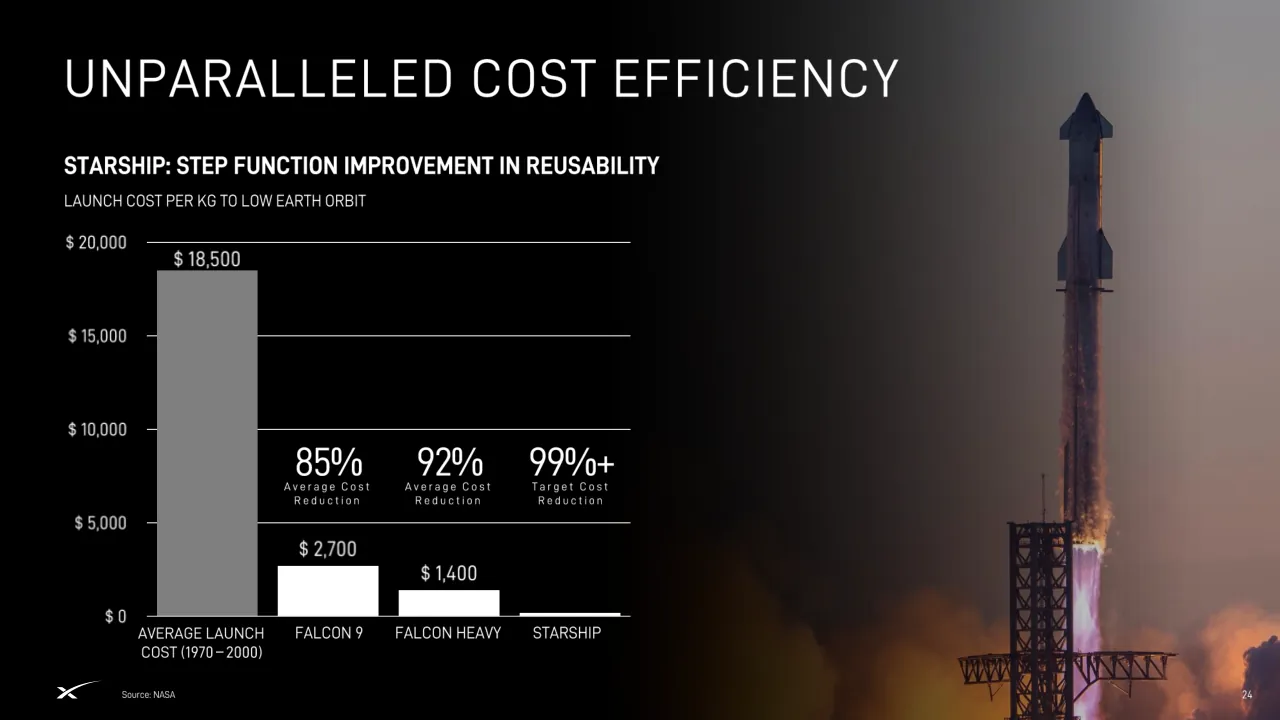
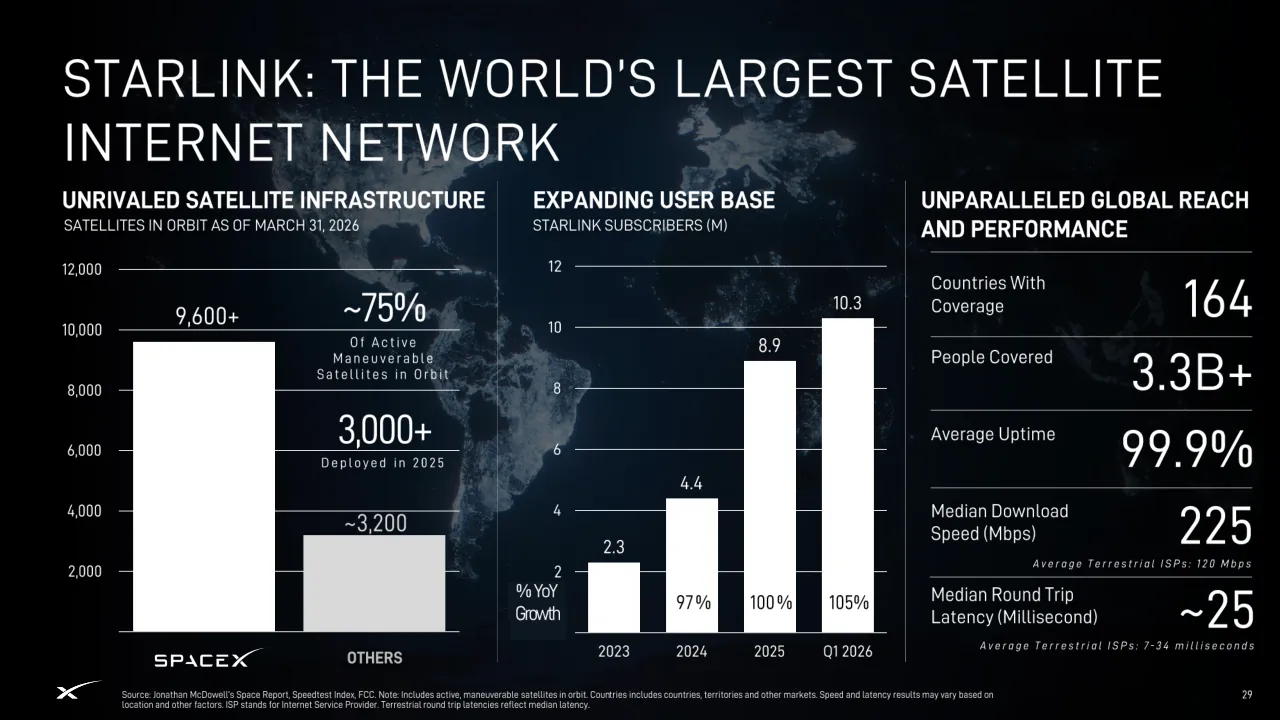
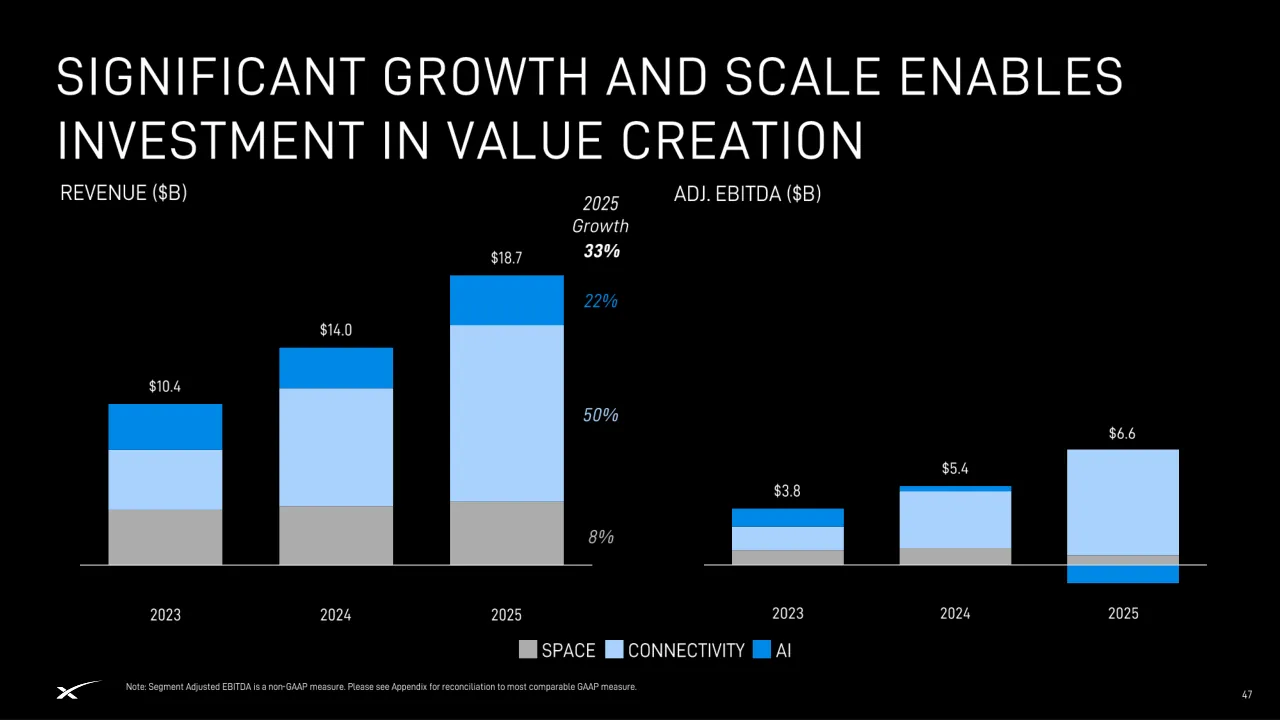
The deck is a roadshow presentation for SpaceX's proposed initial public offering, dated June 2026. It opens with a forward-looking statements disclaimer, then an offering summary covering issuer, size, price, use of proceeds and lock-up terms, followed by the company mission and an integrated platform overview across space, connectivity and AI. The main body runs through the space business (launch vehicles, reusability, cost per kilogram), the connectivity business (Starlink broadband and mobile), and the AI business (compute infrastructure, Grok, X), before covering the growth strategy, lunar ambitions and financial track record with segment revenue and capital expenditure. The closing section shows the revenue growth, margin and net income targets, and an appendix reconciles non-GAAP measures to GAAP. Slides worth studying include the market sizing bar chart on slide 13, the launch cost comparison on slide 24, the Starlink satellite and subscriber charts on slide 29, and the segment financials on slides 47 and 48. Many slides use large numerals and short headline claims, and a number of charts carry the argument directly.
Slides worth studying
Questions about this deck
How many slides does the SpaceX roadshow presentation have?
The SpaceX roadshow presentation for its proposed IPO, dated June 2026, has 60 pages. Slide 2 holds the forward-looking statements disclaimer and slide 3 holds the offering summary.
What does the SpaceX deck say about its market size?
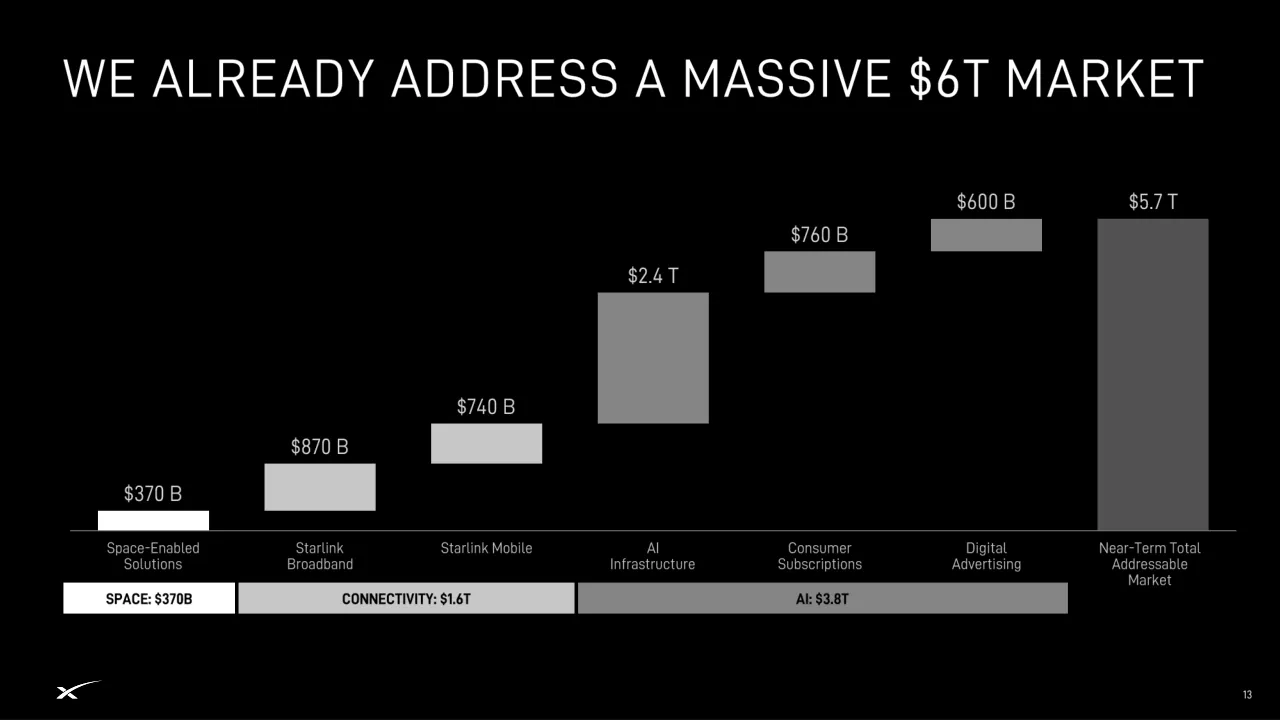
Slide 13 states "WE ALREADY ADDRESS A MASSIVE $6T MARKET" and breaks the opportunity into SPACE: $370B, CONNECTIVITY: $1.6T and AI: $3.8T. Slide 14 then shows how AI unlocks an even larger opportunity.
What is the SpaceX offering price and ticker symbol in the deck?
Slide 3 lists the offering price as $135 per share and the ticker as SPCX on Nasdaq and Nasdaq Texas. The offering size is 555.6M shares (100% Primary), with an expected pricing date of June 11th, 2026.
What payload capacity does the SpaceX deck give for its rocket fleet?
Slide 18, titled "World's Only Fleet of Reusable Rockets," gives payload capacity to LEO of 23 Metric Tons for Falcon 9, 64 Metric Tons for Falcon Heavy and 100 Metric Tons for Starship V3. The slide notes that all payload capacity metrics reflect expected capacity.
Details
- Company: SpaceX
- Year: 2026
- Type: Investor presentation
- Industry: Aerospace and Telecommunications
- Pages: 60
Review score: 8 out of 10, Strong
Presentation quality, judged with the SlideDeck Co review heuristic. Ask, evidence and idea merit are not rated here.
The deck has a clear route: offering terms, mission, platform, then space, connectivity, AI, growth, financials and an appendix, with section-opener photo slides and consistent dark styling, a single typeface and a steady footer. Charts carry the argument directly, with headline claims as titles and big numerals (slides 13, 24, 29, 47 to 54). Weak spots are some text over photos with low contrast (slides 7, 31, 42, 43), a few tiny captions and labels (slides 6, 27, 36, 52 to 54), and a few busy slides (9, 29, 36). The extremely dense disclaimer on slide 2 and the grey-on-black tables are acceptable for a roadshow read, but they are hard to read.
Worth keeping: Keep the headline-claim titles, large numerals, the stepped market bar on slide 13, the cost comparison on slide 24 with its percentage callouts, and the three-panel layout on slide 29.
Most useful repair: Fix legibility where text sits on photos or is very small, including slides 7, 31, 36, 42 and 43, by adding a dark panel or raising size and contrast.
What would change the score: I would thin the smaller gray captions and the run of near-identical reconciliation tables, and add a clear takeaway line to the financial slides 47 to 54.
Confidence high. 60 of 60 pages inspected on contact sheets, 4 at readable size. Reviewed 2026-11-08. Model-assisted review (claude-sonnet-5-5).
Full text of the slides (60 slides)
Every slide's words and a description of its charts and images, so the deck can be searched and rebuilt. Also available as Markdown.
Slide 1
SPACEX
Roadshow Presentation
June 2026
Visuals: Full-bleed photograph of Mars seen from orbit: a dark, nearly black sky fills the upper two-thirds, and a curved reddish-orange planetary limb runs from the lower left to the right edge at about 65 percent of slide height. The limb shows rust-brown and ochre terrain with darker crater-like shading and a thin pale-blue atmospheric glow along its edge. Lighting is a low sun from the left, so the surface is lit warmly and the lower third fades to dark grey-green. The image is not cropped and is not boxed, and no tint or overlay is applied beyond the image itself. Logo: the white SpaceX wordmark with the swoosh tail to its right, flat white with no shadow, sitting over the black sky above the planet limb.
Slide 2
DISCLAIMER / This Information Presentation (the "Presentation") regarding Space Exploration Technologies Corp. (the "Company") is being furnished to you on the terms set out below. / The Company has filed a registration statement on Form S-1 (including a preliminary prospectus) with the Securities and Exchange Commission (the "SEC") for the offering to which this Presentation relates, but it has not yet become effective. These securities may not be sold nor may offers to buy be accepted prior to the time the registration statement becomes effective. Before you invest, you should read the preliminary prospectus in that registration statement, including the "Risk Factors" set forth therein, and any other documents the Company has filed with the SEC for more complete information about the Company and this offering. You may obtain these documents for free by visiting EDGAR on the SEC web site at www.sec.gov. Alternatively, the Company, any underwriter or any dealer participating in the offering will arrange to send you the preliminary prospectus if you request it by contacting: Goldman Sachs & Co. LLC, Attention: Prospectus Department, 200 West Street, New York, NY 10282, by telephone at 866-471-2526 or by email at [email protected]; Morgan Stanley & Co. LLC, Attention: Prospectus Department, 180 Varick Street, Second Floor, New York, NY 10014, by telephone at 866-718-1649 or by email at [email protected]; J.P. Morgan Securities LLC, c/o Broadridge Financial Solutions, 1155 Long Island Avenue, Edgewood, New York 11717 or by email at [email protected] and [email protected]; Citigroup Global Markets, Inc., c/o Broadridge Financial Solutions, 1155 Long Island Avenue, Edgewood, New York 11717 or by telephone at 1-800-831-9146; or BofA Securities, Inc., Attention: Prospectus Department, NC1-022-02-25, 201 North Tryon Street, Charlotte, NC 28255-0001 or by email at [email protected]. / This Presentation and its contents are confidential and proprietary to the Company, and no part of may be reproduced, redistributed, passed on, or the contents otherwise divulged, directly or indirectly, to any other person or published in whole or in part for any purpose without the Company's prior written consent. This Presentation shall not constitute an offer to sell or the solicitation of an offer to buy these securities, nor shall there be any sale of these securities in any state or jurisdiction in which such offer, solicitation or sale would be unlawful prior to registration or qualification under the securities laws of any such state or jurisdiction. / The information in this Presentation is provided in summary form only and does not purport to be complete. This Presentation does not contain all the information that is or may be material to you in considering a potential investment in the Company and should not be considered as a recommendation in respect of the holding, purchasing or selling of any securities of the Company. This Presentation should not be construed as, nor be relied on in connection with, any offer or invitation to purchase or subscribe for, underwrite or otherwise acquire, hold or dispose of any securities of the Company, and shall not be regarded as a recommendation in relation to any such transaction whatsoever. / This Presentation contains forward-looking statements. Such forward-looking statements include, but are not limited to, statements about: the Company's initial public offering and the use of proceeds therefrom, the development and deployment of Starship in accordance with our anticipated schedule (including commencement of payload delivery to orbit in 2026) and launch cadence and our ability to achieve expected performance, reusability, and cost efficiencies; the size and growth of our various existing and future markets, including the markets for commercial launch services, satellite connectivity services, our AI platforms, AI compute infrastructure (terrestrial and orbital), lunar-related activities and interplanetary activities, including the extent to which such markets develop, particularly emerging or unproven markets that may not materialize as expected or on anticipated timelines; demand for our products and services, including our launch, connectivity, and AI offerings, and our ability to grow our customer base and generate revenue; the deployment of our next-generation Starlink satellites, satellite-to-mobile connectivity, and orbital AI compute infrastructure (including potential deployment of our orbital AI compute satellites as early as 2028), including our ability to successfully develop, scale, and commercialize such technologies, which are subject to significant technical complexity, capital requirements, new innovations and regulatory approvals; our target launch cadence and expansion of our manufacturing and operational capacity necessary to support our strategies, including our ability to scale production, supply chain, infrastructure, and workforce efficiently; our ability to execute our growth strategy and scale our operations efficiently, including managing costs, timelines, and operational complexity; our ability to solve novel issues and navigate and monetize technologies and environments that have never been accessed or economized before; our ability to design, develop and successfully commercialize new and innovative technologies, products, and services, including our AI platforms and Terafab, and our ability to achieve and maintain a low cost per token, in each case in rapidly evolving and competitive markets; our ability to scale and monetize our AI products, services, and compute infrastructure, including the development, performance, and adoption of our frontier models and related applications, and to realize benefits from related acquisitions and initiatives, such as our arrangement with Cursor; the amount, nature and timing of our capital expenditures and the impact of such capital expenditures on our growth and performance, including our ability to fund such expenditures, manage costs, strategically reduce costs and achieve expected returns on investment; our ability to obtain sufficient power, GPUs, and other critical components and manage our supply chain to support our operations and growth; our ability to obtain and maintain required regulatory approvals, licenses and spectrum authorizations in the United States and internationally, and the timing, scope, and conditions of such approvals; the competitive landscape in the industries in which we operate and our ability to compete effectively; the implementation, interpretation, and impact of current or future regulations including laws and regulations relating to space operations, communications, AI, data privacy, and other areas; our ability to realize benefits and manage risks of being a public company; and general economic conditions. These forward-looking statements may be accompanied by words such as "anticipate," "believe," "estimate," "expect," "intend," "may," "outlook," "plan," "potential," "predict," "project," "will," "should," "could," "would," "likely," "future," "budget," "goal," "commit," "pursue," "target," "seek," "objective" or the negative of these words, or similar expressions that are predictions of or indicate future events or trends that do not relate to historical matters. We caution you that the foregoing list may not contain all of the forward-looking statements made in this Presentation. Such forward-looking statements involve known and unknown risks, uncertainties and other important factors which may affect the Company's ability to implement and achieve the targets, estimates, plans and benchmarks set out in such forward-looking statements and which may cause actual results, performance or achievements to be materially different from future results, performance or achievements expressed or implied by such forward-looking statements. Such forward-looking statements are based on numerous assumptions regarding the Company's present and future operations and plans and the environment in which the Company will operate in the future. Furthermore, certain forward-looking statements are based on assumptions or future events which may not prove to be accurate, and no reliance whatsoever should be placed on any forward-looking statements in this / Presentation or such other date as specified herein. The forward-looking statements in this Presentation speak only as of the date of this Presentation, and the Company expressly disclaims to the fullest extent permitted by law any obligation or undertaking to disseminate any updates or revisions to any forward-looking statements contained herein to reflect any change in expectations with regard thereto or any change in events, conditions or circumstances on which any such statements are based unless required by law. / No representation or warranty, express or implied, is made as to the fairness, accuracy or completeness of the Presentation and the information contained herein and no reliance should be placed on it. Any financial data in this Presentation are solely for your information, as background to the Company and may not be relied upon for the purpose of entering into any transaction whatsoever. The financial information set out in this presentation is based on certain important assumptions and adjustments and does not purport to represent what the Company's results of operations are on an audited basis or actually will be in any future periods. Furthermore, no representation is made as to the reasonableness of the assumptions made in this Presentation or the accuracy or completeness of any modelling, scenario analysis or back-testing. The information in this Presentation is not intended to predict actual results and no assurances are given with respect thereto. None of the Company, its advisers, connected persons or any other person accepts any liability whatsoever for any loss howsoever arising, directly or indirectly, from this Presentation or its contents. This Presentation includes certain financial information that is preliminary, unaudited and subject to revision upon completion of the Company's closing and audit processes. / This Presentation may contain certain financial measures, such as Adjusted EBITDA and Segment Adjusted EBITDA, that include adjustments to GAAP figures. The Company believes these non-GAAP financial measures, when considered together with the GAAP figures, can enhance an overall understanding of its financial performance. The non-GAAP financial measures are included with the intent of providing the reader a more complete understanding of the Company's operational results and trends. These non-GAAP financial measures should be considered in addition to, and not as a substitute for, or superior to, financial measures calculated in accordance with GAAP. See Appendix for reconciliation for each non-GAAP measure used in this presentation to most directly comparable GAAP measure. / 2
Visuals: No charts, photographs, diagrams or tables. The only non-text visual is the small white flame-style logo at bottom left.
Slide 3
OFFERING SUMMARY
ISSUER
Space Exploration Technologies Corp.
OFFERING SIZE
555.6M shares (100% Primary)
OVER-ALLOTMENT
15% (100% Primary)
OFFERING PRICE
$135 per share
EXCHANGE / TICKER
Nasdaq; Nasdaq Texas / SPCX
EXPECTED PRICING DATE
June 11th, 2026
USE OF PROCEEDS
To fund the Company's growth strategy, including the expansion of AI compute infrastructure, enhancements to launch infrastructure and launch vehicles,
increases in the scale and capacity of satellite constellations, and any remaining amounts for general corporate purposes
LOCK-UP PERIOD
(i) 366-day lock-up for Elon Musk; (ii) Staggered lock-up release for a portion of shares held by select investors, officers, and directors starting after Q4 26 earnings
through Q2 27 earnings; (iii) Staggered early lock-up release for all other shares starting after Q2 26 earnings through 180 days after the IPO date
BOOKRUNNERS
Goldman Sachs & Co. LLC, Morgan Stanley, BofA Securities, Citigroup, J.P. Morgan
Barclays, Deutsche Bank Securities, RBC Capital Markets, UBS Investment Bank, Wells Fargo Securities
CO-MANAGERS
Allen & Company LLC, Cantor, Needham & Company, Raymond James, Societe Generale, Stifel, William Blair
BTG Pactual, ING, Macquarie Capital, Mirae Asset Securities, Mizuho, Santander
3
Visuals: One small white logo at bottom-left: a stylised swept-back arrow or X-like mark (the company wordmark symbol), white on black. Ten thin grey horizontal rules separate the table rows, each about 1 px in grey #4A4A4A spanning the full table width. No photographs, charts, or diagrams.
Slide 4
OUR MISSION
To build the systems and technologies necessary to make life multiplanetary, to understand the true nature of the universe, and to extend the light of consciousness to the stars
While we remain dedicated to our fundamental mission, our progress in accessing space continues to yield opportunities that enrich life on Earth. For example, by dramatically reducing the cost of access to space, we have been able to expand our mission to address some of the Earth's most pressing challenges, including bridging the digital divide by aiming to connect over three billion unconnected people to the internet and humanity's collective knowledge
The rapid emergence of the AI era intensifies the urgency of our mission, as AI has the potential to accelerate not only space exploration, but also transformative societal advancements on Earth. AI's ability to revolutionize human potential is directly dependent on meeting exponentially increasing resource demands
C:\Users\brigee\Downloads\2026.06 Project Apex Roadshow Discussion Materials Long Form (2026.06.05).pptx (hidden, black on black)
4
Visuals: Photograph-style rendered image of two celestial bodies on black space. Left: a crescent Moon, lit from the right, roughly 41% to 57% of slide width and 36% to 80% of slide height, with a dark blue-black unlit side showing faint scattered bright specks, and a thin bright highlight line along its upper terminator. Right: Mars, orange-red and lit from the right, roughly 62% to 98% of slide width and 12% to 89% of slide height, with visible craters, a canyon system across its lower right, and a dark night side on its left with scattered warm glowing city-light specks and a bright cluster near its centre-left. Composition: the two bodies sit side by side with the Moon overlapping the lower left of the Mars disc region. The image is not cropped in a box; its black background blends into the slide, so it appears full-bleed in tone. Lighting: a single distant light source from the right. Dominant colours: black #000000, rust orange #B8552A, warm highlight #E0874A, Moon grey-white #D8D8D8, deep navy shadow #1B2233. No overlay or tint. Also a white logo mark at bottom-left, a thin white swoosh-style X symbol, and the page number.
Slide 5
OUR INTEGRATED
PLATFORM
We are the only company building the integrated hardware and software infrastructure of the future across space, connectivity, and AI. At our core, we are builders
C:\Users\brigee\Downloads\2026.06 Project Apex Roadshow Discussion Materials Long Form (2026.06.05).pptx
Visuals: One full-bleed photograph of a vertical stainless-steel rocket vehicle (Starship-style upper stage with nose cone, two small fins at the top and two larger fins at the base, and a small rectangular flap on the right side) flying above the curved limb of Earth. The vehicle is centred at about x 49 percent, y 36 to 65 percent, viewed side-on, nose pointing up, and is small relative to the frame. The upper part of the frame is near-black space. A thin bright blue atmospheric band runs diagonally from the right edge at about y 36 percent down to the left at about y 45 percent. Below it, the Earth's surface shows blue-grey cloud layers over dark blue ocean, with the lower right lighter and the lower left darker. Lighting comes from the right, so the vehicle's right side and the horizon are brightest. Dominant colours are black #000000, deep navy #0B1F3A, steel grey #7A8594, and atmospheric blue #5B8FD0. The photo is uncropped and full-bleed, with a dark gradient overlay that darkens the left side to black so the white text is legible. Two 623 by 540 pixel gradient images cover the left 64.9 percent of the slide, and four 2 by 2 pixel images are placed in the left text area; these are effectively invisible tints. A small white logo (a stylised X with a swoosh) sits at the bottom left.
Slide 6
N OF 1
BUILDING THE INFRASTRUCTURE OF THE FUTURE
SPACE
CONNECTIVITY
AI
Activated in 2002
Activated in 2020
Activated in 2023
Unparalleled launch capabilities
with high cadence, reusability, and capability
The world's largest and most advanced high-
speed, low-latency satellite internet network
Gigawatt-scale compute infrastructure, frontier
truth-seeking AI model, and real-time
information platform
TOTAL LAUNCHES
~650
STARLINK SATELLITES
9,600+
MAJOR MODEL
RELEASES
4
MISSIONS FLOWN IN
2025 WITH ONE OR MORE
REUSED BOOSTERS
95%+
% OF ALL ACTIVE
MANEUVERABLE
SATELLITES
~75%
DAILY POSTS
ON X
~350M
% OF GLOBAL
MASS TO ORBIT
SINCE 2023
80%+
COUNTRIES
164
MONTHLY ACTIVE
USERS ACROSS
GROK AND X
~550M
CREWMEMBERS
SAFELY FLOWN
SINCE 2020
78
STARLINK
SUBSCRIBERS
~10.3M
NAMEPLATE
COMPUTE DRAW
~1.0GW
Note: All statistics are as of or for the twelve months ended March 31,2026 unless otherwise indicated. Countries are inclusive of countries, territories, and other markets.
6
Visuals: A full-bleed black-and-white photograph of the lunar surface fills the bottom 38.5% of the slide, with a curved limb horizon near its top edge and a crater-pocked grey surface below. A black gradient overlay fades the top of the photo into the solid black background. The photo is cropped by the slide edges, not boxed. Lighting is low, raking light from the left, with grey tones. Also present: one small white X-style logo at bottom left, thin grey hairline rules (15 in total: 3 under column headers, 3 under descriptions, and 9 between stat rows), and no charts, tables or other graphics.
Slide 7
WE MAKE THE EXTRAORDINARY POSSIBLE
SPACE
The FIRST private company to develop and launch a liquid fuel rocket to reach orbit (2008)
The FIRST private company to successfully dock a spacecraft with the International Space Station (2012)
The FIRST to successfully propulsively land (2015) and refly orbital-class rocket boosters (2017)
The FIRST private company to transport astronauts to orbit and fly to and from the International Space Station (2020)
CONNECTIVITY
The FIRST to begin deploying a large-scale LEO broadband satellite constellation (2019)
The FIRST to manufacture consumer-grade phased-array user terminals at scale (2022)
The FIRST to deploy a large-scale LEO satellite-to-mobile constellation (2025)
The ONLY low-latency network available globally
AI
The FIRST to build a gigawatt-scale AI training cluster and largest coherent supercomputer (2026)
The FIRST gigawatt-scale Megapack battery installation (2026)
The ONLY company capable of building orbital AI compute at scale
7
Visuals: Full-bleed photograph of a tall grey-white rocket stage in flight at upper left, its engines firing orange flame and a thin white exhaust trail trailing below it, beside a dark steel launch tower with horizontal access arms (chopsticks) extending left from its upper section and a second arm lower left, against a large billowing orange-brown exhaust cloud on the left and a grey-blue sky on the right. Lighting is daylight with the scene slightly hazy; dominant colours are slate grey #5E6B76, rust orange #B9764A, pale sky blue-grey #8C9BA8 and near-black tower steel #222427. The image is cropped to the full slide with no border, and a black overlay at 30% opacity tints the whole picture to darken it. Two thin light-grey horizontal rules (#C8C8C8, about 0.2% of slide height, 1 px stroke) sit under the SPACE and CONNECTIVITY headings and a third sits under AI, each spanning the text column width.
Slide 8
WHY WE WIN
Global leadership in orbital launch services
Unrivaled satellite and connectivity platform across design, manufacturing,
deployment, and operations
Truth-seeking AI model enhanced by real-time data
Extreme vertical integration enabling high velocity and superior cost efficiency at scale
Unique ability to scale new trillion-dollar markets across space, connectivity, and AI
Business models that are incredibly difficult to replicate
Mission-driven culture and world-class talent
8
Visuals: Full-bleed photograph occupying the whole slide, behind all text. Subject: a close-up of a metallic rocket-like structure on the right third, showing a dark grey protruding fin or grid-fin with a rounded pale collar and a textured, weathered silver-brown surface at the right edge. A bright white-orange glowing streak curves diagonally from top-centre down to the lower-right, suggesting exhaust or light bloom. Left two-thirds is a soft out-of-focus gradient of deep navy, indigo and teal fading to dark near the top-left corner. Lighting: warm orange-peach rim light on the central curve, cool blue ambient light elsewhere. Dominant colours: navy #0B1F3A, indigo #3B3B8C, peach #E8A277, slate grey #7A7F8C. Full-bleed, not cropped inside a box; a darkening tint is present over the left side to support the white text. No other visuals.
Slide 9
EXTREME VERTICAL INTEGRATION
SPACE
CONNECTIVITY
AI
INFRASTRUCTURE
Launch Pads, Landing Pads, Factories, / Test Infrastructure, Droneships
Satellite Constellation, Inter-Satellite / Laser Mesh Network, Ground Stations, / Spectrum Licenses, User Terminal & / Satellite Production
Turbine Power Plants, Substations, / Liquid-Cooling Systems, Battery / Installations
Terafab
HARDWARE
Rockets, Engines, Reusable Boosters, / Second Stages, Spacecraft / Manufacturing
User Terminals, Routers, Optical / Space Lasers, Gateway Antennas
Compute Processors, RDMA / Network, Storage, Fiber
Chips
SOFTWARE
End-to-End (Manufacturing, Pad, / Telemetry, Launch Vehicle), / Test and Flight Simulation
End-to-End (User Terminal, Satellite, / Ground Systems), Dynamic Beam / / Capacity Allocation, Customer-Facing / App Ecosystem
X Data, Proprietary Model Tooling, / Starfleet, Compute Fleet Management
OPERATIONS
Mission Control, / Refurbishment Operations, / Launch / Landing Operations
Constellation Management, / Autonomous Safety Maneuvers, / Customer Operations and Support
Compute Deployment, / Training, Inference
END CUSTOMER / RELATIONSHIP
Government, Commercial, / Private
Consumer, Enterprise, / Government, Mobile Network Operators
Consumer, Enterprise, / Government
HIGH VELOCITY AND SUPERIOR COST EFFICIENCY AT SCALE
9
Visuals: One photograph: a tall cylindrical stainless steel rocket stage (vertical, centred slightly left, roughly x 15 to 45) standing inside a dark industrial hangar with scaffolding, catwalks, gantry frames and angled lattice struts on both sides. Viewed from low, straight-on, full height, cropped top and bottom by the slide edge. Lighting is soft, diffuse and cool, with bright metal highlights on the stage and darker shadowed hangar structure. Dominant colours are grey, steel silver and near-black. The image is full-height and sits on the left 59 percent of the slide, with a black gradient veil over the right portion so it fades into #0D0D0D. Several black translucent bands (opacity 0.10) lie across each row. A vertical white timeline line runs from y 21 to y 88 at x 21.5, with five white filled circles (about 1.9 by 3.4 percent each) centred on it at the row heights, and a white stylised X-shaped logo mark bottom-left. No charts, tables or other graphics.
Slide 10
THE / ALGORITHM / 01 / MAKE THE REQUIREMENTS / LESS DUMB / 02 / DELETE THE PART OR / PROCESS STEP / 03 / OPTIMIZE / 04 / ACCELERATE / 05 / AUTOMATE / 10
Visuals: One photograph of three rocket engine assemblies (Raptor-type) standing upright on white pallets on grey concrete, lined up left to right in front of a corrugated light grey metal wall. The left engine is unlabelled and has a weathered bronze-green nozzle skirt. The middle engine has a pale sage-green nozzle skirt with the number 569 painted in white on it, and a red-capped sensor on top. The right engine has a dark charcoal nozzle with the number 1 painted in white. Lighting is flat, diffuse daylight. Dominant colours are silver-grey, charcoal, weathered green and white. Composition is a horizontal eye-level frame with all three engines fully visible; the photo is not cropped and is boxed to the right edge with no overlay or tint. One small logo: a white stylised X-with-swoosh mark at bottom left.
Slide 11
MISSION-DRIVEN CULTURE / AND WORLD-CLASS TALENT
Average Tenure of / Top 3 Executives
21
YEARS
Average Tenure of / Senior Management
12
YEARS
ELON MUSK
GWYNNE SHOTWELL
BRET JOHNSEN
Percent of Engineer / Applicants Accepted / in 2025
<2%
Note: Unless otherwise indicated, all information as of March 31, 2026. Senior Management is defined as Vice Presidents and up.
11
Visuals: Three portrait photographs, all converted to grayscale and framed in thin boxes. (1) Left: Elon Musk, head and shoulders, tousled dark hair, dark suit jacket over open-collar white shirt, slight closed-mouth smile, looking to camera, plain mid-gray studio backdrop, lit softly from the front. (2) Middle: Gwynne Shotwell, head and shoulders with arms crossed, shoulder-length blond hair, dark blazer, white top, pearl necklace, broad smile, mid-gray backdrop. (3) Right: Bret Johnsen, head and shoulders, short dark hair, gray blazer over open-collar white shirt, smiling, blurred interior background with warm lights and shelving. All photos are full portraits, not cropped beyond the shoulders, with a thin light-gray border around each box and no overlay or tint. Three horizontal thin gray rules divide the stat column; no charts, icons or logos besides the small X-style logo in the footer.
Slide 12
OUR REPEATABLE\nBUSINESS MODEL\nSEVEN\nLeverage our unparalleled launch capabilities to enable massive scale\nSIX\nIdentify and create new trillion-dollar market opportunities\nFIVE\nDesign a solution with world-class engineering and first-principles thinking\nFOUR\nApply “The Algorithm” (make less dumb, delete, optimize, accelerate, automate)\nTHREE\nVertically integrate all the way to the end customer\nTWO\nContinuously drive cost down and throughput up\nONE\nGenerate significant cash flow and reinvest in the future\nLIFTOFF\n12
Visuals: One photograph filling the right side (x 46.5% to 100%, full height, full-bleed to the top, bottom and right edges, with a black-to-transparent gradient fading its left edge into the black background). Subject: a tall vertical Falcon 9 first-stage booster standing upright on its four deployed landing legs on a dark ground, with the word SPACE painted vertically down its body in dark letters, a small Falcon 9 wordmark and a small American flag decal near the top, and scorched, soot-streaked panels along the lower body. What is happening: the booster is standing still, presumably after a landing. Composition: vertical subject centred at about x 75% of the slide, nearly filling the frame height, with the top of the booster near y 11% and the legs near y 95%. Lighting: a cool blue glow from a low horizon on the right side and warm light on the booster's lower metal sections; a starfield and faint clouds fill the dark blue sky. Dominant colours: near-black #05080F sky at the top, deep blue #1B4F78 to pale cyan #8FC4E0 at the horizon, booster off-white #D9CFC2 and dark grey #2A2A2A. The photo is not cropped at its sides, not boxed, and has no overlay other than the left-edge fade into black. Foreground: silhouetted dead shrubs and a dark flat horizon band across the bottom-left of the photo. Horizontal hairline rules (grey #8A8A8A, about 0.1% of slide height thick) separate the seven rows, spanning from x 4.4% to about x 58.8%. The logo is a white stylised X-like mark with a swoosh, at bottom-left.
Slide 13
WE ALREADY ADDRESS A MASSIVE $6T MARKET
$600 B
$5.7 T
$760 B
$2.4 T
$740 B
$870 B
$370 B
Space-Enabled Solutions
Starlink Broadband
Starlink Mobile
AI Infrastructure
Consumer Subscriptions
Digital Advertising
Near-Term Total Addressable Market
SPACE: $370B
CONNECTIVITY: $1.6T
AI: $3.8T
13
Visuals: Waterfall (bridge) chart with no axis titles, no gridlines and no numeric axes; values are printed above each bar. Chart title: none printed beyond the slide title. Bars from left to right, each with its value printed above: Space-Enabled Solutions $370 B (white #FFFFFF bar, about 7.7% from left, 8.7% wide, from the baseline up to about 70.9% of height); Starlink Broadband $870 B (light grey #C8C8C8 floating bar, 20.7% from left, 8.7% wide, top at 64.4%, height 6.5%); Starlink Mobile $740 B (light grey #C8C8C8 floating bar, 33.7% from left, top at 58.8%, height 5.6%); AI Infrastructure $2.4 T (mid grey #868686 floating bar, 46.7% from left, top at 40.6%, height 18.2%); Consumer Subscriptions $760 B (mid grey #868686 floating bar, 59.7% from left, top at 34.9%, height 5.7%); Digital Advertising $600 B (mid grey #868686 floating bar, 72.7% from left, top at 30.4%, height 4.5%); Near-Term Total Addressable Market $5.7 T (dark grey #525252 full bar, 85.7% from left, 8.7% wide, top at 30.4%, height 43.3%, extending down to the baseline). Each bar is a flat rectangle with square corners and no outline. Bars are stepped so each floating bar starts where the previous one ends. Below the chart, three segment bars with bold uppercase black labels: SPACE: $370B in a white #FFFFFF box (5.0% from left, 13.4% wide), CONNECTIVITY: $1.6T in a light grey #C8C8C8 box (18.6% from left, 26.2% wide), AI: $3.8T in a mid grey #868686 box (45.2% from left, 38.3% wide), all 4.3% tall at 80.9% from top with thin black gaps between them. The Space segment matches the white bar, the Connectivity segment spans the Starlink Broadband and Starlink Mobile bars, and the AI segment spans the AI Infrastructure, Consumer Subscriptions and Digital Advertising bars. Baseline: thin horizontal line in grey #868686, about 1 px wide, from about 5.5% to 96.5% at 73.6% from top. Logo: white stylised X/rocket-swoosh mark (SpaceX-style logo) at bottom left.
Slide 14
AI UNLOCKS AN EVEN LARGER OPPORTUNITY / $370B / $870B / $740B / $2.4T / $760B / $600B / $22.7T / $28.5T / Space-Enabled / Solutions / Starlink / Broadband / Starlink / Mobile / AI / Infrastructure / Consumer / Subscriptions / Digital / Advertising / Enterprise / Applications / Total / Addressable / Market / SPACE: $370B / CONNECTIVITY: $1.6T / AI: $26.5T / 14
Visuals: Vertical bar chart (waterfall-style, floating bars) with no axes, gridlines or legend titles. Seven bars step up from left to right, each bar labelled above with its value: Space-Enabled Solutions $370B (very short bar), Starlink Broadband $870B, Starlink Mobile $740B, AI Infrastructure $2.4T, Consumer Subscriptions $760B, Digital Advertising $600B (all five short, thin grey bars about 0.5% to 3% of slide height tall), Enterprise Applications $22.7T (tall light grey bar from about 31.6% to 63.7% of slide height), and Total Addressable Market $28.5T (tallest dark grey bar from about 31.6% to 70.8% of slide height, flush with the baseline). Values are printed for every bar, so no estimates are needed. Below the chart are three segment bands: a white box labelled SPACE: $370B spanning the first bar, a light grey box labelled CONNECTIVITY: $1.6T spanning the Starlink Broadband and Starlink Mobile bars, and a mid grey box labelled AI: $26.5T spanning AI Infrastructure through Enterprise Applications. The chart area sits on a translucent black panel (opacity 0.70). Seven 2 by 2 pixel placeholder images are present but are invisible flat fills. The logo is a white stylised rocket-swoosh mark.
Slide 15
2026... A MOMENTOUS YEAR SO FAR
Feb-26
Acquired xAI
Feb-26
Starlink 10M Active Customers
Surpassed 10 million active Starlink customers
Mar-26
Terafab
Announced strategic collaboration with Tesla to create the world's largest chip manufacturing facility. Intel joined the project in April 2026
Apr-26
X Ads Manager Launch
Began a phased roll-out of advertising platform
Apr-26
Release of Grok 4.3
Released fastest, most intelligent Grok model to date
Apr-26
Partnered with Cursor to advance Grok
May-26
Anthropic
Entered into Cloud Services Agreements to provide access to compute
May-26
EchoStar spectrum licenses
Received FCC approval of the EchoStar license transfer
May-26
Starship V3
Completed Starship's 12th test flight (first of Starship V3)
May-26
Announced agreement with American Airlines
Jun-26
Entered into Cloud Services Agreement to provide access to compute (Starting Oct-26)
Source: Free Writing Prospectus filed as of 06/05/2026.
15
Visuals: Vertical grey timeline line running from about 19 percent to 91 percent of slide height at about 10.5 percent of width, with 11 small grey filled circles centred on it, one per row. Eleven horizontal hairline grey rules, one below each row, spanning from about 11.6 percent to 96.9 percent of width. Four logos: the white xAI X-mark logo in row 1 (about 12.6 to 14.3 percent wide, 21.4 to 24.7 percent high); the grey and white Cursor cube logo with CURSOR wordmark in row 6 (about 12.8 to 19.9 percent wide); the American Airlines logo, black wordmark with white swoosh, in row 10 (about 11.9 to 20 percent wide, 79.4 to 84.7 percent high); and the white SpaceX-style X logo at bottom left (about 5 to 8.9 percent wide, 93 to 95.8 percent high). No photographs, charts or tables.
Slide 16
MORE MILESTONES AHEAD
STARSHIP V3
BROADBAND
V3 SATELLITE
MOBILE V2
SATELLITE
TERRESTRIAL
COMPUTE
AI COMPUTE
SATELLITE
H2 2026
H2 2026
2027
400MW+
2028
Commence payload
delivery to orbit
Begin deployment
on Starship
Begin deployment
on Starship
Compute power in next
phase of Colossus II
Begin deployment
on Starship
100
1,024
5G
220K+
100KW
Metric tons per
launch over time
Gigabits per second
per satellite
Speed, voice and
data services
Additional GB300s in
next phase of Colossus II
Compute power
per metric ton
16
Visuals: Four thin vertical divider lines, each light grey about #8C8C8C at roughly 1 px width, spaced at x about 22.6%, 40.9%, 59.1% and 77.3% of slide width, each spanning y about 31.7% to 78.3%. A small white logo mark at bottom left (a stylised swept-back X/arrow glyph). No photographs, charts, or illustrations.
Slide 17
OUR SPACE
BUSINESS
We are the world's leading launch provider, with more than 80% of mass to orbit for the world since 2023
This critical capability is our foundation and enables the rest of our businesses
Visuals: Photograph, full-bleed: a view of Earth from orbit, with the blue-and-white curved limb of the planet filling the upper two-thirds and the right side. Clouds are white over dark blue ocean and land. In the foreground, a red sports car (a Tesla Roadster) runs diagonally from lower-left to lower-right, showing its glossy red bodywork and a black roof panel at about mid-left. A mannequin in a white spacesuit sits in the driver seat, with a grey-and-white helmet and gloved arm resting on the door, seen from behind and to the right. A small red light glows on the car's dashboard near the centre-left. Composition is wide-angle with a fisheye-like curvature. Lighting is from the sunlit Earth above and right; the car is in shadow with red reflected highlights along its lower edge. Dominant colours are black #000000, deep blue #1E3A6E, white #FFFFFF and red #B3201C. The image is not cropped in a boxed frame; it runs to all four edges. A black gradient overlay covers the left third, fading from solid black at the left edge to transparent around the centre, to make the text legible. No chart, table or diagram.
Slide 18
WORLD'S ONLY FLEET OF REUSABLE ROCKETS
FALCON 9
FALCON HEAVY
STARSHIP V3
PAYLOAD CAPACITY TO LEO
23 Metric Tons
64 Metric Tons
100 Metric Tons
TOTAL NUMBER OF FLIGHTS
~620
11
12
SUCCESS RATES
99%
100%
Testing Phase
USE CASES
Starlink V2 Mini Satellite, Cargo and Humans to
Earth's Orbit, and Deep Space Missions
Heavy Cargo to Earth's Orbit
Deep Space Missions
Starlink V3 Satellites, Starlink Mobile V2 Satellites,
AI Compute Satellites, Interplanetary Travel
Note: Information as of March 31, 2026 except for Starship flights which is inclusive of flight 12. Number of flights since inception of each vehicle. Falcon 9 payload to LEO reflects fully expendable configuration. All payload
capacity metrics reflect expected capacity.
18
Visuals: Three vehicle illustrations, all rendered in white and light-grey metallic tones on black with no boxes, frames or overlays. Falcon 9: two vertical rockets side by side, a booster on the left with a white nose cone, a black band on the lower body and small red markings, and a second-stage-like vehicle on the right with a dark grey nose and black band; both show small blue-grey SpaceX lettering on the body and black landing legs at the base. Falcon Heavy: a central vertical core with a white nose cone, flanked by two side boosters with white nose cones and black engine bases, all standing on a common black base area. Starship V3: a tall silver stainless-steel stack with a pointed nose and grey delta flaps near the top, a thin band of flaps mid-body, and a dark engine section at the base. The three images are standing vehicles drawn at the same baseline scale in full profile, with the Starship roughly twice the height of the others. Table: three columns and four rows. Row 1 PAYLOAD CAPACITY TO LEO: 23 Metric Tons, 64 Metric Tons, 100 Metric Tons. Row 2 TOTAL NUMBER OF FLIGHTS: ~620, 11, 12. Row 3 SUCCESS RATES: 99%, 100%, Testing Phase. Row 4 USE CASES: Starlink V2 Mini Satellite, Cargo and Humans to Earth's Orbit, and Deep Space Missions; Heavy Cargo to Earth's Orbit Deep Space Missions; Starlink V3 Satellites, Starlink Mobile V2 Satellites, AI Compute Satellites, Interplanetary Travel. Hairline rules in dark grey separate rows. A small SpaceX logo mark sits at bottom left.
Slide 19
DRAGON
50+
Visits to the International Space / Station Since 2012
78
Crewmembers Safely Flown Since 2020
20
Countries Represented by / Passengers Since 2020
ONLY
Private Company Certified by NASA to / Fly Astronauts to the International / Space Station
Note: Information as of March 31, 2026 unless otherwise noted.
19
Visuals: One full-bleed photograph of the Earth's limb seen through a spacecraft window. Subject: a curved Earth with a blue atmospheric band, pinkish-brown continents, white cloud streaks and black space. In the bottom right, the rounded white-grey top of the Dragon capsule with a transparent glass cupola dome; inside the dome an astronaut in a light shirt holds a phone up toward the camera. Orange trim shows at the lower right edge of the capsule. Lighting is sunlit from the upper left, with a dark shadowed area on the left side. Composition: the Earth arcs from lower left to upper right, the capsule is cropped at the bottom edge of the slide. Dominant colours: blue #2A8FD6, pinkish-brown #B07A6A, white #F2F2F2, black #000000, capsule grey #C8CCD0. The photo is full-bleed, not boxed. A dark curved shadow shape (near-black #000000, partly transparent) overlays the left third of the photo. Four thin grey horizontal rules (#9A9A9A, about 0.2% of slide height thick) divide the stat blocks. A small white X-style swoosh logo sits bottom left.
Slide 20
THE VALUE OF ROCKET REUSABILITY / COST / Reuse of expensive hardware / lowering launch costs / LAUNCH CADENCE / Enables higher flight rate, rapid large-scale / deployments and human transportation / RELIABILITY / Post-flight inspections feed an iterative re- / engineering loop that increases reliability / ENVIRONMENT / Reduces manufacturing waste, emissions and / ocean-polluting debris / ADVANTAGE TO SPACEX / LOWER / Cost per launch compared to / expendable rockets / MOST / Launches of any provider / in the industry / ADVANTAGE TO OUR CUSTOMERS / LOWEST / Cost per kg to orbit / LOWER / Insurance premiums / 20
Visuals: One photograph, full-bleed across the whole slide, of a vertical SpaceX Falcon 9 booster standing on its landing legs at night. Subject: the first-stage booster, white-grey body with a dark scorched lower section and black landing-leg struts splayed to the ground; a US flag decal and small 'FALCON 9' marking are visible near the upper third, and 'SPACEX' is printed vertically in black along the body. Composition: rocket centred, running from the top edge to the bottom edge, roughly x 47% to 53%, with the sky filling both sides. Framing is full-height and the photo is not cropped at the rocket. Lighting: night scene, the booster lit from below by a soft floodlight, with a cyan glow along the horizon. Dominant colours: deep navy #0A1A2F at top, blue #1E6FA0 and cyan #3FA9D6 near the horizon, white-grey #C9CED4 and brown-grey #5A4A40 on the rocket. Overlay: none visible; bare tree silhouettes along the bottom edge and a dark light pole near x 80% at the bottom right. Stars are scattered across the sky.
Slide 21
STARSHIP / First ever heavy-lift rocket built for full and rapid reusability / 12 test flights to date / Demonstrated successful atmospheric entry and precision landing / Proven Starship booster reusability; the remaining technical milestone is the catch and re-flight of the ship / Proven full-duration ascents and hot staging separation / Propellant transfer for missions beyond Earth's orbit / Robust multi-destination landing capability including Mechazilla tower system / Goal is to replicate airline-like operations with propellant (methane / liquid oxygen) to be the only marginal cost for launch / STARSHIP / SUPER HEAVY / Note: All references to tons in this presentation refer to metric tons. / 21
Visuals: Full-height vertical photograph of a Starship upper stage (black nose cone and payload section with a white/steel midsection and dark grid fins) stacked on a Super Heavy booster (white steel tanks with a dark lower section) on a tan-and-grey launch mount, shown as a tall narrow column in the right panel. Composition: the rocket runs the full height of the slide, with the nose tip cropped at the top edge and the base at the bottom edge; the surrounding sky is pale blue-grey fading to light grey toward the top right. Lighting is soft natural daylight with the metal lightly reflective. Dominant colours: black, steel grey, off-white and tan. The photo is full-bleed to the right and top and bottom edges, with a black-to-transparent gradient overlay across its left edge (about 54% to 60% of width). Two white callout labels, STARSHIP and SUPER HEAVY, each have a thin white horizontal leader line ending in a small solid white dot placed toward the rocket. Eight thin grey horizontal rules divide the bullet items in the left column. A small white SpaceX logo sits bottom-left.
Slide 22
UNPARALLELED MARKET LEADERSHIP
MASS TO ORBIT FOR THE WORLD
% SPACEX SHARE
90%
80%+
80%
70%
65%
60%
50%
45%
40%
30%
20%
2021
2022
2023-2025
Source: BryceTech, management
22
C:\Users\brigee\Downloads\2026.06 Project Apex Roadshow Discussion Materials Long Form (2026.06.05).pptx
Visuals: Vertical bar chart. Title: MASS TO ORBIT FOR THE WORLD. Subtitle: % SPACEX SHARE. Y axis: percentage share, labelled 20% to 90% in 10% steps, gridlines every 10%; the axis starts at 20%, not zero. X axis: categories 2021, 2022, 2023-2025 (no unit label). Series: one series, white bars. Labelled values: 2021 = 45%; 2022 = 65%; 2023-2025 = 80%+ (bar top about 82%, estimated, label printed as 80%+). No legend. No highlighted points; all bars same white. Photograph, right side: a Starship launch-tower scene at sunset. A tall stainless booster is held between the open arms of a dark steel lattice launch and catch tower, with engine flame visible below it at the top arm and a second bright exhaust plume below it. Tower is a dark grey-black steel lattice rising from bottom centre-right of the photo to the top. Sky is pale blue at top fading to orange and pink near a horizon at about 66% of height; sea sits at mid-right with a flat horizon; green-brown coastal land runs along the bottom. Lighting is low, warm sunset from the right. Composition is a vertical tower in the right third with the booster in the upper third. Photo is full-bleed to the right edge and top and bottom, not boxed or cropped to a shape. Left edge of the photo fades into the black field via a gradient from black at about 42% of width to transparent at about 52%. Logo: a small white SpaceX-style swoosh mark at bottom left.
Slide 23
C:\Users\brigee\Downloads\2026.06 Project Apex Roadshow Discussion Materials Long Form (2026.06.05).pptx
FOUNDATIONAL LAUNCH ADVANTAGE
BOOSTER REUSABILITY ENABLES INCREASING LAUNCH RATES
ANNUAL NUMBER OF FALCON FAMILY LAUNCHES BY SPACEX
180
160
140
120
100
80
60
40
20
0
2010
//
2017
2018
2019
2020
2021
2022
2023
2024
2025
165
8
MISSIONS
NEW BOOSTERS FLOWN
UNMATCHED LAUNCH CADENCE
RELIABLE AND REUSABLE
DRAMATICALLY REDUCED COST-TO-ORBIT
23
Visuals: Chart: combined bar and line chart titled BOOSTER REUSABILITY ENABLES INCREASING LAUNCH RATES, with subtitle ANNUAL NUMBER OF FALCON FAMILY LAUNCHES BY SPACEX. Y axis: annual number of launches, unit count, range 0 to 180 in steps of 20, with horizontal light-grey gridlines at each step. X axis: years 2010, a break marked by two diagonal slashes, then 2017 to 2025 in single years; the 2010 bar is shown separately from the 2017 to 2025 run. Series 1, MISSIONS, drawn as a smooth white line with no markers: about 18 in 2017, about 21 in 2018, about 13 in 2019, about 27 in 2020, about 28 in 2021, about 30 in 2022 to 2023 region rising steeply, labelled 165 at the 2025 end point; values other than 165 are estimates. Series 2, NEW BOOSTERS FLOWN, drawn as solid grey #7F7F7F vertical bars: 2010 about 2, 2017 about 13, 2018 about 10, 2019 about 7, 2020 about 5, 2021 about 2, 2022 about 7, 2023 about 9, 2024 about 9, 2025 labelled 8. Data labels: 165 in bold white above the line end point at 2025; 8 in bold white above the 2025 bar. Legend: centred below the chart at about y 90%, a short white line swatch labelled MISSIONS followed by a grey square swatch labelled NEW BOOSTERS FLOWN. No highlighted points beyond the two labelled values. Photograph: a SpaceX Falcon family rocket launching vertically from the right of centre, with its white-hot exhaust plume trailing down beneath it; the booster body is dark grey and the vehicle is seen in silhouette against a very large pale-white sun low in the sky. Lighting is backlit from the sun, giving an orange and white glow; the sky is a warm orange gradient. Foreground shows dark silhouetted trees, a lattice launch tower on the far right, and two thin utility poles on the left. Framing: full-bleed, tall vertical composition, rocket centred at about x 79 of the slide; not boxed, not cropped at the edges apart from the bleed. Dominant colours: orange #E8731A, white #FFF6E0, black #000000 in the foreground. Overlay: the left edge of the photograph fades into solid black, creating a dark gradient that merges with the black slide background behind the chart. Logo: the white SpaceX logo mark (stylised swoosh) at bottom left, the only logo.
Slide 24
UNPARALLELED COST EFFICIENCY / STARSHIP: STEP FUNCTION IMPROVEMENT IN REUSABILITY / LAUNCH COST PER KG TO LOW EARTH ORBIT / $ 20,000 / $ 18,500 / $ 15,000 / $ 10,000 / 85% / Average Cost / Reduction / 92% / Average Cost / Reduction / 99%+ / Target Cost / Reduction / $ 5,000 / $ 2,700 / $ 1,400 / $ 0 / AVERAGE LAUNCH / COST (1970 – 2000) / FALCON 9 / FALCON HEAVY / STARSHIP / Source: NASA / 24
Visuals: Bar chart titled LAUNCH COST PER KG TO LOW EARTH ORBIT (subtitle above the chart). Vertical bar chart, single series of launch cost in US dollars per kilogram to low Earth orbit. Y axis: $0 to $20,000, labelled every $5,000 ($ 0, $ 5,000, $ 10,000, $ 15,000, $ 20,000), with thin white horizontal gridlines at each labelled value. X axis categories from left to right: AVERAGE LAUNCH COST (1970 – 2000); FALCON 9; FALCON HEAVY; STARSHIP. Values printed above bars: average launch cost $ 18,500 (grey bar, #7F7F7F); Falcon 9 $ 2,700 (white bar); Falcon Heavy $ 1,400 (white bar); Starship has no printed value, its bar is a thin white sliver of about $200 (estimate). No legend. No highlighted points beyond the grey bar. Above the Falcon 9, Falcon Heavy and Starship columns, three large percentage callouts: 85% Average Cost Reduction (over Falcon 9), 92% Average Cost Reduction (over Falcon Heavy), 99%+ Target Cost Reduction (over Starship). Photograph: a Starship vehicle flying vertically upward from a steel launch tower, with a bright orange-pink exhaust plume beneath it and dark smoke clouds rising at the bottom right. The vehicle is a tall grey-white rocket with a pointed nose and fins, centred around x 84% of the slide. Composition is vertical and full height, cropped at the top and bottom edges and blended into the black background on the left through a gradient. Lighting is dusky, with the sky dark grey to near black at the top and warm orange light from the exhaust. Dominant colours are grey, black, orange and pink. Logo: the white stylised X mark of SpaceX at the bottom left.
Slide 25
UNPARALLELED THROUGHPUT
STARSHIP: THE KEY TO UNLOCKING NEW MARKETS
PAYLOAD CAPACITY (METRIC TONS)
200
200
150
100
100
50
64
23
0
FALCON 9
(EXPENDABLE)
FALCON HEAVY
(EXPENDABLE)
STARSHIP V3
(REUSABLE)
FUTURE STARSHIP
(REUSABLE)
Note: Payload capacity to orbit is a theoretical payload capacity under specific conditions derived from advanced computer simulations. Please refer to the definition of "payload capacity to orbit" in the Glossary for additional details. Starship metrics reflect expected payload capacity. Future Starship payload capacity expected to reach 200 metric tons as soon as Starship V4
25
Visuals: Photograph: a Starship booster during launch, shown from below in a near-vertical framing with the rocket's grid of about 33 engine bells in a dense circular cluster, glowing white-hot, at the upper-middle of the frame, surrounded by billowing tan and brown smoke and a pinkish-violet exhaust plume descending to the bottom edge. Lighting is self-lit by the engine flames against a dark blue-grey night sky at the left; dominant colours are slate blue-grey, warm cream-white, amber-brown and lilac-pink. The photo is full-height and cropped at the top and bottom edges, not boxed, and fades to black on its right side. Bar chart: vertical bar chart titled STARSHIP: THE KEY TO UNLOCKING NEW MARKETS with subtitle PAYLOAD CAPACITY (METRIC TONS). Y-axis runs 0 to 200 metric tons with labelled gridlines at 0, 50, 100, 150 and 200. Series values, labelled above each bar: Falcon 9 (expendable) 23; Falcon Heavy (expendable) 64; Starship V3 (reusable) 100; Future Starship (reusable) 200. Bars are solid white with no outlines, evenly spaced, categories labelled below in white uppercase. No legend; no highlighted points. Logo: a small white stylised X swoosh at bottom-left.
Slide 26
C:\Users\brigee\Downloads\2026.06 Project Apex Roadshow Discussion Materials Long Form (2026.06.05).pptx
OUR CONNECTIVITY
BUSINESS
We leveraged our foundational launch capabilities to develop the
most advanced global satellite internet constellation
We operate a high-speed, low-latency global broadband data and
communications network powered by thousands of satellites in
low-Earth Orbit, delivering connectivity to millions of consumer,
enterprise, and government customers
Visuals: Photograph, full-bleed, uncropped to the slide frame (1428 by 802 px source). Subject: a man in a red hooded jacket with a grey backpack and headlamp, crouched on a rocky outcrop at a mountain summit, holding an open white tablet with a blank lit screen angled toward the viewer, with brown trousers and brown hiking boots. Behind him: layered mountain ridges with snow-dusted peaks, a long blue lake in a valley, and green forested slopes. Sky: dusk gradient from blue-violet at the top through pink to a pale blue band at the horizon. Lighting: soft low-angle dusk light, with the figure lit from the front. Dominant colours: red, pink, violet, blue, green and brown. Framing: subject placed in the lower right third, camera slightly above him. A black gradient overlay fades from opaque at the left edge to transparent at about 47% width, darkening the left side for the text. One small white logo mark at the bottom left.
Slide 27
UNRIVALED SATELLITE CONSTELLATION
V2 SATELLITES
V3 SATELLITES
COMPETITIVE STRENGTHS
Availability
Today
H2 2026
Bandwidth per Satellite
96 Gbps
1,024 Gbps
Deployment per Launch
27 Satellites
On Falcon 9
60 Satellites
On Starship
Bandwidth per Launch
2,600 Gbps
61,000 Gbps
MORE THAN 20X BANDWIDTH PER LAUNCH WITH V3
Unparalleled launch capabilities and rocket reusability led to the development of Starlink, making satellite internet economically viable
Integrated platform spanning architecture, chip design, software, power systems, and final assembly
Ability to scale new businesses leveraging the core satellite technology platform: Starlink Broadband, Starlink Mobile, and AI Compute
Note: Gbps are gigabits per second. V3 satellites are in development.
27
Visuals: Full-bleed photograph of stacked satellite units: on the left and centre a dark, densely packed array of rectangular satellite panels with metallic edges, faint highlights and cable-like lines, diagonally receding toward the top right; on the right the curved limb of Earth with a thin blue atmospheric glow, white and grey cloud banks and brown-grey landmass in the lower right. Lighting is a dim, low-key cool light on the satellites with the Earth lit from the upper right. The image covers the whole slide with no crop frame and a dark black overlay or gradient that darkens the left side and the lower half, so text stays legible. Dominant colours are black, charcoal grey, deep blue and muted brown. Table: columns are a row-label column, V2 SATELLITES and V3 SATELLITES; rows are Availability (V2 Today, V3 H2 2026), Bandwidth per Satellite (V2 96 Gbps, V3 1,024 Gbps), Deployment per Launch (V2 27 Satellites, sub-line On Falcon 9; V3 60 Satellites, sub-line On Starship), Bandwidth per Launch (V2 2,600 Gbps, V3 61,000 Gbps). Thin grey horizontal rules separate the header from the first row and each row from the next, with a final rule under the last row. No chart. Logo: a small white swoosh-style X mark at bottom left.
Slides 28 to 60 continue in the full text file.
Download this deck
The hosted PDF of every library deck is free for readers of the SlideDeck Co newsletter. Join with your email and the viewer and download appear here.
Preparing a results presentation or business update of your own? The SlideDeck Co Standard Deck is a slide library for business reviews, updates and plans.