The deck opens with a KubeCon + CloudNativeCon Europe 2024 title slide and a platform engineering title naming Rajarajan Pudupatti, VP of Platforms-as-a-Service at Fidelity Investments. It then gives company context: Fidelity's heritage as a privately held firm founded in 1946, an overview of its scale in customers, employers and associates, and a timeline of its move from mainframes to public cloud and multi-cloud. Next come the core technology platforms and container platform scale figures, followed by a foundational capabilities diagram layered over business platforms, core platforms and cloud services. The middle section argues why Kubernetes suits AI workloads, then explains retrieval augmented generation with a flow diagram, and introduces Ray and KubeRay as an emerging pattern for distributed machine learning. The later slides cover the KubeRay architecture on AWS, Azure and private cloud, and Kubernetes Dynamic Resource Allocation for GPUs, including its limitations over the device plugin. The deck closes with key takeaways, an outro and a contact slide.
Slides worth studying
Questions about this deck
How many slides does the Fidelity Investments deck have?
The Fidelity Investments deck has 19 slides. Slide 19 is the closing "Thank you!" slide with the presenter Rajarajan Pudupatti and a contact link.
What does the Fidelity Investments deck say about its container platform scale?
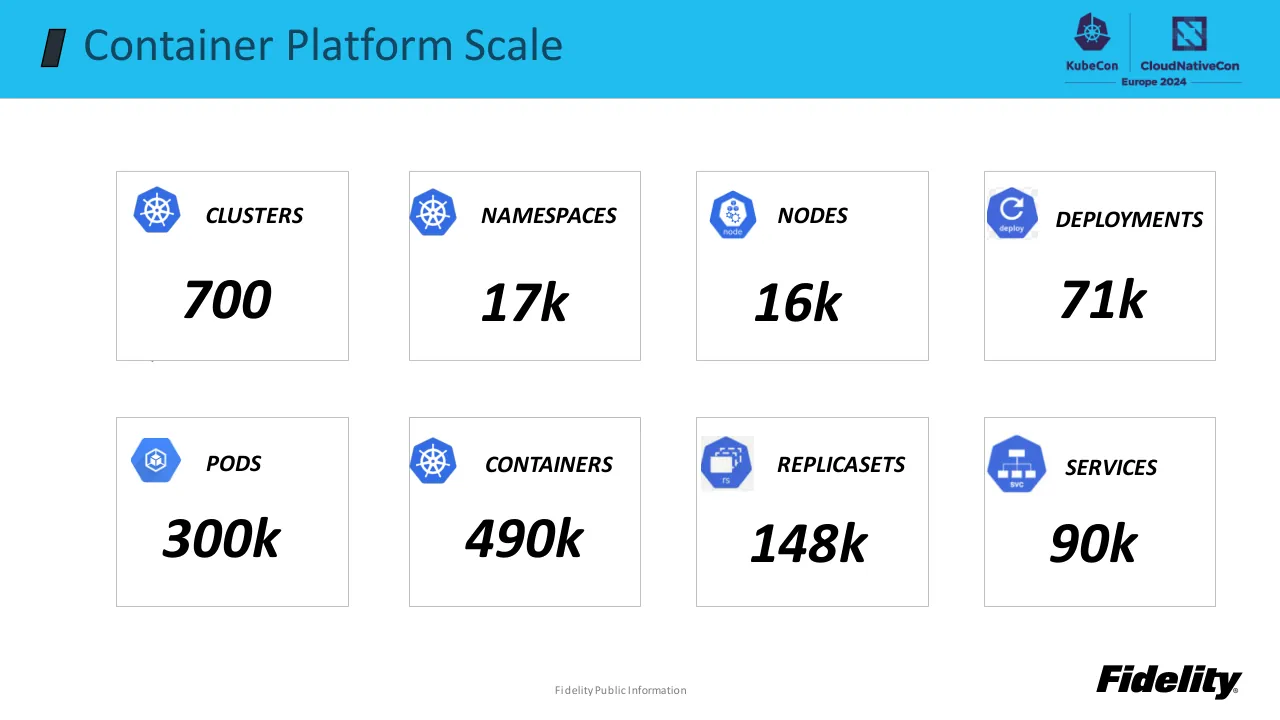
Slide 7, Container Platform Scale, lists 700 clusters, 17k namespaces, 16k nodes, 71k deployments, 300k pods, 490k containers, 148k replicasets and 90k services. These figures are presented as the platform scale stated on that slide.
What does the Fidelity Investments deck say about its move to the cloud?
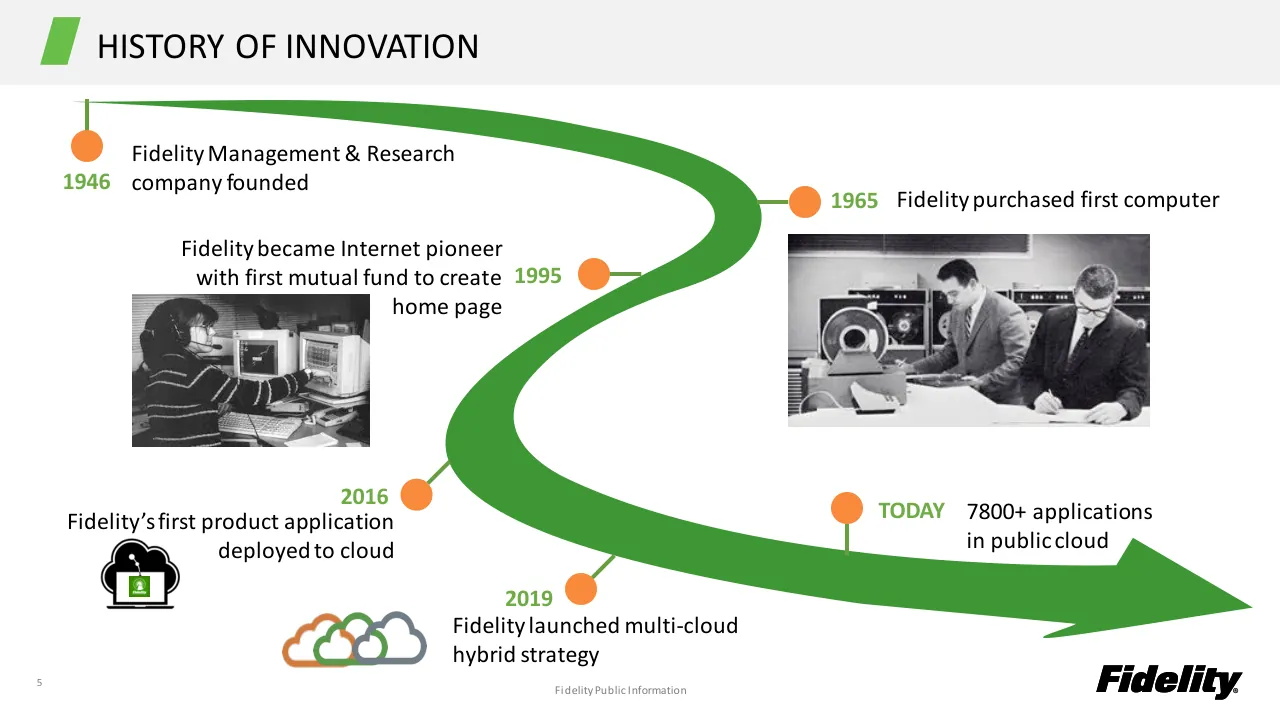
Slide 5, History of Innovation, says Fidelity deployed its first product application to the cloud in 2016 and launched a multi-cloud hybrid strategy in 2019. The same slide lists 7800+ applications in public cloud today, with data as of September 30, 2020.
What limitations of the Kubernetes device plugin for GPUs does the Fidelity Investments deck describe?
Slide 15, K8S Dynamic Resource Allocation (KEP-3063), says the existing Kubernetes device plugin for GPUs does not support more than one GPU type per node, does not support complex constraints when requesting a GPU, and gives no control over how oversubscribed GPUs are shared between jobs. The slide also notes a few more limitations.
Details
- Company: Fidelity Investments
- Year: 2024
- Type: Conference talk
- Industry: Financial services
- Pages: 19
Review score: 5 out of 10, Needs substantial work
Presentation quality, judged with the SlideDeck Co review heuristic. Ask, evidence and idea merit are not rated here.
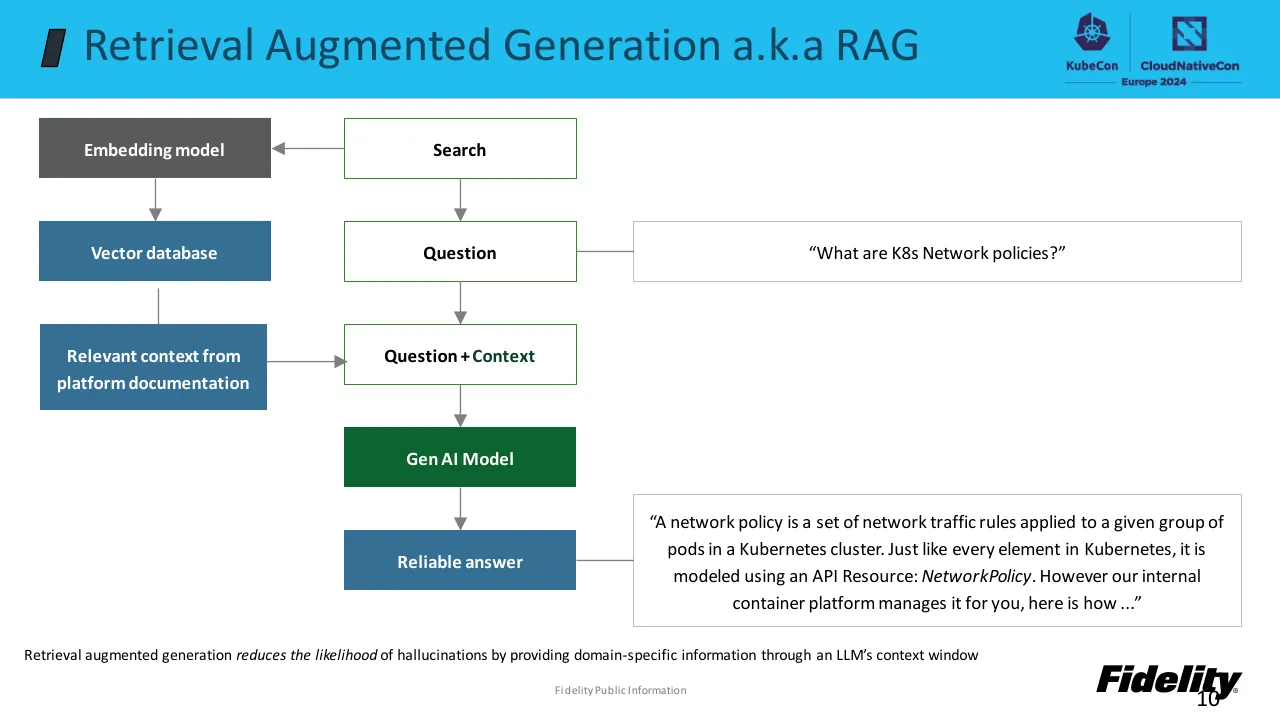
The deck has a recognizable arc from company context to platform scale to AI patterns and GPU allocation, and some slides communicate well, such as the RAG flow on slide 10 and the scale cards on slide 7. But the ending fails: slide 17 (Key Takeaways) is blank and slide 18 is only 'Outro..', so the audience gets no conclusion or action. The technical middle is also weak, with tiny, unreadable diagram text on slides 8, 12 and 13, and slide 9 has no explained point, so a viewer cannot follow the AI argument without the speaker.
Worth keeping: Keep the clear RAG flow with an example question and answer on slide 10, the large scale-number cards on slide 7, and the timeline with period photos on slide 5.
Most useful repair: Fill slide 17 with the actual takeaways, delete or merge slide 18 into the contact slide, and enlarge or simplify the diagrams on slides 8, 12 and 13 to a few labeled components that are legible in a room.
What would change the score: I would cut the heritage and company overview slides to one, give each AI slide a statement title that makes its claim, and remove the page number overlapping the logo on slide 10.
Confidence high. 19 of 19 pages inspected on contact sheets, 4 at readable size. Reviewed 2026-11-08. Model-assisted review (claude-sonnet-5-5).
Full text of the slides (19 slides)
Every slide's words and a description of its charts and images, so the deck can be searched and rebuilt. Also available as Markdown.
Slide 1
KubeCon / CloudNativeCon / Europe 2024 / Fidelity Public Information
Visuals: Illustration of a flat paper-cut style Paris skyline in the lower right, about x 40-100% and y 46-94%. Left to right: a green Panthéon-style domed building, a red La Défense-style arch block, a peach Arc de Triomphe-style gate, a blue Sacré-Cœur-style basilica, a red Eiffel Tower, a peach Louvre pyramid building, and a red Notre-Dame-style cathedral at far right. A dark purple silhouette skyline sits behind the landmarks. Three white-blue paper-cut clouds with soft grey shadows float in the sky: a large cloud at top right (about x 71.8-91.0%, y 6.4-26.7%), a medium cloud at right (about x 86.7-96.5%, y 47.6-58.0%), and a small cloud at left of the skyline (about x 40.8-50.5%, y 57.8-68.3%). A light blue sky disc with a large curved edge fills the centre-right. A large light blue arc band curves in the lower left. A pale grey ground strip sits along the bottom of the skyline. The lighting is flat with soft drop shadows. No photograph is present. The KubeCon logo is a white ship's wheel inside a hexagonal shape, about x 8.7-17.7%, y 12.9-29.8%. The CloudNativeCon logo is a white square outline with grey diagonal stripes, about x 33.1-41.7%, y 14.7-29.9%.
Slide 2
Platform Engineering / Foundations for AI Innovation / Rajarajan Pudupatti / VP, Platforms-as-a-Service / Fidelity Investments / Fidelity Public Information
Visuals: One full-bleed background illustration of flat geometric shapes, with no photograph or logo. Upper-left: a light blue (#22BDEF) field. A diagonal edge runs from about (68.7%, 0%) down to (12.5%, 100%) and divides the blue field from a light warm grey (#E9E8E6) field at upper right and lower left. Lower right: a large light blue (#22BDEF) circular arc, its outline running from about (56.5%, 100%) up to (100%, 38.7%), with its interior the same blue. Inside it, a lighter sky-blue (#5DD5F5) rectangle spans from about x 75.7% to the right edge and from y 53.6% to y 86.7%, sitting on the blue circle with a hard edge. No overlays, gradients or shadows.
Slide 3
OUR HERITAGE
Founded in and privately
held since 1946
Our goals have always been:
To strengthen and secure our customers’ financial well-being,
and to bring unparalleled value to the people and companies
we have the privilege to serve.
To create a courteous, safe and respectful, and
challenging workplace where people can develop and
grow their careers.
Fidelity®
3
Visuals: Photograph: black-and-white street-level view of a multi-storey stone office building with a corner facade, a stepped cornice along the roofline, and rows of tall rectangular windows, several lit from within. Behind it at upper left and centre are taller glass-and-steel towers against a pale grey sky. At the bottom left a street runs diagonally toward the viewer with parked cars (about five, including white and dark sedans), street lamps and a traffic signal at the bottom edge. The image is cropped full-height and bleeds off the left and bottom edges, with its right edge covered by the white diagonal panel. Lighting is daylight with warm lit windows; no overlay or tint. Dominant colours: greys, black and white. Shapes: a green parallelogram marker at top left, light grey header band, thin grey horizontal rule under the headline, Fidelity wordmark in black bold italic sans-serif.
Slide 4
COMPANY OVERVIEW
AS OF DECEMBER 31, 2023
nearly 50 million
people Fidelity helps feel more confident in their financial goals
16,000+
wealth management firms and institutions firms
24,000+
employers by managing their employee benefits
74,000+
associates across the globe
*Data as of December 31, 2023. U.S. and global regular associates.
Fidelity’s strength comes from the scale across our interconnected, market-leading financial services businesses and the customers we serve…
4
Fidelity
Visuals: Photograph: a candid, warm group portrait of three people on a couch or sofa. On the left a smiling woman with voluminous curly dark hair and a nose ring, in the centre-back a smiling man with short dark hair and a beard, and in the foreground right a laughing young girl with curly hair in a purple long-sleeve top, mouth open. Hands of the woman and girl are clasped in the lower left. Composition: close, medium framing, subjects cropped at the edges of the frame, photo cropped by the diagonal white panel on its right edge. Lighting: soft, warm natural light from the upper left. Dominant colours: warm beige and tan background, dark brown and black hair, purple sweater, white shirt, grey sleeve. A dark translucent overlay (#000000 at 62% opacity) covers the lower-left corner beneath the caption. Icons, all single-weight green outline line icons in #00843D: (1) a person silhouette with a check mark in a circle, beside 'nearly 50 million'; (2) a headset with a microphone, beside 16,000+; (3) a circle containing a plus/medical cross, beside 24,000+; (4) a clipboard or ID badge with a person silhouette, beside 74,000+. Thin dark grey line at the bottom edge from about x 28% to x 53%, y 99.7%. Fidelity wordmark logo: bold black italic sans-serif 'Fidelity' with small registered mark, bottom right.
Slide 5
HISTORY OF INNOVATION
1946
Fidelity Management & Research / company founded
1995
Fidelity became Internet pioneer / with first mutual fund to create / home page
1965
Fidelity purchased first computer
2016
Fidelity’s first product application / deployed to cloud
TODAY
7800+ applications / in public cloud
2019
Fidelity launched multi-cloud / hybrid strategy
Fidelity Public Information
5
*Data as September 30, 2020
Visuals: Milestone timeline drawn as a thick green ribbon (#3F9835) shaped like an S-curve that ends in an arrowhead pointing right and down. Seven orange (#F4862E) filled circles mark the milestones, each joined to its label by a short green (#70AD47) stem line. Photograph 1 (top right, about 61.6% x 32.5% of slide, 28.3% wide): black-and-white photo of two men in suits and ties at a large mid-century mainframe computer with tape reels; the man on the left in a grey suit leans toward the console and the man on the right in a dark suit and glasses writes at a desk in the foreground; cabinets behind them; soft even lighting; full-frame rectangle, not cropped, no overlay. Photograph 2 (left, about 10.3% x 40.8%, 18.6% wide): black-and-white photo of a person in a striped jumper with a headset microphone seated at a desk with a monitor and keyboard, reaching toward the keyboard; window blinds behind; grey tones; rectangular, not cropped, no overlay. Icon (about 7.3% x 73.1%, 7.3% wide): black outline cloud over a black-framed laptop screen showing a small green square with a white Fidelity logo and a white pin-like cursor line; black and green. Icon group (about 22.0% x 83.8%, 11.6% wide): three overlapping cloud outlines, left one orange (#F4862E), middle one green (#3F9835), right one grey (#7F8C99), each with a thick outline and no fill detail. Fidelity wordmark logo bottom-right (about 85.5% x 91.5%, 14% wide): bold black italic sans-serif word 'Fidelity' with a small registered mark.
Slide 6
CORE & COMMON TECHNOLOGY PLATFORMS / CLOUD / ENABLEMENT / APPLICATION / SOFTWARE / DELIVERY / CONTAINER / MANAGEMENT / API / OBSERVABILITY / EVENT/DATA / STREAMING / OPERATIONAL / DATA PLATFORM / *Data as September 30, 2020 / 6 / Fidelity Public Information / Fidelity®
Visuals: Seven vertical rectangular column blocks in a single row, each filled with a solid colour (left to right: light grey #BFBFBF, dark green #094320, dark green #094320, dark green #094320, teal #22807F, mid grey #7F7F7F, charcoal #3B3C3E). Each block carries a white circle (white fill with a thin dark teal #0B4F5C outline, about 6.3% of slide width in diameter) centred on its top edge, containing a black-and-grey line icon: (1) a cloud with two circular sync arrows for Cloud Enablement; (2) a cube with three hexagons and circular arrows for Application Software Delivery; (3) a Kubernetes ship's wheel inside a hexagon outline for Container Management; (4) a browser window with three dots and a gear for API; (5) a magnifying glass over a pie chart for Observability; (6) a node-and-link network diagram of four circles around a central circle for Event/Data Streaming; (7) a stack of three server units with a down-arrow circle at lower right for Operational Data Platform. No chart axes, legends or highlighted points. Blocks are not cropped and have no gradients or shadows.
Slide 7
Container Platform Scale
KubeCon
CloudNativeCon
Europe 2024
CLUSTERS
700
NAMESPACES
17k
NODES
16k
DEPLOYMENTS
71k
PODS
300k
CONTAINERS
490k
REPLICASETS
148k
SERVICES
90k
Fidelity Public Information
Fidelity
Visuals: Eight icon-plus-stat cards arranged in two rows. Row 1 (top): CLUSTERS 700 with a blue Kubernetes wheel hexagon icon; NAMESPACES 17k with a blue Kubernetes wheel hexagon icon; NODES 16k with a blue hexagon icon showing a node cluster and the word node beneath; DEPLOYMENTS 71k with a blue hexagon icon showing a circular arrow and the word deploy beneath. Row 2 (bottom): PODS 300k with a blue hexagon icon showing a cube; CONTAINERS 490k with a blue Kubernetes wheel hexagon icon; REPLICASETS 148k with a blue hexagon icon showing stacked windows and the letters rs beneath; SERVICES 90k with a blue hexagon icon showing a network diagram and the letters svc beneath. Icons on the NODES, DEPLOYMENTS and REPLICASETS cards sit on faint light-grey square backgrounds. There are no charts, photographs or other illustrations. Logos: KubeCon (dark purple wheel mark above the word KubeCon), CloudNativeCon (dark purple square mark above the word CloudNativeCon), Fidelity wordmark (black bold italic). The black slanted parallelogram beside the title is a small dark slate shape.
Slide 8
Foundational Capabilities / KubeCon / CloudNativeCon / Europe 2024 / Business / platforms / Trading / Mobile / Fid.com / NetBenefits / Crypto / Others / Many others / Core & / Common / Platforms / API / Event Streaming & / Messaging / Observability / ALM / ML/Data / Cloud Native DB / Batch / Foundational / Platform / Features / Multi-Tenancy Operators / Cluster Management / Automated Ingress / Certificate management / Autoscaling / Integrated security and compliance / Service Discovery / Audit & Compliance / Cloud services integration / Built-in DR & Resiliency / Logging / RBAC / Connectivity management / Cloud resource optimization / FinOps Optimizations / Chaos engineering / Vulnerability Management / Automated Firewall / DNS / Cloud Discovery / Cloud services integration / Secrets Management / Metrics / Tracing / CI/CD / Capability manager / Automated SRE / Automated / Onboarding / OPA / Access Control / Amazon Elastic / Kubernetes Service / (Amazon EKS) / Azure Kubernetes / Service (Azure AKS) / Private Cloud / Kubernetes / Fidelity Public Information / Fidelity
Visuals: Diagram (layered architecture, no chart). Top band: seven dark green rectangles labelled Trading, Mobile, Fid.com, NetBenefits, Crypto, Others, Many others, in a single row inside a light grey rounded outline. Second band: seven dark navy rectangles labelled API, Event Streaming & Messaging, Observability, ALM, ML/Data, Cloud Native DB, Batch, inside a light grey rounded outline. Third band: a 4-column by 6-row grid of right-pointing chevron shapes inside a light grey rounded outline, with column 1 dark green, column 2 mid green, column 3 dark green, column 4 slate grey; rows read Multi-Tenancy Operators / Cluster Management / Automated Ingress / Certificate management; Autoscaling / Integrated security and compliance / Service Discovery / Audit & Compliance; Cloud services integration / Built-in DR & Resiliency / Logging / RBAC; Connectivity management / Cloud resource optimization / FinOps Optimizations / Chaos engineering; Vulnerability Management / Automated Firewall / DNS / Cloud Discovery; Cloud services integration / Secrets Management / Metrics / Tracing. A thin dark grey curly brace on the left of the grid points left to the label Foundational Platform Features. Fourth band: six dark green rectangles labelled CI/CD, Capability manager, Automated SRE, Automated Onboarding, OPA, Access Control, in a grey outline. Bottom band: three cloud labels with icons. Blue Kubernetes wheel icon (K logo, approximately #326CE5) beside Amazon Elastic Kubernetes Service (Amazon EKS); purple cube cluster icon (approximately #8A5FA8, lavender cubes) beside Azure Kubernetes Service (Azure AKS); a dark grey server-rack icon beside Private Cloud Kubernetes. Fidelity wordmark logo at bottom right in black bold italic. Header logos: a purple KubeCon ship-wheel mark and a CloudNativeCon mark in dark navy-purple with the wordmarks. Tiny grey dot at about x 11.8 y 50.2 left of the grid. Lighting and photographs: none.
Slide 9
Kubernetes Advantages for AI? / KubeCon / CloudNativeCon / Europe 2024 / Cloud Native / Resource Management / Scalability / Portability / Standardization / Tooling Ecosystem / Observability / Flexibility / Multi-Tenant Isolation / Community / Fidelity Public Information / Fidelity
Visuals: Diagram: a dark teal (#004054) ring, about 33.2 to 66.8 percent of slide width and 25.5 to 85.2 percent of height, with a white inner disc at 39.3,35.2 size 22.5 by 41.9 percent. Ten light blue (#A4D4EC) circular nodes with thin black outlines sit on the ring, each about 6.2 percent wide, clockwise from top-left: Cloud Native (top, at 40.3,24.2), Resource Management (at 54.8,25.5), Portability (at 60.7,35.8), Tooling Ecosystem (at 62.8,49.8), Flexibility (at 60.7,63.8), Community (at 53.2,75.1), Multi-Tenant Isolation (at 39.0,74.1), Observability (at 33.2,63.8), Standardization (at 31.1,49.8), Scalability (at 33.2,35.8). Each node holds a dark grey (#404040) line icon: Cloud Native shows a browser window with arrows and a stacked card; Resource Management shows a head profile with gears; Portability shows a code bracket symbol above a hand; Tooling Ecosystem shows a laptop with a padlock; Flexibility shows concentric rings above a person; Community shows three people above an upward arrow and monitor; Multi-Tenant Isolation shows circular arrows around a padlock; Observability shows a dashed circle with a cursor arrow; Standardization shows a browser window with a hierarchy tree; Scalability shows three connected circles (share icon). No arrows connect the nodes; the ring itself is the connector. Logos: KubeCon (kubernetes wheel mark above wordmark) and CloudNativeCon (square mark above wordmark) with Europe 2024 beneath, dark navy, top right. Fidelity wordmark in black bold italic with a registered mark, bottom right. A tiny grey dot at about 11.8,50 percent.
Slide 10
Retrieval Augmented Generation a.k.a RAG
KubeCon
CloudNativeCon
Europe 2024
Embedding model
Search
Vector database
Question
“What are K8s Network policies?”
Relevant context from
platform documentation
Question + Context
Gen AI Model
Reliable answer
“A network policy is a set of network traffic rules applied to a given group of
pods in a Kubernetes cluster. Just like every element in Kubernetes, it is
modeled using an API Resource: NetworkPolicy. However our internal
container platform manages it for you, here is how ...”
Retrieval augmented generation reduces the likelihood of hallucinations by providing domain-specific information through an LLM’s context window
Fidelity
Fidelity Public Information
10
Visuals: Flowchart diagram of rectangular boxes and grey arrow connectors. Left column top to bottom: 'Embedding model' box filled #585A5C (dark grey) with white bold text; 'Vector database' box filled #356F95 (steel blue) with white bold text; 'Relevant context from platform documentation' box filled #356F95 with white bold text on two lines. Centre column top to bottom: 'Search' box, white fill with 1 px green (#3A8A2A) outline and black bold text; 'Question' box, white fill with green outline and black bold text; 'Question + Context' box, white fill with green outline, black bold 'Question +' and dark green #094320 bold 'Context'; 'Gen AI Model' box filled #0D6531 (dark green) with white bold text; 'Reliable answer' box filled #356F95 with white bold text. Connectors: Search points left (arrowhead filled grey #7F7F7F) to Embedding model; Search points down to Question; Embedding model points down to Vector database; Vector database connects by an unarrowed grey line down to Relevant context; Question points down to Question + Context; Relevant context points right (arrowhead) into Question + Context; Question + Context points down to Gen AI Model; Gen AI Model points down to Reliable answer; Question has an unarrowed grey line right to the callout box containing the quote; Reliable answer has an unarrowed grey line right to the answer callout box. Callout 1 (right of Question): white box with thin light grey outline (#BFBFBF) containing centred black text. Callout 2 (right of Reliable answer): white box with thin light grey outline containing centred black text. Fidelity logo: black bold italic wordmark with registered mark, bottom right. KubeCon logo: dark purple (#3D2A6B) Kubernetes wheel icon with 'KubeCon' wordmark. CloudNativeCon Europe 2024 logo: dark purple square-N icon with 'CloudNativeCon' wordmark and 'Europe 2024' beneath, with thin rules. Slash icon: dark slate (#2A2F36) slanted parallelogram at left of title. No photographs.
Slide 11
Ray / Emerging pattern we see gaining traction in the community ! / Distributed Computing is needed at all levels of ML / Each stage/level was creating its own / Distributed Computing solution introducing further / complexities / Distributed / system / Model Serving / Training / Distributed / system / Streaming / Distributed / system / RL / Distributed / system / Data Processing / Ray Libraries / Training / Model Serving / Streaming / RL / Data / Processing / Ray is an open source project focused on creating / a Unified framework for scaling AI and / Python Application; essentially a Universal Distributed / Computation framework across various stage of ML / Scale from a single machine to multi-node cluster with / minimal code changes / Distributed System (Ray) / Reference / : / https://kccncna2023.sched.com/event/1R2vH / Fidelity Public Information
Visuals: Diagram. Top row of five light-green (#BFF7D6) rectangles, left to right, each reading 'Distributed system' in bold black with a dark (#002B38) rectangle inside labelled, in order: 'Training', 'Model Serving', 'Streaming', 'RL', 'Data Processing' (white bold text). A single thick black downward arrow (a PNG image, 70 by 97 pixels, on white) sits centred below the top row and points to a large mid-green (#80EFAD) panel titled 'Ray Libraries' in bold black, containing five dark (#002B38) boxes with white bold labels in order: 'Training', 'Model Serving', 'Streaming', 'RL', 'Data Processing' (wrapped to two lines). Below that panel, a full-width near-black (#191F24) bar reads 'Distributed System (Ray)' in bold white centred. The arrow is not cropped and has no shadow. Logos: KubeCon wordmark with a dark indigo (about #3B2A6B) Kubernetes helm icon, a vertical divider, and CloudNativeCon with a dark indigo square icon and the text 'Europe 2024' below with thin horizontal rules. A dark slate (about #2A3038) slanted parallelogram sits left of the title as a decorative icon. Bullet markers are solid dark slate (about #262E36) circles.
Slide 12
KubeRay: Ray + Kubernetes
Emerging pattern we see gaining traction in the community !
Scalable Ray Applications
RAY
Core APIs
KubeRay
KubeRay
Operator
Ray
Autoscaler
Ray Head Node Pod
Ray Worker Node Pos
Third Party Applications
Services
Services
Amazon EKS
AKS
Private Cloud K8s
Fidelity Public Information
KubeCon CloudNativeCon Europe 2024
Fidelity
Visuals: Diagram with stacked boxes and icons, no chart. Top: a white box labelled Scalable Ray Applications. Second: a white box containing the Ray logo (blue node-and-line mark with the word RAY in grey) followed by the label Core APIs. Third: a light grey container labelled KubeRay in bold at its bottom centre, holding four boxes in a row: KubeRay Operator, Ray Autoscaler, Ray Head Node Pod, and Ray Worker Node Pos, the last one drawn as a stack with a second offset box behind it, implying multiple worker pods. Right: a tall outlined box titled Third Party Applications containing two blue Kubernetes wheel icons, each labelled Services, stacked vertically. Bottom: a wide outlined bar containing three platform logos with labels: a blue Amazon EKS icon with a K mark labelled Amazon EKS; a purple cluster-of-containers AKS icon labelled AKS; and a blue Kubernetes wheel labelled Private Cloud K8s. Logos at top right: KubeCon logo (dark purple Kubernetes wheel above the word KubeCon) beside CloudNativeCon logo (dark indigo square with a diagonal stylised mark above the words CloudNativeCon), with Europe 2024 beneath, separated by thin horizontal rules and a vertical divider. Black slanted parallelogram slash to the left of the title. No photographs, no gradients, all flat.
Slide 13
KubeRay: Ray + Kubernetes
Emerging pattern we see gaining traction in the community !
VPC
Model Registry
PUSH
GET
GET
inference
ALB
Sample App
Ray Auto Scaler
RAY
NVIDIA Device
plugin
EBS CSI Driver
Ray head node
pod
Ray worker
node pod
PUSH
Argo workflows
Container
Registry
KUBERAY operator
Ray cluster
SYNC
Core managed node group
GPU managed node group
Amazon EKS
Fidelity Public Information
Visuals: Architecture diagram drawn with rectangles, a dashed-outline VPC frame and grey dashed arrows. Left column (blue-tinted panel #D8E3FC, light outline): an ALB box (light grey #ECECEC) at top; below it an NVIDIA Device plugin box (orange #F5C994) and an EBS CSI Driver box (cream #F9F6EB) side by side; below them a KUBERAY operator box (dark grey #75787B, white bold text). Middle column (light grey #F3F3F3 panel): an 'inference' bar (light blue #D7E5FC) at top; a Ray Auto Scaler box (sage #D0DFCE) and a RAY logo (blue-grey wordmark with network-node mark, approx. #00ADD8 and #3B4450) to its right; Ray head node pod and Ray worker node pod boxes (sage #D0DFCE); a Ray cluster bar (sage #D0DFCE) at bottom. Right column (light grey #F3F3F3 panel): a Sample App box (light blue #D7E5FC); an Argo logo (orange octopus mascot with 'argo' wordmark in dark grey) at lower left; an Argo workflows box (slate grey #B3BFCF). Node group bars below the columns: Core managed node group and GPU managed node group (peach #FAE4C9), and a full-width Amazon EKS bar (peach #FAE4C9) with the EKS hexagon icon (blue and purple) centred on it. Model Registry box (pale red #F4CDC7). A circular blue-outlined icon (cyan #1CB5E0 ring, white interior with a network/hierarchy glyph) centred between the registry and the columns. Dashed grey connectors: from Model Registry left to inference with arrowhead pointing down at inference, labelled PUSH; from the circle icon left and down to inference with arrowhead, labelled GET; from Sample App top up to the circle icon with arrowhead, labelled GET; from the users icon left to Sample App with arrowhead; from Argo workflows right, right then up to the Container Registry icon, labelled PUSH; from Argo workflows right and down to Git with arrowhead, labelled SYNC. External icons: a users (group of three people) outline icon in dark grey, a blue cloud with grey container/registry glyph (Container Registry), and the Git logo (orange-red diamond with git branch mark and dark olive 'git' wordmark). Cloud icon in the VPC tab at top left. A small dot at left of the diagram.
Slide 14
What is K8S Dynamic Resource Allocation?
KubeCon
CloudNativeCon
Europe 2024
•
New way of requesting access to extended resources. Available from K8s 1.26
•
Provides as alternative to the "count-based" interface of e.g. gpuvendor.com/gpu:2
•
Gives full control of the API to request resources in the hands of 3rd-party developers
•
Generalization of the Persistent Volume API for all types of resources
•
Key concepts:
o ResourceClass --> ClassParameters
o ResourceClaim(Template) --> ClassParameters
Fidelity Public Information
Fidelity
Visuals: Non-text elements: (1) a dark slate parallelogram slash, about #262B36, at the left of the title, slanted to the right; (2) the KubeCon logo, a purple (#4B2A6B approx.) hexagonal emblem with a white ship's-wheel symbol above the word 'KubeCon' in dark navy bold sans-serif; (3) the CloudNativeCon logo, a purple square with a white stylised 'N'-like geometric mark above 'CloudNativeCon' in dark navy bold sans-serif, with 'Europe 2024' beneath between two thin horizontal rules, separated from the KubeCon logo by a thin vertical divider line; (4) the Fidelity wordmark, bold black italic sans-serif with a small registered mark, bottom right. No photographs, charts, or tables.
Slide 15
K8S Dynamic Resource Allocation (KEP-3063) / KubeCon / CloudNativeCon / Europe 2024 / • Some limitations of existing k8s device plugin for GPU include: / • NO support for having more than one GPU type per node / • NO support for providing complex constraints when requesting a GPU / • NO control over how oversubscribed GPUs are shared between jobs / • And a few more ... / Fidelity Public Information / Fidelity
Visuals: None apart from logos and a decorative slanted bar. Logos: (1) the Kubernetes wheel mark in dark purple #3B2A6B with the wordmark 'KubeCon' beneath it in the same purple; (2) a vertical divider line in light grey; (3) the CloudNativeCon icon, a dark purple square with a white stylised 'N'-like diagonal motif, with the wordmark 'CloudNativeCon' in dark purple and 'Europe 2024' beneath it between two thin horizontal rules in dark purple; (4) the Fidelity wordmark 'Fidelity' in heavy black italic sans-serif with a small ® mark. Decorative element: a parallelogram bar in dark slate #2B333B with a thin black outline, placed left of the title, slanted to the right.
Slide 16
K8S Dynamic Resource Allocation
KubeCon
CloudNativeCon
Europe 2024
apiVersion: v1
kind: Pod
metadata:
name: gpu-example
labels:
{{- include ".labels" . | nindent 4 }}
spec:
replicas: 1
selector:
matchLabels:
{{- include ".selectorLabels" . | nindent 6 }}
spec:
containers:
- name: container-name
image: regitry.company.com/gpu
command:
- "/start -L -v"
resources:
limits:
gpu.vendor/gpu: 2
---
apiVersion: resource.k8s.io/v1alpha2
kind: ResourceClaimTemplate
metadata:
name: unique-gpu
spec:
spec:
resourceClassName: gpu.xyz.com
---
apiVersion: v1
kind: Pod
metadata:
name: gpu-example
spec:
containers:
- name: container-name
image: regitry.company.com/gpu
command:
- "/start -L -v"
resources:
claims:
- name: gpu0
- name: gpu1
resourceClaims:
- name: gpu0
source:
resourceClaimTemplateName: unique-gpu
- name: gpu1
source:
resourceClaimTemplateName: unique-gpu
Fidelity Public Information
Fidelity
Visuals: Two screenshots of YAML code on dark backgrounds with syntax highlighting, plus one hollow block arrow and two red highlight boxes. Left: a Kubernetes Pod manifest (apiVersion v1, kind Pod, metadata name gpu-example, labels and selectorLabels template includes, containers container-name with image regitry.company.com/gpu and command '/start -L -v') with a red rounded rectangle around the resources block (limits: gpu.vendor/gpu: 2). The image is a boxed, uncropped screenshot with dark slate background (about #23272E) and text in pale green keys and light blue values, with white-to-blue highlights. Centre: an outlined block arrow pointing right, white fill with a blue outline (about #4472C4), no text. Right: a ResourceClaimTemplate manifest (apiVersion resource.k8s.io/v1alpha2, name unique-gpu, resourceClassName gpu.xyz.com) followed by a Pod manifest with containers using claims gpu0 and gpu1 and resourceClaims sourced from unique-gpu; the top line is cut off by the crop. A red rounded rectangle (about #E8391E) outlines the resources claims and resourceClaims block, with four blue selection handles at its corners and edge midpoints. The right image is boxed with a thin grey edge and dark background. Logos: the KubeCon wheel icon in dark purple (about #3B2A6E) with the KubeCon wordmark, a thin vertical divider, the CloudNativeCon icon in dark purple with its wordmark, and a horizontal rule with 'Europe 2024' in dark purple; the Fidelity wordmark in heavy black italic.
Slide 17
Key Takeaways
Fidelity Public Information
Visuals: Logos: the KubeCon mark (purple Kubernetes-style wheel emblem above the wordmark 'KubeCon') and the CloudNativeCon mark (purple-blue square emblem above the wordmark 'CloudNativeCon'), separated by a thin vertical divider, with a horizontal rule and 'Europe 2024' beneath both. The Fidelity logo (bold black italic wordmark 'Fidelity' with a small registered mark). Shape: a dark slate parallelogram (#262B33, thin dark outline) to the left of the title. A tiny grey speck (about 0.3% of slide width, #7F7F7F) sits in the empty body area at about x 11.8, y 50; it has no legible content. No charts, tables or photographs.
Slide 18
KubeCon CloudNativeCon Europe 2024
Outro..
Fidelity Public Information
Fidelity
Visuals: Logos and icons only, no photographs or charts. Top right: the KubeCon logo (a purple hexagonal ship's-wheel emblem with the word KubeCon beneath it), a thin vertical divider, the CloudNativeCon logo (a purple square emblem with a stylised N-like pattern and the words CloudNativeCon beneath it), and the line Europe 2024 between two thin horizontal rules, all in dark purple on the cyan band. Top left: a dark slate parallelogram (about #262D36) with a thin dark outline, slanted to the right. Bottom right: the black bold italic Fidelity wordmark with a small registered mark. A tiny grey dot sits at the left edge around 12 percent of the slide width and 50 percent of the height.
Slide 19
Thank you!
Rajarajan Pudupatti
/rajarajan-pudupatti
FIND YOUR FIDELITY
Fidelity Public Information
Visuals: One full-bleed photograph of two people walking through a lobby. A man in a dark grey polo shirt and dark jeans with dark sneakers, on the left, turns toward a woman in a cream white denim jacket, white top, dark green trousers and white sneakers, on the right. Behind them, on the right, a large curved wall-mounted display shows a video-call grid of small rounded participant tiles with portraits, and a person in a striped top reaches toward the screen. On the left, a flat wall screen shows a world map with colour data layers and a small Fidelity logo at its bottom left. A white service robot stands beside a yellow counter in the background, and a wall sign reads FIDELITY LAB and FIDELITY CENTER FOR APPLIED TECHNOLOGY. Lighting is warm and ambient from ceiling lights, with a bright blue glow from the curved screen. The dominant colours are warm brown and beige, with blue from the screens. The composition is wide and full-bleed, with the subjects in the left-centre and the screen filling the right. A 50 percent black tint overlays the whole photograph. Also visible: a LinkedIn 'in' icon in white and dark grey, about 2.4 by 4.3 percent of the slide, placed left of the handle text. A QR code, about 10.6 by 19.3 percent of the slide, sits at the bottom right with a green square badge in its centre reading FIDELITY JOBS in white text on bright green.
Download this deck
The hosted PDF of every library deck is free for readers of the SlideDeck Co newsletter. Join with your email and the viewer and download appear here.
Building a deck of your own? The SlideDeck Co Standard Deck is a slide library for business presentations: reviews, updates and plans.