The deck opens with a title slide naming Stefan Prodan, a Flux core maintainer and principal engineer at ControlPlane, and then sets out what Flux is: a foundational layer for continuous delivery platforms and a Kubernetes extension with 13 CRDs and 6 controllers. It then lays out the Flux API constructs covering workload definition, desired state acquisition, reconciliation and observability. The middle section turns to scale, listing the growth factors that drive continuous delivery needs, then presenting scaling strategies in three stages: source optimizations and controller tuning, vertical scaling, and horizontal scaling with sharding. It includes a benchmark table of Mean Time To Production figures across object counts and controller resources, and a multi-cluster sharding diagram. The closing section covers the 2024 roadmap for General Availability of Helm and image automation APIs, new Notary, CDEvents and Helm OCI integrations, and an invitation for community RFC contributions. The deck is built with large headline-style titles, one idea per slide, recurring section graphics and dense tables used only where the benchmark needs them.
Full text of the slides (21 slides)
Every slide's words and a description of its charts and images, so the deck can be searched and rebuilt. Also available as Markdown.
Slide 1
GitOps Continuous Delivery
at scale with Flux
Stefan Prodan
Flux Core Maintainer
Principal Engineer @ ControlPlane.io
KubeCon EU Paris 2024
Visuals: Background artwork: a large cyan (#22BDEE) field on the upper-left, a light warm grey (#E8E7E5) field on the right separated by a diagonal edge running from bottom-left to top-right. In the lower-right a large cyan circular arc/quarter-circle shape in a deeper cyan (#22BDEE) with a lighter cyan (#5DD3F3) rectangular block inside its upper portion, bounded on its left by a vertical edge at about x 75%. No photographs, logos or icons; the artwork is flat geometric shapes, full-bleed and uncropped across the whole slide.
Slide 2
What is Flux?
Visuals: One logo lockup: the Cloud Native Computing Foundation logo, with a square mark at its left and the wordmark 'CLOUD NATIVE / COMPUTING FOUNDATION' in white capitals, placed at about x 36.8%, y 14.8%, 26.0% wide by 7.3% high. To its right is the CNCF emblem, a white upward-arrow diamond over wavy lines, at about x 63.5%, y 14.0%, 5.3% wide by 9.5% high. No photographs, charts or diagrams.
Slide 3
Flux is the foundational layer for
Continuous Delivery platforms
Visuals: Two non-text elements: (1) the Cloud Native Computing Foundation logo, white, horizontal lockup at top centre, consisting of a square mark made of white and semi-transparent white diagonal stripes in a boxed frame on the left, followed by the wordmark 'CLOUD NATIVE' over 'COMPUTING FOUNDATION' in white sans-serif capitals, and at the right a white diamond-shaped icon with an upward arrow above a stacked wave/layers symbol. (2) No photograph, chart or diagram; the background is a smooth diagonal gradient rather than an image.
Slide 4
Flux is a Kubernetes extension
13 CRDs
6 Controllers
Visuals: Logo: the Cloud Native Computing Foundation logo in white, horizontal lockup. Left mark is a white square outline with a diagonal stripe pattern, with the wordmark 'CLOUD NATIVE' on the upper line and 'COMPUTING FOUNDATION' on the lower line in white bold sans-serif capitals. Right of the wordmark is a white rhombus-shaped emblem with an upward arrow, above a white wavy-lines emblem. No photographs, charts or other graphics.
Slide 5
Flux API constructs
Workload definition
Helm, Kustomize and plain Kubernetes manifests
Desire state acquisition
Git, OCI Artifacts, S3-compatible storage
Reconciliation
Cluster state drift detection and correction
Observability
Events, metrics, logs, alerts, traces
5
© 2024 Cloud Native Computing Foundation
Visuals: Two images and one translucent panel. (1) Full-height gradient panel at the right edge (x 61 to 100%, full height): a diagonal gradient from hot pink-magenta #D6218F at the top right through rose #E8507F to coral-orange #F8805F at the bottom left, not cropped, full-bleed to the top, bottom and right edges. (2) A large white-on-pink logo, about 21.7% of slide width, placed at x 78.3%, y 7.8%: a pale pink (#F7C6DE) rounded diamond/rhombus with an upward-pointing arrow shaft in the centre, and below it a set of pale pink wavy diagonal stripes that the arrow passes through; it sits on the magenta gradient with no box. (3) A translucent light rectangle, colour #EEEEEE at 13% opacity, at x 72.1%, y 0%, width 27.9%, height 61.7%, which forms a lighter L-shaped band behind the logo, visible as a lighter strip on the left and bottom edges of the square area. (4) A small white-on-pink logo icon at the bottom right, x 94.9%, y 91.3%, about 2.7% wide, showing a square with diagonal stripes in pale pink and white.
Slide 6
Flux adapts to your / organizational structure and / growth velocity
Visuals: Logo lockup at top center: Cloud Native Computing Foundation logo in white, consisting of a square outline mark with diagonal stripe pattern on the left, the wordmark 'CLOUD NATIVE' over 'COMPUTING FOUNDATION' in white uppercase sans-serif, and a white diamond icon with an upward arrow and wave lines on the right. No photographs, charts or other illustrations.
Slide 7
CD growth factors
Microservices proliferation
Apps made out of many moving pieces each with
its own release cadence and delivery workflow
SLAs & High availability & Disaster Recovery
Multi-AZ, Multi-region app instances
Security constraints
Multi-tenancy, Network isolation, GDPR
Business expansion
New apps are developed, while legacy apps still
require maintenance
7
© 2024 Cloud Native Computing Foundation
Visuals: Right-hand gradient panel (full-bleed, x 61.0%, y 0%, w 39.0%, h 100%): a smooth diagonal gradient from magenta #D6237F at top-right through pink #E6497F in the middle to coral #F78066 at bottom-left, with a faint lighter rectangular tint overlay (#EEEEEE at 13% opacity) forming a stepped inset panel from x 72.1%, y 0%, w 27.9%, h 61.7%. Centred in the upper part of the panel is a large logo (x 78.3%, y 7.8%, w 21.7%, h 38.5%): a pale pink-white (#F5C6DE approx.) rounded diamond shape with an upward-pointing arrow cut out of it, extending down into a stack of wavy diagonal stripes in the same pale tint. Bottom-right corner icon (x 94.9%, y 91.3%, w 2.7%, h 4.7%): a small square of white diagonal stripes with a dark-pink inner frame, reading as a corner logo mark. No chart, table or photograph.
Slide 8
We’ll need to deploy thousands of
workloads over hundreds of clusters 😱
Can Flux do it?
Visuals: The slide has no photograph or chart. It contains the white Cloud Native Computing Foundation logo at top centre: a white square-frame mark with a diagonal cut-out pattern on the left, followed by the wordmark 'CLOUD NATIVE' over 'COMPUTING FOUNDATION' in white bold capitals, and a white diamond-and-arrow mark with wave lines on the right. There is also a face-screaming emoji (😱, face with open mouth and hands on cheeks, yellow with a blue-grey top) placed at the end of the second headline line, to the right of 'clusters'.
Slide 9
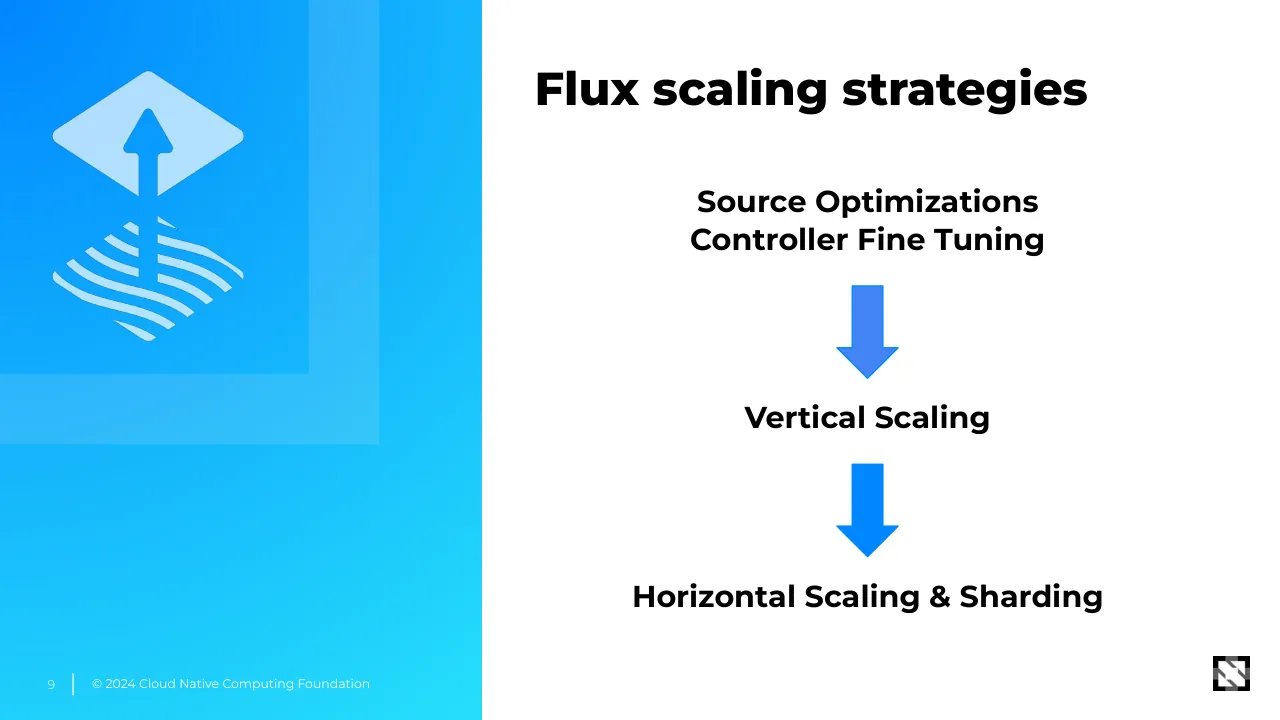
Flux scaling strategies
Source Optimizations
Controller Fine Tuning
Vertical Scaling
Horizontal Scaling & Sharding
9
© 2024 Cloud Native Computing Foundation
Visuals: Logo: a Flux logo in the left panel, 21.7% wide, at x 0.8, y 9.4. It shows a pale light-blue rounded diamond with a blue upward arrow passing into a stack of pale wave lines. Two downward block arrows in the white area, centred on x about 67.8%. Upper arrow: y 39.7 to 52.5, fill #4285F4, about 4.8% wide. Lower arrow: y 64.5 to 77.3, fill #0086FF, about 4.8% wide. Both arrows are solid block arrows with a rectangular shaft and a triangular head, with no outline. Small icon bottom-right at x 94.8, y 91.2, 2.8% by 4.7%: a 52 by 50 pixel black and grey square icon with a diagonal double-headed arrow on a checkered grey background. A translucent light rectangle (#EEEEEE at 13% opacity) sits behind the logo in the top-left area, spanning x 0 to 29.6 and y 0 to 61.7.
Slide 10
Optimizations & Fine Tuning / Source optimizations / - Migrate from Helm HTTP/S repositories to OCI / - Use dedicated Git repositories for Flux / - Split the Kubernetes resources into multiple Flux Kustomizations to take advantage of concurrent reconciliations / Controller fine tuning / - Use persistent storage for Flux internal artifacts / - Use tmpfs for in-memory kustomize builds / 10 / © 2024 Cloud Native Computing Foundation
Visuals: Two non-text visuals. (1) A square-ish illustration of the Flux logo at x 0.8%, y 9.4%, 21.7% by 38.5%, placed on the blue panel and not cropped: a pale light-blue (#B3E0FF approx.) rhombus/diamond with an upward blue (#0A84FF approx.) arrow cut out of its centre, above a set of pale light-blue wavy diagonal stripes arranged as a fan that shrinks toward the bottom-left, with the arrow shaft running down through the stripes. (2) A small monochrome icon at bottom-right, x 94.8%, y 91.2%, 2.8% by 4.7%, showing black and white diagonal corner-arrow shapes in a checkered-looking square. No charts, tables or photographs.
Slide 11
Vertical scaling
Resource limits
-
Increase controller CPU and Memory limits
-
Increase the controller reconciliation
concurrency level based on CPU limits
Rate limits
-
Monitor Kubernetes API requests rate limits
error rate and adjust the reconciliation
concurrency level
https://fluxcd.io/flux/installation/configuration/vertical-scaling
11
© 2024 Cloud Native Computing Foundation
Visuals: Illustration on the left panel: a stylised arrow icon in light blue (#B3E0FF) and white-blue tones. Its upper element is a light-blue rhombus (diamond) with a dark blue (#0086FF) upward arrow cut out of its centre, with the arrow shaft running down; below it is a stack of light-blue wavy diagonal stripes that form a rippled, layered shape, with the arrow shaft passing through it. The icon is centred horizontally in the upper-left area of the panel, full colour, unboxed, with no overlay on it. Behind it is a translucent lighter rectangle (#EEEEEE at 13% opacity) starting at the top-left corner of the slide and extending to 29.6% width and 61.7% height, creating a stepped frame effect. Small logo at bottom right: a square black-and-white mark of diagonal arrows in a chequered-grey pattern (52 by 50 pixels). No charts, tables or photographs.
Slide 12
Flux “Mean Time To Production” benchmark
KubeCon
CloudNativeCon
Europe 2024
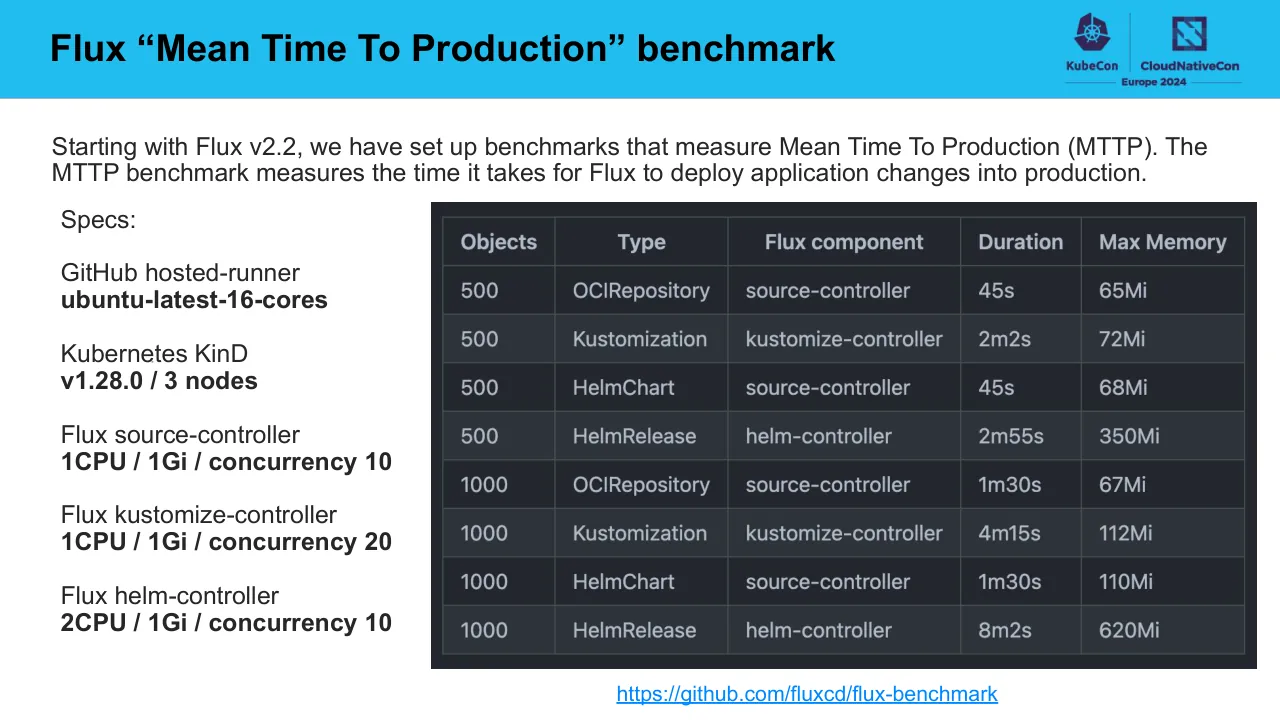
Starting with Flux v2.2, we have set up benchmarks that measure Mean Time To Production (MTTP). The
MTTP benchmark measures the time it takes for Flux to deploy application changes into production.
Specs:
GitHub hosted-runner
ubuntu-latest-16-cores
Kubernetes KinD
v1.28.0 / 3 nodes
Flux source-controller
1CPU / 1Gi / concurrency 10
Flux kustomize-controller
1CPU / 1Gi / concurrency 20
Flux helm-controller
2CPU / 1Gi / concurrency 10
Objects Type Flux component Duration Max Memory
500 OCIRepository source-controller 45s 65Mi
500 Kustomization kustomize-controller 2m2s 72Mi
500 HelmChart source-controller 45s 68Mi
500 HelmRelease helm-controller 2m55s 350Mi
1000 OCIRepository source-controller 1m30s 67Mi
1000 Kustomization kustomize-controller 4m15s 112Mi
1000 HelmChart source-controller 1m30s 110Mi
1000 HelmRelease helm-controller 8m2s 620Mi
https://github.com/fluxcd/flux-benchmark
Visuals: Table screenshot (1260 by 712 px), boxed, sharp corners, placed right of the Specs column. Dark charcoal panel (about #23272E) with a light grey (#D0D4DA) bold header row and rows in regular light grey text (#C9CDD3), alternating dark rows (#1F2329) and slightly lighter rows (#2A2E35), with thin grey (#4A5059) cell borders. Columns: Objects; Type; Flux component; Duration; Max Memory. Rows: 500 | OCIRepository | source-controller | 45s | 65Mi; 500 | Kustomization | kustomize-controller | 2m2s | 72Mi; 500 | HelmChart | source-controller | 45s | 68Mi; 500 | HelmRelease | helm-controller | 2m55s | 350Mi; 1000 | OCIRepository | source-controller | 1m30s | 67Mi; 1000 | Kustomization | kustomize-controller | 4m15s | 112Mi; 1000 | HelmChart | source-controller | 1m30s | 110Mi; 1000 | HelmRelease | helm-controller | 8m2s | 620Mi. No chart axes or legend. Logos: KubeCon logo (dark navy Kubernetes wheel-helm mark, about #2B2F6B, above the wordmark KubeCon) and CloudNativeCon logo (navy square with diagonal stylised mark, about #2B2F6B, above the wordmark CloudNativeCon and the line Europe 2024), separated by a thin vertical navy divider line.
Slide 13
Horizontal scaling
To enable horizontal scaling, each controller can be
deployed multiple times with a unique label selector
which is used as the sharding key.
To spread the load between controller instances, the
Flux resources can be assigned to a particular
instance using the sharding.fluxcd.io/key label.
Sharding strategies
-
Multi-tenant (instance per tenant)
-
Multi-cluster (instance per cluster group)
https://fluxcd.io/flux/installation/configuration/sharding
13
© 2024 Cloud Native Computing Foundation
Visuals: 1) Left panel: a full-height blue-to-cyan gradient image (271 by 405 px) filling x 0 to 37.6%, top to bottom, no photograph content. 2) A lighter translucent square overlay (#EEEEEE at 13% opacity) covering x 0 to 29.6%, y 0 to 61.7%, drawn on top of the gradient panel. 3) A Flux logo icon (1501 by 1501 px) placed at x 0.8%, y 9.4%, 21.7% wide by 38.5% high, on top of the overlay: a pale light-blue (about #B3E0FF) rhombus with a dark-blue (#0086FF) upward arrow cut out of its centre, whose shaft runs down into a stack of pale wavy diagonal stripes, forming a stylised flow mark; flat vector, no shadow. 4) A small black-and-white square icon (52 by 50 px) at bottom right, x 94.8%, y 91.2%, showing a diagonal arrow/chevron pattern in black and grey on white. No charts, tables or photographs.
Slide 14
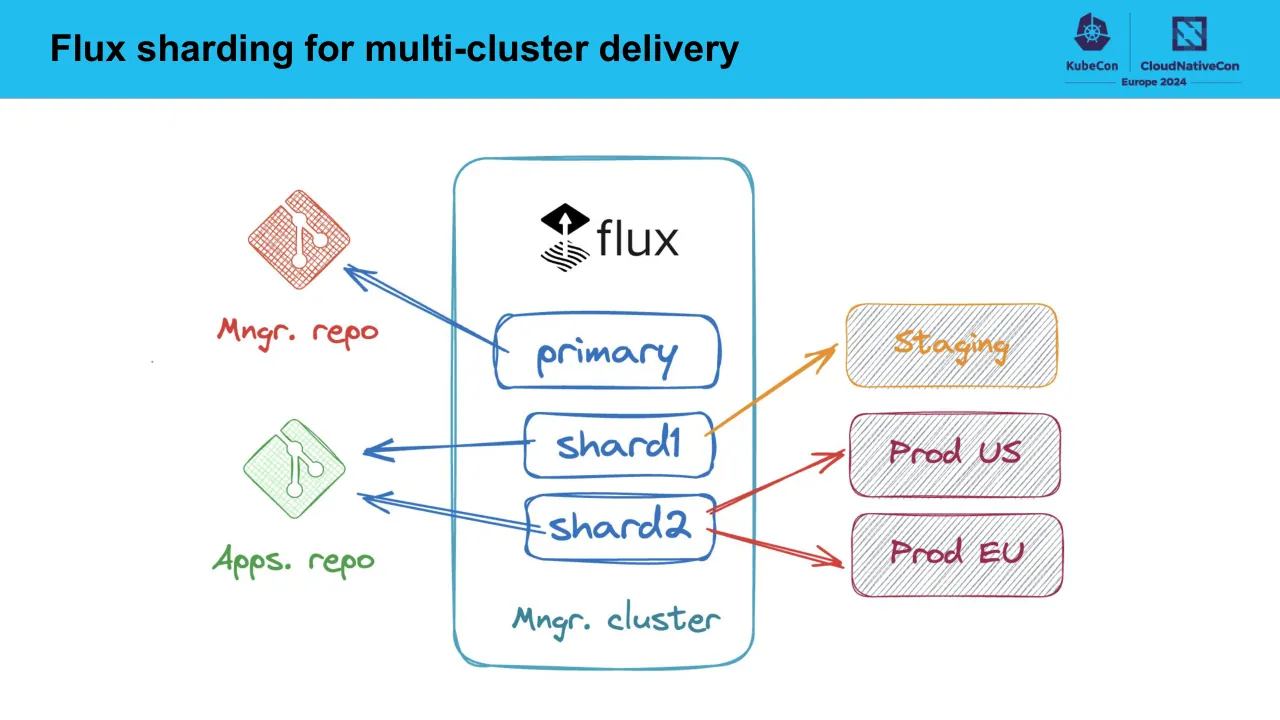
Flux sharding for multi-cluster delivery
KubeCon
CloudNativeCon
Europe 2024
Mngr. repo
flux
primary
shard1
shard2
Mngr. cluster
Staging
Prod US
Prod EU
Apps. repo
Visuals: Hand-drawn style diagram in blue, red, green, orange and magenta line work on white. Shapes: a red sketched git-logo diamond with label 'Mngr. repo' below it at upper left; a green sketched git-logo diamond with label 'Apps. repo' below it at lower left; a tall rounded rectangle with a light teal (#4BA3C3) outline labelled 'Mngr. cluster' at its bottom, containing the black Flux logo (diamond arrow mark over a wave mark, with the word 'flux' in black sans-serif) near the top; three blue (#3A74C9) rounded rectangles stacked inside the cluster labelled 'primary' (top), 'shard1' (middle) and 'shard2' (bottom), each with a double-stroke sketched outline. On the right, three hatched grey-fill rounded rectangles with coloured outlines: 'Staging' (orange outline and text #E8922A), 'Prod US' (magenta outline and text #A3295A) and 'Prod EU' (magenta outline and text #A3295A). Arrows: a blue double-headed arrow runs from 'primary' to the Mngr. repo icon; a blue single arrowhead points from 'shard1' left to the Apps. repo icon; a blue double-headed arrow runs from 'shard2' left to the Apps. repo icon; an orange arrow runs from 'shard1' up-right to 'Staging'; two red arrows run from 'shard2' right to 'Prod US' and to 'Prod EU'. A small grey dot sits at the far left near the vertical middle. Logos: KubeCon logo (purple-navy #2E2A6B wheel mark with text 'KubeCon') and CloudNativeCon logo (navy square-N mark with text 'CloudNativeCon') with 'Europe 2024' beneath, both in the top-right header; the Flux logo in the cluster box. Whole slide is a single image of a diagram; not cropped, not full-bleed, no photograph and no overlay.
Slide 15
Flux Roadmap 2024 / https://fluxcd.io/roadmap
Visuals: Logo: Cloud Native Computing Foundation logo in white, made of two parts. The wordmark (CLOUD NATIVE / COMPUTING FOUNDATION, with a square glyph at its left) is a 384 by 61 pixel image at x 36.8, y 14.8, w 26.0, h 7.3. A separate 1501 by 1501 pixel white mark (a diamond with an upward arrow over wavy lines) sits to its right at x 63.5, y 14.0, w 5.3, h 9.5. Background: a smooth diagonal gradient from magenta at the bottom-left to coral-orange at the top-right, running full-bleed with no photograph, pattern or overlay.
Slide 16
General Availability / Flux v2.3 (Q2 2024) / Promote to GA the Flux Helm APIs and the Flux Helm functionalities. / - HelmRepository / - HelmChart / - HelmRelease / Flux v2.4 (Q3 2024) / Promote to GA the Flux image automation APIs and S3-compatible storage API. / - ImageUpdateAutomation / - ImagePolicy / - ImageRepository / - Bucket / 16 / © 2024 Cloud Native Computing Foundation
Visuals: Right-hand pink gradient panel, full-bleed to the top, right and bottom edges, running from coral-orange #F7805F at bottom-left through rose #E8577A to magenta #D9268E at top-right. A translucent light-grey rectangle (#EEEEEE at 13% opacity) covers the top-right part of the panel, starting at about 72.1% x and 0% y, 27.9% wide and 61.7% tall, creating a lighter L-shaped band overlapping the gradient. A large pale pink-white (#F5C2DE approx.) Flux logo sits at the top right of the panel: a rhombus/diamond outline with an upward arrow in its centre, above a set of stylised wavy stripes forming a lower chevron shape. A small square white-tinted logo mark, with a diagonal striped pattern, sits at the bottom right of the panel. No charts, tables or photographs.
Slide 17
Notary Project integrations / Flux v2.3 scheduled for end of April 2024 will come with support for verifying the signatures of OCI Artifacts using Notation trust policies and CA certificates. / Flux APIs / - HelmChart v1 GA / - OCIRepository v1beta2 / Big thanks to Jason and Jagpreet from Microsoft for contributing this feature and for helping the Flux team maintaining the Notary integration on the long-run. / 17 / © 2024 Cloud Native Computing Foundation
Visuals: A Flux logo icon at the upper left of the blue panel: a light blue (#B3E0FF) diamond-shaped tile with a dark blue (#0088FF) upward arrow cutting through it, and below it a stack of light blue wavy stripes forming a rippled shape with the arrow continuing down through it. A translucent lighter square overlay (#EEEEEE at 13% opacity) sits behind the logo, covering roughly the top-left 29.6% by 61.7% of the slide, with a visible edge at its right and bottom. A small square icon in the bottom-right corner (about 2.8% by 4.7% of the slide) showing a black and grey diagonal double-arrow expand symbol on a white and grey checker-style square. No charts, tables or photographs.
Slide 18
CDEvents integrations
Flux v2.3 will come with support for verifying and
triggering workload reconciliation based on received
CDEvents.
In future releases, the Flux controllers will emit
events in the CDEvents format thus enabling
better interoperability will other CI/CD tools.
Big thanks to Adam from Ericsson for contributing
the CDEvents receiver integration and for continuing
to expand CDEvents support to Flux own events.
18
© 2024 Cloud Native Computing Foundation
Visuals: One illustration: the Flux logo at x 0.8%, y 9.4%, w 21.7%, h 38.5%, drawn as a light blue (#B3E0FF) flat icon on the blue gradient. It shows a diamond (rhombus with rounded corners) at the top with a blue upward arrow cut out of its centre, and below it a stack of three to four wavy horizontal stripes that the arrow shaft passes through. The arrow and wave cut-outs take the blue background colour (about #0A8BFF). The logo is not cropped and sits on a lighter translucent square band. One small icon at bottom right, x 94.8%, y 91.2%, w 2.8%, h 4.7%: a monochrome black and grey square icon with white diagonal stripes forming arrow-like chevrons, roughly 52 by 50 pixels. No charts, tables or photographs.
Slide 19
Helm OCI improvements / Flux v2.3 will come with support for HelmReleases to / refer to OCIRepositories, as an alternative to / HelmRepositories/HelmCharts. / - Better UX when debugging Helm releases / - Allow reusing the same chart between releases / - Allow pinning Helm charts by OCI digests / - Allow automating Helm upgrades using semver / ranges scoped to release candidates only / Big thanks to Soule from ControlPlane for / contributing the Helm OCI enhancements. / 19 / © 2024 Cloud Native Computing Foundation
Visuals: A Flux logo in the left panel, centred in the upper half: a pale light-blue (#B3E0FF) rounded diamond tile with a blue (#0A8CFF) upward arrow cut out of its centre, and below it a pale light-blue wavy striped shape with the arrow line running down through it. Its box is about x 0.8%, y 9.4%, w 21.7%, h 38.5%, and it is a square 1501 by 1501 pixel image on the blue gradient, not cropped and not boxed. A faint translucent lighter-white rectangle (#EEEEEE at 13% opacity) sits behind the logo and forms a stepped frame: a wide block from the top-left corner to about x 29.6%, y 61.7%, with a darker inner block to about x 24.1%, y 51.9%. A small grayscale icon sits bottom-right at x 94.8%, y 91.2%, a 52 by 50 pixel square with black and white diagonal arrows pointing outward, on white. A thin white vertical divider line sits in the footer between the page number and copyright text.
Slide 20
Flux needs your help
We invite the community to help us shape the future of Flux.
We have in place an RFC process for new features and enhancements proposals. We are keen to work with the community on RFCs and drive the project forward in a sustainable manner.
We want to enable community members to take full ownership of Flux features and share the responsibility of feature stability and longer-term maintenance.
https://github.com/fluxcd/flux2/tree/main/rfcs
20
© 2024 Cloud Native Computing Foundation
Visuals: Right-hand panel (x 61 to 100%, full height): a smooth diagonal gradient from hot pink/magenta at top-right through rose-pink in the middle to coral-orange at bottom-left, with a faint lighter rectangular tint (#EEEEEE at 13% opacity) covering the top-right area, forming a stepped lighter band along its left and bottom edges. Centred on this panel at about x 78 to 100%, y 8 to 46%, is a large pale-pink (about #F5C6DF) Flux logo: a rhombus/diamond with an upward arrow shape cut through it above a set of stylised wave stripes, shown at about 80% opacity. No photograph; no chart, table or diagram. Small Flux logo mark at bottom-right (x 94.9%, y 91.3%, 2.7 by 4.7%): a white-outlined square with a diagonal pale-pink stripe pattern.
Slide 21
KubeCon
CloudNativeCon
Europe 2024
Visuals: Illustration: flat paper-cut style Paris skyline across the lower right (from about x 40% to 100%, y 46% to 94%). Landmarks left to right: a green domed building (Pantheon-like, green #2DB88A approx.), a red rectangular arch (La Defense / Grande Arche-like, red #FF4B4B approx.), a peach-and-red triumphal arch (Arc de Triomphe-like, peach #F9C9A0 approx.), a light blue domed church with three domes (Sacre-Coeur-like, blue #3FB4E6 approx.), a tall crimson lattice tower (Eiffel Tower-like, crimson #D0003A approx.), a peach building with a glass pyramid (Louvre-like, peach #F9C9A0 with dark purple pyramid), and a red Gothic cathedral with twin towers (Notre-Dame-like, red #E8353F approx.). Behind them is a dark purple #4B3370 city silhouette with small white window dots. Skyline is cut off at the bottom by a light grey #E6E6E6 ground strip with a row of soft white cloud bumps. Five paper-cut clouds: one large cloud top right (white to pale blue gradient, with soft blue drop shadow), one small cloud right of centre (similar style), one small cloud mid-left above the skyline, and one small cloud far right. Lighting is flat with soft shading on cloud halves. Full-bleed, not cropped inside a box.
Logo: KubeCon logo, white Kubernetes ship's wheel emblem inside a white hexagonal-shaped badge, top-left, on purple.
Logo: CloudNativeCon logo, white square outline with grey diagonal stripe pattern inside, centred top, on purple.
Shape: large light blue #5BD1F2 arc (quarter-circle sky) rising from lower-left to top-right, with a lighter #7DDCF5 inner band on its left side.
Shape: medium blue #45A3CC curved band in the lower-left, with a darker purple #4B3370 inner curved band beneath it.
Shape: thin white vertical rule, centred between KubeCon and CloudNativeCon logos.
Shape: two thin white horizontal rules flanking 'Europe 2024'.