The deck opens with the company name and a title slide, then states the problem: impaired sensory processing from aging, neurological disorders, fatigue and injury reduces acuity and raises fall risk. It presents a noninvasive vagus nerve stimulation patch as the solution. Next it explains the mechanism through a brain-pathway diagram, lists the drawbacks of alternatives such as stimulants, nootropics and therapy, and cites the academic papers behind the approach. The product section covers form factor, features and target price, followed by a competitor comparison table of VNS devices by application, form factor and stimulation location. The deck then describes the consumer impact of age-related sensory decline and sizes adjacent markets. A revenue and gross margin projection table from 2024 to 2029 is followed by a regulatory and reimbursement plan, expansion markets, a timeline of research, funding and milestones, a proposed pilot study, the founding team and partner institutions. It closes with a seed round ask of $400K and contact details.
Full text of the slides (16 slides)
Every slide's words and a description of its charts and images, so the deck can be searched and rebuilt. Also available as Markdown.
Slide 1
Sharper Sense
Instant sensory processing enhancement
www.SharperSense.com
Charles Rodenkirch, PhD
[email protected]
(646) 470-3040
© 2020 Sharper Sense
All rights reserved
Visuals: A thick horizontal blue rule (about #2F5597) spans from about 14% to 86% of slide width beneath the title. In the bottom-left corner is the Sharper Sense logo: a tall condensed black stylised wordmark with a large 'S' and the words 'harper' on the top line and 'ense' on the bottom line, on a white rounded-square background.
Slide 2
Enhance
your senses
Tactile
Auditory
Visual
The Problem:
• The brain’s ability to accurately process sensory information received from the eyes, ears, and skin
can be impaired by aging, numerous neurological disorders, fatigue, inattention, and brain injury
• Impaired sensory processing reduces sensory acuity, makes it difficult to understand written and
spoken words, increases risk of fall and injury, and decreases performance at work, school, or play
Our Solution:
• A noninvasive nerve stimulation patch that restores sensory processing clarity via neuromodulation
© 2020 Sharper Sense
All rights reserved
Visuals: Sharper Sense logo: black stacked wordmark 'Sharper' over 'Sense' with a large S in a condensed font, on a white rounded-rectangle tile. Photo 'Auditory': elderly grey-haired woman with glasses holding a phone to her ear, other hand under her chin, with a worried expression, bright white background, grey sweater. Photo 'Tactile': close-up of hands peeling a red apple with a knife, warm tones. Photo 'Visual': man with dark hair and glasses reading a large newspaper, green plant at right, grey tones. Large photo: side profile of a middle-aged woman with long dark brown hair, hand under her chin, a small triangular translucent patch with the Sharper Sense logo on her neck/jaw, white background, grey top at bottom right. All photos have rounded corners. Small Sharper Sense logo at bottom left on a white rounded tile. Each of the three small photos has a small light-grey label strip at its bottom holding bold black text.
Slide 3
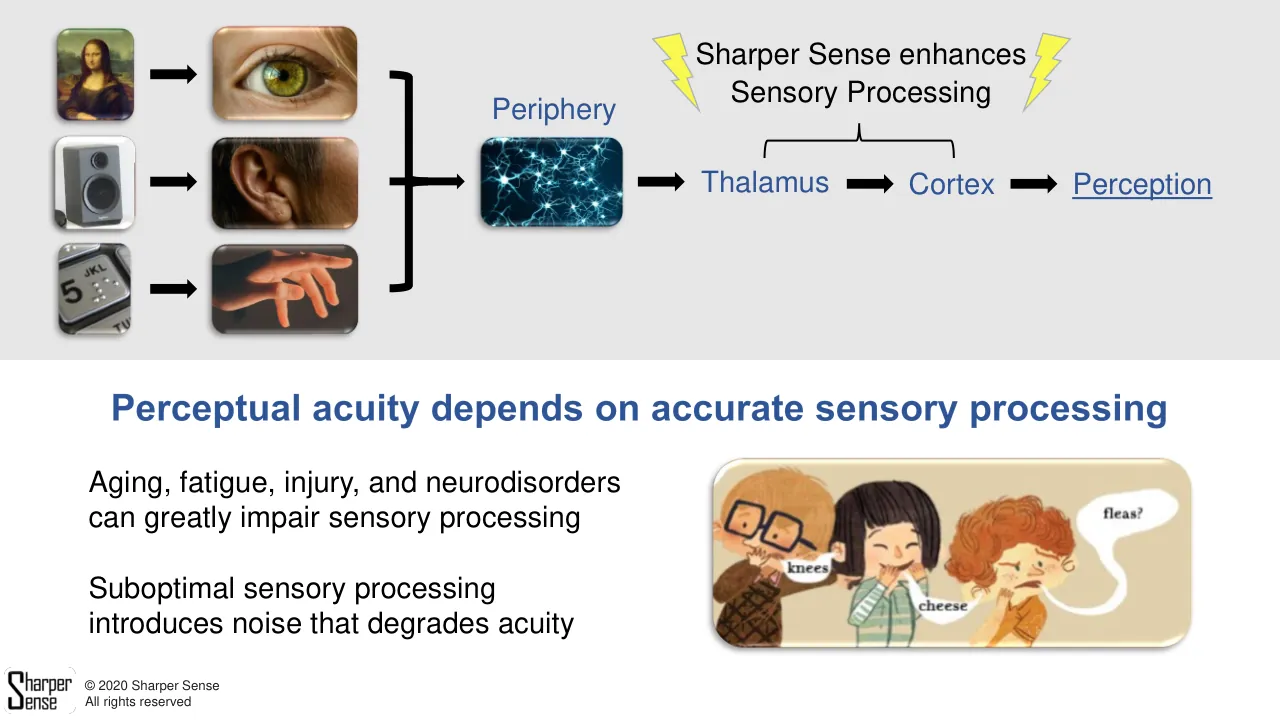
Sharper Sense enhances
Sensory Processing
Periphery
Thalamus
Cortex
Perception
Perceptual acuity depends on accurate sensory processing
Aging, fatigue, injury, and neurodisorders
can greatly impair sensory processing
Suboptimal sensory processing
introduces noise that degrades acuity
© 2020 Sharper Sense
All rights reserved
knees
cheese
fleas?
Visuals: Three rows of rounded, shadowed thumbnails. Row 1: Mona Lisa painting, black arrow, close-up of a green-hazel human eye. Row 2: grey desktop speaker, black arrow, close-up of a human ear. Row 3: braille-marked metal keypad button '5 JKL', black arrow, a hand with outstretched fingers. A large black right brace joins the three rows, with an arrow pointing to a rounded image of glowing blue neurons. A black arrow leads to Thalamus, then arrow to Cortex, then arrow to Perception (underlined). A black curly bracket sits above Thalamus and Cortex and points up to the text 'Sharper Sense enhances Sensory Processing', flanked by two yellow lightning bolts. At lower right is a rounded, shadowed illustration of three children with speech bubbles reading 'knees', 'cheese', 'fleas?' on a beige background. The Sharper Sense logo sits at bottom left, a stylised black 'S' with 'harper' and 'ense' in condensed letters.
Slide 4
Existing methods of improving sensory processing are less than ideal
Stimulants are not safe and cause insomnia, / anxiety, loss of appetite, and cardiac damage
Externally processing audio/video / unnaturally distorts sensory stimuli
Therapy promoting neuroplasticity requires / extensive time and money before any benefit
Nootropics are not effective / and rarely tested for safety
© 2020 Sharper Sense
All rights reserved
Visuals: Four rounded-corner photos with soft drop shadows and a glossy edge: (1) top-left, close-up of a white Ritalin 10 mg methylphenidate tablet bottle with label text, blue edge at right; (2) mid-right, side view of a woman with blonde hair wearing a grey VR headset, green tropical leaves behind; (3) left, a child with headphones in a sensory gym stepping on dome balance pods over colourful floor mats, with a blue bolster and blue crash mat, yellow and pink walls; (4) bottom-right, a hand holding a dark blue Zhou NEURO-PEAK supplement bottle with a mountain logo. Bottom-left Sharper Sense logo: stylised black letters 'Sharper Sense' with a large S, on a white rounded tile.
Slide 5
The brain naturally optimizes sensory processing when alert/attentive
Decreased / Detail
Attention/Arousal
Low
High
Increased / Detail
Vagus nerve stimulation
LC-NE activation
Enhanced sensory / processing & acuity
Enhanced performance
Our team Identified neural circuitry responsible for arousal-linked enhanced sensory processing
We confirmed direct activation of this circuitry in awake rats enhances perceptual acuity
We then optimized a peripheral nerve stimulation method of indirectly activating this circuitry
Charles Rodenkirch, Yang Liu, Brian J Schriver, and Qi Wang. Locus coeruleus activation enhances thalamic feature selectivity via norepinephrine regulation of intrathalamic circuit dynamics. Nature Neuroscience, 2019.
Charles Rodenkirch and Qi Wang. Rapid and transient enhancement of thalamic information transmission induced by vagus nerve stimulation. Journal of Neural Engineering, 2020.
nature neuroscience
JOURNAL OF NEURAL ENGINEERING
© 2020 Sharper Sense
All rights reserved
Visuals: Two rounded-square images of the Mona Lisa with drop shadows: left one heavily blurred (low detail), right one sharp (high detail); each has white overlay text at its lower middle. A thick black double-headed horizontal arrow sits between them, with the label Attention/Arousal above and Low and High below its ends. Three small black down arrows link the right-hand text steps. Logos: the Nature Neuroscience logo (white text on dark teal rounded rectangle), the Journal of Neural Engineering logo (blue and red text on pale background), and the Sharper Sense logo (black stylised S with 'harper' and 'ense').
Slide 6
Our technology: a noninvasive neuromodulation patch that / improves sensory acuity by enhancing sensory processing
Externally worn vagus nerve stimulation (VNS) patch
Easy to take on and off
Proprietary VNS pattern enhances sensory processing
Enhancement occurs within seconds of activation
No unnatural distortion of vision, hearing, or touch
Less than 3 mm thick with 6-8 hours of battery life
Doesn’t obstruct eyes or ears
Transcutaneous stimulation is noninvasive and pain-free
Target price is $15 per patch
Expected COGS at volume is less than $5 per patch
© 2020 Sharper Sense
All rights reserved
Visuals: Photograph of a middle-aged woman with grey-streaked dark hair in profile facing left, her hand resting under her chin. A small triangular silver patch labelled 'Sharper Sense' is on her neck below the jaw. Soft light, pale grey-white background, grey-blue top at the bottom. The photo is boxed with rounded corners and a soft drop shadow. Bottom-left corner: Sharper Sense logo with a large black stylised 'S' and the words 'harper' and 'ense' in condensed black letters, on a white rounded box.
Slide 7
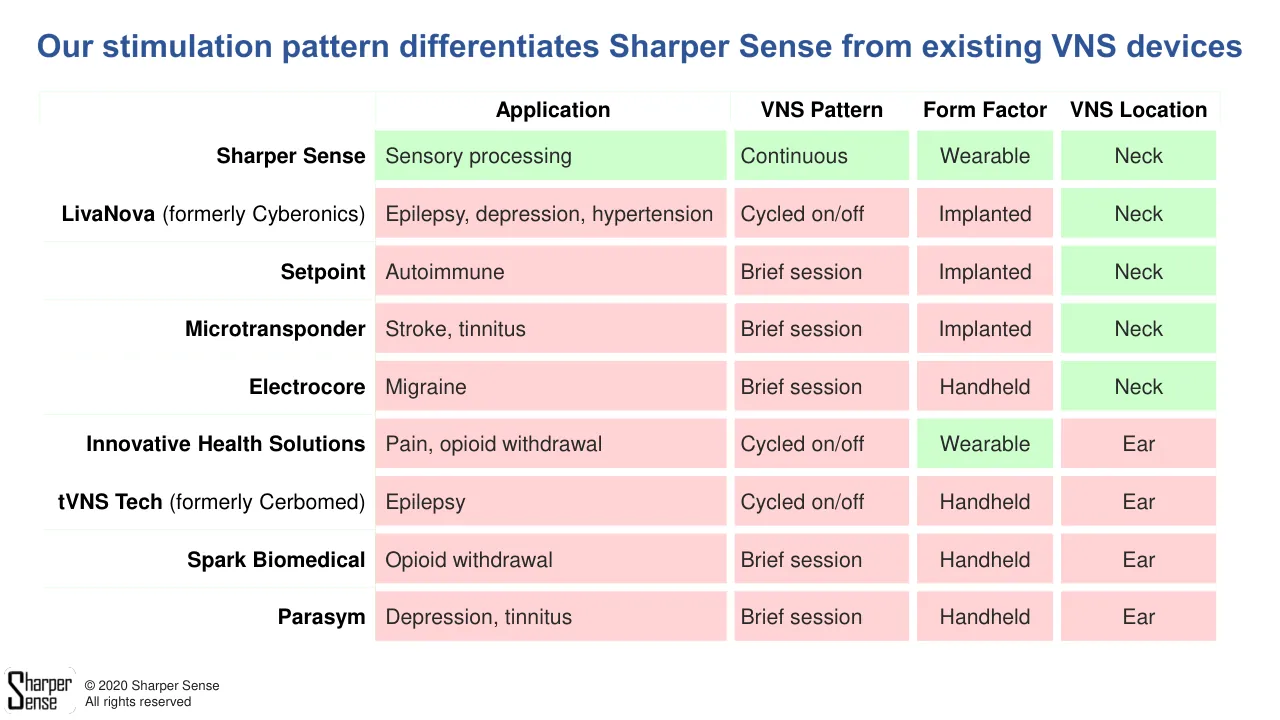
Our stimulation pattern differentiates Sharper Sense from existing VNS devices
Application
VNS Pattern
Form Factor
VNS Location
Sharper Sense
Sensory processing
Continuous
Wearable
Neck
LivaNova (formerly Cyberonics)
Epilepsy, depression, hypertension
Cycled on/off
Implanted
Neck
Setpoint
Autoimmune
Brief session
Implanted
Neck
Microtransponder
Stroke, tinnitus
Brief session
Implanted
Neck
Electrocore
Migraine
Brief session
Handheld
Neck
Innovative Health Solutions
Pain, opioid withdrawal
Cycled on/off
Wearable
Ear
tVNS Tech (formerly Cerbomed)
Epilepsy
Cycled on/off
Handheld
Ear
Spark Biomedical
Opioid withdrawal
Brief session
Handheld
Ear
Parasym
Depression, tinnitus
Brief session
Handheld
Ear
© 2020 Sharper Sense
All rights reserved
Visuals: Comparison table with a white header row with bold black column headings (the first header cell is empty). Row labels are on white. Data cells are colour-coded: green for the Sharper Sense row and for matching attributes, pink for differing ones, with thin white gaps between cells. Row 1 Sharper Sense: all four cells green. Rows LivaNova, Setpoint, Microtransponder: Application and VNS Pattern pink, Form Factor (Implanted) pink, VNS Location (Neck) green. Electrocore: Application, Pattern, Form Factor (Handheld) pink, Location (Neck) green. Innovative Health Solutions: Application and Pattern pink, Form Factor (Wearable) green, Location (Ear) pink. tVNS Tech, Spark Biomedical and Parasym: all four cells pink. Bottom-left logo: the Sharper Sense wordmark in black condensed lettering, with a large 'S' on 'harper' and 'ense' below it.
Slide 8
Sharper Sense’s technology has many potential applications
First target market: age-related sensory processing deficits
Age-degraded sensory processing is isolating and dangerous
Affects the vast majority of seniors
Interferes with communication
Increases likelihood of falls
Accelerates dementia onset and progression
Precludes employment and recreation
Leads to depression and anxiety
© 2020 Sharper Sense
All rights reserved
Visuals: Photograph of an older woman with light grey-blonde hair, seen in close-up, squeezing her eyes shut in discomfort. One hand rubs her eyes and the other holds red-burgundy framed glasses against her forehead. Soft, neutral, warm indoor lighting with a blurred light background and beige clothing. Boxed with large rounded corners and a soft feathered edge/shadow. Bottom-left corner has the Sharper Sense logo: a stylised black serif-condensed 'Sharper Sense' wordmark with a large S and D-like shape, stacked on two lines on a white rounded tile. Underlined words in the bullets: falls, dementia, depression, anxiety.
Slide 9
Restoring high-fidelity sensory processing in seniors
is at the intersection of multiple growing markets
Market size (global)
CAGR
Neuromodulation:
$6B
9%
Human augmentation:
$71B
24%
Elderly and disabled assistive devices:
$23B
6%
Hearing aids:
$9B
7%
Vision care :
$52B
4%
[Data from Allied Market Research, Imarc, and MarketsandMarkets]
© 2020 Sharper Sense
All rights reserved
Visuals: Table with an empty top-left header cell, header cells 'Market size (global)' and 'CAGR', and five rows: Neuromodulation: $6B, 9%; Human augmentation: $71B, 24%; Elderly and disabled assistive devices: $23B, 6%; Hearing aids: $9B, 7%; Vision care : $52B, 4%. Row labels sit in pale blue cells, right-aligned. Value cells are light grey and centred. Thin white gaps separate the cells. Top photo: close-up of an elderly white-haired man with glasses cupping his hand behind his ear, bright high-key lighting, blue collar and navy cardigan, white background, rounded corners with a soft shadow. Bottom photo: an elderly grey-haired woman in a blue sweater sitting on a sofa, looking down through a magnifying glass at an open book, soft daylight, blue and green tones, rounded corners with a soft shadow. Bottom-left logo: 'Sharper Sense' in black condensed stylised lettering with a large S and a large S dropping below.
Slide 10
We will leverage our solid science to gain de novo clearance as
a prescription treatment for age-degraded sensory processing
Using our networks and future marketing team we will drive adoption by prescribing physicians
2024
2025
2026
2027
2028
2029
Revenue:
$0.9M
$2.5M
$24M
$55M
$134M
$287M
Gross Profit:
$0.1M
$1M
$13M
$37M
$103M
$220M
Gross Margin:
13%
40%
53%
67%
77%
77%
[Revenue projections from age-degraded sensory processing only, other applications not included]
Aggressively pursuing eligibility for reimbursement by 3rd party payers is key to our success,
we expect a favorable likelihood of approval due to our strong value versus existing treatments
© 2020 Sharper Sense
All rights reserved
Visuals: Photograph of a doctor's hands (white coat sleeve visible) writing a prescription with a silver pen on a light blue pad printed with an Rx symbol; close-up, soft focus background in teal-green and warm skin tones, boxed in a rounded-corner rectangle with a soft vignette edge. Table: header row of years 2024-2029 on pale blue cells; row labels Revenue:, Gross Profit:, Gross Margin: on pale blue cells, right-aligned; data cells light grey. Revenue $0.9M, $2.5M, $24M, $55M, $134M, $287M; Gross Profit $0.1M, $1M, $13M, $37M, $103M, $220M; Gross Margin 13%, 40%, 53%, 67%, 77%, 77%. Small white gaps separate the cells. Bottom-left logo: stylised 'Sharper Sense' wordmark in black with a large S and a large D-like S on a second line.
Slide 11
Abundant potential for future expansion into multiple markets
Clinical Applications
(Class 2 nonsignificant risk medical device)
Performance Enhancement Applications
(General wellness device)
Sensory Processing
Degradation
Age-related, Parkinson’s,
Multiple sclerosis
Sensory Processing
Disorders
ADHD, Autism, Dyslexia,
Language impairment,
Audiovisual disorders
Demanding &
Hazardous Jobs
Sports & E-Sports
Those suffering from impaired sensory processing are in dire need of a safe and effective way to restore sensory clarity
Sharper Sense has spoken to multiple military groups interested in testing our technology as soon as it is available
We have received similar interest from athletes and e-athletes we’ve spoken with
© 2020 Sharper Sense
All rights reserved
Visuals: Two red-outlined rounded cards each contain the same colourful translucent brain illustration (multicoloured wireframe brain, green, blue, orange, magenta, in a white rounded square with soft shadow). The blue card 'Demanding & Hazardous Jobs' has two overlapping rounded-corner photos: a camouflaged soldier in a boonie hat aiming a scoped sniper rifle against a cloudy sky (upper left), and a female worker in a yellow hard hat, safety glasses and plaid shirt working on machinery (lower right). The blue card 'Sports & E-Sports' has two overlapping photos: a golfer in a purple shirt and grey trousers putting on a green with a flag (upper left), and hands holding a black Xbox-style game controller (lower right). Sharper Sense logo at bottom left: stylised black 'Sharper Sense' wordmark with large S letters.
Slide 12
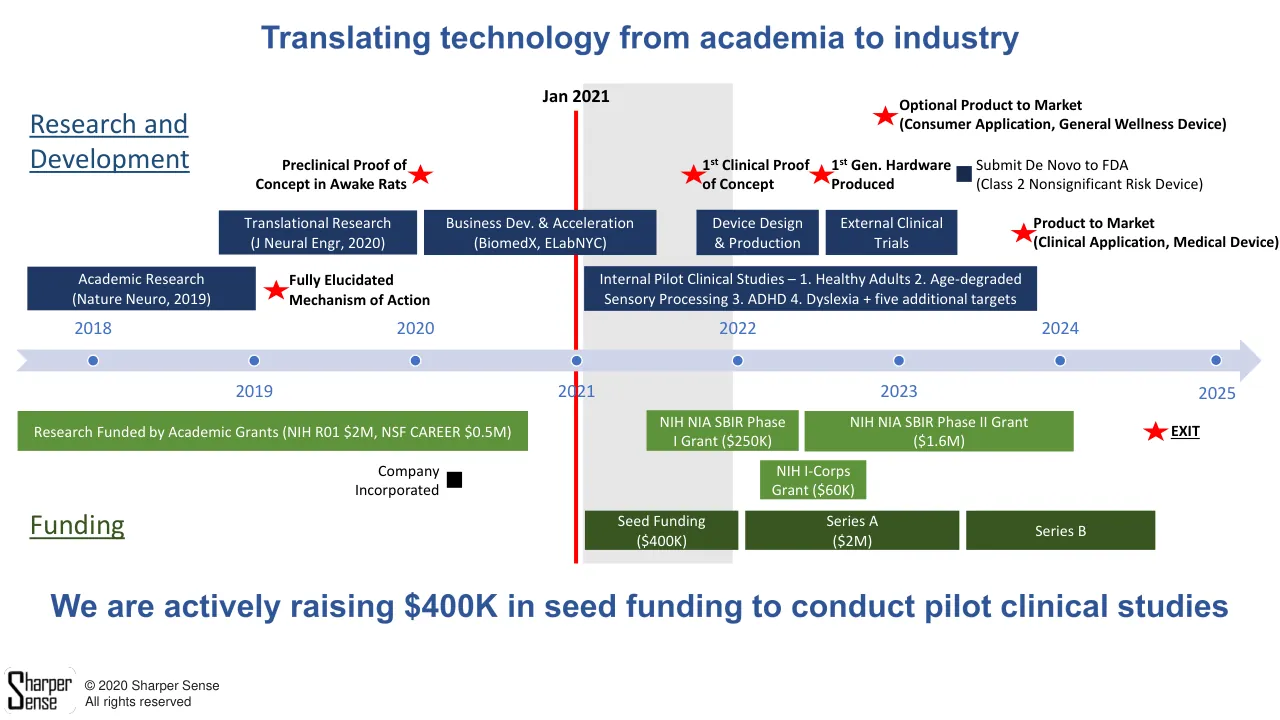
Translating technology from academia to industry
Research and
Development
Jan 2021
Optional Product to Market
(Consumer Application, General Wellness Device)
Preclinical Proof of
Concept in Awake Rats
1st Clinical Proof
of Concept
1st Gen. Hardware
Produced
Submit De Novo to FDA
(Class 2 Nonsignificant Risk Device)
Translational Research
(J Neural Engr, 2020)
Business Dev. & Acceleration
(BiomedX, ELabNYC)
Device Design
& Production
External Clinical
Trials
Product to Market
(Clinical Application, Medical Device)
Academic Research
(Nature Neuro, 2019)
Fully Elucidated
Mechanism of Action
Internal Pilot Clinical Studies – 1. Healthy Adults 2. Age-degraded
Sensory Processing 3. ADHD 4. Dyslexia + five additional targets
2018
2020
2022
2024
2019
2021
2023
2025
Research Funded by Academic Grants (NIH R01 $2M, NSF CAREER $0.5M)
NIH NIA SBIR Phase
I Grant ($250K)
NIH NIA SBIR Phase II Grant
($1.6M)
EXIT
Company
Incorporated
NIH I-Corps
Grant ($60K)
Funding
Seed Funding
($400K)
Series A
($2M)
Series B
We are actively raising $400K in seed funding to conduct pilot clinical studies
© 2020 Sharper Sense
All rights reserved
Visuals: Timeline arrow (light lavender, right-pointing) with seven blue circular markers at 2018 through 2025 positions. A vertical red line at Jan 2021 and a light grey rectangular band from about 2021 to mid 2022 behind the content. Navy rectangles with white text for R&D phases. Medium green rectangles for grants. Dark green rectangles for equity funding rounds. Red five-point stars mark milestones: Fully Elucidated Mechanism of Action, Preclinical Proof of Concept, 1st Clinical Proof of Concept, 1st Gen. Hardware Produced, Optional Product to Market, Product to Market, EXIT. A small navy square marks the Submit De Novo to FDA entry and a black square marks Company Incorporated. Sharper Sense logo at bottom left, a stylised black handwritten 'Sharper Sense' wordmark with large S letters.
Slide 13
Our proposed pilot clinical study plan will validate our technology’s
beneficial effect in humans as well as prove its clinical value
Sensory stimuli:
Visual (LCD screen)
Auditory (headphones)
Tactile (haptic feedback)
Transcutaneous nerve stimulation:
Vagus nerve
Sham location
Experimental subject:
Seated at computer
Measure sensory performance:
With and without nVNS
Measure physiology:
Pupil dilation (index of target circuitry activation)
Galvanic skin response
Heart rate variability
nVNS will be delivered with a programmable, desktop size, medical stimulator FDA cleared for human use
Vision: Gratings
Tactile: Vibration
Auditory: Tone
1. Tactile, auditory, and visual frequency discrimination testing in healthy adults
Snellen Chart
QuickSIN
2. Standardized visual acuity and speech intelligibility testing in seniors with impaired audiovisual ability
IVA-AE2
3. Continuous performance tests (CPT, audiovisual discrimination) in adults with ADHD
TAPS-3
CTOPP-2
4. Visual (reading) and auditory (speech) processing tests in adults with dyslexia
5. Subsequently test five additional clinical targets
© 2020 Sharper Sense
All rights reserved
Visuals: Grey cartoon illustration of a seated man with glasses typing at a computer monitor and keyboard, centered. Four dark grey block arrows: two pointing right from the left lists to the subject, two from the subject to the right lists. Thick grey horizontal rule separates the grey panel from the lower section, with three grey vertical dividers. Lower panels: two circular vertical grating patterns in grey stripes; a hand pressing a fingertip with vibration motion lines; two music staves with treble clef and musical notes; a Snellen eye chart on a black computer monitor; a QuickSIN yellow-red-orange DVD case with disc; a diagram of three stacked grey rectangles stepping up diagonally labeled with +, 1, + and red (1) (2) markers, a speaker icon with “Five” in the top box and a thin black arrow pointing up-right; a TAPS-3 orange-brown box with CD and booklet; a CTOPP-2 blue and orange box with stopwatch image. Sharper Sense logo in black stylised lettering at bottom left.
Slide 14
Our / Founding / Team
Charles Rodenkirch, PhD
President of Sharper Sense (full-time)
Biomedical engineer, systems neuroscientist
Worked for Columbia Technology Ventures
Second-time entrepreneur
Professor Qi Wang, PhD
Consultant to Sharper Sense (part-time)
Columbia Professor of Biomedical Engineering
Head of Neural Engineering Lab
Doctorates in electrical engineering & robotics
Scientific Advisory Board
Professor Jason Carmel, MD, PhD
Columbia Professor of Pediatric Neurology and practicing neurologist
Expert in clinical neural stimulation & sensorimotor neurology
Business Advisory Board
John Sullivan, MBA
Leader in healthcare innovation with extensive business development experience
BioHealth Innovation Entrepreneur In Residence
© 2020 Sharper Sense
All rights reserved
Visuals: Five photos with rounded corners and soft drop shadows: (1) wide group photo in a lab at top, two smiling men standing side by side, the left a young man in a white lab coat over a maroon shirt, the right a man in a tan checked blazer and blue shirt, with a white microscope/robotic arm setup with orange knobs and lab equipment racks and glass cabinets behind; (2) headshot of Charles Rodenkirch, young man with short brown hair in dark suit and white shirt against a brick wall; (3) headshot of Professor Qi Wang, man with glasses in dark suit, light blue shirt and blue tie against a pale blue background; (4) headshot of Jason Carmel, smiling man with dark hair in a white coat over a blue checked shirt; (5) headshot of John Sullivan, grey-haired man with glasses in a dark suit, light blue shirt and red patterned tie. Small square bullets in dark grey. Sharper Sense logo at bottom left: stylized black 'S' with 'harper' and 'ense' lettering. A vertical grey divider line between the halves.
Slide 15
Supporting preclinical research was conducted at:
COLUMBIA | ENGINEERING
The Fu Foundation School of Engineering and Applied Science
Biomedical Engineering
Laboratory for Neural Engineering and Control
Intellectual property protected by:
PCT patent application filed 6/2020, additional provisional patent application filed 9/2020
IP covers novel VNS application, proprietary VNS pattern, device aspects, and accurate application methods
Sharper Sense is in the process of converting our exclusive option agreement to an exclusive license
COLUMBIA | TECHNOLOGY VENTURES
Honored to have been accepted and participated in:
ENTREPRENEURSHIP LAB
BIO AND HEALTH TECH NYC
COLUMBIA | BIOMEDX
Biomedical Technology Accelerator
Legal counsel:
WILSON SONSINI
Sharper Sense
© 2020 Sharper Sense
All rights reserved
Visuals: Logos: Columbia Engineering Biomedical Engineering / Laboratory for Neural Engineering and Control, on a white rounded card with a soft shadow, navy crown emblem and navy serif text. Columbia Technology Ventures: a blue glossy rounded banner with a white crown and white small-caps serif text. Entrepreneurship Lab Bio and Health Tech NYC: white rounded card with a teal, green and blue ring at left and grey condensed text. Columbia BioMedX Biomedical Technology Accelerator: white rounded card with navy crown and serif text. Wilson Sonsini: dark teal rounded square with white spaced capitals and a red-pink stripe at the bottom. Sharper Sense logo: black stylised lettering at bottom-left on a white tile.
Slide 16
We are actively raising a seed round of $400K
$50K of this round has been raised as of Jan. 2021
This funding will be efficiently spent to generate clinical proof of concept for multiple applications, protect our IP, and validate our hardware development plan
At our current lean burn rate, the requested funding could conduct 18 months of pilot clinical studies
We expect to produce our first clinical proof of concept within 6-9 months, at which point we can slowly accelerate burn to build our team for a series A raise
Contact: Charles Rodenkirch, PhD
[email protected]
(646) 470-3040
Anticipated Distribution of Funding Use
Personnel 22%
Taxes 1%
Legal 9%
Insurance 4%
Facilities 11%
Misc 5%
Patents 27%
Consumables 2%
Equipment 6%
Subjects 11%
Design 2%
© 2020 Sharper Sense
All rights reserved
Visuals: Pie chart titled 'Anticipated Distribution of Funding Use', 11 slices with white separators, each labelled with category and percentage in white bold text on dark semi-transparent grey label boxes with a slight shadow. Clockwise from top (about 12 o'clock): Personnel 22% (medium blue #4472C4), Taxes 1% (orange #ED7D31), Legal 9% (purple #7F3880), Insurance 4% (yellow-gold #FFC000), Facilities 11% (light blue #5B9BD5), Misc 5% (green #70AD47), Patents 27% (dark navy #264478), Consumables 2% (rust brown #9E480E), Equipment 6% (dark grey #636363), Subjects 11% (olive brown #7F6000), Design 2% (grey #808080). No legend. A thin black-outlined rectangle surrounds the contact text. Bottom-left corner has the Sharper Sense logo: stylised black text 'Sharper Sense' with large S and S, in two lines, on white.