
A services proposal has two jobs at once: sell the engagement and define it precisely enough that nobody argues later about what was bought. This guide walks through the worked proposal that ships with the Sales Deck: Northline Studio proposing an eight-week client onboarding redesign to Acme Services for a fixed fee of $48,000. Every organization, person, record and price in it is fictional, and the slides say so in their footer.
What the client asked for
The brief that starts the workflow records Acme's request in one paragraph: agree a consistent onboarding process, clarify ownership, test a practical toolkit, and show what will be delivered, what Acme must provide, how the work will be reviewed and what it costs. It also records the meeting decision the proposal is built to get: agree the scope and the approval path. Budget approval, signatures and payment are still pending, and the proposal never pretends otherwise.
Slide 2: the proposal in one page
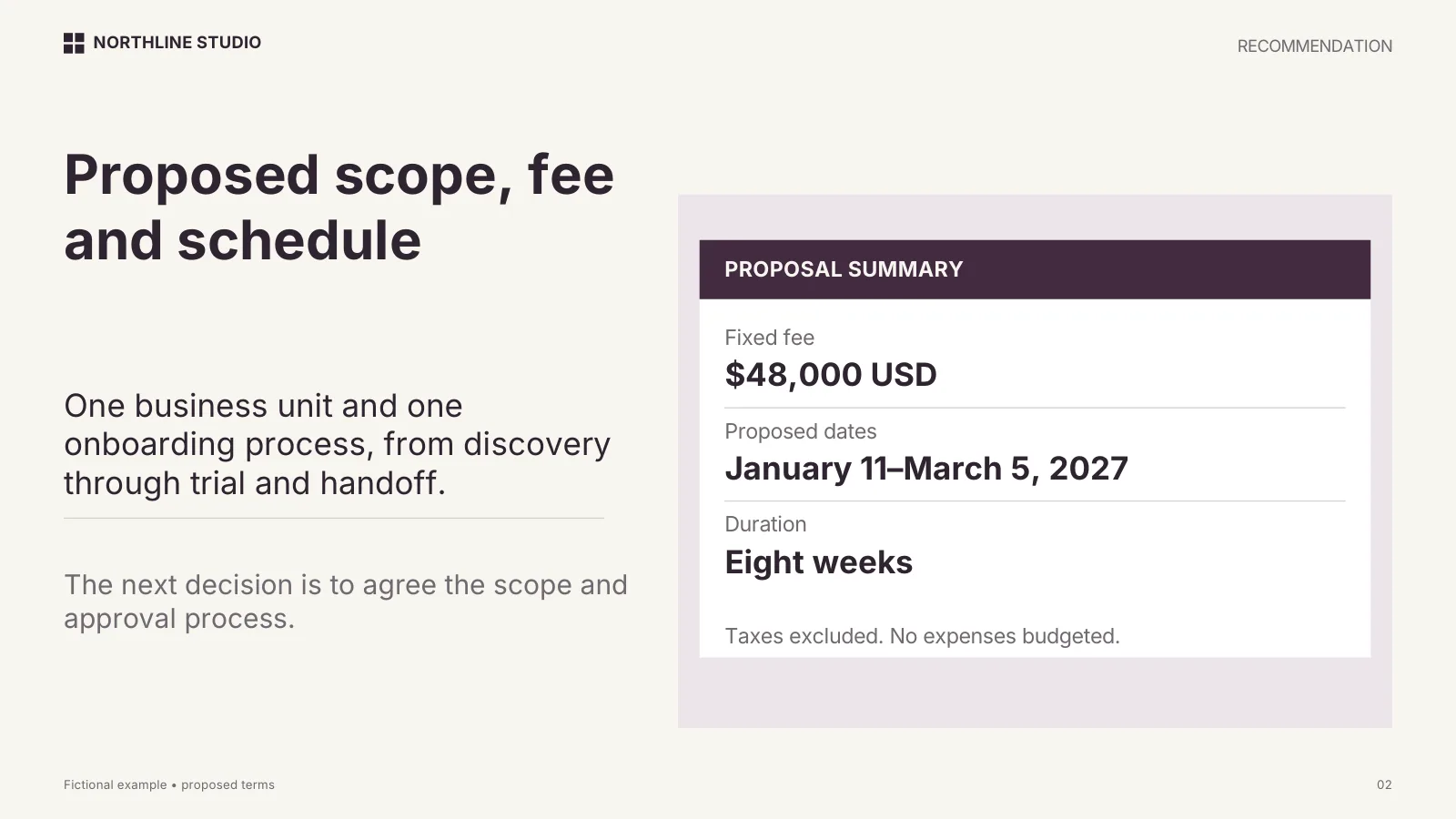
The second slide states the scope as a boundary ("one business unit and one onboarding process, from discovery through trial and handoff"), the fixed fee, the proposed dates and the duration, and names the next decision. A buyer who reads only this slide can take it to whoever approves spending.
Slides 3 to 5: evidence before promises
Slide 3 reports what discovery found, each finding tagged with its source record. Slide 4 gives the baseline: a median of 14.5 business days from signed order to kickoff readiness across 12 completed cases, nine of them with no named owner at first handoff, with a stated sample limit (completed cases only, counts supplied rather than reconstructed). Slide 5 sets the trial targets and says in its subtitle that results are not yet available. The proposal measures what it will measure; it does not claim an outcome.
Slide 6: what is included and what is not
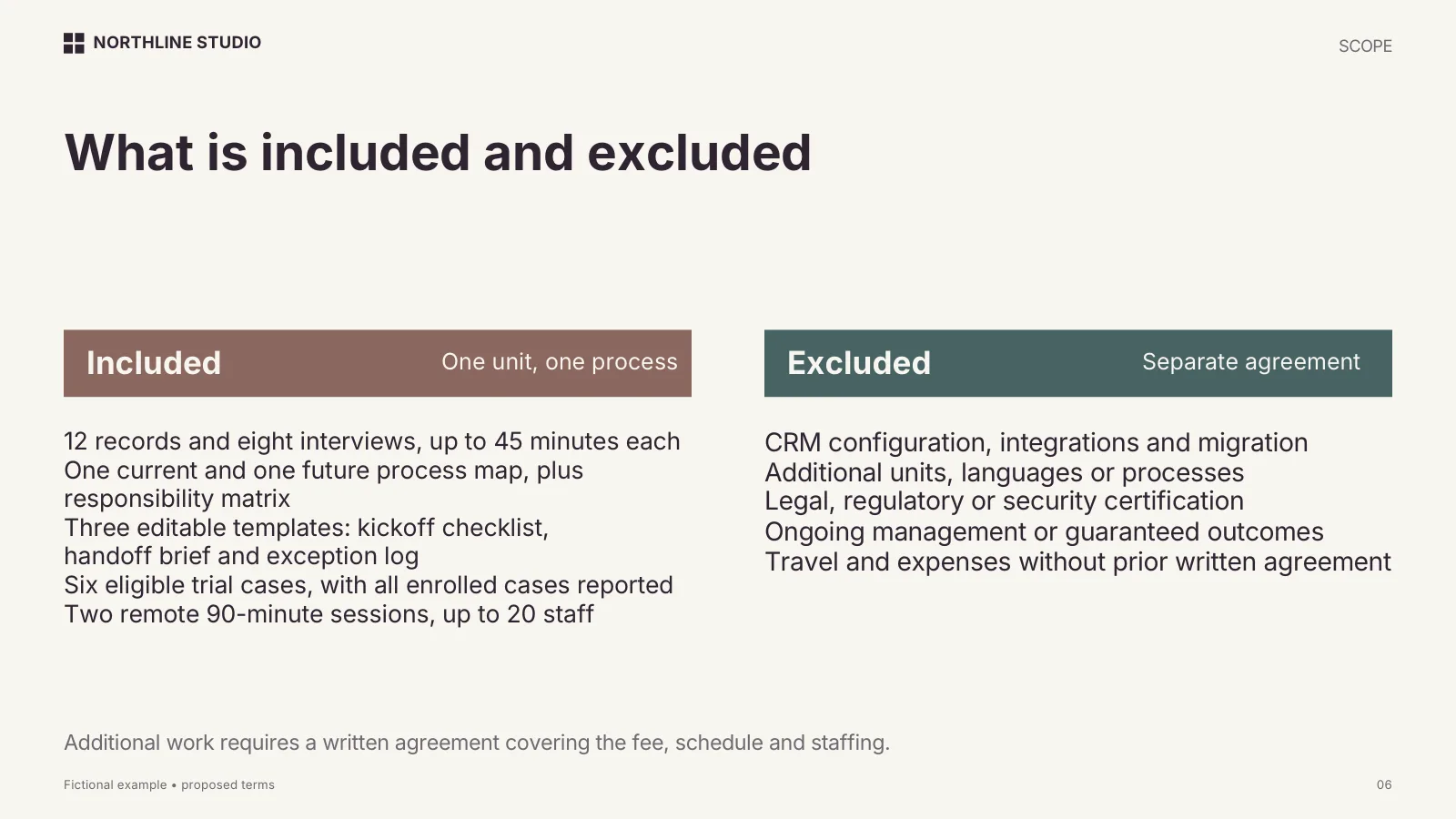
This is the slide that prevents scope arguments. Included: 12 records and eight interviews, two process maps and a responsibility matrix, three editable templates, a six-case coached trial, two remote sessions. Excluded, and marked as a separate agreement: CRM configuration, integrations, migration, additional units and languages. Exclusions written down before signature are cheaper than exclusions argued about in week five.
Slide 7: deliverables with acceptance criteria
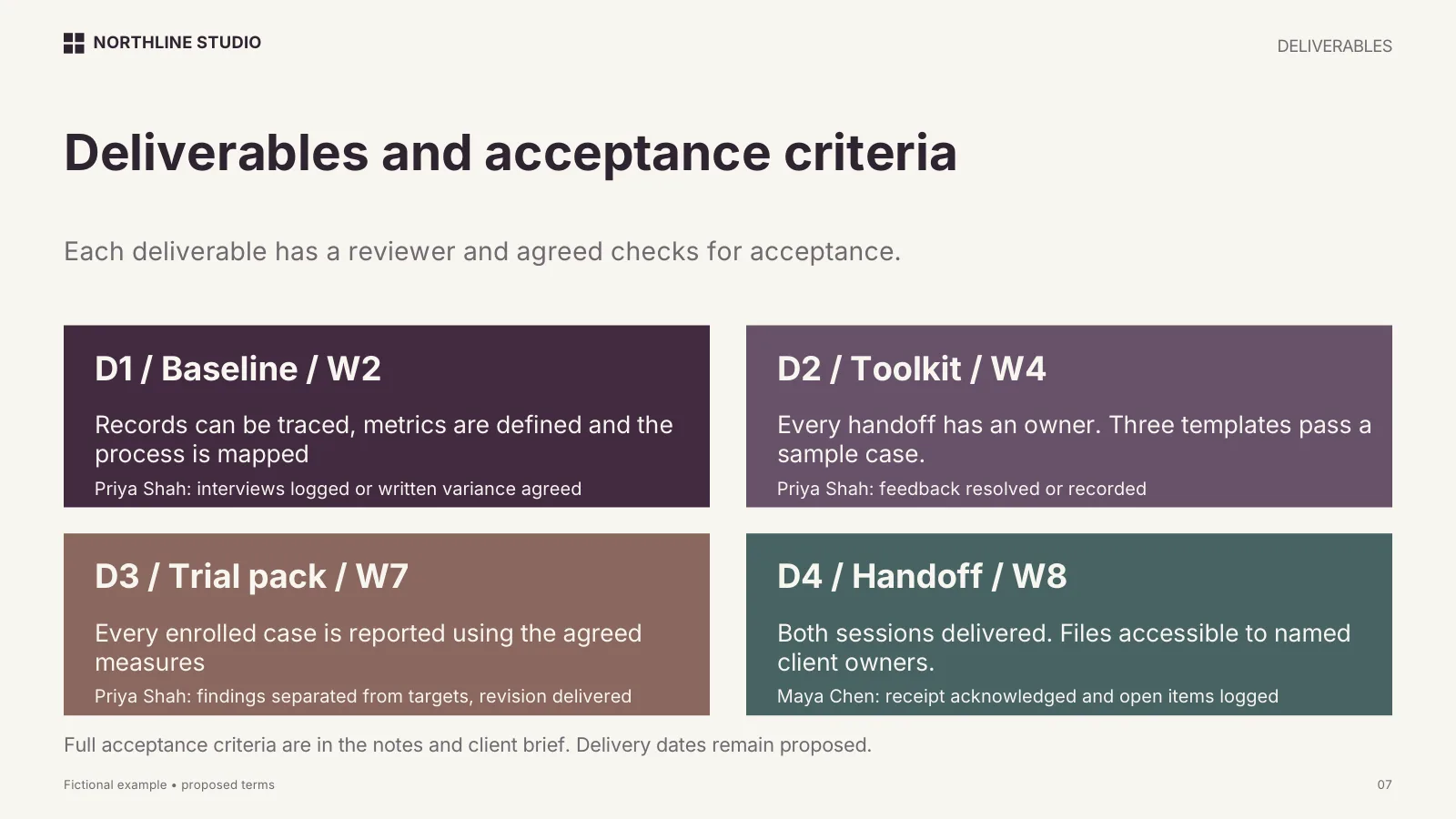
Four deliverables, each with the week it lands, the check that means it is accepted ("every handoff has an owner; three templates pass a sample case") and the person at the client who reviews it. Acceptance criteria agreed up front are what make the payment schedule on slide 12 enforceable.
Slides 8 to 10: plan, team and what the client must provide
Slide 8 is the eight-week plan with proposed dates per deliverable and a note that dates depend on start conditions. Slide 9 names the three people doing the work and what each is responsible for. Slide 10 lists the client dependencies with owners and dates: 12 de-identified case records by 8 January, eight interview slots, six eligible trial cases, and the terms, signer and payment. A proposal that names what the client owes is harder to blame when the client is late.
Slides 11 and 12: the fee and how it is paid
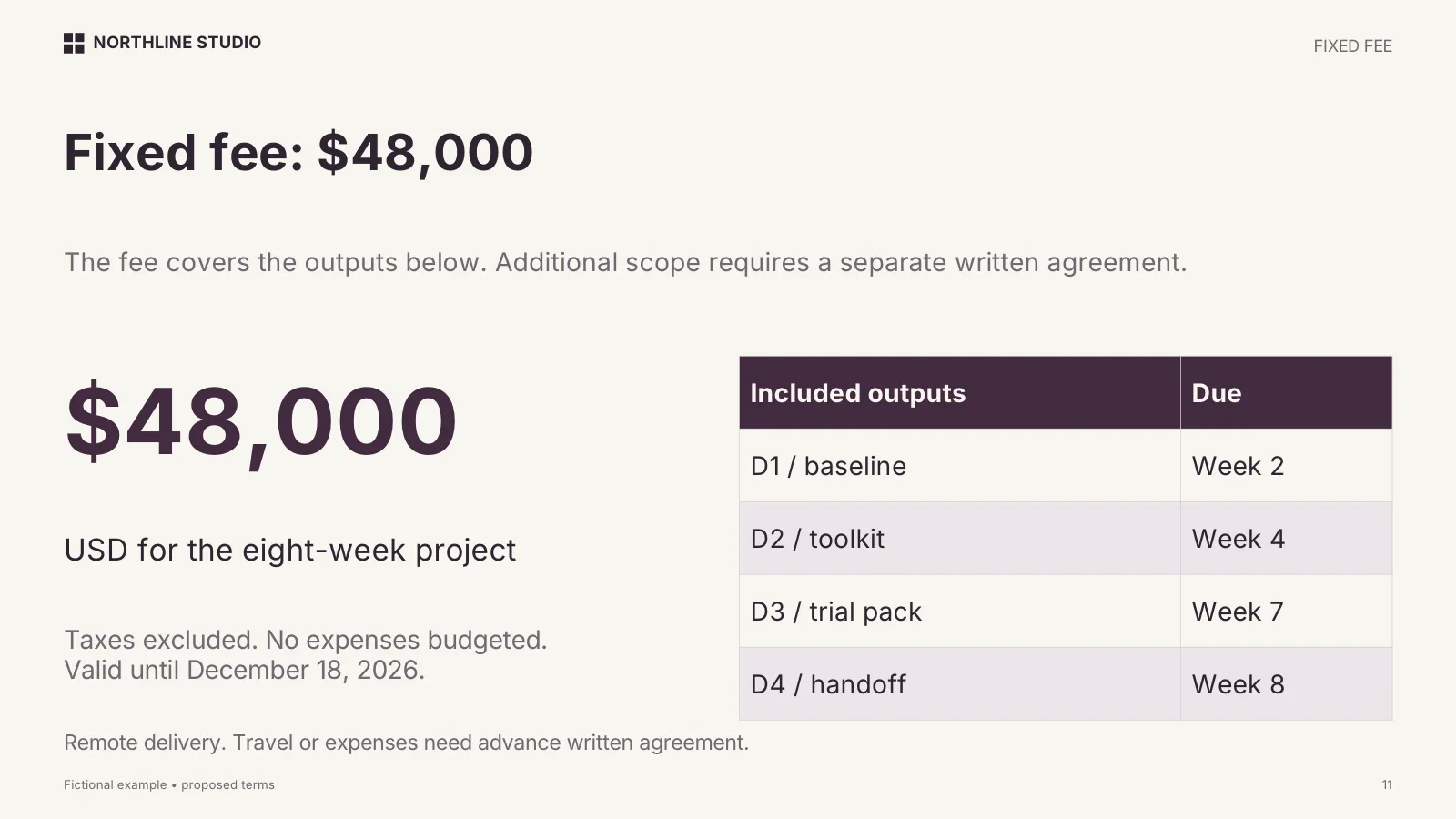
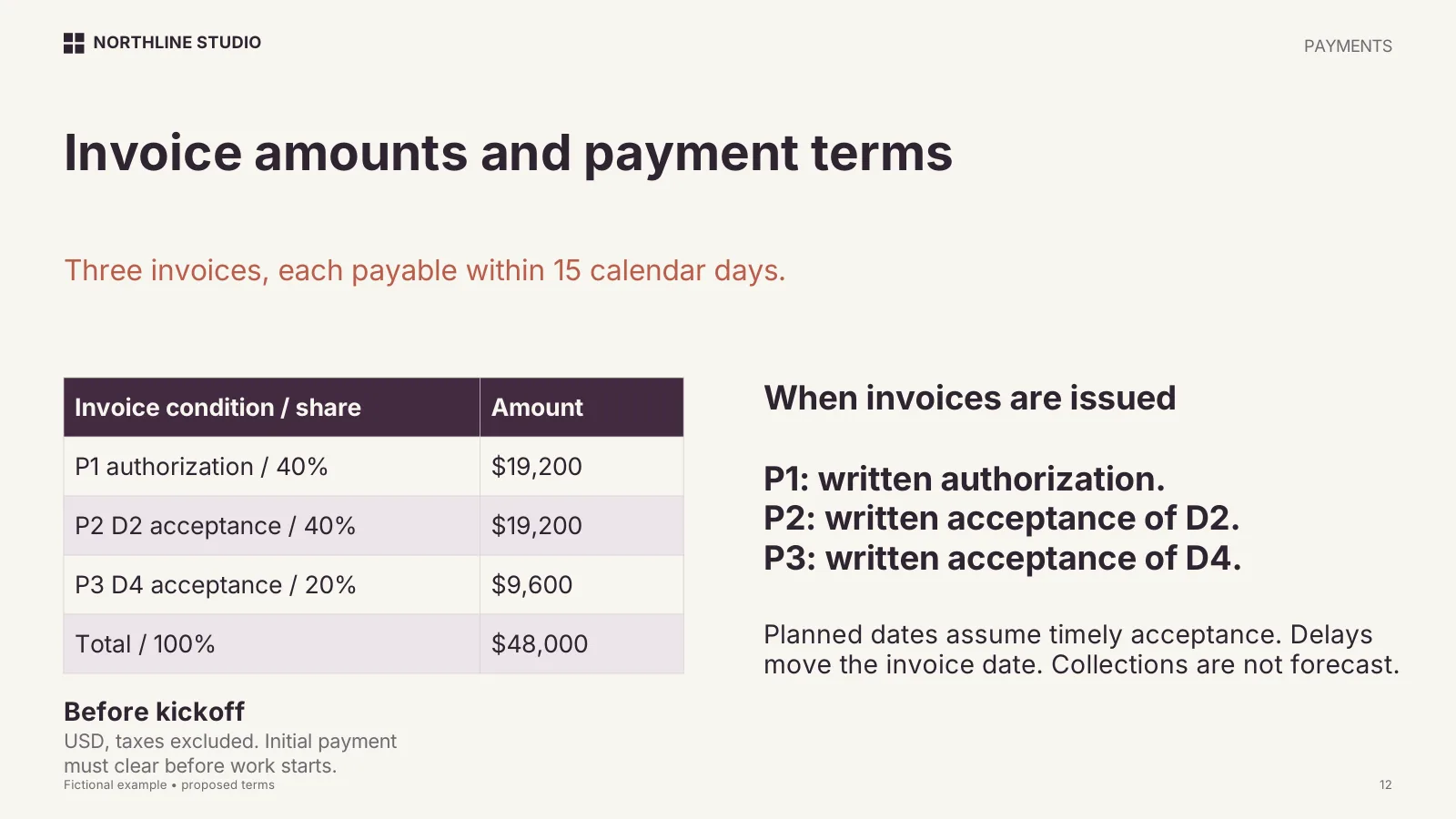
The fee slide says what $48,000 covers, that taxes are excluded, that no expenses are budgeted, and when the offer expires. The payments slide splits it into three invoices (40 percent on written authorization, 40 percent on acceptance of the toolkit, 20 percent on acceptance of the handoff), each payable in 15 days, with the condition that the first payment clears before work starts. The amounts come from the pricing model in the package; they are typed into the slides by hand, and the model does not update them.
Slides 13 to 16: change control, risks, next steps, sources
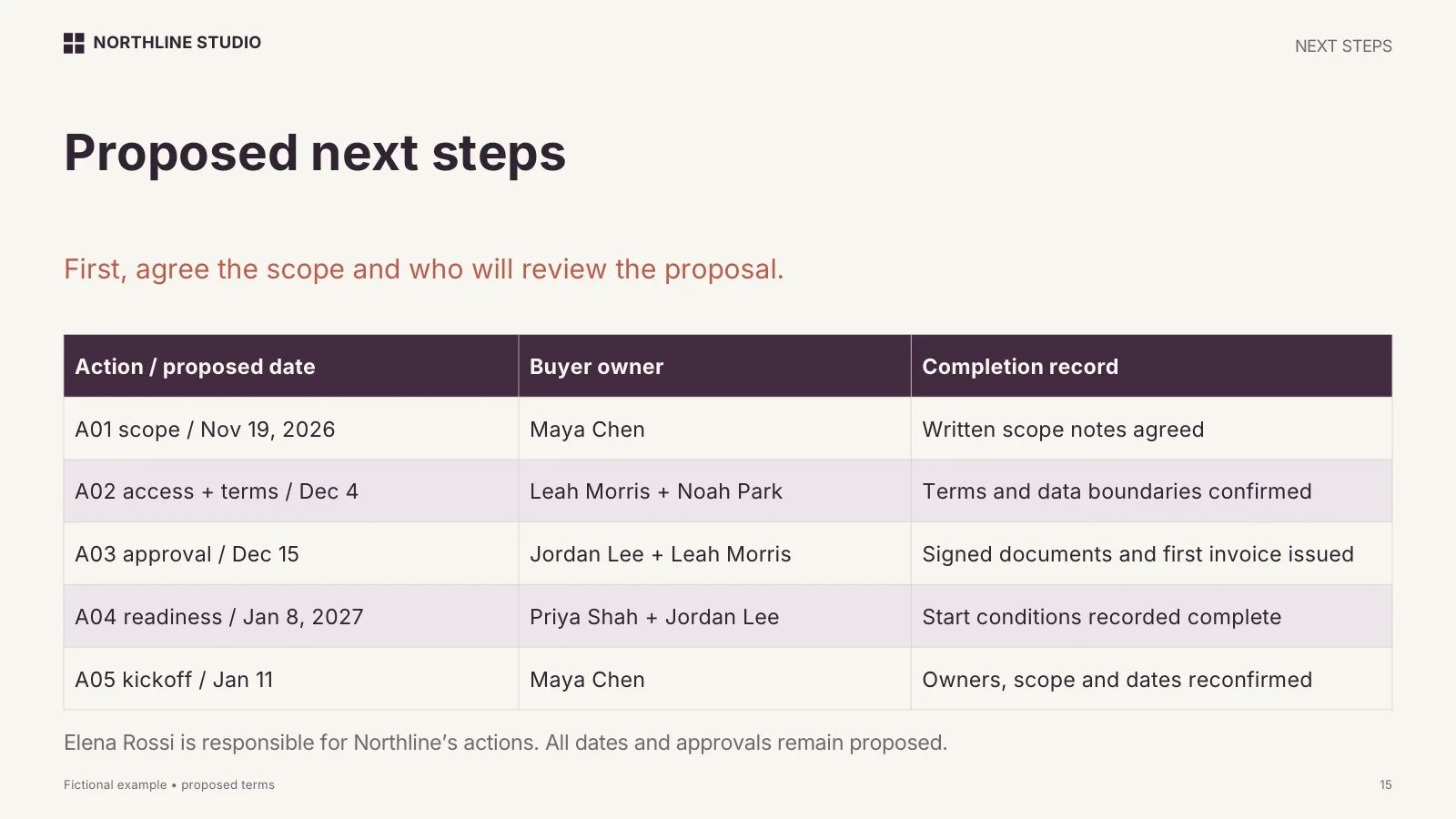
Slide 13 fixes the review rules: consolidated written feedback within five business days, acceptance in writing, one design revision and one trial revision included, and a written path for new scope. Slide 14 lists four delivery risks with the proposed response to each. Slide 15 is the next-steps table: four actions, each with a proposed date, a buyer-side owner and the record that proves completion. Slide 16 lists every source the proposal relied on, with its owner and limitation.
How the files fit together
| File | What it does |
|---|---|
| Client brief (PDF and HTML) | Records the request, the meeting decision, the baseline evidence and the exclusions before any slide is made. |
| Statement of work (Word and PDF) | A template with bracketed fields; its scope, deliverables, acceptance, fees and change sections mirror slides 6, 7, 11, 12 and 13, so the document the client signs says what the deck said. |
| Sample inputs workbook (Excel) | The pricing model and baseline figures. Fees and dates move to the slides and the statement of work by hand. |
| Finished example (PowerPoint, Keynote, PDF) | The 16 slides shown here. |
| Editable starter (PowerPoint, Keynote) | The same sequence with placeholders for your own proposal. |
| Workflow field guide (PDF and HTML) | The order of work from brief to signed proposal. |
What to copy
The order (summary, evidence, scope, deliverables, plan, team, dependencies, fee, payments, change control, risks, next steps, sources), the habit of pairing every deliverable with an acceptance test and a reviewer, and the exclusions list. Do not copy the numbers; Northline and Acme are fictional and the proposal says so on every slide. A real proposal needs your own baseline records behind slide 4 and your own pricing model behind slides 11 and 12.
Where this comes from
The proposal, brief, statement of work, workbook and starter ship with the Sales Deck, a 27-layout library for product demos and services proposals. For a sales deck read page by page, see the Perplexity ads deck review; the slide-level judgments above follow How to review a deck.
Guides use the SlideDeck Co decks as their examples. See the six decks.

