
A fund presentation sells a manager, not a product. The prospective limited partner is deciding whether to trust a team with capital for ten years, so every slide is read as evidence about judgment and candor. This guide walks through the worked fundraising memorandum that ships with the Private Equity Deck: Juniper Partners raising Juniper Fund III, a $300m control-buyout fund. Juniper, its funds, its people and every figure are fictional, and each slide says so in its footer. This is a presentation example, not investment advice and not a claim about what investors will fund.
The request the deck is built for
The fundraising brief in the package sets the goal narrowly: an initial diligence meeting and a prioritized question list, not a commitment. It names who owns what (investor relations the materials, the CFO the reconciliations, the managing partner the release of answers), and it lists the records the presentation must be built from, each with the work still open on it. A fund deck that knows which of its own numbers are unverified is more credible than one that does not.
Slides 2 to 4: mandate, approach, portfolio construction
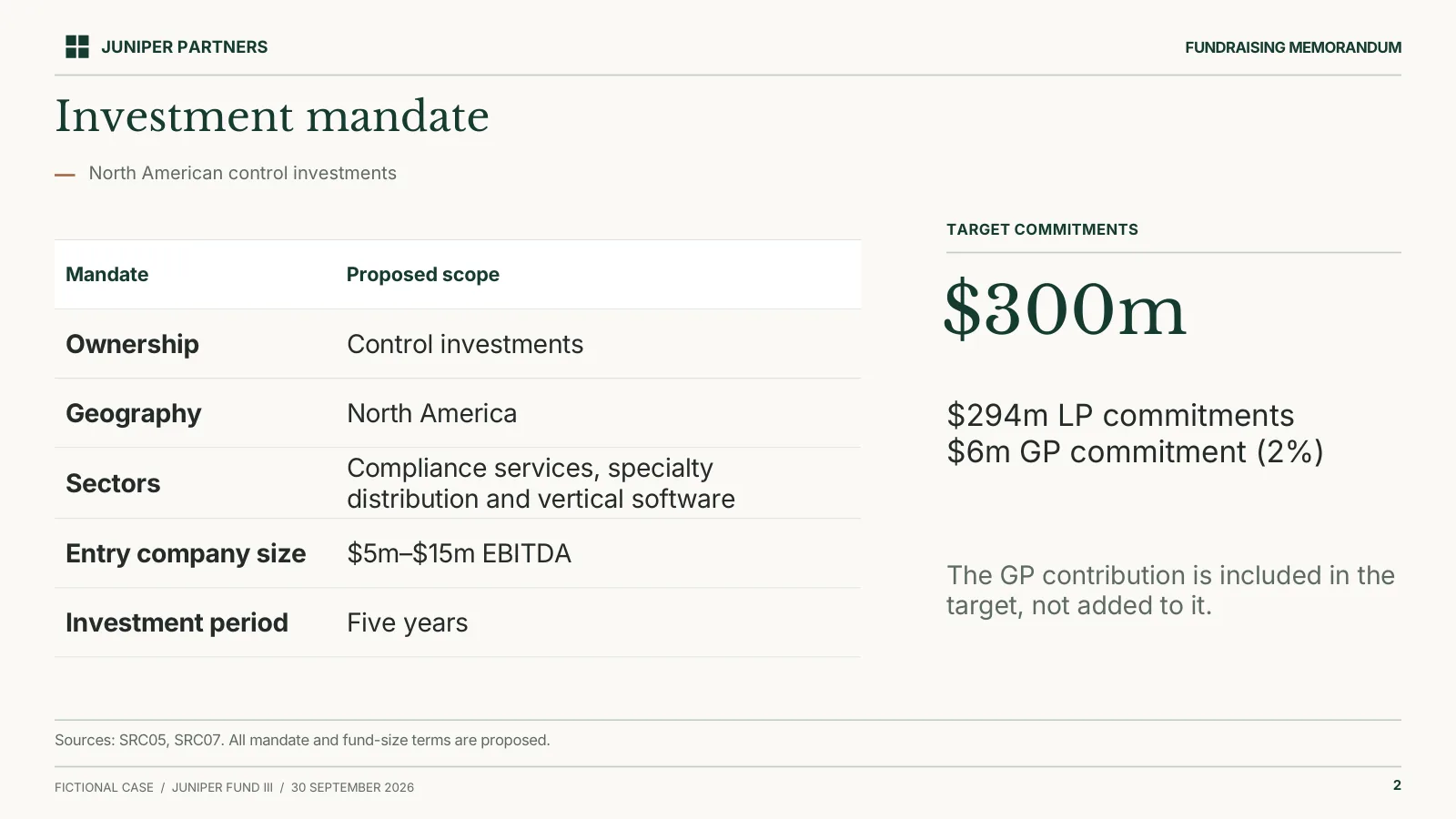
Slide 2 states the mandate as constraints an LP can test against the track record: control investments, North America, three sectors, $5m to $15m of entry EBITDA, a five-year investment period, $300m target of which $6m (2 percent) comes from the GP. Slide 3 describes the investment process stage by stage and, for each stage, the records an LP should ask to examine. Slide 4 shows portfolio construction as planning slots by sector with initial and follow-on amounts, labeled as slots, not identified investments.
Slides 5 and 6: sourcing and the team
Slide 5 is a sourcing funnel for the last three years by original channel: 360 screened, 84 meetings, 21 final reviews, 9 closed, a 2.5 percent conversion. Slide 6 lists the four partners, their current responsibilities, their role on the one realized deal shown later, and, in its last column, the evidence an LP should request for each person. That column is the deck admitting that attribution is a diligence question, not a slide.
Slides 7 and 8: predecessor performance, net
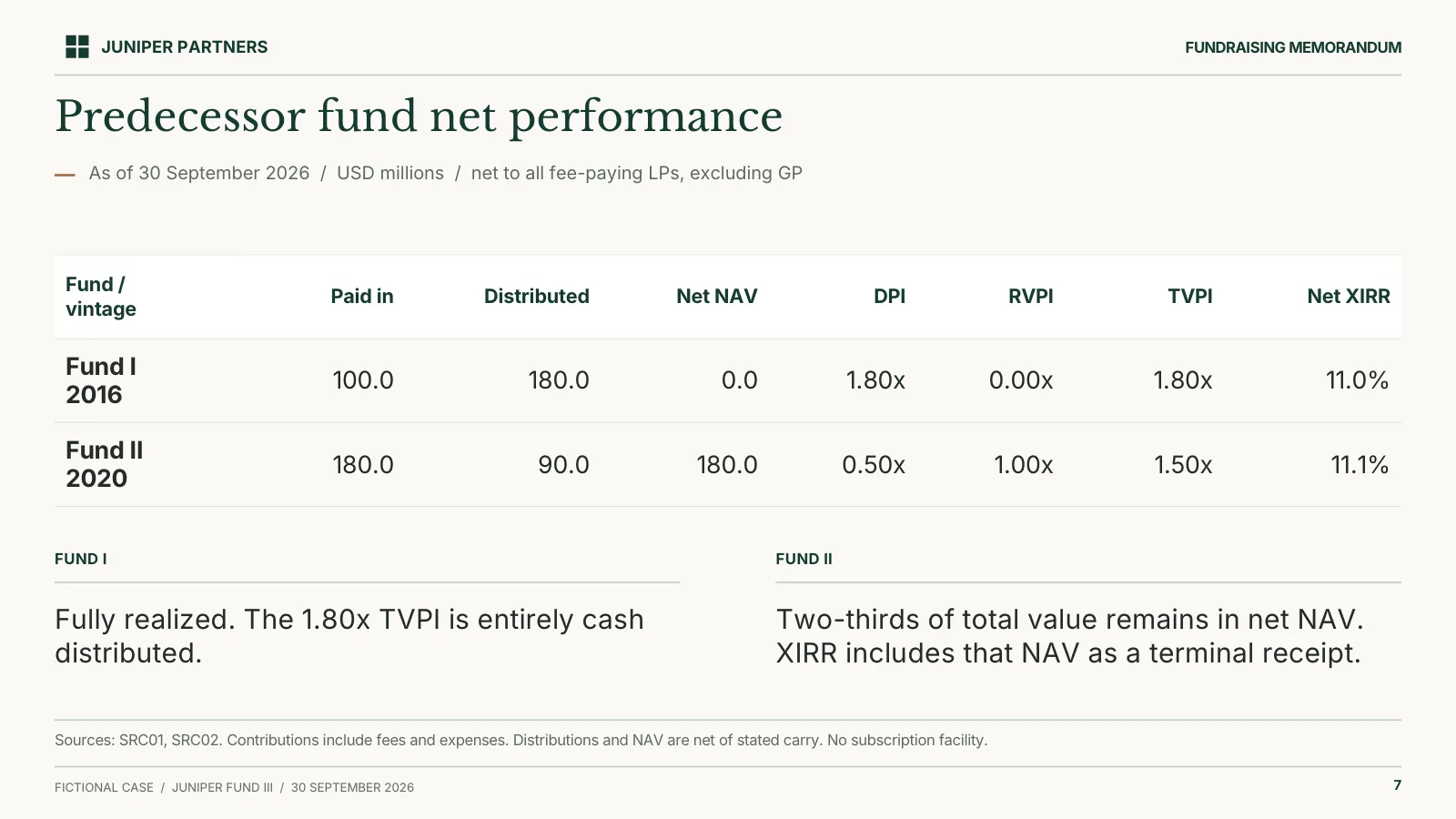
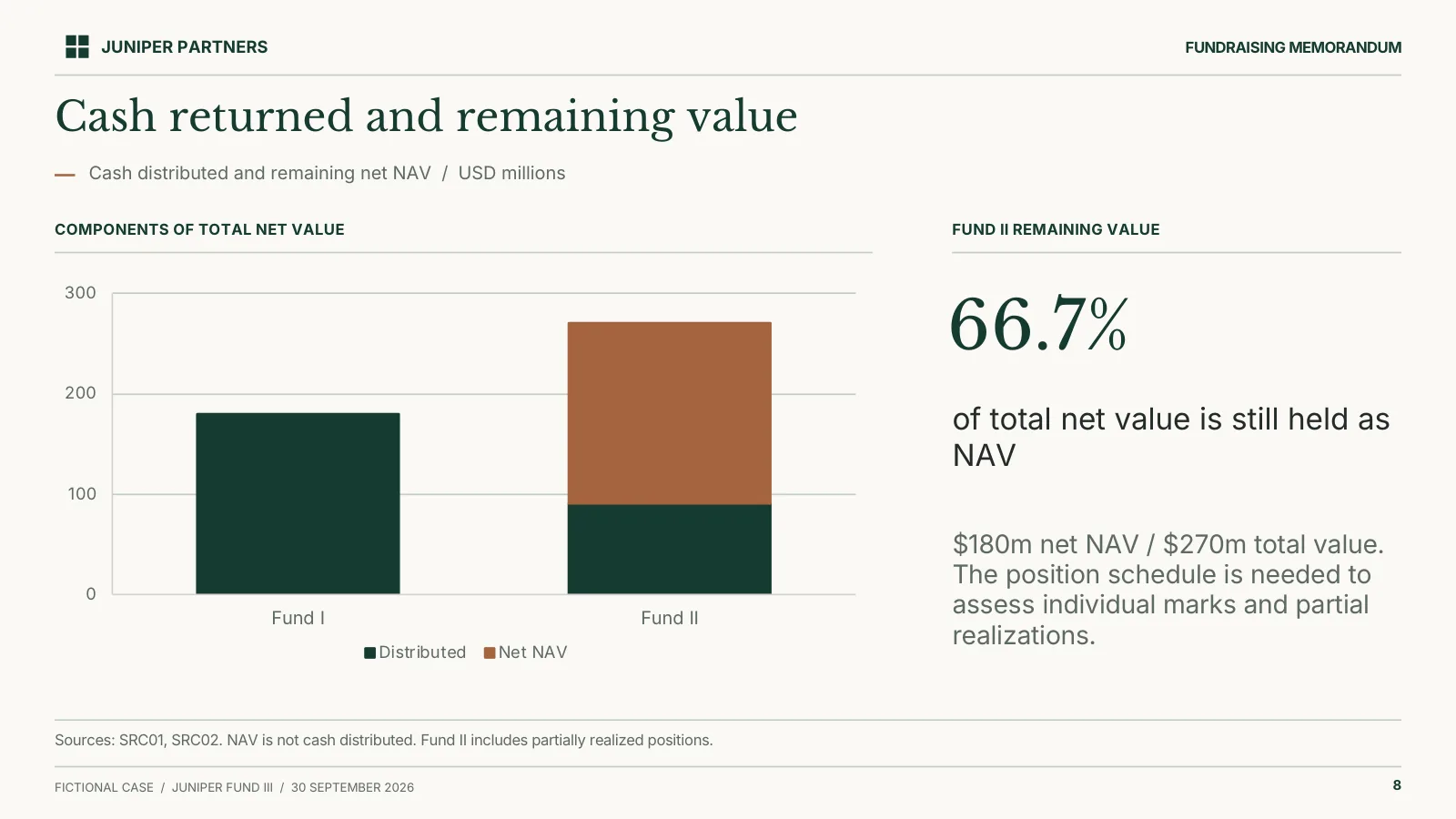
Slide 7 gives both predecessor funds on one line each: paid in, distributed, net NAV, DPI, RVPI, TVPI and net XIRR, net to all fee-paying LPs and excluding the GP, with no subscription facility, as the subtitle states. Slide 8 redraws the same figures so the reader sees that two thirds of Fund II's total value is still net asset value, not cash. Putting that fact on its own slide, in the manager's own deck, is what an experienced LP expects; omitting it is what they look for.
Slides 9 and 10: one realized deal, and what a markdown would do
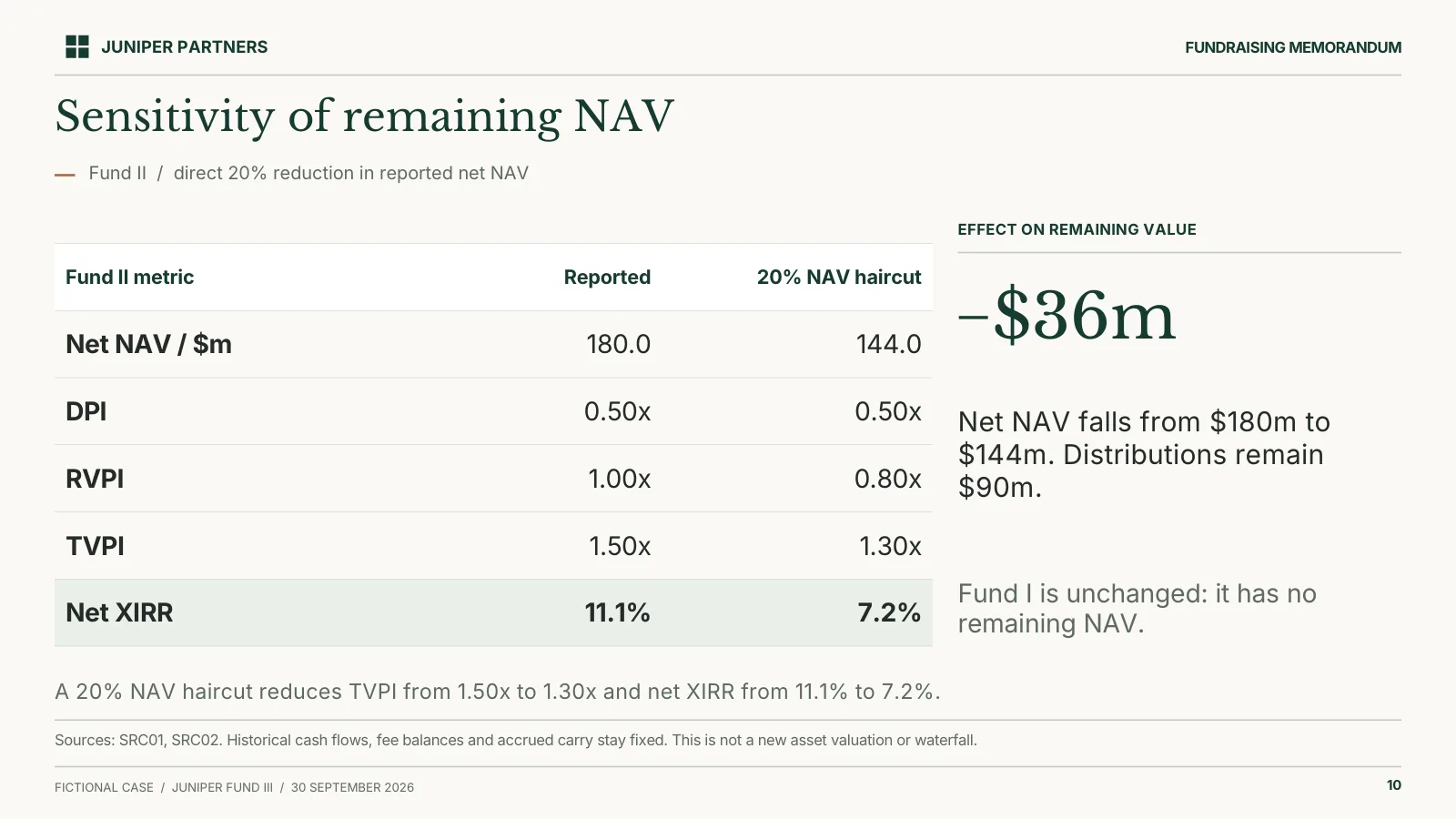
Slide 9 is an equity value bridge for one realized investment, Orchard Inspection: entry equity, earnings growth at the entry multiple, multiple change, debt reduction, exit costs, exit proceeds, with the note that gross deal returns are before fund fees and carry and that the full Fund I population includes a loss. Slide 10 answers the question slide 8 raises: if Fund II's remaining NAV were 20 percent lower, TVPI falls from 1.50x to 1.30x and net XIRR from 11.1 to 7.2 percent, with historical cash flows held fixed. The subtitle says what the slide is not: a new valuation or a waterfall.
Slides 11 and 12: where the money goes and when the LP needs it
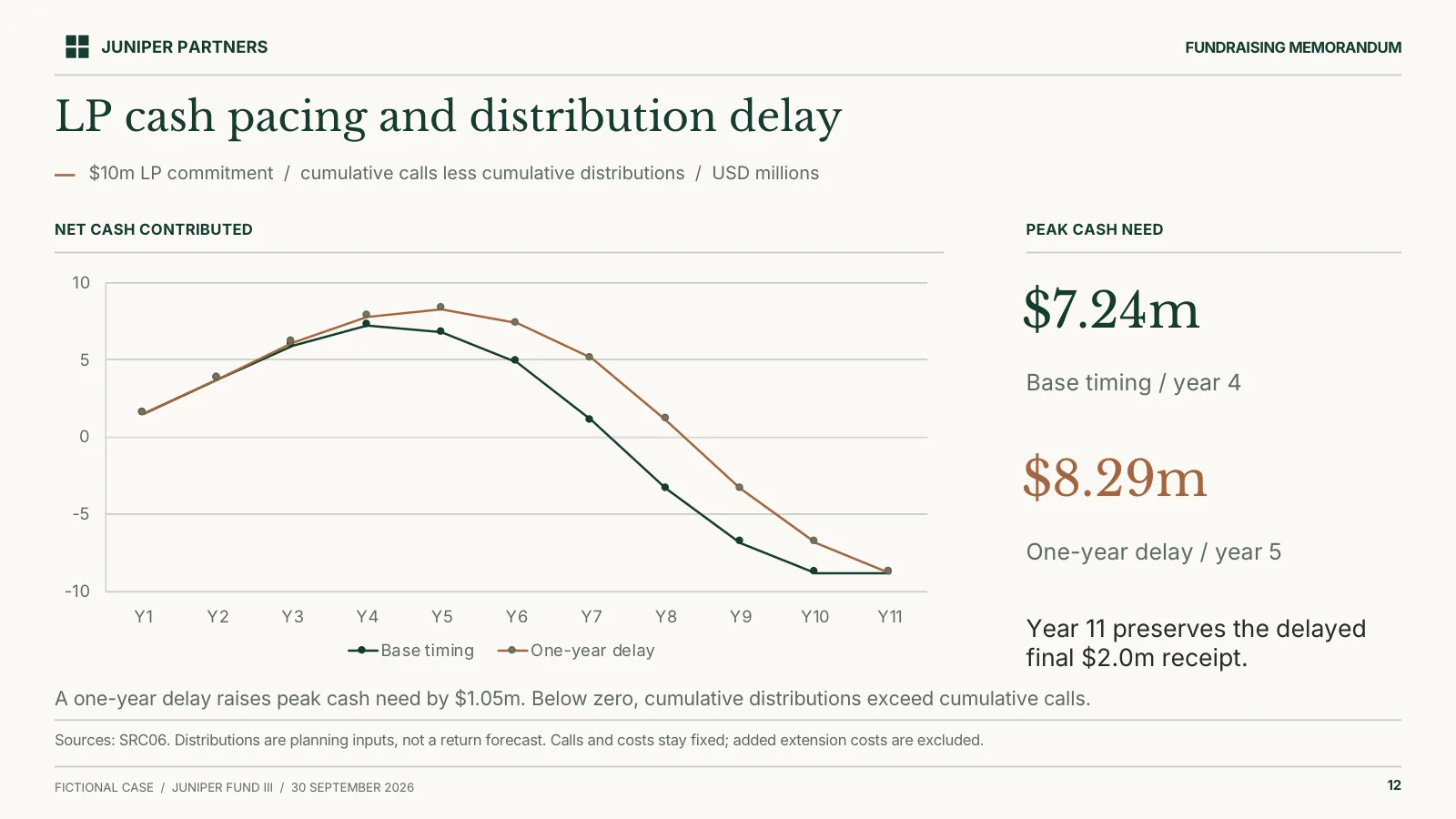
Slide 11 budgets the $300m: $230m initial investments, $30m follow-ons, $34.3m management fees (paid by LPs only), $5m expenses, $0.7m uncalled GP commitment, with annual calls charted. Slide 12 turns that into the LP's own view: for a $10m commitment, cumulative calls less distributions by year, the peak cash need ($7.24m in year 4 under base timing), and the same curve with distributions delayed a year. The subtitle calls the distributions planning inputs, not a return forecast.
Slides 13 to 15: terms, governance, risks
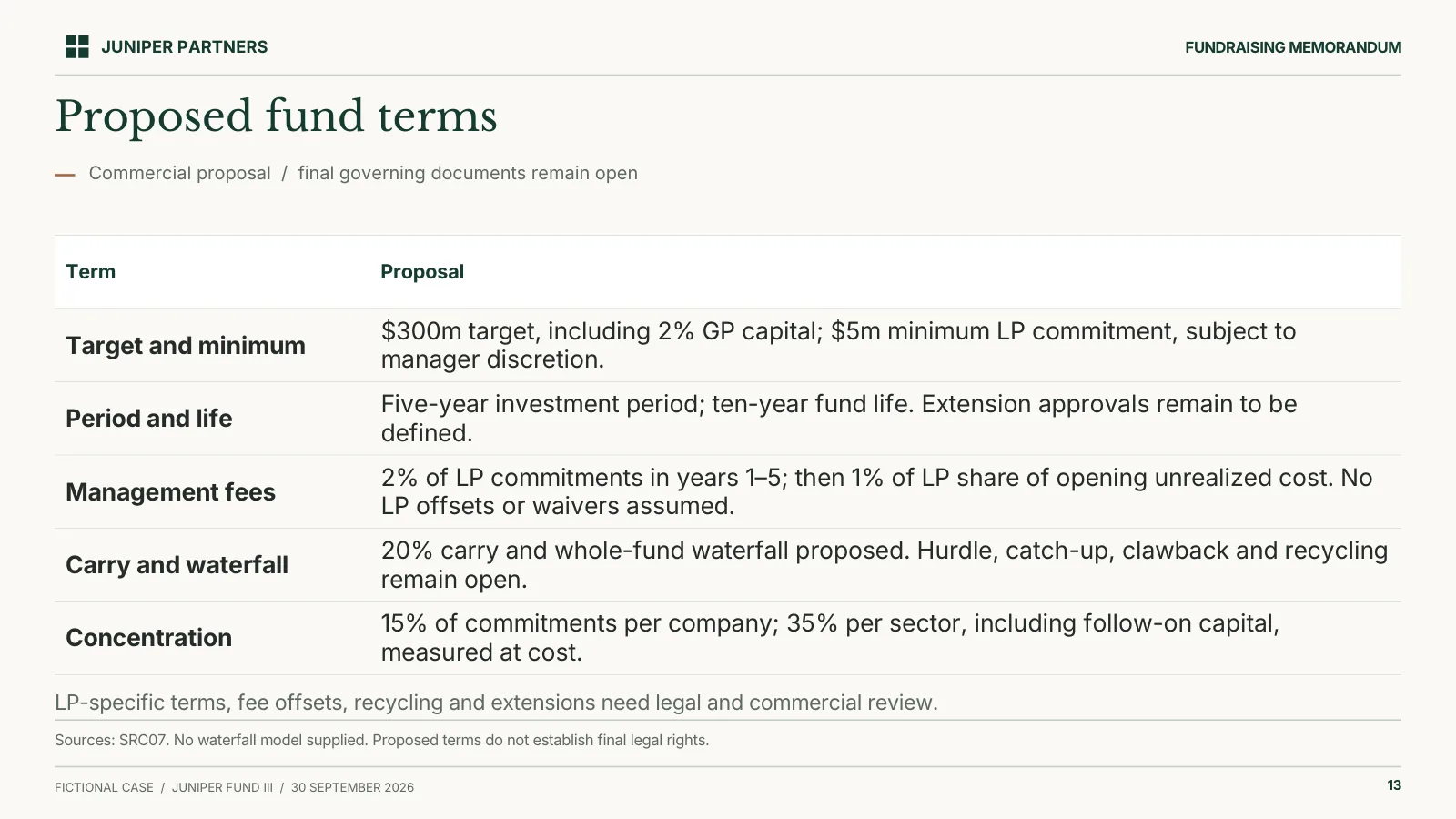
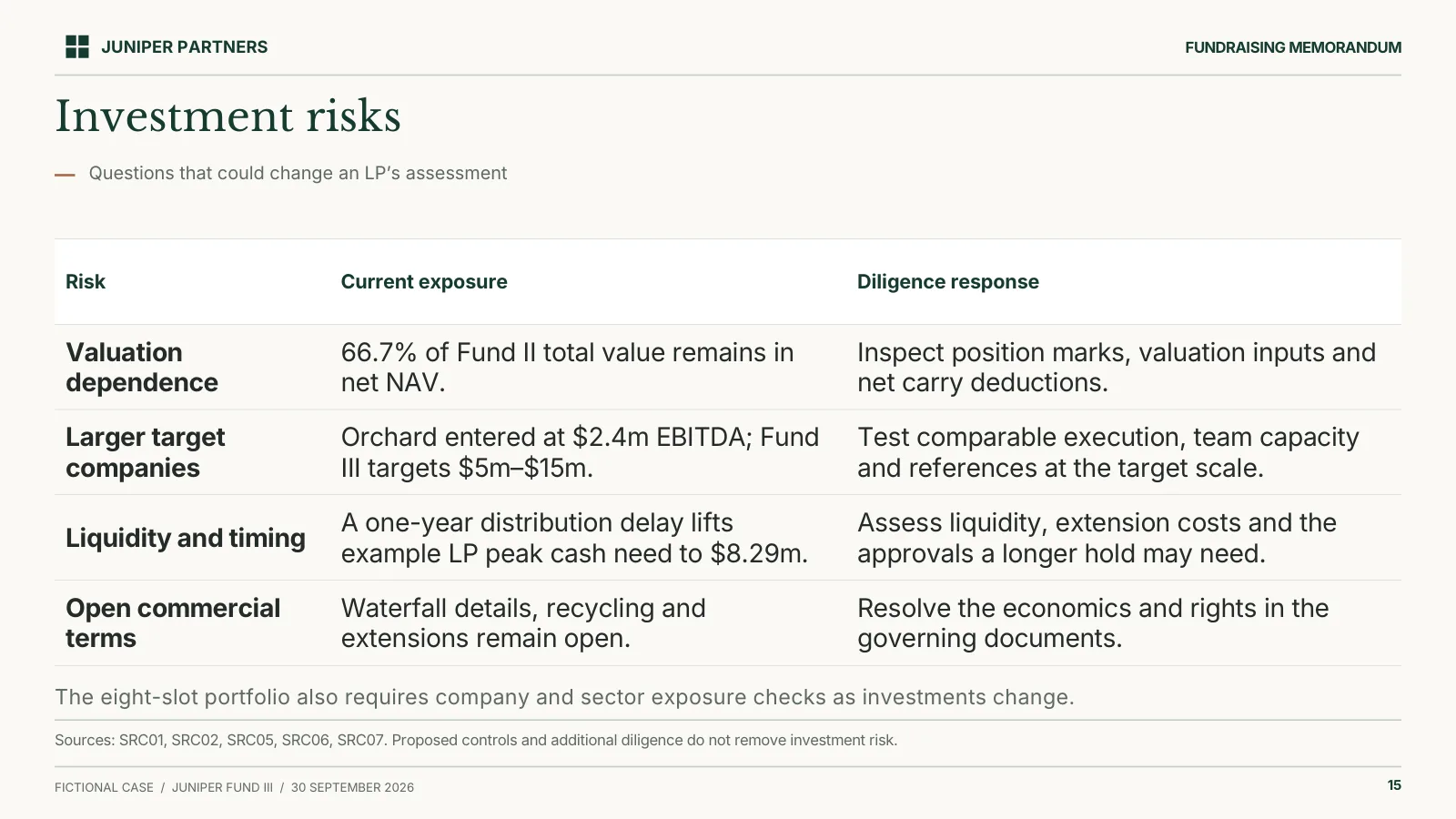
Slide 13 lists the proposed terms and says that no waterfall model is supplied and that proposed terms do not establish legal rights. Slide 14 maps governance: who decides investments, valuations and conflicts, and what evidence to review for each, with a related-fund transfer example. Slide 15 lists the risks with the current exposure stated in numbers (66.7 percent of Fund II value still in NAV; the realized deal entered at $2.4m EBITDA while the new mandate targets $5m to $15m) and the diligence response for each. A risk slide that quantifies the exposure is doing the LP's first pass for them.
Slides 16 to 18: process, open requests, next step
Slide 16 is the fundraising timetable with the status of each stage; slide 17 lists what has been provided and what is still needed, by request ID, owner and due date; slide 18 asks for one thing, to begin diligence and agree the questions that matter most to the LP, and says that a meeting or data-room request is not a commitment. The package's LP diligence response record (a Word document) keeps the full answers and exchange history by question ID, and its workbook keeps the summary.
What makes this a fund deck and not an acquisition deck
An acquisition or investment-committee case argues for one company at one price. A fund deck argues for a manager over a decade: mandate, process, team, net track record, a realized example, the valuation that remains, cash pacing, terms, governance and risks. The Private Equity Deck keeps these as separate books; this guide covers the fundraising book. A separate guide for the acquisition book will follow only if the package's examples support the exact task.
Where this comes from
The memorandum, brief, diligence record, workbook and starter ship with the Private Equity Deck, 60 layouts in three books for acquisitions, fundraising and investor reporting. The slide-level judgments above follow How to review a deck. Nothing here is investment advice.
Guides use the SlideDeck Co decks as their examples. See the six decks.

